What It’s Like Being A Royal Air Force Photographer Capturing The Action On Deployment作为一名英国皇家空军摄影师,在部署期间捕捉精彩瞬间是怎样的体验
A behind-the-scenes account from an RAF Photographer on deployment with the UK contingent in Cyprus.
By Corporal ‘Matty’ Matthews , Thomas Newdick
Published Sep 8, 2021 3:20 PM EDT
Military aviation and photography are inextricably linked, evidenced by the multitude of enthusiasts who love nothing more than to seek out the best opportunities to capture aircraft in the air or on the ground, often going considerable distances , metaphorically and physically, to ensure they’re in the right place at the right time to get that once-in-a-lifetime shot .
As well as all those civilians who love nothing more than photographing these military machines at work, there is a much smaller cadre of air force professionals for whom this is their daily job. Working as an air force photographer brings the same kinds of demands of any uniformed career, but it’s perhaps the best way to ensure hands-on access to these aircraft, and it’s a job that can take you around the world, to wherever, in fact, air forces go about their daily operations.
Corporal ‘Matty’ Matthews, in his ‘office’ aboard a C-130J Hercules., Crown Copyright
Among the air force photographers out there capturing some truly memorable imagery is Corporal ‘Matty’ Matthews. What follows is his account of the challenges — and the big rewards — of a fascinating career with the British Royal Air Force (RAF), as well as how he captured some of his most eye-catching images:
I sometimes find it difficult to talk about what I do, and not see it as being a normal ‘nine-to-five’ job. After all, it has been 14 years since I took my first step into the world, and the lifestyle, that is photography in the Royal Air Force.
It’s only when I stop and look back through what I have managed to capture, what I have experienced, only then do I start to realize that actually what we do as Royal Air Force Photographers is simply unexampled.
During my 14 years with the RAF, I have been stationed at Cosford, Aldergrove, Henlow, High Wycombe, and Halton. Currently, I’m at Brize Norton , Oxfordshire, as a photographer within the trials unit that is the Joint Air Delivery Test and Evaluation Unit , or JADTEU. It’s funny, when you say ‘JADTEU’ it doesn’t sound overly exciting, and yet of all my postings, it has been the most unique, fascinating, and diverse of the roles I’ve encountered.
Loading an Army Air Corps Bell 212 helicopter onboard a Royal Air Force C-17, a job planned and executed by engineers and logisticians at the Joint Air Delivery Test and Evaluation Unit based at RAF Brize Norton., Crown Copyright
I am one of five ‘trials’ photographers and we are there directly supporting the Air & Space Warfare Centre, a research and test organization. This entails capturing rappelling, fast-roping , rope troop extraction system and ladder troop extraction system (RTES and LTES), test parachuting, as well as trialing loads on every aircraft type in service, be it fixed-wing or rotary. We fly flight trials, para trials, and dispatch trials here in the UK and further afield in the likes of Temecula in California, Seville in Spain, and Yuma in Arizona.
To add, who we work with is just as diverse. No surprise, then, that all three U.K. armed services work within JADTEU, and further still a myriad of branches lend their trade knowledge in what is arguably the most forward-thinking unit within the U.K. Ministry of Defense.
It can be a very challenging role, with lots of hanging out of aircraft doors and ramps. Crawling under vehicles photographing chain patterns. Long ‘tabs’ [British Army slang for a loaded march] in the pouring rain accessing trials sites. Then again, I wouldn’t change what we do, and the team of photographers around me are some of the best in my branch, so everything just works.
But the point of this is to talk about the other aspect of being an RAF Photographer — deploying. We currently have two permanently deployed photogs, one in the British Forces South Atlantic Islands, also known as the Falklands . The other (that was me) is based out of RAF Akrotiri on the Mediterranean island of Cyprus, covering defense operations across the entire Middle East.
The Akrotiri posting is about as diverse a role as they come, and this was my second time behind the proverbial wheel. You travel a lot, you fly a lot, you capture, a lot.
Whether it’s our Typhoons , in their fully-loaded-out ‘fits,’ providing essential overwatch for the Coalition over Iraqi and Syrian airspace, or the C-130Js flying missions moving freight and personnel throughout the Middle East from Erbil in Iraq through to Kuwait. Then there are the A400Ms that are beginning to take the lion’s share of the deployed workload from the Hercules, and not forgetting the Voyager tankers providing that tactically required fuel for the aforementioned Typhoons.
As with the rest of the world, COVID has been the biggest change and consideration this time around in Akrotiri. However, it was simply another aspect of the role that was managed, ensuring that we abided by the government directives while capturing defense as it supported operations.
Despite the challenges that were faced by me and my Media Officer we still walked away with some unique and, at times, historic imagery while deployed for four months in Cyprus. So, here’s a look at some of my favorites, how I took them, why I took them, and some of the challenges we faced in the planning and during capture.
This night-time shot was captured during one of my earliest tasks. I never had, but always wanted to, capture the Typhoons and Voyagers during a night sortie while flying over Iraq.
It was far from easy. The Typhoon pilots refueled with night-vision goggles meaning the Voyager’s wing lights couldn’t be utilized. Furthermore, despite almost every evening being generally pretty clear below, on this sortie there was a huge amount of cloud cover over our operating area. Then, as if to cement the already present issues, the moon was nowhere to be seen, so ambient light was as close to zero as you could ever imagine it to be.
Despite the challenges, I did all I could to capture the Typhoons. The reds and greens of their wing beacons scream through my imagery, seemingly reverberating off of the heightened ISO [the camera setting for the sensitivity of the sensor, similar to the speed of film]. Amazingly, using a tripod helped ever so slightly — there were fleeting moments when the Typhoons, through some skilled flying, somehow matched the flow of the Voyager, allowing for a couple of usable shots to creep through my memory cards.
Voyager in hyperspace
I wasn’t overly happy with what I had captured during the Typhoon refueling, but not one to rest on any laurels, I strapped in for our descent into Akrotiri. My 5D and 16-35mm was ready to go, secured to a tripod which was secured to me. I wanted to get a nice shot of the landing, a long exposure, sacrificing as little of my ISO as I could manage while ensuring that the image wasn’t littered with enough movement to make it unusable.
Throughout the flight, you’re on the aircraft’s comms, so I was talking to the Voyager pilots and jokingly mentioned my idea for a shot, elaborating that this needed to be the smoothest landing they had ever performed. As expected they did not disappoint. As the aircraft effortlessly came into land it gave me the opportunity to capture the above shot from the flight deck, and a good few more frames with the cockpit sharp and the outside exhibiting that awe-inspiring, hyperspace-esque blur ahead of us.
If this next shot had another name, it would be ‘labor of love.’ Last time I deployed I wanted to get this shot and never managed it, through a mixture of Tornado GR4s (oh, how I miss them) aborting their take-offs, bad timing, or just general bad luck.
I went straight into trying to grab the shot again. I sat out on the runway on what must have been four or five different sorties. Waves of mosquitos rose up around me as the sun and temperature dropped. Each time the aircraft lifted the sun was too high, the jets went too early, or too late. One sortie I took a risk standing on the other side of the runway — yeah, that didn’t work.
Then came sortie number five… or six… I can’t remember. I once again placed myself back out on the runway. Approximately at the halfway point, just before the jets hit rotate. I watched the sun setting slowly ahead of me and heard their roar as they lined up on runway 28’s threshold.
At this point, the sun seemed too high, so I expected nothing. Two of the four EJ200 engines wound up and I saw aircraft 345 begin to roll. She hit her rotate point, the nose lifted, wheels up and just as she got parallel to me I realized that she was flying straight for the sun.
I couldn’t believe it: no two take-offs are the same, so I was ecstatic to see this one fly the path that it did. Noting the change in exposure I went from f5 [aperture] through to f32 in a couple of seconds and watched as the pilot effortlessly took the delta wing straight into, and through the sun.
A bird’s eye view at Akrotiri
This image started out as an inspirational idea courtesy of @onemoreweektogo over on Instagram. A good deal of his imagery includes shots of airliners at the likes of LAX, taken from a helo tracking the jets around the airfield. With that in mind, I drew up the idea to capture a Shader wave while flying in a Griffin HAR2 search-and-rescue helicopter of 84 Squadron.
The sortie started life as a crudely drawn-up flight path on Google Maps. One route for the 28 runway, another for runway 10, depending on the way the wind blew. Invariably the wind runs east to west after midday, so I hedged my bets on 28. As ever until about 30 minutes before lift-off, the wind stubbornly kept us on 10, thankfully as we walked it swung enough and I knew I’d be tracking the Voyager up the taxiway.
Once airborne the Griffin flew at 500 feet, performing a snaking motion while matching the taxi speed of the Voyager throughout the entire 9,000 feet of asphalt. As we came up to the 28 hold, the Griffin then performed a fluid horizontal loop with us crossing the runway as a Typhoon pairing lined up on the threshold.
Once lined up we transited north of the runway, lining up two-thirds down the runway going static just as the Typhoons began to roll. The pair lifted and as always banked left into their circuit well away from us. Knowing the Voyager utilizes much more runway to lift we crept a further 500 feet down and captured her lift and again left-break away from us.
A nice surprise was this C-130J, which we noticed lining up earlier than expected, allowing even more media-collect of another iconic and important aircraft that operates in support of defense out there. It must be noted, none of this would have been possible had it not been for the ninja flying of the 84 Squadron crew at the controls of the Griffin. As with everything aviation-related we had a pre-planned path that had to be dynamically changed while flying.
Paratroopers over Jordan
Then there was the week the carrier came to town. Operation Fortis, as the Carrier Strike Group 21 (CSG21) deployment is named, was a huge moment out there, and the aircraft carrier HMS Queen Elizabeth was of course on the forefront of everyone’s minds. That being said, we also wanted to ensure that the RAF was well represented within the media output for this phase of CSG21.
This resulted in me being embedded within the Hercules Detachment. The first sortie I was rostered to fly on, arguably the most important, involved three Hercs flying over to Jordan, two carrying 80 paras apiece, the third frame with containers (using the CDS, or container delivery system method) to be dispatched by members of 47 Air Dispatch Squadron.
Considering the magnitude of what was about to happen it was no surprise to hear that the civilian press was on board the two para Hercs to document the drops. With that in mind, I had been manifested to also fly on one of those frames.
Thankfully having worked at JADTEU for the previous year I had a much greater understanding of how para and CDS drops were conducted. The paradoors were always going to be the method of exit. This meant the split ramp wouldn’t be lowered and I couldn’t get on the harness. CDS, on the other hand, will always have the ramp lowered and I knew I could follow it down the aircraft while on the harness.
I took the risk and jumped on with the CDS knowing I may get nothing of the paras. I spoke with the crew and asked if it were possible to run in when the paras dropped; as ever, no promises, the task was always the priority. We lifted and transited to Jordan, lined up for our drop watching for the despatcher’s signal, and before we knew it the back of the aircraft was empty.
After a bit of ramp-riding capturing some B-roll of Jordan, I got a tap on the shoulder from my Air Loadmaster, and he pointed out to our right. Off in the distance, I saw the other two Hercs lining up for their second stick. I couldn’t believe it, this was ideal, I had my 100-400mm lens on and despite the distance knew I could still record the event from this awesome angle.
The first paras started littering the skies and the rest is recorded history now.
Hercules, ninja-style
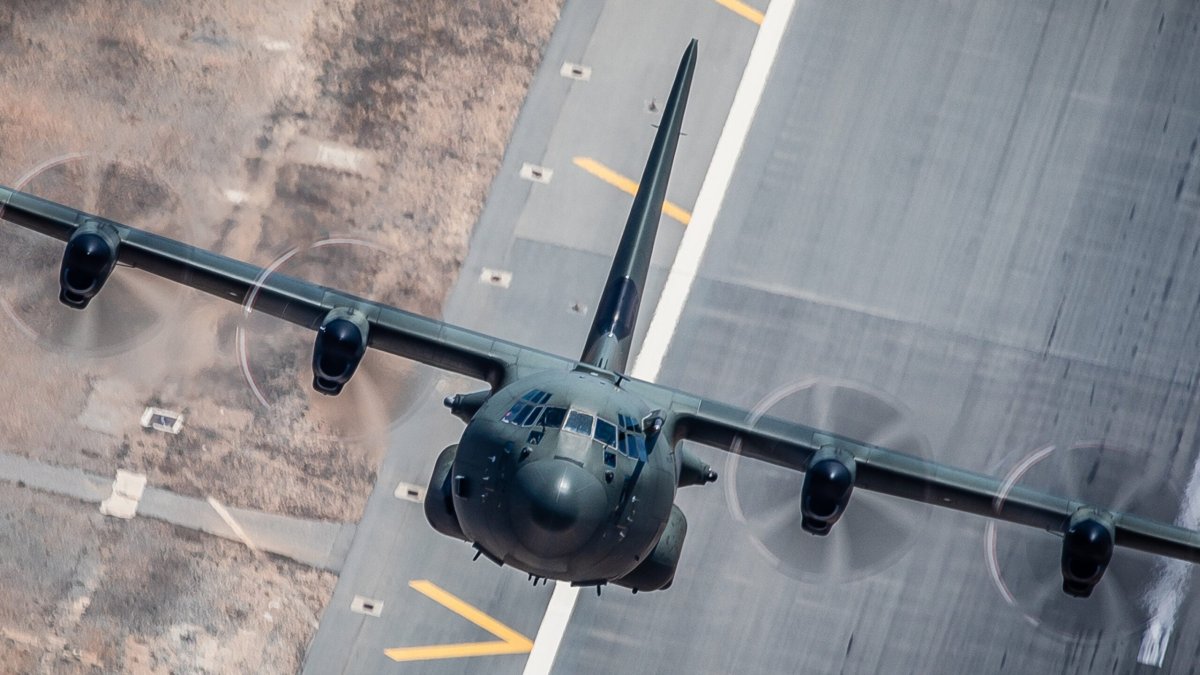
This came about after being part of a sortie that involved unloading troops, vehicles, and equipment on the ground in Jordan. A pair of C-130J Hercules headed back to RAF Akrotiri to conduct a circuit, running along the runway before breaking left and coming into land.
The capture involved being on the harness with the split ramp open 1,000 feet higher than the second Herc flying in at 180 knots, below the max speed allowed with the cargo door open. As we flew over the water, the lowest aircraft started 6,000 feet away laterally, judging when to accelerate to 230 knots, catching up with my C-130J pushing the nose up as we hit the minimum allowed 2,000-foot lateral separation.
Once we reached this predetermined point in the runway, the lowest Herc raised its nose before conducting a left break into the circuit.
This was a huge challenge photographically for a few reasons. The biggest being the time on target; I had one frame to capture the lower Herc where it was at the point where she lined up to make it appear to be flying vertical.
I also had to battle with staying rigid on the harness while shooting at a lower-than-normal shutter speed to ensure I captured the iconic ‘prop-blur’ seen with imagery of turboprop-driven aircraft.
As ever, a well-planned brief made all the difference, not to mention some ninja flying by the Herc crews.
Impressions of Shader
My four months out in Akrotiri have borne a lot of imagery I will never forget. This has included capturing loaded F-35Bs breaking away from our Voyager after tanking on one sortie, with Typhoons doing the same on another.
I’ve captured the now-retired E-3D Sentry at night, sitting with her for four hours capturing the star trails above. I’ve flown down-route documenting RAF Movers in Iraq, moving personnel, freight and vehicles in high-threat environments.
I’ve flown in one of the final ever E-3D operational sorties, filmed HMS Queen Elizabeth from a Herc, and managed to produce videos highlighting the amazing work of the Typhoon, Voyager, and C-130J.
Though none of these shots were possible without the skilled personnel I work with throughout the Ministry of Defence, Royal Air Force, and all of the squadrons flying daily missions supporting operations.
And now to a few more highlights…
The E-3D flew its final operational sorties out of RAF Akrotiri both in support of NATO Assurance Measures , as well as over Iraq as part of the global Coalition’s mission to degrade and defeat Daesh.
I captured the final ever operational lift-off from the air. Flying with 84 Squadron, Akrotiri’s resident search and rescue squadron, the pilot placed the Griffin HAR2 exactly where it needed to be to catch the Sentry as it hit its rotate point.
This was followed by a trip onto the Alpha dispersal at 3:00 am. With the aircraft’s mission done, the only thing left was a final taxi and park-up. Not wanting this moment to be missed, the Akrotiri fire section created a water arch to mark this truly historic moment.
These next shots were all about highlighting the Typhoon’s armed overwatch mission over Iraq and Syria. When you speak about our Typhoons and Daesh you picture the strikes, yet a huge part of their skillset involves the aircraft and crews flying non-traditional intelligence, surveillance, and reconnaissance (NTISR) missions in support of RAF and allied-nation interests.
While the HMS Queen Elizabeth was in the Med, the F-35Bs of the RAF and U.S. Marine Corps supported Operation Shader, the United Kingdom’s contribution to the ongoing military campaign against ISIS in the Middle East. The F-35Bs were flying the Typhoon’s missions as they launched on the first-ever operational sorties from the carrier, transiting into Iraq and Syria, supported by the Voyagers from Akrotiri, which allowed the jets to remain on station for the duration of their sortie.
While airborne in the Voyager there’s always a chance that allied nations will come alongside for fuel. I was quite lucky to witness this happen twice. First from a pair of French Navy Rafale Ms and a few weeks later a pair of Italian Air Force F-2000 Typhoons operating in support of that country’s Prima Parthica mission over the Middle East.
French Navy Rafale M., Crown Copyright
Italian Air Force F-2000 Typhoon., Crown Copyright
A number of my nights had me up with the C-130J Hercules Detachment. I captured several aspects including the Ground Engineers, Movers, Force Protection, and, as seen here, the flight crews.
Herc missions are invariably conducted during the twilight hours. This always makes photography a challenge, especially when the cockpit lights are switched off, or dimmed. However, when I did manage to capture something worthwhile, the resulting images always came out pretty special.
For now, it’s time to sign off as my replacement takes a hold of the role at Akrotiri, and, as all RAF photographers do, creates their own unique documentation of this detachment.
Contact the author: Thomas@thedrive.com
Comments couldn’t be loaded. Please refresh the page.
作者:下士“马蒂”·马修斯,托马斯·纽迪克
发布于美国东部时间2021年9月8日下午3:20
军事航空和摄影密不可分,众多爱好者热衷于寻找最佳机会拍摄空中或地面上的飞机,这便是最好的证明。他们常常跋涉相当远的距离(无论是比喻意义上的还是实际意义上的),以确保在正确的时间出现在正确的地点,从而获得一生难得一见的精彩瞬间。
除了那些热爱拍摄这些军用飞机作业的平民之外,还有一小部分空军专业人员以拍摄军用飞机为日常工作。空军摄影师的工作与其他任何军人职业一样,都面临着各种挑战,但这或许是近距离接触这些飞机的最佳途径,而且这份工作还能带你环游世界,去到空军日常行动的任何地方。
下士“马蒂”·马修斯在他的C-130J大力神运输机“办公室”里。(图片版权归英国皇家所有)
在众多拍摄出令人难忘照片的空军摄影师中,下士“马蒂”·马修斯 (Matty Matthews) 就是其中之一。以下是他讲述在英国皇家空军 (RAF) 精彩职业生涯中所面临的挑战和获得的巨大回报,以及他如何拍摄出一些最引人注目的照片:
我有时觉得很难谈论我的工作,而不把它看作一份普通的朝九晚五的工作。毕竟,自从我踏入英国皇家空军摄影师这个行业,开始这种生活方式以来,已经过去了14年。
只有当我停下来回顾我所捕捉到的、我所经历的一切时,我才开始意识到,我们作为皇家空军摄影师所做的一切,实际上是前所未有的。
在英国皇家空军服役的14年间,我先后驻扎过科斯福德、奥尔德格罗夫、亨洛、海威科姆和霍尔顿。目前,我在牛津郡的布里兹诺顿空军基地,担任联合空中投送测试与评估部队(JADTEU)的摄影师。有趣的是,一提到“JADTEU”,听起来似乎并不那么令人兴奋,然而在我所有的驻地经历中,它却是我遇到过的最独特、最引人入胜、也最丰富多彩的工作。
一架陆军航空兵贝尔212直升机被装载到英国皇家空军C-17运输机上,这项工作由位于布里兹诺顿皇家空军基地的联合空中投送测试与评估部队的工程师和后勤人员计划并执行。(英国皇家版权所有)
我是五名“试验”摄影师之一,我们直接为空天作战中心(一个研究和测试机构)提供支持。我们的工作包括拍摄速降、快速绳降、绳索部队撤离系统(RTES)和梯子部队撤离系统(LTES)、跳伞试验,以及对各种现役飞机(无论是固定翼飞机还是旋翼飞机)进行载荷试验。我们在英国以及更远的地方(例如加利福尼亚州的特梅库拉、西班牙的塞维利亚和亚利桑那州的尤马)进行飞行试验、跳伞试验和投送试验。
此外,我们的合作伙伴也同样多元化。因此,英国所有三个军种都在联合防务技术与工程单位 (JADTEU) 内开展工作也就不足为奇了,而且还有众多其他部门贡献各自的专业知识,使这个堪称英国国防部最具前瞻性的机构受益匪浅。
这份工作极具挑战性,需要经常探出飞机舱门和坡道,爬到车辆底下拍摄链条图案,还要冒着倾盆大雨长途跋涉(英国陆军俚语,指负重行军)前往试验场地。不过,我并不想改变我们的工作,而且我身边的摄影团队也是我所在部门最优秀的,所以一切都很顺利。
但我想重点谈谈作为一名英国皇家空军摄影师的另一个方面——部署。我们目前有两名常驻海外的摄影师,一名驻扎在英国南大西洋群岛部队,也就是福克兰群岛。另一名(就是我)驻扎在地中海塞浦路斯岛的阿克罗蒂里皇家空军基地,负责报道整个中东地区的国防行动。
阿克罗蒂里哨所的工作内容极其丰富多样,这已经是我第二次担任这个职位了。你需要经常旅行,经常飞行,还要拍摄很多照片。
无论是满载弹药、为联军在伊拉克和叙利亚领空提供关键空中掩护的“台风”战斗机,还是从伊拉克埃尔比勒到科威特,在中东地区执行货物和人员运输任务的C-130J运输机,都发挥着至关重要的作用。此外,还有A400M运输机,它们正逐渐从“大力神”运输机手中分担大部分部署任务;当然,也别忘了“旅行者”加油机,它们为上述“台风”战斗机提供战术所需的燃料。
与世界其他地区一样,新冠疫情是阿克罗蒂里此次行动中最大的变化和需要考虑的因素。然而,这只是我们工作中需要应对的另一个方面,我们始终确保在履行国防职责的同时,遵守政府指令,为作战行动提供支持。
尽管我和我的媒体官在塞浦路斯的四个月部署期间面临诸多挑战,但我们仍然拍摄到了一些独特且有时具有历史意义的影像。接下来,我将分享一些我最喜欢的照片,以及拍摄过程、拍摄原因,还有我们在计划和拍摄过程中遇到的一些挑战。
这张夜景照片是我早期任务中拍摄的。我一直很想拍到台风战斗机和旅行者战斗机在伊拉克上空夜间执行任务的画面,但从未有机会。
这绝非易事。“台风”战斗机的飞行员戴着夜视镜加油,这意味着“旅行者”号的机翼灯无法使用。此外,尽管几乎每天晚上下方的天空都相当晴朗,但这次飞行任务中,我们的作战区域却被厚厚的云层覆盖。雪上加霜的是,月亮也消失不见,环境光线几乎为零。
尽管困难重重,我还是竭尽全力去拍摄台风战斗机。它们机翼上的红色和绿色指示灯在我的照片中格外醒目,仿佛在高感光度(ISO,相机传感器的感光度设置,类似于胶片的感光度)的映衬下熠熠生辉。令人惊讶的是,使用三脚架竟然略有帮助——有时,台风战斗机凭借精湛的飞行技术,能够与旅行者号的飞行轨迹完美契合,让我得以捕捉到几张可用的照片。
旅行者号在超空间
我对台风战斗机加油时拍到的照片不太满意,但我可不是那种会就此止步的人,我系好安全带,准备降落阿克罗蒂里。我的5D相机和16-35mm镜头已经准备就绪,固定在三脚架上,三脚架也牢牢地固定在我身上。我想拍一张漂亮的着陆照片,采用长曝光,尽可能少地降低ISO,同时确保画面不会因为抖动而变得无法使用。
整个飞行过程中,我都通过机载通讯系统与“旅行者”号的飞行员们保持联系,并开玩笑地提到了我的拍摄想法,还补充说,这次着陆必须是他们有史以来最平稳的一次。不出所料,他们没有让我失望。飞机轻盈地降落,让我有机会从驾驶舱拍摄了上面这张照片,以及更多清晰的驾驶舱照片,而窗外则呈现出令人叹为观止的、如同超空间般的模糊景象。
如果接下来这张照片还有别的名字,那就是“爱的结晶”。上次我部署的时候就想拍到这张照片,但一直没能成功,原因有多种:一是“旋风”GR4战斗机(哦,我多么怀念它们啊!)中止起飞;二是时机不对;三是运气不好。
我立刻开始尝试再次拍摄。我坐在跑道上,大概经历了四五次不同的飞行任务。随着太阳西沉,气温下降,蚊子像潮水般涌来。每次飞机起飞,太阳都太高,要么是起飞太早,要么是起飞太晚。有一次,我冒险站在跑道的另一边——结果,还是失败了。
然后是第五次……或者第六次……我记不清了。我再次回到跑道上。大约在跑道中段,就在喷气式飞机即将起飞之前。我看着夕阳缓缓落下,听着它们在28号跑道入口处排成一列时的轰鸣声。
这时太阳似乎太高了,所以我什么也没期待。四台EJ200发动机中的两台开始加速,我看到345号飞机开始滑行。它到达了旋转点,机头抬起,起落架收起,就在它与我平行的时候,我意识到它正朝着太阳直飞。
我简直不敢相信:没有两架飞机的起飞是完全相同的,所以看到这架飞机飞出这样的航线,我欣喜若狂。我注意到曝光的变化,几秒钟内就把光圈从f5调到了f32,然后眼睁睁地看着飞行员轻松地驾驶着三角翼飞机,径直冲向太阳,穿过它。
从高空俯瞰阿克罗蒂里
这张照片的灵感来自Instagram用户@onemoreweektogo。他的很多作品都包含从直升机上拍摄的洛杉矶国际机场(LAX)等机场的客机照片,这些直升机通常围绕着机场飞行。受此启发,我构思了乘坐第84中队的格里芬HAR2搜救直升机飞行时拍摄Shader Wave的画面。
这次飞行计划最初只是在谷歌地图上粗略地规划了一条飞行路线。根据风向,我选择了一条走28号跑道的路线,另一条走10号跑道的路线。通常情况下,中午过后风向都是自东向西,所以我选择了28号跑道,以防万一。和往常一样,直到起飞前大约30分钟,风向依然顽固地把我们挡在10号跑道上。好在我们步行前往跑道时,风向发生了变化,我知道我最终会沿着滑行道看到旅行者号飞机。
格里芬飞机升空后,以500英尺的高度飞行,在9000英尺长的沥青跑道上,以蛇形轨迹飞行,并始终保持与旅行者号滑行速度相同的速度。当我们接近28号等待航线时,格里芬飞机流畅地完成了一个水平环形飞行,我们则横穿跑道,此时一架台风战斗机已在跑道入口处排好队。
对准跑道后,我们向北飞行,在跑道三分之二处再次对准跑道,并静止不动,此时台风战斗机开始滑行。两架飞机升空,像往常一样向左转弯,进入它们的盘旋航线,远远地远离我们。我们知道旅行者号需要更长的跑道才能升空,所以我们又向下移动了500英尺,捕捉到了它的升力,它再次向左转弯,远离了我们。
令人惊喜的是,我们注意到这架C-130J比预期更早抵达,这让我们得以拍摄到更多这架在国防领域服役的标志性重要飞机。必须指出的是,如果没有第84中队机组人员驾驶“格里芬”运输机的精湛飞行技术,这一切都不可能实现。正如所有航空活动一样,我们原本制定了一条预定的飞行路线,但飞行过程中不得不根据实际情况进行调整。
约旦上空的伞兵
接下来是航母进驻的那一周。代号为“福蒂斯行动”的第21航母打击群(CSG21)部署行动意义重大,伊丽莎白女王号航空母舰自然是众人瞩目的焦点。与此同时,我们也希望确保英国皇家空军在CSG21这一阶段的媒体报道中得到充分展现。
这使我被编入大力神运输机分遣队。我被安排执行的第一次飞行任务,可以说是最重要的一次,涉及三架大力神运输机飞往约旦,其中两架各搭载80名伞兵,第三架则装载着集装箱(使用CDS,即集装箱投放系统),由第47空运中队的成员进行投放。
考虑到即将发生的事情的严重性,听说民间媒体记者搭乘两架伞降大力神运输机进行空投报道,也就不足为奇了。正因如此,我也被安排搭乘其中一架飞机。
幸好我之前在JADTEU工作了一年,对伞降和CDS空降的流程有了更深入的了解。伞降舱门始终是出舱方式。这意味着跳伞坡道不会放下,我也无法穿戴安全带。而CDS空降则不同,跳伞坡道总是会放下,我知道我可以穿戴安全带,沿着坡道滑下飞机。
我冒险跳上了CDS的飞机,明知可能跟不到伞兵。我跟机组人员商量,问他们能不能在伞兵跳伞的时候跟上;和往常一样,他们不作任何承诺,任务永远是第一位的。我们升空后飞往约旦,排好队等待伞兵跳伞,等着调度员的信号,还没反应过来,飞机后舱就空了。
在坡道上滑行了一会儿,拍了一些乔丹的辅助镜头后,我的空中装卸长拍了拍我的肩膀,指了指右边。远处,我看到另外两架大力神运输机正在排队准备进行第二次起飞。我简直不敢相信,这真是个绝佳的拍摄角度!我当时装着100-400mm的镜头,虽然距离有点远,但我知道我可以从这个绝佳的角度记录下整个过程。
第一批伞兵开始出现在天空中,剩下的故事现在都已成为历史。
大力神,忍者风格
此前,两架C-130J“大力神”运输机参与了一次在约旦地面卸载部队、车辆和装备的任务。它们返回阿克罗蒂里皇家空军基地进行绕场飞行,沿着跑道滑行一段距离后左转着陆。
这次拦截行动中,我系着安全带,打开了分体式舷梯,高度比第二架以180节速度飞来的大力神运输机高出1000英尺,低于货舱门打开时允许的最大速度。当我们飞越水面时,高度最低的那架飞机从6000英尺的横向距离开始加速,判断何时加速到230节,最终追上了我的C-130J,并在达到允许的最小横向间隔2000英尺时,机头向上抬起。
当我们到达跑道上的预定点时,最低的大力神飞机抬起机头,然后向左偏离进入航线。
这在摄影上极具挑战性,原因有几个。最大的挑战在于拍摄时间;我只有一帧时间来捕捉大力神运输机较低的位置,也就是它与地面对齐,使其看起来像是垂直飞行的时候。
我还必须克服在安全带上保持身体僵硬的困难,同时使用比正常速度低的快门速度进行拍摄,以确保捕捉到涡轮螺旋桨飞机图像中标志性的“螺旋桨模糊”效果。
一如既往,一份精心准备的简报起到了决定性作用,更不用说一些忍者在大力神运输机机组人员身边飞来飞去了。
着色器的印象
我在阿克罗蒂里待了四个月,拍到了许多我永生难忘的画面。其中包括在一次飞行任务中,满载燃料的F-35B战斗机从我们的“旅行者”号航母上脱离,以及在另一次飞行任务中,台风战斗机也完成了同样的动作。
我曾拍摄过现已退役的E-3D“哨兵”预警机的夜景,与它一起待了四个小时,记录下它头顶的星轨。我还曾驾驶飞机沿航线飞行,记录英国皇家空军在伊拉克运送人员、货物和车辆的行动,这些行动都在高风险环境中进行。
我曾驾驶 E-3D 执行过最后一次作战任务,从大力神运输机上拍摄过伊丽莎白女王号航空母舰,还制作了一些视频,重点介绍了台风战斗机、旅行者战斗机和 C-130J 运输机的出色表现。
如果没有国防部、皇家空军以及所有执行日常任务支援作战的飞行中队的技术人员的帮助,所有这些照片都不可能拍摄出来。
接下来是一些亮点……
E-3D 预警机从英国皇家空军阿克罗蒂里基地起飞执行了最后一次作战任务,既支持北约的保证措施,也飞越伊拉克,作为全球联盟削弱和击败达伊沙行动的一部分。
我拍摄到了最后一次实战起飞。当时我隶属于驻阿克罗蒂里空军基地的第84中队,这是该基地的搜救中队。飞行员驾驶着格里芬HAR2无人机,精准地将飞机投放到预定位置,在哨兵无人机旋转到预定位置时将其捕获。
随后,飞机于凌晨3点飞往阿尔法分散区。任务完成后,飞机只剩下最后的滑行和停放。为了不让这一刻被错过,阿克罗蒂里消防队用水拱门纪念了这历史性的时刻。
接下来的镜头主要展现了“台风”战斗机在伊拉克和叙利亚执行的武装侦察任务。提到“台风”战斗机和“伊斯兰国”,人们往往会想到空袭,但实际上,它们的大部分技能还包括执行非传统的情报、监视和侦察(NTISR)任务,以支持英国皇家空军及其盟国的利益。
在“伊丽莎白女王”号航母于地中海航行期间,英国皇家空军和美国海军陆战队的F-35B战斗机支援了“沙德行动”(Operation Shader),这是英国对中东地区持续打击“伊斯兰国”(ISIS)军事行动的贡献。这些F-35B战斗机执行了“台风”战斗机的作战任务,从该航母上起飞执行了首次作战飞行任务,途经伊拉克和叙利亚。在阿克罗蒂里空军基地的“航海家”运输机的支援下,这些战斗机得以在飞行任务期间保持驻防状态。
在“旅行者”号飞行器上,盟国飞机随时可能前来加油。我有幸两次亲眼目睹这种情况。第一次是两架法国海军的“阵风”M战斗机,几周后是两架意大利空军的F-2000“台风”战斗机,它们当时正在支援意大利在中东执行的“第一方舟”行动。
法国海军阵风M型战斗机,版权所有
意大利空军F-2000“台风”战斗机,版权所有
有好几个晚上,我都和C-130J大力神运输机分遣队一起熬夜。我拍摄了多个方面,包括地面工程兵、运输人员、部队防护人员,以及如图所示的飞行机组人员。
大力神运输机的任务总是在黄昏时分进行。这给摄影带来了挑战,尤其是在驾驶舱灯光关闭或调暗的情况下。然而,一旦我成功捕捉到一些值得一看的画面,最终的照片效果总是非常出色。
现在,我该告别了,我的继任者将接任阿克罗蒂里分遣队的工作,并且,像所有英国皇家空军摄影师一样,为这个分遣队创作他们自己独特的记录。
联系作者:Thomas@thedrive.com
评论加载失败,请刷新页面。