The Untold Story Of How Indonesian And Australian Jets Nearly Came To Blows Over East Timor印尼和澳大利亚战机在东帝汶上空险些发生冲突的鲜为人知的故事
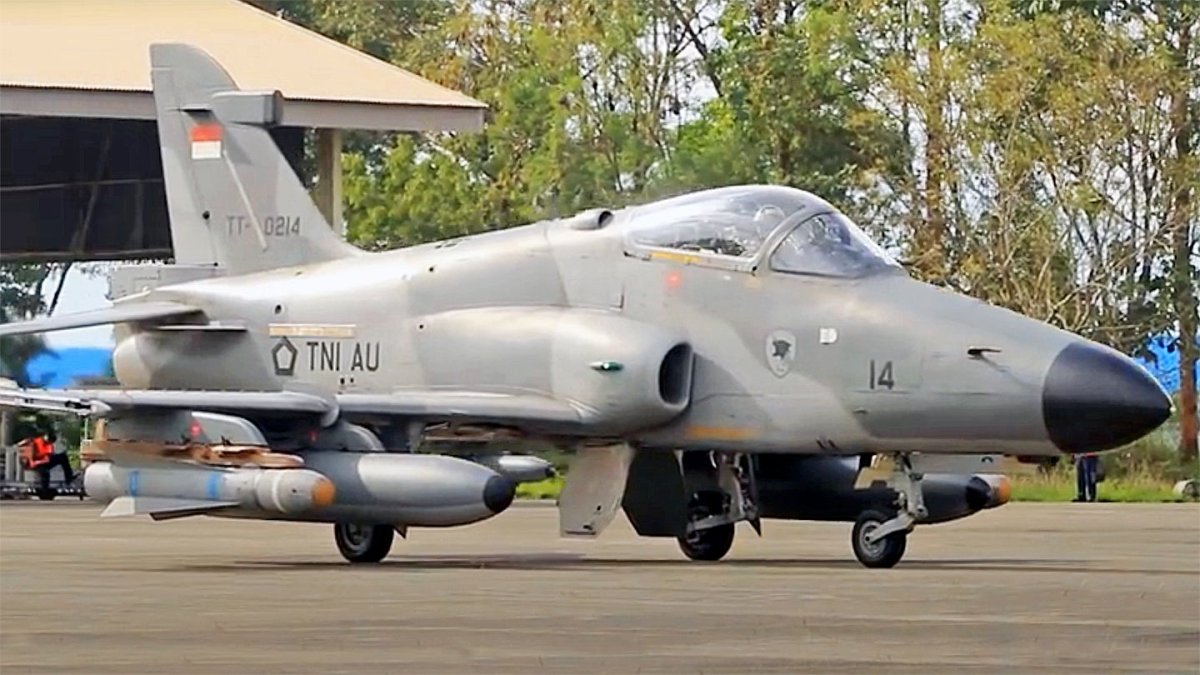
Amid rising tensions, one Indonesian Air Force Hawk pilot had an intense aerial encounter with an Australian Hornet.
新闻视频
Published Dec 2, 2020 5:53 PM EST
It’s a previously unknown story of an unusual, and dramatic, aerial encounter in a little-known conflict. If fully accurate, a new account detailing the events that allegedly occurred on September 16, 1999, suggests they could have potentially led to a deadly aerial encounter between an Australian F/A-18 Hornet jet fighter and a British Aerospace Hawk light combat aircraft flown by an Indonesian Air Force pilot.
The narrative, which is based on an interview with the Indonesian Hawk pilot, Henri Alfiandi , appears on the Indonesian Mylesat website, which covers defense affairs. As well as his description of a confrontation with Royal Australian Air Force (RAAF) Hornets, the same aviator recalls a mission to try and intercept a single RAAF F-111 swing-wing combat jet that was flying an apparent “show of force” mission.
While the incident involving the F-111 doesn’t quite seem to perfectly tally with other published accounts , the story Henri recounts otherwise seems fairly credible and the level of detail it provides on an underreported air war, down to individual aircraft serial numbers, is notable.
The events described took place at the height of the 1999 East Timor crisis , when violence erupted on the eastern half of the island of Timor, a former Portuguese colony, after it had voted overwhelmingly for independence from Indonesia. The Indonesian military had occupied East Timor for the previous 24 years, maintaining a brutal rule and seeking to eliminate any resistance from the insurgents that resisted Jakarta’s rule.
In the wake of the independence vote in August 1999, pro-Jakarta militias, backed by Indonesian security forces, stepped up their attacks on East Timorese civilians. With 2,600 people killed in a three-week period, and many thousands more displaced, international concern began to mount.
A pair of Indonesian Air Force A-4E Skyhawks on patrol., Dirgantara Mandala Museum/Wikimedia Commons
The Indonesian Air Force was ostensibly tasked with covering the withdrawal of Indonesian forces from East Timor, but with deployments of combat jets to West Timor and an Indonesian Navy task group patrolling the waters off East Timor, the United Nations, which had overseen the election, was worried about possible retribution from Indonesia in the form of military intervention.
The interview begins with Henri reminiscing about his time flying the A-4 Skyhawk , an earlier-generation subsonic attack jet that had seen previous use on anti-guerrilla operations in East Timor. “It was the days of Top Gun and I flew on the A-4, not to be outdone by the F-16,” Henri reflects. “The Top Gun film influenced me as a combat pilot and made me proud.” At this time, the F-16 jet was the most capable air-to-air fighter in the Indonesian Air Force, but by 1999, Henri had been posted to a unit flying the British Aerospace Hawk.
While the F-16 was the most capable fighter in service with the Indonesian Air Force in 1999, it was the Hawk that bore the brunt of the missions over Timor., Australian Department of Defence
The nimble Hawk was designed as a jet trainer, but also employed as a light combat aircraft, and flown by Indonesia in both single-seat and two-seat versions. The transfer of Hawks to Indonesia was itself the source of a major controversy in the United Kingdom, with critics voicing their concerns that the jets were being used in a combat role, despite informal British government assurances that they would not be used against the Timorese. In one high-profile incident, campaigners broke into the British Aerospace factory and attacked one of the Hawks destined for Indonesia with hammers.
With the Indonesian Air Force at increased readiness to respond to the tense situation in East Timor as of September 1999, Captain Henri found himself deployed to Kupang Air Base, in West Timor. At the time, Henri explains, the base was hosting two-week rotations of three Hawk jets and the pilots had orders to shoot down any unauthorized aircraft entering Indonesian airspace.
Four days after arriving at Kupang, on September 16, Henri says he was tasked with a routine combat air patrol (CAP) mission. The flight lead for the sortie was Captain Azhar “Gundala” Aditama in single-seat Hawk Mk 209 serial number TT-1207. Henri, callsign “Tucano,” was in two-seat Hawk Mk 109 TL-0501 together with Anton “Tomcat” Mengko.
The two jets reportedly took off at around 09:00 hours to fly a CAP in the southeast Flight Information Region (FIR), which bordered Australian airspace off Darwin, in that country’s Northern Territory. The Hawk mission was coordinated using Ground Control Interception (GCI), via a radar unit at Kupang commanded by Major Lek Haposan.
It was Haposan who alerted Azhar to the fact that two unidentified aircraft had crossed the Darwin FIR boundary at an altitude of 8,000 feet and a speed of 160 knots.
According to the account, the radar operator then requested that the Hawk flight check on what he assumed were helicopters, heading for Dili, the capital of East Timor.
Henri asked Azhar, the flight lead, to use his radar — the single-seat Hawk Mk 209 has the AN/APG-66H pulse-Doppler set, similar to the radar found on the F-16A/B, while the two-seater has no radar — and to verify the contacts’ speed.
A pilot salutes ground crew ahead of a mission in a two-seat Indonesian Air Force Hawk Mk 109., Indonesian Air Force
The flight lead reported the contacts moving at a speed of 150 knots, then noted that the figure was steadily increasing… 160, 170, 200 knots. The unknown aircraft were now at a distance of around 80 miles from the Hawks. At this point in the account, it is not clear if the GCI was still providing information on the contacts, or if they were being tracked using Azhar’s radar, which would have been very much at the limits of its range.
“Knowing that, I immediately went high and assumed a dogfight position to protect Azhar because I didn’t have radar,” Henri recalled. “I was behind him.”
The two Hawks then climbed to an altitude of 28,000 feet, and by now it was clear the contacts weren’t helicopters, but fighter jets. The flight lead selected a combat mode for his radar and then the unidentified fighters turned directly towards the Indonesian Hawks.
An Indonesian Air Force Hawk Mk 209 armed with wingtip AIM-9P Sidewinder missiles, like Azhar’s aircraft., Indonesian Air Force
As the contacts came toward them, Henri explains that Azhar identified them, shouting “Hornet” over the radio. The pair of RAAF F/A-18A/B Hornets were presumably flying from RAAF Tindal, a base in the Northern Territory, from where a reinforced RAAF presence was intended to dissuade Jakarta from embarking on any military escalation in East Timor.
According to Henri’s account, Azhar locked on to at least one of the F/A-18s before Henri warned him “We have not declared war!” It seems the Hornets didn’t enter Indonesian airspace at any point.
A pair of RAAF F/A-18A Hornets during a refueling mission., Australian Department of Defence
The Hornets then turned back south toward the Darwin FIR while the Hawk pair returned to Kupang.
Henri then explains that more aircraft began to pour into the Darwin FIR, with another two groups of four fighters each, plus a larger aircraft that he suspected was a tanker.
As soon as he landed, Henri says he ordered the ground crew at Kupang to prepare the radar-equipped Hawk Mk 209 for another flight, requesting a “hot” refueling, in which fuel is pumped into the tanks while the engine is still running. That wasn’t possible, but, after rapidly draining a cup of tea, Henri was able to get airborne in the Mk 209, which was still armed with a pair of AIM-9 Sidewinder heat-seeking air-to-air missiles. It’s not clear whether or not he was accompanied by another Hawk this time.
Airborne again, Henri claims he immediately selected the radar, but found it wasn’t functioning. He attributed this to the far more sophisticated electronic countermeasures on the Australian Hornets.
A RAAF F/A-18A prepares from departure from Tindal during a deployment to the Northern Territory. , Australian Department of Defence
The Australian fighters are then said to have approached to within 20 miles of Henri’s Hawk, as the tense GCI operator at Kupang screamed instructions at him. At this point, Henri realized that his Hawk’s drop tank was not delivering fuel properly, interfering with the jet’s center of gravity and affecting its handling.
Once again, the engagement between Hawk and Hornet was broken off, this time before Henri had made visual contact with the Australian jets.
Henri returned again to Kupang, where senior officers apparently berated him for being too eager to confront the Hornets.
Over the next three days, the Indonesian Hawk pilots remained on alert, but there were no more reports of any more aerial incursions, Henri contends. The pilots were on standby to scramble from 06:00 to 21:00, but in this period activity was often limited to watching transport aircraft arriving to bring in aid to Dili, the aviator recalls.
A U.S. Air Force C-5 Galaxy cargo aircraft lifts off at Lajes Field, Azores. The C-5, from the 312th Airlift Squadron, Travis AFB, California, was carrying pallets of Meals Ready to Eat (MREs) as part of the humanitarian relief effort for East Timor., US NATIONAL ARCHIVES
In the meantime, a multinational International Force East Timor (INTERFET), organized and led by Australia, had been deployed to East Timor to establish and maintain peace. The first INTERFET forces arrived in Dili on September 20 and, by the end of the month, more than 4,000 troops were deployed.
Australian troops on patrol in East Timor in their Australian Light Armoured Vehicles (ASLAVs)., Australian Department of Defence
On September 23, 1999, Henri remembers the siren suddenly sounding again and the Indonesian pilots, some of whom had just begun their evening prayers, running to the ready room before jumping into a car that took them to the flight line. In the race to scramble, one of the aviators recalled lacing his boots and strapping himself into the cockpit while the Hawk’s engine was spooled up.
This time, Henri’s wingman was Major Hasbullah, and he explains that they were tasked with catching another unidentified aircraft. Henri reckons the two Hawk Mk 209s were airborne within 12 minutes of the alert sounding, which left the controllers at the base with no time to illuminate the runway.
With no time for a pre-flight briefing, either, Henri decided to speak in Javanese to explain the mission plan to his wingman, since it was expected that the Australians would be listening in on their communications and that they understood Indonesian. Henri quickly realized that Hasbullah didn’t understand Javanese, before the two Hawks then headed north.
Then, according to Henri, a radio call came from the GCI at Kupang, “half screaming,” to announce that a RAAF F-111 had just roared over the base, apparently from the direction of Dili.
An afterburner takeoff for a RAAF F-111 at the Australian International Airshow, Avalon., Australian Department of Defence
Capable of speeds of Mach 1.2 at sea level, the F-111 was clearly well beyond the reach of the subsonic Hawks.
The F-111, affectionately known to RAAF crews as the “Pig,” had been deployed to RAAF Tindal in late August, bringing them closer to East Timor and other potential Indonesian targets. These powerful, if aging, jets were then on standby to support INTERFET with reconnaissance flights and airstrikes if required. In the event, they never dropped any weapons in anger.
An F-111 taxies to the RAAF Tindal runway with a load of high-explosive bombs during an exercise., Australian Department of Defence
Official Australian accounts note that some RF-111C reconnaissance sorties were flown over East Timor between November 5 and 9, albeit with Indonesian approval, marking the only operational employment of the RAAF F-111 fleet. This suggests the reported September 23 mission, if it indeed took place, may not have been authorized by Jakarta.
Regardless, Henri and Hasbullah returned to base, carefully noting the waypoints since they had no experience in night flying from Kupang.
For their actions on the 23rd, both airmen were apparently personally congratulated by the commander of the Indonesian National Armed Forces, Soni Rizani, and the incident made national headlines.
It was the end of this brief period of combat service for Henri Alfiandi and he was promoted to the rank of Major later the same year.
East Timor formally declared its independence in May 2002. The crisis of 1999 had damaged the previously good Indonesian-Australian relations, and both Canberra and Jakarta subsequently worked hard to restore elements of past cooperation. This has extended to the military sphere, including joint maneuvers, such as the Pitch Black air warfare exercise , and the transfer of Australian military aid to Indonesia, including C-130H Hercules transports.
A former RAAF C-130H Hercules transport, now in service with the Indonesian Air Force., Australian Department of Defence
Ten years after the standoff in East Timor, Henri was Indonesian Air Attaché in Washington D.C., where, by a remarkable coincidence, he claims to have met one of his antagonists from 1999, during a round of golf.
“Henri, where were you in September 1999?” the Australian Air Attaché apparently asked him, before explaining that he had been the pilot of the F-111. “I just wanted to test your combat readiness,” the Australian reportedly told Henri. It’s a surprising twist to an equally surprising story, but at least one ex-RAAF F-111 pilot served in this capacity at the time, so it’s quite possibly an authentic account.
While the crisis only marks an obscure entry into the annals of air combat history, it can only be hoped that further details of the Indonesian-Australian encounters over East Timor will also finally come to light.
Contact the author: thomas@thedrive.com
Comments couldn’t be loaded. Please refresh the page.
发布于美国东部时间2020年12月2日下午5:53。
这是一个此前鲜为人知的故事,讲述了一场发生在鲜为人知的冲突中的非同寻常且惊心动魄的空中遭遇战。如果完全属实,一份详细描述1999年9月16日事件的新报告表明,这些事件可能导致了一架澳大利亚F/A-18“大黄蜂”战斗机与一架由印尼空军飞行员驾驶的英国“鹰”式轻型战斗机之间发生致命的空中遭遇战。
这篇报道基于对印尼鹰式教练机飞行员亨利·阿尔菲安迪的采访,发表在印尼国防新闻网站Mylesat上。除了描述与澳大利亚皇家空军(RAAF)大黄蜂战斗机的遭遇战外,这位飞行员还回忆起一次拦截一架RAAF F-111可变后掠翼战斗机的任务,当时这架飞机显然是在执行“武力展示”任务。
虽然涉及 F-111 的事件似乎与其他已发表的描述不太吻合,但亨利讲述的故事在其他方面似乎相当可信,而且它对一场鲜为人知的空战提供的细节,甚至包括单个飞机的序列号,都值得注意。
所描述的事件发生在1999年东帝汶危机的高峰期。当时,东帝汶岛(前葡萄牙殖民地)东部地区爆发了暴力冲突,此前该地区以压倒性多数投票决定脱离印度尼西亚独立。印尼军队此前已占领东帝汶长达24年,实行残酷统治,并试图消灭任何反抗雅加达统治的叛乱分子。
1999年8月东帝汶独立公投后,亲雅加达的民兵组织在印尼安全部队的支持下,加大了对东帝汶平民的袭击力度。短短三周内,就有2600人丧生,数千人流离失所,国际社会开始高度关注这一局势。
两架印度尼西亚空军 A-4E 天鹰巡逻机。Dirgantara Mandala 博物馆/维基共享资源
表面上,印尼空军的任务是掩护印尼军队从东帝汶撤离,但由于印尼向西帝汶部署了战斗机,并且印尼海军特遣队在东帝汶附近海域巡逻,监督选举的联合国担心印尼可能会以军事干预的形式进行报复。
采访伊始,亨利回忆起他驾驶A-4“天鹰”攻击机的时光。A-4是一款早期亚音速攻击机,曾参与过东帝汶的反游击作战。“那正是《壮志凌云》风靡的年代,我驾驶A-4,不甘示弱,与F-16一较高下,”亨利回忆道,“《壮志凌云》这部电影对我的战斗机飞行员生涯产生了深远的影响,也让我倍感自豪。”当时,F-16是印尼空军性能最强的空对空战斗机,但到了1999年,亨利被调往一个装备英国宇航公司“鹰”式攻击机的部队。
尽管F-16是1999年印尼空军服役的最先进战斗机,但鹰式教练机却承担了对东帝汶的大部分作战任务。——澳大利亚国防部
灵活的“鹰”式教练机最初设计为喷气式教练机,但也曾被用作轻型战斗机,印度尼西亚曾装备过单座和双座版本的“鹰”式飞机。向印度尼西亚交付“鹰”式飞机本身在英国就引发了一场重大争议,批评人士担心这些飞机会被用于作战,尽管英国政府曾非正式地保证不会用于攻击东帝汶。在一次引人注目的事件中,一些活动人士闯入英国宇航公司工厂,用锤子袭击了一架即将交付给印度尼西亚的“鹰”式飞机。
1999年9月,随着印尼空军为应对东帝汶紧张局势而加强戒备,亨利上尉被派往西帝汶的古邦空军基地。亨利解释说,当时该基地每两周轮换部署三架鹰式教练机,飞行员接到命令,击落任何未经授权进入印尼领空的飞机。
亨利说,抵达古邦四天后,也就是9月16日,他被指派执行一次例行战斗空中巡逻(CAP)任务。此次飞行任务的领队是阿扎尔·“贡达拉”·阿迪塔马上尉,他驾驶的是单座鹰式Mk 209教练机,序列号TT-1207。亨利,呼号“图卡诺”,与安东·“雄猫”·孟科一起,驾驶的是双座鹰式Mk 109教练机,序列号TL-0501。
据报道,这两架喷气式飞机于上午9点左右起飞,前往东南飞行情报区(FIR)执行空中巡逻任务。该区域与澳大利亚北领地达尔文附近的领空接壤。鹰式教练机的任务由地面控制拦截(GCI)系统协调,并通过位于古邦的雷达站进行,该雷达站由莱克·哈波桑少校指挥。
是哈波桑提醒阿扎尔,有两架不明飞机以 8000 英尺的高度和 160 节的速度越过了达尔文飞行情报区的边界。
据该报道,雷达操作员随后要求鹰式战斗机检查他认为是直升机的飞行目标,这些目标正飞往东帝汶首都帝力。
亨利让飞行队长阿扎尔使用他的雷达——单座的霍克Mk 209配备了AN/APG-66H脉冲多普勒雷达,类似于F-16A/B上的雷达,而双座的霍克Mk 209没有雷达——来确认目标的速度。
一名飞行员驾驶印尼空军双座鹰式Mk 109教练机执行任务前向地勤人员敬礼。(印尼空军)
领队报告称目标飞行速度为150节,随后注意到速度持续增加……160节、170节、200节。此时,这些不明飞行物距离“鹰”式教练机约80英里。根据报告,目前尚不清楚地面控制拦截系统(GCI)是否仍在提供有关目标的信息,或者是否正在使用“阿扎尔”雷达进行跟踪,而“阿扎尔”雷达当时已接近其探测范围极限。
“知道这一点后,我立即爬升到高空,采取近距离空战姿势保护阿扎尔,因为我没有雷达,”亨利回忆道。“我就在他身后。”
两架鹰式教练机随后爬升至28000英尺的高度,此时它们已经清楚地意识到,目标并非直升机,而是战斗机。领队飞行员将雷达切换至战斗模式,随后,这些不明战斗机径直朝印尼鹰式教练机飞来。
一架印尼空军的鹰式Mk 209教练机,翼尖挂载AIM-9P响尾蛇导弹,与阿扎尔的飞机相同。
亨利解释说,当敌机靠近时,阿扎尔通过无线电喊道“大黄蜂”,确认了敌机身份。这两架澳大利亚皇家空军的F/A-18A/B“大黄蜂”战斗机很可能是从位于北领地的廷德尔皇家空军基地起飞的。澳大利亚皇家空军此举旨在加强在该基地的军事存在,以阻止雅加达在东帝汶采取任何军事行动。
据亨利所述,阿扎尔锁定了至少一架F/A-18战斗机,之后亨利警告他“我们还没有宣战!”看来这些“大黄蜂”战斗机在任何时候都没有进入印度尼西亚领空。
两架澳大利亚皇家空军F/A-18A“大黄蜂”战斗机正在进行空中加油任务。(澳大利亚国防部)
随后,黄蜂队向南返回达尔文飞行情报区,而鹰队则返回了古邦。
亨利接着解释说,更多的飞机开始涌入达尔文飞行情报区,还有另外两组各有四架战斗机的飞机,以及一架他怀疑是加油机的大型飞机。
亨利说,他一落地就命令古邦机场的地勤人员准备好那架配备雷达的鹰式Mk 209教练机,准备再次飞行,并要求进行“热加油”,即在发动机运转的情况下向油箱内注入燃油。热加油无法实现,但亨利迅速喝完一杯茶后,便驾驶着Mk 209教练机升空了。这架飞机上仍然挂载着两枚AIM-9“响尾蛇”红外制导空空导弹。目前尚不清楚他这次是否还有另一架鹰式教练机随行。
亨利再次升空后,声称他立即选择了雷达,但发现雷达无法正常工作。他将此归咎于澳大利亚“大黄蜂”战机上更为先进的电子对抗措施。
一架澳大利亚皇家空军的F/A-18A战斗机在部署至北领地期间,准备从廷德尔空军基地起飞。(澳大利亚国防部)
据称,澳大利亚战斗机随后逼近到距离亨利驾驶的鹰式战斗机20英里以内,古邦空军基地的地面控制拦截操作员紧张地向他大声发出指令。此时,亨利意识到他的鹰式战斗机的副油箱供油不畅,影响了飞机的重心,进而影响了其操控性能。
鹰式战斗机和黄蜂式战斗机之间的交战再次中断,这次是在亨利与澳大利亚战机建立目视联系之前。
亨利再次返回古邦,在那里,高级军官们显然斥责他太急于与黄蜂队对抗。
亨利表示,接下来的三天里,印尼鹰式战斗机飞行员保持高度戒备,但没有再收到任何空中入侵的报告。飞行员们从早上6点到晚上9点都处于待命状态,随时准备紧急起飞,但在此期间,他们的活动通常仅限于监视运送援助物资到帝力的运输机,这位飞行员回忆道。
一架美国空军C-5“银河”运输机从亚速尔群岛拉杰斯机场起飞。这架C-5隶属于加利福尼亚州特拉维斯空军基地的第312空运中队,机上装载着成托盘的即食军粮(MRE),作为对东帝汶人道主义救援行动的一部分。(美国国家档案馆)
与此同时,由澳大利亚组织和领导的多国部队——东帝汶国际部队(INTERFET)已部署到东帝汶,以建立和维护和平。首批东帝汶国际部队于9月20日抵达帝力,到月底,部署的士兵人数已超过4000人。
澳大利亚国防部供图:澳大利亚军队驾驶澳大利亚轻型装甲车(ASLAV)在东帝汶巡逻。
1999年9月23日,亨利记得警报再次响起,印尼飞行员们——其中一些人刚刚开始晚祷——跑到准备室,跳上一辆汽车,前往飞行跑道。在争分夺秒的起飞过程中,一位飞行员回忆说,他一边系好靴子,一边把自己固定在驾驶舱里,而鹰式战斗机的发动机已经启动。
这次,亨利的僚机是哈斯布拉少校,他解释说,他们的任务是拦截另一架不明飞行物。亨利估计,两架鹰式Mk 209教练机在警报响起后12分钟内就升空了,这使得基地管制员根本来不及点亮跑道。
由于没有时间进行飞行前简报,亨利决定用爪哇语向僚机解释任务计划,因为他预计澳大利亚人会监听他们的通讯,而且他们应该能听懂印尼语。亨利很快意识到哈斯布拉听不懂爪哇语,随后两架鹰式战斗机向北飞去。
然后,据亨利说,古邦的地面控制中心(GCI)传来一个无线电呼叫,声音“近乎尖叫”,宣布一架澳大利亚皇家空军的F-111刚刚从基地上空呼啸而过,显然是从帝力方向飞来的。
在澳大利亚阿瓦隆举行的澳大利亚国际航展上,一架澳大利亚皇家空军F-111战斗机开启加力燃烧室起飞。(澳大利亚国防部)
F-111 在海平面上的速度可达 1.2 马赫,显然远远超过了亚音速鹰式战斗机的飞行能力。
F-111战斗机,被澳大利亚皇家空军机组人员亲切地称为“猪”,于8月下旬部署到廷德尔皇家空军基地,使其更接近东帝汶和其他潜在的印尼目标。这些性能强大但略显老旧的战机当时处于待命状态,随时准备在必要时为国际维和部队提供侦察飞行和空袭支援。最终,它们并未在实战中投下任何武器。
一架F-111战斗机载着大量高爆炸弹,在演习期间滑行至廷德尔皇家空军基地跑道。(澳大利亚国防部)
澳大利亚官方记录显示,11月5日至9日期间,澳大利亚皇家空军F-111C侦察机曾飞越东帝汶上空执行侦察任务,尽管这些任务得到了印尼方面的批准,但这却是澳大利亚皇家空军F-111机队唯一一次实际作战行动。这表明,如果9月23日的任务确有发生,那么它可能并未获得雅加达方面的授权。
尽管如此,亨利和哈斯布拉还是返回了基地,并仔细记下了航路点,因为他们没有从古邦进行夜间飞行的经验。
23日当天,这两名飞行员的英勇行为显然受到了印度尼西亚国民军司令索尼·里扎尼的亲自祝贺,此事也登上了全国新闻头条。
亨利·阿尔菲安迪的短暂战斗服役期就此结束,同年晚些时候,他被晋升为少校。
东帝汶于2002年5月正式宣布独立。1999年的危机损害了此前良好的印尼-澳大利亚关系,此后堪培拉和雅加达都努力恢复了过去的合作。这种合作已扩展到军事领域,包括联合演习,例如“漆黑行动”空中作战演习,以及澳大利亚向印尼提供军事援助,包括C-130H“大力神”运输机。
一架原澳大利亚皇家空军的C-130H“大力神”运输机,现服役于印度尼西亚空军。(澳大利亚国防部)
东帝汶对峙事件发生十年后,亨利担任印度尼西亚驻华盛顿特区空军武官。在那里,他声称,在一次高尔夫球赛中,他遇到了 1999 年的一位对手,这真是一个惊人的巧合。
“亨利,1999年9月你在哪里?”这位澳大利亚空军武官显然这样问他,然后解释说自己当时是F-111战斗机的飞行员。“我只是想测试一下你的作战能力,”据报道,这位澳大利亚人这样告诉亨利。这则故事本身就令人匪夷所思,而其中又出现了一个令人惊讶的转折。不过,当时至少有一位前澳大利亚皇家空军F-111飞行员担任过类似的职务,所以这很可能是一份真实的记录。
虽然这场危机只是空战史上一个不起眼的插曲,但人们只能希望,有关印尼和澳大利亚在东帝汶上空遭遇的更多细节最终也能水落石出。
联系作者:thomas@thedrive.com
评论加载失败,请刷新页面。