US to destroy its last chemical weapons美国将销毁其最后一批化学武器
The weapons’ destruction alleviates a concern that civic leaders in Colorado and Kentucky admit was always in the back of their minds.
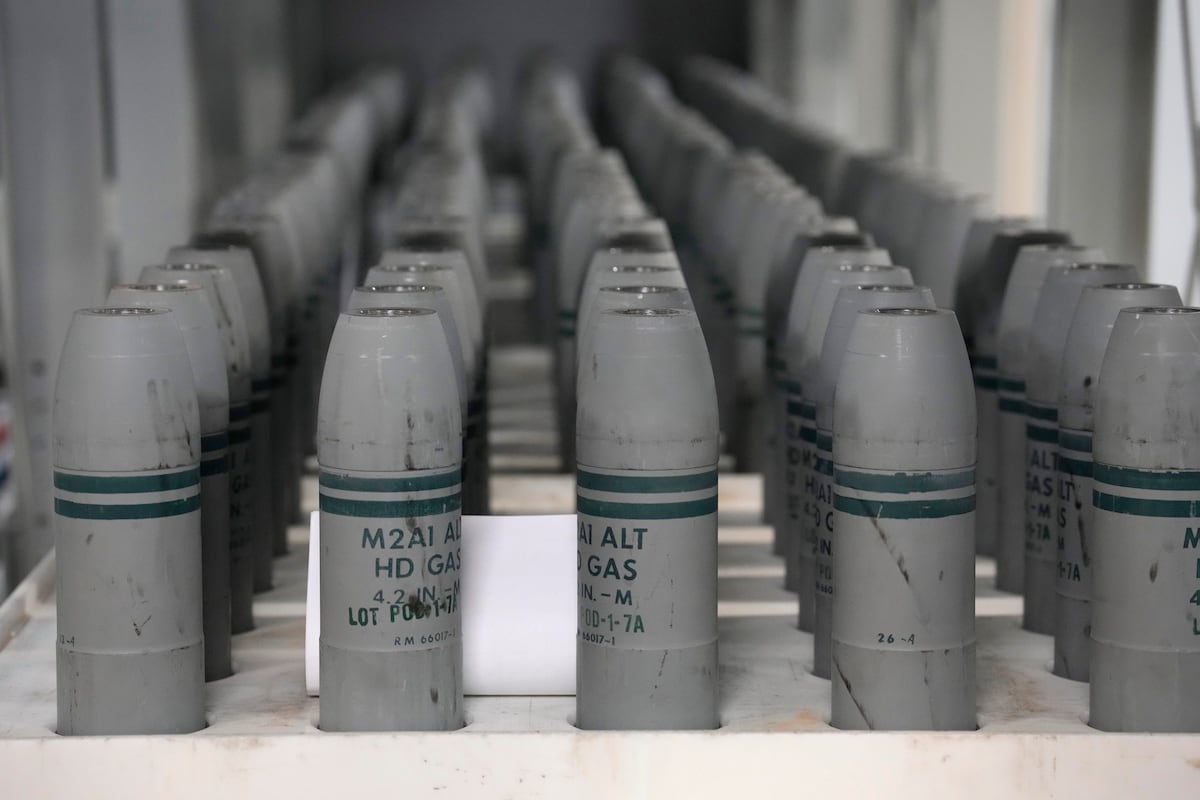
RICHMOND, Ky. — At a sprawling military installation in the middle of the rolling green hills of eastern Kentucky, a milestone is about to be reached in the history of warfare dating back to World War I.
Workers at the Blue Grass Army Depot are close to destroying rockets filled with GB nerve agent that are the last of the United States’ declared chemical weapons and completing a decades-long campaign to eliminate a stockpile that by the end of the Cold War totaled more than 30,000 tons.
The weapons’ destruction is a major watershed for Richmond, Kentucky and Pueblo, Colorado, where an Army depot destroyed the last of its chemical agents last month. It’s also a defining moment for arms control efforts worldwide.
The U.S. faces a Sept. 30 deadline to eliminate its remaining chemical weapons under the international Chemical Weapons Convention, which took effect in 1997 and was joined by 193 countries. The munitions being destroyed in Kentucky are the last of 51,000 M55 rockets with GB nerve agent — a deadly toxin also known as sarin — that have been stored at the depot since the 1940s.
By destroying the munitions, the U.S. is officially underscoring that these types of weapons are no longer acceptable in the battlefield and sending a message to the handful of countries that haven’t joined the agreement, military experts say.
“One thing that we’re really proud of is how we’re finishing the mission. We’re finishing it for good for the United States of America,” said Kim Jackson, manager of the Pueblo Chemical Agent-Destruction Pilot Plant.
Chemical weapons were first used in modern warfare in World War I, where they were estimated have killed at least 100,000. Despite their use being subsequently banned by the Geneva Convention, countries continued to stockpile the weapons until the treaty calling for their destruction.
In southern Colorado, workers at the Army Pueblo Chemical Depot started destroying the weapons in 2016, and on June 22 completed their mission of neutralizing an entire cache of about 2,600 tons of mustard blister agent. The projectiles and mortars comprised about 8.5% of the country’s original chemical weapons stockpile of 30,610 tons of agent.
Nearly 800,000 chemical munitions containing mustard agent were stored since the 1950s inside row after row of heavily guarded concrete and earthen bunkers that pock the landscape near a large swath of farmland east of Pueblo.
The weapons’ destruction alleviates a concern that civic leaders in Colorado and Kentucky admit was always in the back of their minds.
A worker toils to destroy the United States' chemical weapons stockpile at the U.S. Army Pueblo Chemical Depot on June 8, 2023, in Pueblo, Colo. (David Zalubowski/AP)
“Those [weapons] sitting out there were not a threat,” Pueblo Mayor Nick Gradisar said. But, he added, “you always wondered what might happen with them.”
In the 1980s, the community around Kentucky’s Blue Grass Army Depot rose up in opposition to the Army’s initial plan to incinerate the plant’s 520 tons of chemical weapons, leading to a decadeslong battle over how they would be disposed of. They were able to halt the planned incineration plant, and then, with help from lawmakers, prompted the Army to submit alternative methods to burning the weapons.
Craig Williams, who became the leading voice of the community opposition and later a partner with political leadership and the military, said residents were concerned about potential toxic pollution from burning the deadly chemical agents.
Williams noted that the military eliminated most of its existing stockpile by burning weapons at other, more remote sites such as Johnston Atoll in the Pacific Ocean or at a chemical depot in the middle of the Utah desert. But the Kentucky site was adjacent to Richmond and only a few dozen miles away from Lexington, the state’s second-largest city.
“We had a middle school of over 600 kids a mile away from the [planned] smokestack,” Williams said.
The Kentucky storage facility has housed mustard agent and the VX and sarin nerve agents, much of it inside rockets and other projectiles, since the 1940s. The state’s disposal plant was completed in 2015 and began destroying weapons in 2019. It uses a process called neutralization to dilute the deadly agents so they can be safely disposed of.
The project, however, has been a boon for both communities, and facing the eventual loss of thousands of workers, both are pitching the pool of high-skilled laborers as a plus for companies looking to locate in their regions.
Workers at the Pueblo site used heavy machinery to meticulously — and slowly — load aging weapons onto conveyor systems that fed into secure rooms where remote-controlled robots did the dirty and dangerous work of eliminating the toxic mustard agent, which was designed to blister the skin and cause inflammation of the eyes, nose, throat and lungs.
Robotic equipment removed the weapons’ fuses and bursters before the mustard agent was neutralized with hot water and mixed with a caustic solution to prevent the reaction from reversing. The byproduct was further broken down in large tanks swimming with microbes, and the mortars and projectiles were decontaminated at 1,000 degrees Fahrenheit and recycled as scrap metal.
Problematic munitions that were leaky or overpacked were sent to an armored, stainless steel detonation chamber to be destroyed at about 1,100 degrees Fahrenheit.
The Colorado and Kentucky sites were the last among several, including Utah and the Johnston Atoll, where the nation’s chemical weapons had been stockpiled and destroyed. Other locations included facilities in Alabama, Arkansas and Oregon.
Kingston Reif, an assistant U.S. secretary of defense for threat reduction and arms control, said the destruction of the last U.S. chemical weapon “will close an important chapter in military history, but one that we’re very much looking forward to closing.”
Officials say the elimination of the U.S. stockpile is a major step forward for the Chemical Weapons Convention. Only three countries — Egypt, North Korea and South Sudan — have not signed the treaty. A fourth, Israel, has signed but not ratified the treaty.
Reif noted that there remains concern that some parties to the convention, particularly Russia and Syria, possess undeclared chemical weapons stockpiles.
Still, arms control advocates hope this final step by the U.S. could nudge the remaining countries to join. But they also hope it could be used as a model for eliminating other types of weapons.
“It shows that countries can really ban a weapon of mass destruction,” said Paul F. Walker, vice chairman of the Arms Control Association and coordinator of the Chemical Weapons Convention Coalition. “If they want to do it, it just takes the political will and it takes a good verification system.”
DeMillo reported from Little Rock, Arkansas, and Peipert reported from Pueblo, Colorado.
肯塔基州里士满——在肯塔基州东部连绵起伏的绿色山丘中央的一处庞大的军事基地,战争史上一个里程碑即将到来,这一里程碑可以追溯到第一次世界大战。
蓝草陆军仓库的工人们即将销毁装满GB神经毒剂的火箭,这些火箭是美国最后公开的化学武器,并完成一项长达数十年的行动,以消除冷战结束时总计超过3万吨的库存。
这些武器的销毁对肯塔基州里士满和科罗拉多州普韦布洛来说意义重大,因为上个月普韦布洛的一个陆军仓库销毁了最后一批化学制剂。这对全球军控努力而言也是一个具有里程碑意义的时刻。
根据1997年生效、193个国家加入的《化学武器公约》,美国必须在9月30日之前销毁其剩余的化学武器。在肯塔基州销毁的弹药是自20世纪40年代以来一直储存在该仓库的51000枚装有GB神经毒剂(一种致命毒素,又称沙林)的M55火箭弹中的最后几枚。
军事专家表示,美国销毁这些弹药,正式表明此类武器在战场上不再被接受,并向少数尚未加入该协议的国家发出信号。
“我们真正引以为豪的一点是,我们完成了这项任务。我们正在为美利坚合众国彻底完成这项任务,”普韦布洛化学制剂销毁试验工厂经理金·杰克逊说道。
化学武器首次在现代战争中使用是在第一次世界大战中,据估计造成至少 10 万人死亡。尽管日内瓦公约随后禁止使用化学武器,但各国仍继续囤积这些武器,直到条约要求销毁它们为止。
在科罗拉多州南部,陆军普韦布洛化学武器库的工作人员于2016年开始销毁这些武器,并于6月22日完成了销毁任务,成功中和了约2600吨芥子气糜烂剂。这些炮弹和迫击炮弹约占美国最初30610吨化学武器库存的8.5%。
自 20 世纪 50 年代以来,近 80 万枚含有芥子气的化学弹药被储存在普韦布洛东部大片农田附近一排排戒备森严的混凝土和土质掩体中。
武器的销毁消除了科罗拉多州和肯塔基州的市政领导人一直担忧的问题,他们承认,这个问题一直萦绕在他们心头。
2023年6月8日,在科罗拉多州普韦布洛市的美国陆军普韦布洛化学武器库,一名工人正在努力销毁美国的化学武器库存。(David Zalubowski/AP)
普韦布洛市市长尼克·格拉迪萨尔说:“那些(武器)摆在那里并不构成威胁。”但他补充道,“你总会担心它们最终会落入谁的手中。”
上世纪80年代,肯塔基州蓝草陆军基地附近的社区民众强烈反对陆军最初计划焚烧该基地储存的520吨化学武器,由此引发了一场长达数十年的关于如何处理这些武器的争论。他们最终成功阻止了焚烧厂的建设,并在立法者的帮助下,促使陆军提交了替代焚烧方案。
克雷格·威廉姆斯后来成为社区反对派的领军人物,并与政治领导人和军方合作。他表示,居民们担心焚烧致命化学制剂可能会造成有毒污染。
威廉姆斯指出,军方已将大部分现有库存武器销毁,销毁地点选在了其他较为偏远的地方,例如太平洋的约翰斯顿环礁或犹他州沙漠中心的化学品仓库。但肯塔基州的这个地点毗邻里士满,距离该州第二大城市列克星敦也只有几十英里。
威廉姆斯说:“我们有一所中学,有 600 多名学生,距离(计划中的)烟囱只有一英里。”
自20世纪40年代以来,肯塔基州的储存设施一直存放着芥子气、VX神经毒剂和沙林神经毒剂,其中大部分被封存在火箭弹和其他弹药中。该州的销毁厂于2015年建成,并于2019年开始销毁武器。它采用一种称为中和的工艺来稀释这些致命毒剂,以便安全处置。
然而,该项目对两个社区来说都是一大福音,面对最终可能流失的数千名工人,双方都在大力宣传当地高技能劳动力资源,以此吸引企业落户。
在普韦布洛遗址,工人们使用重型机械,一丝不苟地——缓慢地——将老化的武器装载到传送带系统上,这些传送带系统将武器送入安全的房间,在那里,遥控机器人进行肮脏而危险的工作,清除有毒的芥子气。芥子气旨在使皮肤起泡,并引起眼睛、鼻子、喉咙和肺部的炎症。
机器人设备拆除了武器的引信和爆破片,然后用热水中和芥子气,并与腐蚀性溶液混合以防止反应逆转。副产品在充满微生物的大型容器中进一步分解,迫击炮弹和炮弹在华氏1000度(约摄氏538度)的高温下进行消毒,并作为废金属回收利用。
有泄漏或过度包装的问题弹药会被送到装甲不锈钢引爆室,在大约 1100 华氏度的温度下销毁。
科罗拉多州和肯塔基州的这两个地点是最后几个销毁化学武器的地点,其他地点还包括犹他州和约翰斯顿环礁,这些地方曾是美国储存和销毁化学武器的场所。其他地点还包括阿拉巴马州、阿肯色州和俄勒冈州的设施。
美国国防部负责减少威胁和军备控制的助理部长金斯顿·雷夫表示,销毁美国最后一件化学武器“将结束军事史上一个重要的篇章,但我们非常期待这一篇章的结束。”
官员们表示,美国销毁化学武器库存是《化学武器公约》向前迈出的重要一步。目前只有三个国家——埃及、朝鲜和南苏丹——尚未签署该条约。第四个国家以色列已签署但尚未批准该条约。
赖夫指出,人们仍然担心该公约的一些缔约方,特别是俄罗斯和叙利亚,拥有未申报的化学武器库存。
尽管如此,军控倡导者们仍然希望美国这最后一步能够促使其他国家加入。他们也希望这能成为消除其他类型武器的典范。
“这表明各国确实能够禁止大规模杀伤性武器,”军备控制协会副主席兼《化学武器公约》联盟协调员保罗·F·沃克说。“如果他们想这样做,只需要政治意愿和良好的核查机制。”
德米洛从阿肯色州小石城报道,佩珀特从科罗拉多州普韦布洛报道。