How Marine Commandant Berger became ‘the poster child for change’海军陆战队指挥官伯杰如何成为“变革的典范”
Gen. David Berger relinquishes command on July 10, after four years of reforms that will shape the Marine Corps for years to come.
WASHINGTON — In the small town of Newport, Rhode Island, a U.S. force lacking in capabilities was about to face off against well-armed and advanced Chinese troops.
It was 2018, and then-Lt. Gen. David Berger was putting four years of simmering thoughts to the test in a wargame at the Naval War College, in hopes of figuring out a better way to employ forces in the Pacific.
His last two assignments had put him at the forefront of the Marine Corps’ shift away from ground wars and back to sea. And he now had a chance to see how all these ideas would play out in a fight against an advanced competitor.
In the wargame, the adversarial force was based on China’s current capabilities plus expected growth in the next couple years. The friendly force was played by the U.S. joint force strictly as it was — no future capabilities, no aspirational readiness levels and not even the F-35 Joint Strike Fighter, as it wasn’t fielded in great numbers at the time.
Though the wargame’s details and results are classified, Berger had clear takeaways for the Marine Corps: Anything heavy was a liability; mobility would be a huge challenge, as would sustaining a force operating so near to China’s shores; and Marines, with the right command-and-control structure, could be a game-changing tool for sea-control and sea-denial missions.
However, Berger told Defense News in a June 8 interview that his primary takeaway from that wargame was the importance of already having forces in the theater before a conflict starts.
“If we didn’t have something forward, then I think [then-Commandant Gen. Robert] Neller is exactly right. He said we should expect to fight to get to the fight — but this fight to get to the fight was getting to be a slaughter [in previous wargames]. So more and more it was clear to not just me, [but to] a bunch of people, the imperative of being forward all the time, persistently,” Berger said.
In the wargame, that pre-positioned force included special operations units and submarines. But Berger wanted Marines already in theater, too, as something of a stand-in force.
“And if they’re going to be in there, then you have to answer the question of: How are they going to survive? How are you going to resupply them? So these became real thinking efforts for a lot of us,” he explained.
Fast forward a few years, and the takeaways from the 2018 wargame directly led to Berger’s Commandant’s Planning Guidance, released the day after he became the Corps’ top officer in July 2019; the Force Design 2030 modernization program, first released in March 2020 and updated annually; the Stand-In Forces concept, released in December 2021 and brought to life by the 3rd Marine Littoral Regiment that was activated in March 2022; and a contested logistics concept released earlier this year, among them.
U.S. Marines with 3d Littoral Combat Team, along with U.S. soldiers and Philippine marines, secure a landing zone during the Balikatan exercise on Basco, Philippines, in April 2023. (Sgt. Patrick King/U.S. Marine Corps)
These changes were met with resistance. In fact, Berger faced vocal opposition from the retiree community, unusual for the small service that “was always taught that we did our laundry in private,” said former Navy Secretary and Marine pilot Richard V. Spencer.
Spencer called Berger “the poster child for change, urgency and deliberation,” and said the general fully embodied the phrase “talk softly and carry a big stick.”
“His demeanor is so calm and so collected because it’s based in thought and data,” he told Defense News in a June 21 interview.
A flurry of opinion pieces — some signed, some nameless — began circulating in March 2022, accusing Berger of creating a one-trick pony of sorts, a force optimized for a fight against China but no longer capable of conducting other types of missions around the globe.
“I’m saddened beyond belief knowing that our Marine Corps soon will no longer be the ready combined-arms force that our nation has long depended upon when its interests were threatened,” former Marine Corps combat development head Lt. Gen. Paul Van Riper wrote in Marine Corps Times . “It will be a force shorn of all its tanks and 76% of its cannon artillery, and with 41% fewer Marines in its infantry battalions.”
Despite additional pushback from the likes of former Commandant Gen. James Amos and former Navy Secretary James Webb , Berger has continued undeterred to overhaul his Corps.
Retired Adm. Scott Swift, who commanded U.S. Pacific Fleet when Berger led U.S. Marine Corps Forces Pacific, had observed how the ideas behind Force Design 2030 were validated in the 2018 wargame.
Berger “understood the challenges he was taking on and how he would be criticized, but he had done enough study — this wasn’t just, he showed up as commandant and decided to do this; this came out of his experiences,” Swift said in a June 23 interview.
“He was there when they were using armor and long-range artillery in the Middle East; he saw what the value of it was, but that’s a different warfight” than what the joint force was to prepare for in the Pacific, the admiral said, adding that Berger combined his experiences and a campaign of wargaming to reform the Marine Corps “in a much more consequential way than I think other leaders really had the courage to do.”
Berger took command of the Marine Corps on July 11, 2019. He relinquishes command on July 10, after four years of reforms that will shape the Corps for years to come.
The 38th commandant of the Marine Corps almost became a Navy officer.
Ahead of his 1977 graduation from high school in rural Maryland, Berger applied for ROTC scholarships at the advice of his father, who Berger called “the smartest person that I know.” His father had gone to Duke University on an Air Force ROTC scholarship, and Berger ultimately chose to attend Tulane University on a Navy ROTC scholarship due to his interest in the school’s engineering program.
That fall, Berger began school as a naval cadet, but quickly noticed the Marines.
“If you’re a college freshman and don’t know anything about the military, they [Marines] were just a poster. And they not just looked the part — they were clearly different from the Navy instructors, the way they handled themselves, the way they taught their classes, and it was clear that the [cadets in the Marine Corps program] were different, too. So I was drawn to that,” Berger told Defense News in the interview, and he switched to the Marine Corps program as soon as he was assured his scholarship would allow it.
Berger graduated and was commissioned a Marine Corps officer in 1981. He spent his first two tours on the West Coast, with deployments to the Pacific on amphibious ships.
Though separated by geography, he said two formative events happened in October 1983, just two years into his career: Operation Urgent Fury in Grenada, where Marine and joint forces stormed the Caribbean island following a coup, losing 19 American service members but quickly occupying the island; and the bombing of the Marine barracks in Beirut, Lebanon, that killed 241 American service members, including 220 Marines.
“Lieutenants who were in my [The Basic School] class were killed. And I was on the West Coast, and the unit was from the East Coast, but it shocked the whole Marine Corps. And you could understand why, when you lose 240 like that. It’s just not something anyone was expecting. So that definitely shaped things,” he said, looking back at foundational moments in his career.
Berger described the operation in Grenada as a high point for inspiring young Marines, but said the loss in Beirut “made everything real.”
The start of the Gulf War in 1990 and the Sept. 11, 2001, attacks were other “real” moments for him — reminders of the seriousness of his business.
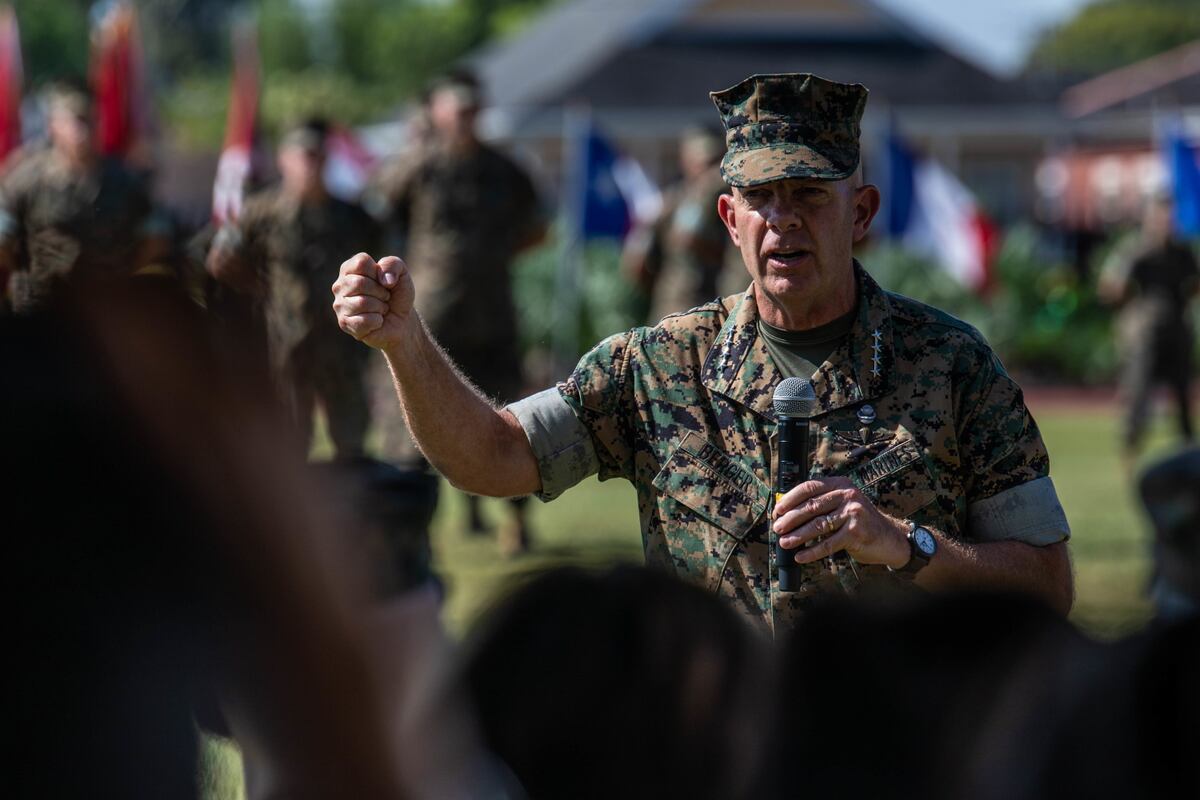
Commandant of the Marine Corps Gen. David Berger speaks to the Marines and sailors at Marine Corps Air Station Cherry Point, N.C., on July 31, 2019. (Cpl. Ethan Pumphret/U.S. Marine Corps)
But Berger said the experiences that shaped him as a leader were the losses of Marines directly under his command.
Asked by Defense News what stands out as defining moments in building who he is today, he said, “almost all of them were not necessarily moments, but when you lost Marines, because your immediate thought, most Marine leaders’ immediate thought is, you missed something. You overlooked something. You skipped a step. You immediately take responsibility yourself and go, there’s something we didn’t see. There are a lot of them, a lot of them.”
Berger recounted losing 10 Marines to one improvised explosive device attack in Iraq, and losing a Marine to an accidental grenade explosion inside their own camp in Kuwait. Each time, he said, he scoured Marine Corps procedures for missed or forgotten steps that could have saved lives.
“Those stay with you forever,” Berger said.
Berger showed up at Marine Corps Forces Pacific headquarters in Hawaii in 2016, having read about China’s rise and the changing landscape in the region, but with questions about the pace of that change.
Swift and then-U.S. Pacific Command chief Adm. Harry Harris assured him the change was happening faster than most understood, Berger recalled.
Though much of China’s rising military power and its aggressive behavior toward its neighbors was out of his control as the top Marine in the Pacific, Berger could take steps to strengthen relationships with local partners and allies — another theme he brought to Force Design 2030.
“Our relationship at the Marine Corps level with Japan, with Korea, with the Philippines, with Australia, was still strong and growing — and in some cases, growing much faster than I was aware of,” he said.
The ability to entrust allies and partners to share targeting data, protect and resupply small formations of Marines, and otherwise operate intertwined with the Corps and the U.S. joint force is key to Force Design 2030. Berger said he’s seen allies in the Pacific repeatedly prove their trustworthiness throughout his career, and particularly while commanding Marine Corps Forces Pacific.
In 2012, while commanding 1st Marine Division (Forward) in Afghanistan, Berger said one of his reconnaissance teams in northern Helmand province got stuck in their position one night, with bad weather and no American forces nearby to extract them.
An Australian special operations force liaison officer overheard Berger talking to Maj. Gen. Charles Gurganus, the I Marine Expeditionary Force (Forward) commander in Afghanistan.
The Australian Army major chimed in: “ ‘We can do that.’ And, I mean, couldn’t have been 30, 45 minutes later, they take off in MV-22s,” Berger recalled. “I’m sure they had just returned from some other mission and all, but it didn’t matter. He knew the U.S. unit was in a pickle, in a tough spot: ‘We got this. We’ve got aircraft, we’re going.’ No rehearsals, no six hours of prep — just get on the aircraft and go.”
The U.S. Navy guided-missile destroyer Chung-Hoon observes a Chinese military vessel conduct what the service called an "unsafe” maneuver in the Taiwan Strait on June 3, 2023. (MCS1 Andre T. Richard/U.S. Navy via AP)
Berger said the power of the “mateship” between the U.S. and Australia was even more evident while he commanded Marine Forces Pacific.
In August 2017, a Marine Corps MV-22 was flying back to the amphibious transport dock Green Bay, which was operating off the coast of Queensland, Australia. As it approached the ship to land, the aircraft suddenly dropped, slammed into the side of the vessel and quickly sank , injuring 23 and killing three.
“I called a couple people in Australia directly, immediately,” Berger said, as the U.S. did not have the right divers on hand to recover the wreckage and the bodies of the missing Marines.
His Australian contacts made a few calls, and then called back Berger to promise a ship with deep-sea divers within 12 hours.
“No paperwork, no messages, no money, no anything — on a phone call,” Berger said.
Though the three Marines who went down with the aircraft could not be rescued, Berger said the Australian divers spent at least three days in the water, exceeding the time limits for how long they should be underwater at those depths, all to assure they recovered the fallen Marines’ bodies.
Berger and his team flew to Australia in January 2018 to award the divers and other supporting units with a Meritorious Unit Commendation .
Berger has experienced opposition to the reliance on allies and partners in the Force Design 2030 and Stand-In Forces strategies. The two main criticisms are that partner forces aren’t skilled enough, and that the U.S. couldn’t rely on them to show up in the event of a conflict.
“They’re just excuses,” he said, referring to the criticism and noting that he “absolutely” believes allies will be there for the Marine Corps and the rest of the U.S. military if called upon for a fight.
Swift said people often talk about a Chinese invasion of Taiwan by 2027 as a fait accompli, a given.
“That doesn’t have to be the case if they do more thoughtful things like Gen. Berger’s doing — the biggest thing that he’s doing is deterrence,” Swift said, highlighting Berger’s work to deepen Marines’ ties to allies and partners in the Pacific.
Creating a lasting change
In 2018, Neller — the commandant at the time — tapped Berger to come to Washington to serve as the deputy commandant for combat development and integration. In this position, Berger would take his knowledge of the Pacific and his four years of reforming regional Marine forces, and apply it to the entire Corps.
“It was very clear to everyone the rising prominence of China in terms of the National Defense Strategy, so I think he brought me to CD&I because that’s where combat development happens. And if China is central to our security, then you need to understand the Pacific,” Berger said.
Berger said he didn’t have a force-wide reform plan going into the job, but it “gave me time to observe, to think of, if we needed to accelerate [the reforms Neller was starting], what would that take? What kind of hard decisions would we have to make?”
Retired Marine Lt. Gen. Paul Van Riper, shown, is a critic of some warfighting concepts backed by Gen. David Berger. (Cpl. Michael C. Guinto/U.S. Marine Corps)
That forethought caught the eye of Spencer, who served as secretary of the Navy from August 2017 to November 2019. Spencer interviewed several candidates during the search for the 38th commandant, and he said his initial conversation with Berger started slowly.
“It just progressed so comfortably and so logically, and so data-informed. I remember the data-informed nature,” he said, noting that Berger didn’t just answer Spencer’s questions but rather explained how analysis informed an answer.
Spencer said he went into the interview process without a front-runner in mind but was drawn to Berger, knowing that the Marine Corps would need a major overhaul in the coming years.
“You can get change agents — and some are very successful — that just come in and put a 12-volt battery, boom, charge right to the heart, and go” ‘We’re changing. Those of you who can’t take it, you can take a left; we’re all going right,’ ” Spencer said.
Berger, on the other hand, wanted everyone to come along with his reforms and get as much change implemented as possible.
“You could see it in his demeaner and the way he led, that a steady hand at the tiller doing something this dramatic was exactly what we needed,” Spencer said.
Those dramatic changes were revealed July 12, 2019 — one day after Berger was sworn in as commandant. He released a Commandant’s Planning Guidance that portended a fundamental overhaul.
“Visions of a massed naval armada nine nautical miles off-shore in the South China Sea preparing to launch the landing force in swarms of [surface connectors] are impractical and unreasonable,” he wrote. Instead, Marines would rethink their strategy in light of growing anti-access/area-denial threats, and would collaborate with the Navy to become a sea-control and sea-denial fleet.
Within 24 hours he released his first thoughts, and within eight months Force Design 2030 was released, kicking off a generational change for the Corps.
Gen. David Berger poses with Gen. Byung Hyuk Choi, deputy commander of Combined Forces Command, during a visit to Yongsan, South Korea, in 2019. (Sgt. Olivia Knapp/U.S. Marine Corps)
Berger said he didn’t mind the wave of criticism from retired Marine Corps leaders, as debate can be healthy.
But he said red lines have been crossed since last year.
A Wall Street Journal op-ed , written by former Navy Secretary Webb, alleged that 22 retired four-star generals signed a private letter to Berger, and that “above 90 percent” of retired general officers were concerned about Force Design 2030.
“Everybody speaks for themselves; you don’t speak for others,” Berger said. “So when you say all or most or three dozen, or whatever, you better have their concurrence.”
Berger said another line was crossed when an opposition group hired lobbyists to make their case on Capitol Hill.
“Congress is the operating area for the sitting commandant, and you don’t wade into there, you don’t try to resist or fight there, you don’t have an active insurgency there. That’s where the commandant operates on behalf of the Marine Corps,” Berger said.
“The debate is healthy, but once you’ve had the debate and it’s very clear that the organization is headed in a certain direction and is supported by the civilian leadership and is supported by Congress, OK, then you’re done. Then just being loud over and over and over again — unless there’s some new information,” Berger added. “I’m not sure what is the benefit of that.”
Former combat development head Van Riper, who has led opposition, told Defense News the strong pushback from the retired community had nothing to do with Berger as a person but was the result of “the drastic changes and the nontraditional way in which those changes were handled and executed.”
“Our Corps made its reputation because of its willingness to close with and destroy the nation’s enemies, and it did this with an infantry-heavy force supported by tanks, cannon artillery, engineers, close air support and dedicated logistics efforts,” he said.
Changes over time, he added, were “the product of a highly regarded combat development process, which thoroughly vetted new operational methods before implementation.”
“Force Design 2030 has severely crippled Marine Corps capabilities to respond quickly and effectively to global crises and contingencies across the spectrum of conflict,” he said, noting that Berger may not want the Corps to be a second ground force but that sometimes that’s what the nation demands.
Dakota Wood, a senior research fellow for defense programs at the Heritage Foundation think tank, said that while Force Design 2030 is sound, the sales pitch could have gone better.
Wood noted the Marine Corps began to worry in the 1990s about long-range anti-ship cruise missiles and how they would affect amphibious operations, leading to early acquisition wins like the MV-22 Osprey program and failures like the Expeditionary Fighting Vehicle, both of which were meant to help Marines get from the ship to shore across greater distances and at higher speeds.
“What’s interesting about Gen. Berger’s commandancy is he grew up in that whole debate that took place in the pages of the Marine Corps Gazette and in intellectual forums” regarding growing threats to amphibious operations, Wood said. But after 9/11, the Marine Corps was committed to land wars and “lost touch with the sea” in many ways.
“What Gen. Berger really brought with him into the commandancy is saying: ‘The world has not gotten easier; it’s gotten harder. We are a naval power projection force, not a second army,’ ” Wood added. “I find it stunning that this guy comes into the office and he implements things that the Marine Corps has talked about for 30 years. But change is scary, and it was in the implementation that generated all this criticism.”
Wood said Berger talked a lot in 2020 about what would change, what the Corps would divest to free up funds for new investments, and what new gear and concepts the service would come to rely on.
For his part, Berger has acknowledged he should have spent more time talking about the fundamentals of the Marine Corps that would not change.
However, Wood noted that the divest-to-invest approach, while unpopular, was necessary to make significant change during tight fiscal times.
“You can either stay with the old Marine Corps and proven, known sorts of things, and actually be irrelevant in your primary mission area, which is naval power projection; or you can adopt these new things, which are really, really good and have been [proved] in the various testing and training and force-on-force exercises, but that means you’re going to have to leave something behind,” Wood said.
Despite the initial messaging, the analyst said he believes Force Design 2030 was the right change, and Berger was the right man to lead it.
“His legacy — it’s so premature to be talking about that — [is] that he will be seen as one of these pivotal commandants, just like when we shifted from small wars to large-scale amphibious operations going into World War II, and then innovation in the use of helicopters and all the other things — deployed MEUs that were all over the world doing crisis response and all that. So this is a big change for the Corps that enables it to keep pace with changing times.”
Megan Eckstein is the naval warfare reporter at Defense News. She has covered military news since 2009, with a focus on U.S. Navy and Marine Corps operations, acquisition programs and budgets. She has reported from four geographic fleets and is happiest when she’s filing stories from a ship. Megan is a University of Maryland alumna.
华盛顿——在罗德岛州纽波特这个小镇,一支能力不足的美军即将与装备精良、技术先进的中国军队对峙。
那是 2018 年,时任海军中将的戴维·伯杰正在海军战争学院的一次兵棋推演中检验他酝酿了四年的想法,希望找到一种更好的在太平洋地区运用兵力的方法。
他之前的两项任务让他站在了海军陆战队从地面战争转向海上作战的最前沿。现在,他有机会亲眼见证所有这些理念在与先进对手的战斗中将如何发挥作用。
在这次兵棋推演中,敌军的实力基于中国目前的军事能力以及未来几年的预期增长。友军则由美国联合部队严格按照其现有实力进行模拟——不包含未来能力、不包含预期战备水平,甚至没有包含F-35联合攻击战斗机,因为当时该机型尚未大规模部署。
尽管兵棋推演的细节和结果属于机密,但伯杰对海军陆战队给出了明确的启示:任何重型装备都是累赘;机动性将是一个巨大的挑战,维持一支在中国海岸附近作战的部队也是如此;而海军陆战队,如果拥有正确的指挥控制结构,可以成为海上控制和海上拒止任务中改变战局的工具。
然而,伯杰在 6 月 8 日接受《防务新闻》采访时表示,他从那次战争演习中得到的主要启示是,在冲突开始之前,在战区部署兵力至关重要。
“如果我们没有前沿阵地,那么我认为(时任司令罗伯特·)内勒将军的说法完全正确。他说我们应该做好战斗到战场的准备——但这种战斗到战场的过程(在之前的兵棋推演中)已经演变成一场屠杀。因此,不仅是我,还有很多人越来越清楚地认识到,必须始终保持前沿阵地,坚持不懈,”伯杰说道。
在兵棋推演中,这支预先部署的部队包括特种作战部队和潜艇。但伯杰还希望将已经部署在战区的海军陆战队也纳入其中,作为某种替代部队。
“如果他们要待在那里,那么你就必须回答这个问题:他们如何生存?如何为他们提供补给?所以这些问题成了我们很多人真正需要认真思考的问题,”他解释说。
几年后,2018 年兵棋推演的经验直接促成了以下成果:伯杰司令的《规划指导》,该指导于 2019 年 7 月他成为海军陆战队最高指挥官的第二天发布;《2030 年部队设计现代化计划》,该计划于 2020 年 3 月首次发布并每年更新;《常备部队概念》,该概念于 2021 年 12 月发布,并由 2022 年 3 月成立的第三海军陆战队近岸团付诸实施;以及今年早些时候发布的《对抗性后勤概念》等等。
2023年4月,在菲律宾巴斯科举行的“肩并肩”联合军演期间,美国海军陆战队第3濒海战斗队的队员与美国陆军士兵和菲律宾海军陆战队员一起,确保着陆区的安全。(美国海军陆战队中士帕特里克·金摄)
这些改革遭到了抵制。事实上,伯杰遭到了退休人员群体的强烈反对,这对于这个规模较小的海军部门来说实属罕见。正如前海军部长兼海军陆战队飞行员理查德·V·斯宾塞所说,“我们一直被教导要在私下里洗衣服”。
斯宾塞称伯杰是“变革、紧迫感和深思熟虑的典范”,并表示这位将军完全体现了“温和说话,手握大棒”这句话。
“他举止如此冷静沉着,是因为他基于思考和数据,”他在 6 月 21 日接受《防务新闻》采访时表示。
2022 年 3 月,开始出现大量评论文章——有些署名,有些匿名——指责伯杰打造了一支只会一招鲜的部队,这支部队虽然针对对抗中国进行了优化,但已不再具备在全球执行其他类型任务的能力。
“得知我们的海军陆战队很快将不再是国家在利益受到威胁时赖以生存的快速反应联合作战部队,我感到无比悲痛,”前海军陆战队作战发展主管保罗·范·里珀中将在《海军陆战队时报》上写道。“它将失去所有坦克和76%的火炮,步兵营的陆战队员人数也将减少41%。”
尽管前海军司令詹姆斯·阿莫斯将军和前海军部长詹姆斯·韦伯等人反对,伯杰仍然毫不气馁地继续改革他的海军陆战队。
退役海军上将斯科特·斯威夫特曾在伯杰领导美国海军陆战队太平洋部队期间指挥美国太平洋舰队,他观察到“2030 年部队设计”背后的理念在 2018 年的战争游戏中得到了验证。
斯威夫特在 6 月 23 日的一次采访中说:“伯杰明白他所面临的挑战以及他会受到怎样的批评,但他做了足够的研究——这不仅仅是他作为指挥官出现并决定这样做;这是源于他的经历。”
“他亲眼目睹了他们在中东使用装甲部队和远程火炮;他看到了这些武器的价值,但这与联合部队在太平洋地区准备的战争截然不同,”这位海军上将说道。他还补充说,伯杰结合了自己的经验和一系列兵棋推演,对海军陆战队进行了改革,“其意义之重大,我认为其他领导人并没有勇气去做。”
伯杰于 2019 年 7 月 11 日接管海军陆战队指挥权。在四年的改革之后,他于 7 月 10 日卸任,这些改革将在未来几年塑造海军陆战队。
美国海军陆战队第38任司令差点成为一名海军军官。
1977年,伯杰从马里兰州乡村的高中毕业前,听从父亲的建议申请了后备军官训练团(ROTC)奖学金。伯杰称他的父亲是“我认识的最聪明的人”。他的父亲曾凭借空军ROTC奖学金进入杜克大学就读,而伯杰最终因为对杜兰大学的工程专业感兴趣,选择了海军ROTC奖学金进入该校。
那年秋天,伯杰开始以海军学员的身份上学,但他很快就注意到了海军陆战队。
“如果你是大学新生,对军队一无所知,海军陆战队员就只是一张海报而已。他们不仅外表像军人——他们与海军教官截然不同,他们的举止、教学方式都不一样,而且很明显,海军陆战队学员也与众不同。所以我被吸引住了,”伯杰在接受《防务新闻》采访时说道。一旦确定奖学金允许,他就立即转到了海军陆战队项目。
伯杰于 1981 年毕业并被任命为海军陆战队军官。他的前两次服役都在西海岸进行,并曾随两栖舰艇部署到太平洋。
尽管地理位置相隔甚远,但他表示,在他职业生涯的头两年,也就是 1983 年 10 月,发生了两件对他影响深远的事件:格林纳达的“紧急狂怒行动”,海军陆战队和联合部队在政变后攻占了这座加勒比海岛屿,损失了 19 名美国军人,但迅速占领了该岛;以及黎巴嫩贝鲁特海军陆战队兵营的爆炸事件,造成 241 名美国军人死亡,其中包括 220 名海军陆战队员。
“我(新兵学校)班上的几位少尉阵亡了。当时我在西海岸,而我们部队来自东海岸,但这起事件震惊了整个海军陆战队。想想也难怪,一下子就损失了240人。这完全出乎所有人的意料。所以,这件事无疑影响了我的人生轨迹,”他回顾自己职业生涯中的重要时刻时说道。
伯杰称格林纳达的行动是激励年轻海军陆战队员的一大亮点,但他表示,贝鲁特的失败“让一切都变得真实起来”。
1990 年海湾战争的爆发和 2001 年 9 月 11 日的袭击事件对他来说也是其他“真实”的时刻——提醒他自己所从事的事业的严肃性。
2019年7月31日,美国海军陆战队司令大卫·伯杰将军在北卡罗来纳州樱桃角海军陆战队航空站向海军陆战队员和水兵发表讲话。(下士伊桑·庞弗雷特/美国海军陆战队)
但伯杰表示,塑造他领导才能的经历,是他直接指挥下的海军陆战队员的伤亡。
当被《防务新闻》问及哪些时刻对他今天的成就影响最大时,他回答说:“几乎所有时刻都不能算是真正的‘时刻’,但当你失去海军陆战队员时,你的第一反应,大多数海军陆战队指挥官的第一反应,都是:你漏掉了什么,你忽略了什么,你跳过了某个步骤。你会立刻承担起自己的责任,然后想:肯定有什么我们没注意到。这样的时刻有很多,真的很多。”
伯杰回忆起在伊拉克一次简易爆炸装置袭击中失去10名海军陆战队员,以及在科威特营地内因手榴弹意外爆炸失去一名海军陆战队员的情景。他说,每次发生这种情况,他都会仔细查阅海军陆战队的规章制度,寻找那些可能挽救生命的遗漏或遗忘的步骤。
“那些记忆会永远伴随着你,”伯杰说。
2016 年,伯杰来到位于夏威夷的美国海军陆战队太平洋司令部,他此前已阅读过有关中国崛起和该地区格局变化的文章,但对这种变化的速度仍有疑问。
伯杰回忆说,斯威夫特和当时的美国太平洋司令部司令哈里·哈里斯海军上将向他保证,这种变化发生的速度比大多数人理解的要快得多。
尽管作为太平洋地区最高级别的海军陆战队员,伯杰无法控制中国日益增长的军事实力及其对邻国的侵略行为,但他可以采取措施加强与当地伙伴和盟友的关系——这也是他带到“2030 年部队设计”计划中的另一个主题。
他说:“我们海军陆战队与日本、韩国、菲律宾、澳大利亚的关系依然牢固且不断发展——在某些情况下,其发展速度比我意识到的要快得多。”
能够信任盟友和伙伴共享目标数据、保护和补给小型海军陆战队部队,以及与海军陆战队和美国联合部队协同作战,是“2030 年部队设计”的关键。伯杰表示,在他的职业生涯中,尤其是在担任海军陆战队太平洋部队司令期间,他多次看到太平洋地区的盟友证明了他们的可靠性。
2012 年,伯杰在阿富汗指挥第一海军陆战师(前进)时说,他手下的一个侦察队在赫尔曼德省北部的一个夜晚被困在了原地,当时天气恶劣,附近又没有美军可以营救他们。
一名澳大利亚特种作战部队联络官无意中听到伯杰与驻阿富汗第一海军陆战队远征军(前进)司令查尔斯·古尔加努斯少将的谈话。
澳大利亚陆军少校插话说:“‘我们能做到。’我的意思是,大概过了30分钟、45分钟,他们就驾驶MV-22飞机起飞了,”伯杰回忆道。“我确信他们刚执行完其他任务回来,但这都不重要。他知道美军部队处境艰难,非常棘手:‘我们搞定了。我们有飞机,我们出发。’没有演练,没有六个小时的准备——直接登上飞机就走。”
2023年6月3日,美国海军导弹驱逐舰“钟云”号在台湾海峡观察一艘中国军舰进行美军所称的“不安全”机动。(MCS1 Andre T. Richard/美国海军,图片来自美联社)
伯杰表示,在他担任太平洋海军陆战队司令期间,美国和澳大利亚之间的“战友情谊”的力量更加明显。
2017年8月,一架海军陆战队的MV-22飞机正飞回位于澳大利亚昆士兰海岸附近海域的两栖船坞运输舰“绿湾”号。当飞机接近舰艇准备降落时,突然下坠,撞上舰艇侧面并迅速沉没,造成23人受伤,3人死亡。
“我立即直接给澳大利亚的几个人打了电话,”伯杰说,因为美国没有合适的潜水员来打捞残骸和失踪海军陆战队员的遗体。
他的澳大利亚联系人打了几个电话,然后回电给伯杰,承诺 12 小时内派一艘载有深海潜水员的船过来。
“没有文件,没有留言,没有钱,什么都没有——只通过一次电话,”伯杰说。
尽管与飞机一同沉没的三名海军陆战队员未能获救,但伯杰表示,澳大利亚潜水员在水下至少待了三天,超过了在相同深度水下停留的时间限制,这一切都是为了确保他们能够找到阵亡海军陆战队员的遗体。
2018 年 1 月,伯杰和他的团队飞往澳大利亚,向潜水员和其他支援单位颁发了功勋单位嘉奖。
伯杰在“2030年部队设计”和“常备部队”战略中,对盟友和伙伴的依赖遭遇了反对。主要批评有两个:一是伙伴部队的技能不足;二是美国无法指望他们在冲突发生时及时赶到。
“这些都只是借口,”他指的是这些批评,并指出他“绝对”相信,如果海军陆战队和美国其他军种被召唤参战,盟友们一定会与他们并肩作战。
斯威夫特说,人们经常把中国在 2027 年入侵台湾视为既成事实,是既定事实。
“如果他们像伯杰将军那样做更周全的事情,情况就不一定如此了——他所做的最重要的事情就是威慑,”斯威夫特说,并强调了伯杰为加深海军陆战队与太平洋盟友和伙伴的联系所做的工作。
创造持久的改变
2018年,时任司令内勒任命伯杰前往华盛顿担任作战发展与整合副司令。伯杰将利用他对太平洋地区的了解以及四年改革地区海军陆战队的经验,将其应用于整个海军陆战队。
“中国在国防战略中日益重要的地位,这一点每个人都非常清楚,所以我认为他带我来国防发展与创新部是因为那里是作战发展发生的地方。如果中国对我们的安全至关重要,那么你就需要了解太平洋地区,”伯杰说。
伯杰表示,他上任之初并没有制定全警力范围的改革计划,但这“给了我时间去观察、去思考,如果我们需要加快(内勒正在启动的改革),那需要做些什么?我们需要做出哪些艰难的决定?”
图为退役海军陆战队中将保罗·范·里珀,他对戴维·伯杰将军支持的一些作战理念持批评态度。(美国海军陆战队下士迈克尔·C·金托摄)
斯宾塞注意到了这种远见卓识,他于 2017 年 8 月至 2019 年 11 月担任海军部长。在寻找第 38 任司令官期间,斯宾塞面试了几位候选人,他说他与伯杰的第一次谈话开始得比较慢。
“整个过程进展得非常顺利,逻辑性很强,而且完全基于数据。我记得它完全基于数据,”他说道,并指出伯杰不仅回答了斯宾塞的问题,还解释了分析是如何得出答案的。
斯宾塞表示,他在面试过程中并没有心仪的人选,但被伯杰所吸引,因为他知道海军陆战队在未来几年需要进行重大改革。
斯宾塞说:“你可以找到一些变革推动者——其中一些非常成功——他们就像装上一块12伏的电池,砰的一声,直接注入人们的心脏,然后说:‘我们要改变了。那些接受不了的人,你们可以左转;我们都要向右走。’”
另一方面,伯杰希望每个人都支持他的改革,并尽可能多地实施变革。
斯宾塞说:“从他的举止和领导方式就能看出,我们需要的正是这样一位沉稳的领导者来掌舵,来处理如此重大的事情。”
这些重大变革于2019年7月12日公布——就在伯杰宣誓就任司令的第二天。他发布了一份司令规划指南,预示着一场根本性的改革。
他写道:“设想在南海离岸九海里处集结一支庞大的海军舰队,准备以密集的水面登陆艇投放登陆部队,这种想法既不切实际也不合理。”相反,鉴于反介入/区域拒止威胁日益增长,海军陆战队将重新思考其战略,并与海军合作,打造一支具备海上控制和海上拒止能力的舰队。
24 小时内,他发表了自己最初的想法;8 个月内,《2030 年部队设计》发布,开启了海军陆战队的世代更迭。
2019年,大卫·伯杰将军访问韩国龙山期间,与联合部队司令部副司令崔炳赫将军合影。(美国海军陆战队中士奥利维亚·克纳普摄)
伯杰表示,他不介意来自退役海军陆战队领导人的批评浪潮,因为辩论可能是有益的。
但他表示,自去年以来,一些事情已经越过了红线。
《华尔街日报》一篇由前海军部长韦伯撰写的评论文章称,22 位退役四星上将联名致信伯杰,并称“超过 90%”的退役将领对“2030 年部队设计”表示担忧。
“每个人都只能代表自己发言,你不能代表别人发言,”伯杰说。“所以当你用‘所有’、‘大多数’、‘三打’或其他任何说法时,你最好先得到他们的同意。”
伯杰表示,当一个反对团体雇佣游说者在国会山游说时,这又越过了一条底线。
“国会是现任司令官的行动区域,你不能涉足那里,你不能在那里抵抗或战斗,你不能在那里进行任何形式的叛乱。那是司令官代表海军陆战队开展行动的区域,”伯杰说。
“辩论是有益的,但一旦辩论结束,组织的发展方向明确,并得到文职领导层和国会的支持,那就足够了。除非有新的信息出现,否则就没必要再反复大声疾呼了,”伯杰补充道,“我不确定这样做有什么好处。”
曾领导反对派的前作战发展主管范·里珀告诉《防务新闻》,来自退役军人的强烈反对与伯杰本人无关,而是由于“剧烈的变化以及处理和执行这些变化的非传统方式”造成的。
他说:“我们军团之所以赢得声誉,是因为我们愿意与国家的敌人正面交锋并将其消灭,而我们做到这一点,依靠的是以步兵为主的部队,辅以坦克、大炮、工兵、近距离空中支援和专门的后勤保障。”
他补充说,随着时间的推移而发生的变化是“备受推崇的作战发展过程的产物,该过程在实施之前对新的作战方法进行了彻底审查”。
“2030 年部队设计严重削弱了海军陆战队快速有效地应对全球危机和各种冲突突发事件的能力,”他说道,并指出伯杰可能不希望海军陆战队成为第二支地面部队,但有时国家却要求如此。
传统基金会智库国防项目高级研究员达科塔·伍德表示,虽然“2030 年部队设计”方案本身是合理的,但其推销方式可以做得更好。
伍德指出,海军陆战队在 20 世纪 90 年代开始担心远程反舰巡航导弹及其对两栖作战的影响,这导致了早期采购的成功,例如 MV-22 鱼鹰计划,以及失败的远征战斗车辆计划,这两个计划都是为了帮助海军陆战队员以更高的速度和更远的距离从舰船到达岸上。
伍德说:“伯杰将军担任司令官期间最有趣的一点是,他成长于《海军陆战队公报》和学术论坛上关于两栖作战面临的日益增长的威胁的辩论之中。” 但9·11事件后,海军陆战队专注于陆地战争,并在许多方面“与海洋脱节”。
伍德补充道:“伯杰将军真正带到司令部的理念是:‘世界并没有变得更容易,反而变得更难了。我们是一支海军力量投送部队,而不是第二支陆军。’” “令我震惊的是,这个人上任后,竟然把海军陆战队30年来一直在讨论的事情付诸实施。但变革总是令人恐惧的,而所有这些批评都源于变革的实施过程。”
伍德说,伯杰在 2020 年经常谈到将会发生哪些变化,海军陆战队将剥离哪些资产以腾出资金进行新的投资,以及海军陆战队将依赖哪些新装备和新理念。
伯杰本人也承认,他应该花更多时间谈论海军陆战队那些不会改变的基本原则。
然而,伍德指出,虽然撤资再投资的做法不受欢迎,但在财政紧张时期,为了进行重大变革,这种做法是必要的。
伍德说:“你可以选择继续沿用海军陆战队的传统做法和那些行之有效、为人熟知的做法,但这样一来,你在海军力量投送这一主要任务领域实际上就显得无关紧要了;或者你可以采用这些新的做法,这些新做法确实非常有效,并且在各种测试、训练和对抗演习中都得到了验证,但这也就意味着你必须放弃一些东西。”
尽管最初的信息传递方式有所不同,但这位分析师表示,他认为“部队设计 2030”是正确的变革,而伯杰是领导这项变革的合适人选。
“他的功绩——现在谈论这个还为时尚早——是他将成为一位举足轻重的指挥官,就像二战期间我们从小型战争转向大规模两栖作战,以及后来在直升机和其他装备的使用上进行创新——部署到世界各地执行危机应对任务的海军陆战队远征部队等等。所以,这对海军陆战队来说是一次巨大的变革,使其能够跟上时代发展的步伐。”
梅根·埃克斯坦是《防务新闻》的海军作战记者。自2009年以来,她一直从事军事新闻报道,主要关注美国海军和海军陆战队的行动、采购项目和预算。她曾报道过四个不同地理区域的舰队,最喜欢在舰艇上进行新闻报道。梅根毕业于马里兰大学。