What happens inside a baby’s brain when looking at screens婴儿看屏幕时,大脑内部会发生什么?
Excessive screen time in young children is linked to altered brain development and cognitive deficits, but parent-child interaction can help mitigate these effects. Read more at straitstimes.com.
新闻视频
Published: Sep 20, 2026, 05:00 AM
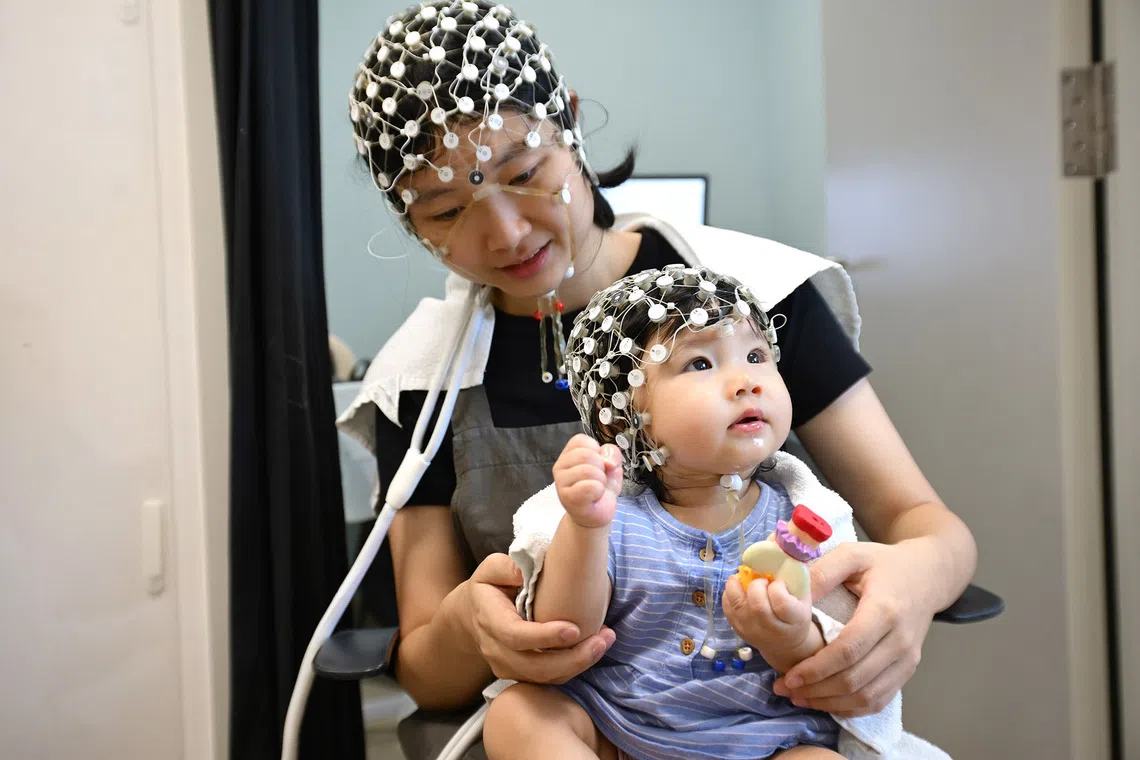
Tan Yin Ling and her baby, eight-month-old Raynera, are taking part in an experiment at NUS Medicine , where their brain activity is detected using the equipment they wear on their heads.
Raynera sits face to face with her mother.
Tan smiles, makes faces and plays peek-a-boo with Raynera.
There is a beautiful rhythm to their interaction, a back-and-forth response that looks almost like a dance.
Then, under the instructions of NUS Medicine clinician scientist Evelyn Law , who is conducting the experiment, Tan turns away briefly.
When she faces her daughter again, she is holding her phone, head down and absorbed in reading an e-mail on her phone.
She does not smile and does not react to anything that Raynera does.
What happens next is most striking.
Within seconds, baby Raynera senses the change.
Puzzled at her mother’s sudden unresponsiveness, she looks around for her father, seeming to seek assurance from someone else.
Not seeing him, she cries, as if protesting that her mum is no longer available to her.
Still, she cannot reclaim her mum’s attention. She becomes more agitated, slumps in her seat and begins to wail.
At this point, Tan softens her facial expression and starts interacting with Raynera again, re-establishing and repairing their connection.
Adapted from a famous experiment from the 1970s, similar ones are being replicated around the world. The results are similar – infants cry when their parents and caregivers turn their attention away from their children to their mobile phones.
This phenomenon is called “technoference”. It is one of the issues being studied by Law, who is an associate professor, and teams of researchers at NUS Medicine and A*STAR as they examine the effects of screens on children.
They are among researchers worldwide looking into the impact of screen exposure on growing children – including their social, emotional and cognitive development at a young age and into their teenage years.
One of the most impactful studies to date by the NUS team led by Law looked inside the brains of babies with varying levels of screen exposure to investigate whether and how it might affect them. The study found differences in the brains of toddlers as young as 18 months of age.
Here are the brain scans of two toddlers who took part in the study, which was published in 2023 in the peer-reviewed medical journal JAMA Pediatrics.
Look closely at the 18-month-olds’ brain scans.
Child A, who has had no screen time, has more blue and green brainwaves, associated with active thinking and focus.
Child B, who has more than four hours of screen time a day, has more orange and red brainwaves, reflecting a more passive and unengaged state.
The colours represent the balance between two types of brainwaves.
Blue and green beta waves are faster brainwaves that are associated with active thinking, focus and executive function.
Orange and red theta waves are slower brainwaves that, when a child is awake, reflect a more passive and unengaged state.
Law said the findings add to the evidence that excessive screen time is linked to differences in brain development and learning in children from a very young age.
Law specialises in developmental and behavioural paediatrics at the NUS Yong Loo Lin School of Medicine and National University Hospital. She is also principal investigator at the A*STAR Institute for Human Potential and Development.
Evelyn Law, an associate professor and clinician scientist from NUS Medicine and National University Hospital, with a flexible cap or “net” equipped with electrodes to detect electrical activity. ST PHOTO: NG SOR LUAN
Evelyn Law, an associate professor and clinician scientist from NUS Medicine and National University Hospital, with a flexible cap or “net” equipped with electrodes to detect electrical activity.
ST PHOTO: NG SOR LUAN
The children are part of the GUSTO (Growing Up in Singapore Towards healthy Outcomes) study, a long-term project that tracks mothers and their children from pregnancy to childhood and adolescence.
When the 500 babies involved in the study were 12 months old, researchers asked the parents how much time their babies spent with screens on weekdays and weekends. The children were then divided into four groups according to their daily screen exposure – less than one hour, one to two hours, two to four hours and more than four hours.
Law explained that researchers included television viewing as part of screen time because a TV is a digital display device that emits light, motion and sound, capturing a toddler’s attention just like a phone or tablet.
In child development research, any time spent watching a video display counts as screen exposure because it replaces active play, human interaction and hands-on learning.
When the same group of children were 18 months old, the researchers used electroencephalograms to study the electrical activity in their brains. The toddlers wore a flexible cap or “net” equipped with electrodes to detect electrical activity.
This revealed that infants with high daily screen time had disproportionately stronger theta waves compared with beta waves when they were awake.
At age nine, the children in the study were assessed again. The aim was to find out whether screen time and the changes observed in their brain activity had impacted them as they grew up .
This time, the researchers used a neuropsychological test, the Nepsy-II, to assess executive function abilities, such as the ability to focus and pay attention, memory and self-control.
Again, the pattern in the earlier findings held. As screen exposure increased, the greater the difficulties with attention and executive functioning.
In one part of the Nepsy test, a child sees a series of black and white arrows that are randomly pointed up and down.
First, the child is asked to state the direction of each arrow .
Then the rules change: An arrow pointing up must be called “down”, and vice versa.
The next level is even harder: The children are asked to state an arrow’s correct direction when it is black and the opposite direction when it is white.
Law explained that this test measures attention, self-monitoring and inhibitory control – how well the brain can adapt when the rules of a task change suddenly, and the ability to override an automatic response and do the opposite.
In one part of the Nepsy-II test, a child initially has to call out the direction of each arrow shown in a series. ST PHOTO: NG SOR LUAN
In one part of the Nepsy-II test, a child initially has to call out the direction of each arrow shown in a series.
These are the same skills that children with executive function deficits struggle with when they have to follow multi-step instructions, control an impulse, persist in a difficult task or manage their impulses or emotions, she said.
These are essential skills for learning and doing well in school, Law added.
Then the rules change. An arrow pointing up must be called “down”, and vice versa.
Law conducting the Nepsy test with a child. The test measures attention, self-monitoring and inhibitory control. ST PHOTO: NG SOR LUAN
Law conducting the Nepsy test with a child. The test measures attention, self-monitoring and inhibitory control.
So what does screen time actually do to the brain?
According to the researchers, one explanation is that the bombardment of fast movements, sounds and scene changes can leave few resources for the brain to build self-regulation skills. This then leads to an inability to follow multi-step instructions or persist in challenging activities.
Law, who is a mother of two children, said the findings of the study made her think of the times she herself had resorted to using the TV or iPad as a babysitting tool.
“I am a parent myself and I know how hard it is to keep screens away from kids. But as the brain scans and Nepsy test results show, it is important for all of us, parents and caregivers, to keep screen time to a minimum.”
The results of the Singapore study are not isolated findings. Research elsewhere in the world has also found possible links between more screen exposure and differences in brain development, cognition and behaviour.
Research carried out at the Cincinnati Children’s Hospital in the United States using brain scans found that higher screen usage among children of pre-school age was associated with “lower integrity” in parts of the brain supporting language and emergent literacy skills.
The Adolescent Brain Cognitive Development Study (ABCD) has similarly found links between high digital media use in youth and structural differences in brain regions tied to visual processing, attention and memory. The parents of the youth also reported more behavioural problems among the youngsters.
ABCD, the largest long-term study of brain development and child health in the US, tracks nearly 12,000 young people starting at ages nine to 10 till early adulthood.
Five-year-old Xavier, who has on a flexible cap or “net” equipped with electrodes, and his mother getting ready for an experiment at NUS Medicine. ST PHOTO: NG SOR LUAN
Five-year-old Xavier, who has on a flexible cap or “net” equipped with electrodes, and his mother getting ready for an experiment at NUS Medicine.
But all is not lost.
Law said that the effects of screen time can be mitigated.
For children under five, Law said parents should seize every opportunity to talk and play with them.
A baby does not need to be able to speak to benefit from conversation.
“Parent talk is one of the most important things you can do with your child to develop their brain,” Law said.
In early child development research, back-and-forth exchanges between a young child and a caring adult are called “serve and return”.
A glance, a pointed finger, a little kick of the legs, making a sound or a facial expression – these are a child’s “serves”, said Law.
When a parent responds by naming what the child sees, does or expresses, the exchange helps build early language and social connections in a developing brain. These serve as a foundation for more complex cognitive abilities that form later in life.
Wong Ken Rhee, Xavier’s father, being readied for the experiment.
Wong and his wife, Mok Sook Fern, coaxing their son to put on the flexible cap equipped with electrodes.
Father and son preparing to read together to show what happens to their brain activity when they are engaged with each other.
“Whether it is playing or reading a book together, the best thing about serve-and-return interactions is that you don’t need any special knowledge or training to do it. It’s just you and your baby or child having fun and responding to each other,” Law said.
She also recommends reading books aloud to babies.
When a father and his young son play and read together, their brain activity, heartbeats and breathing often synchronise, she said, pointing to research done in her lab as well as research led by Alan Mendelsohn, a renowned developmental-behavioural paediatrician at New York University.
Wong and his son Xavier, five, playing and reading together. Research has shown that when parents and young children do such activities together, their brain activity, heartbeats and breathing often synchronise. ST PHOTO: NG SOR LUAN
Wong and his son Xavier, five, playing and reading together. Research has shown that when parents and young children do such activities together, their brain activity, heartbeats and breathing often synchronise.
This shared rhythm calms the child’s developing mind, while the reading itself stimulates the toddler’s frontal lobe and builds crucial neural pathways for language and emotional safety.
Another study using some children from GUSTO, headed by researcher Tan Ai Peng at NUS and A*STAR, showed that parent-child reading at the age of three acts as a critical buffer against the negative neurological impacts of early childhood screen time.
In the study, published in Psychological Medicine in 2024, the team found that infant screen time can alter brain networks that govern emotional regulation, but consistent parent-child reading could counteract some of these brain changes.
This suggests that shared reading may provide the kind of enriched, interactive experience that passive screen consumption lacks, including back-and-forth engagement, language exposure and emotional connection.
Given how crucial the bond between a parent and baby is to a child’s healthy development, and how building this bond requires parents to respond appropriately to their child’s cues, technoference is a huge problem, Law said.
Observational research done by the University of Washington in the US has found that 35 per cent of parents spend about one out of every five minutes of their time – or even more – on their phone while at the playground with their child.
Law talking to baby Raynera’s father, Rodney Chan, while his daughter and wife interact with each other at NUS Medicine. ST PHOTO: NG SOR LUAN
Law talking to baby Raynera’s father, Rodney Chan, while his daughter and wife interact with each other at NUS Medicine.
Babies look to parents and caregivers to learn how to calm down. Occasional phone use by parents is normal, said Law, and not harmful to children, especially when parents know how to re-engage with the baby and repair the connection.
But she cautioned that if those moments of connection are repeatedly interrupted and for long periods of time, there may be fewer opportunities for this kind of co-regulation and social-emotional learning.
“Constant inattentiveness can also lead to higher anxiety or attachment issues in children over time,” she added.
What we have to ask ourselves is this, she said: “Do we need to disconnect to reconnect with our children?”
Brain scan image: NUS Medicine and A*STAR
Produced by: Andy Chen, Sandra Davie, Stephanie Yeow and Yu Sheng Sin
发布时间:2026年9月20日 上午5:00
谭茵玲和她八个月大的女儿雷内拉正在新加坡国立大学医学院参加一项实验,实验中,她们头上佩戴的设备会检测她们的大脑活动。
雷内拉和她的母亲面对面坐着。
Tan 笑着、做鬼脸,还和 Raynera 玩躲猫猫。
他们的互动有一种优美的节奏,一来一往的回应看起来几乎像是一种舞蹈。
然后,在负责进行实验的新加坡国立大学医学院临床科学家 Evelyn Law 的指示下,谭短暂地转过身去。
当她再次面对女儿时,她正低着头,拿着手机,全神贯注地阅读手机上的电子邮件。
她既不微笑,也不对雷纳拉的任何举动做出反应。
接下来发生的事情最令人震惊。
几秒钟之内,小雷内拉就感觉到了变化。
她对母亲突然失去反应感到困惑,四处寻找父亲,似乎想从别人那里寻求安慰。
见不到他,她哭了起来,仿佛在抗议妈妈再也无法陪伴在她身边。
然而,她还是无法重新引起妈妈的注意。她变得更加焦躁不安,瘫坐在椅子上,开始嚎啕大哭。
这时,谭的表情柔和下来,开始再次与雷内拉互动,重新建立并修复了她们之间的关系。
这项实验改编自20世纪70年代的一项著名实验,类似的实验正在世界各地进行。结果相似——当父母或照护者将注意力从孩子身上转移到手机上时,婴儿会哭闹。
这种现象被称为“科技干扰”。这是新加坡国立大学医学院和新加坡科技研究局(A*STAR)的副教授罗教授及其研究团队正在研究的问题之一,他们正在研究屏幕对儿童的影响。
他们是全球范围内研究屏幕接触对儿童成长影响的研究人员之一,这些影响包括儿童在幼年时期以及青少年时期的社交、情感和认知发展。
由罗教授领导的新加坡国立大学团队开展的一项迄今为止最具影响力的研究,深入探究了不同屏幕接触水平的婴儿大脑发育情况,以了解屏幕接触是否以及如何影响他们的大脑。该研究发现,早在18个月大的幼儿大脑就存在差异。
以下是参与这项研究的两名幼儿的脑部扫描图,该研究于 2023 年发表在同行评审的医学期刊《美国医学会杂志儿科学》上。
仔细观察一下这些18个月大婴儿的脑部扫描图。
儿童 A 没有接触过任何电子屏幕,他的脑电波中蓝色和绿色电波较多,这与积极的思考和专注力有关。
儿童 B 每天屏幕使用时间超过 4 小时,脑电波中橙色和红色电波较多,反映出他处于一种更被动、更不投入的状态。
这些颜色代表两种脑电波之间的平衡。
蓝色和绿色β波是较快的脑电波,与积极的思维、专注力和执行功能有关。
橙色和红色θ波是较慢的脑电波,当孩子清醒时,反映出一种更被动、不投入的状态。
劳表示,这些发现进一步证实了屏幕时间过长与儿童从小大脑发育和学习能力的差异有关。
Law女士在新加坡国立大学杨潞琳医学院和新加坡国立大学医院专攻发育和行为儿科学。她同时也是新加坡科技研究局人类潜能与发展研究所的首席研究员。
新加坡国立大学医学院及国立大学医院的副教授兼临床科学家伊芙琳·劳(Evelyn Law)手持一顶带有电极的柔性帽状物或“网”,用于检测人体电活动。(海峡时报摄影:吴淑銮)
来自新加坡国立大学医学院和新加坡国立大学医院的副教授兼临床科学家 Evelyn Law 戴着一个带有电极的柔性帽或“网”,用于检测电活动。
圣徒照片:吴索銮
这些孩子是 GUSTO(在新加坡健康成长)研究项目的一部分,这是一个长期项目,追踪母亲及其子女从怀孕到童年和青春期的成长历程。
研究中的500名婴儿12个月大时,研究人员询问了他们的父母,他们的孩子在工作日和周末使用电子屏幕的时间。然后,根据他们每天使用电子屏幕的时间,将孩子们分为四组:少于1小时、1至2小时、2至4小时和超过4小时。
劳解释说,研究人员将看电视纳入屏幕时间的一部分,因为电视是一种数字显示设备,可以发出光、运动和声音,像手机或平板电脑一样吸引幼儿的注意力。
在儿童发展研究中,任何观看视频的时间都算作屏幕暴露时间,因为它取代了积极的游戏、人际互动和动手学习。
当同一批儿童18个月大时,研究人员使用脑电图来研究他们大脑的电活动。这些幼儿戴着一个带有电极的柔性帽子或“网”,用于检测脑电活动。
研究表明,每天屏幕时间长的婴儿在清醒时,θ波相对于β波的强度明显更高。
研究中的儿童在九岁时再次接受评估。目的是了解屏幕时间以及观察到的大脑活动变化是否对他们的成长产生了影响。
这一次,研究人员使用神经心理学测试 Nepsy-II 来评估执行功能能力,例如集中注意力、记忆力和自控力。
先前的研究结果再次印证了这一规律:随着屏幕使用时间的增加,注意力不集中和执行功能障碍的程度也越来越严重。
在 Nepsy 测试的其中一部分中,孩子会看到一系列随机向上和向下指向的黑白箭头。
首先,要求孩子指出每个箭头的方向。
然后规则就变了:向上指的箭头必须称为“向下”,反之亦然。
下一关更难:要求孩子们指出黑色箭头的正确方向和白色箭头的相反方向。
劳解释说,这项测试衡量的是注意力、自我监控和抑制控制——即当任务规则突然改变时,大脑的适应能力,以及克服自动反应并做出相反行为的能力。
在Nepsy-II测试的其中一个环节,孩子首先需要说出一系列箭头的方向。ST PHOTO:NG SOR LUAN
在 Nepsy-II 测试的其中一部分中,孩子首先需要说出一系列箭头中每个箭头的方向。
她说,这些技能与执行功能缺陷儿童在遵循多步骤指令、控制冲动、坚持完成困难任务或管理自己的冲动或情绪时所面临的困难技能相同。
劳补充说,这些都是学习和在学校取得好成绩所必需的技能。
然后规则就变了。向上指的箭头必须称为“向下”,反之亦然。
劳正在给一个孩子做Nepsy测试。该测试旨在评估注意力、自我监控和抑制控制能力。(海峡时报照片:吴淑銮)
劳正在对一名儿童进行Nepsy测试。该测试旨在测量注意力、自我监控和抑制控制能力。
那么,屏幕时间究竟会对大脑造成什么影响呢?
研究人员认为,一种解释是,频繁接触快速运动、声音和场景变化会耗尽大脑资源,使其无暇发展自我调节能力。这会导致人们无法遵循多步骤指令或坚持完成具有挑战性的活动。
身为两个孩子母亲的劳表示,这项研究的结果让她想起了自己也曾多次使用电视或 iPad 来照看孩子。
“我自己也是一位家长,我知道让孩子远离电子屏幕有多难。但正如脑部扫描和Nepsy测试结果所示,对我们所有人来说,包括家长和监护人,尽量减少孩子的屏幕时间至关重要。”
新加坡的研究结果并非孤例。世界其他地区的研究也发现,屏幕接触时间过长可能与大脑发育、认知和行为方面的差异有关。
美国辛辛那提儿童医院利用脑部扫描进行的研究发现,学龄前儿童屏幕使用时间越长,大脑中负责语言和早期读写能力的某些区域的完整性就越低。
青少年大脑认知发展研究(ABCD)也发现,青少年大量使用数字媒体与大脑中负责视觉处理、注意力和记忆的区域的结构差异之间存在关联。这些青少年的父母也反映,他们的孩子出现了更多行为问题。
ABCD 是美国规模最大的长期脑发育和儿童健康研究,追踪了近 12,000 名青少年从 9 至 10 岁到成年早期的情况。
五岁的泽维尔戴着一个带有电极的柔性帽或“网”,他和母亲正在为在新加坡国立大学医学院进行的一项实验做准备。(海峡时报摄影:黄淑銮)
五岁的泽维尔戴着一个装有电极的柔性帽子或“网”,他的母亲正在为新加坡国立大学医学院的一项实验做准备。
但一切尚未结束。
劳表示,屏幕时间的影响是可以减轻的。
罗先生表示,对于五岁以下的儿童,家长应该抓住每一个机会与他们交谈和玩耍。
婴儿不需要会说话也能从对话中受益。
“父母与孩子交谈是你能为孩子做的最重要的事情之一,这有助于他们大脑发育,”劳说道。
在早期儿童发展研究中,幼儿与照顾他们的成年人之间的来回交流被称为“服务和回应”。
劳说,眼神、指指点点、踢踢腿、发出声音或做个面部表情——这些都是孩子的“发球”。
当父母通过描述孩子所见、所做或所表达的内容来回应时,这种互动有助于在发育中的大脑中建立早期语言和社交联系。这些联系为日后形成更复杂的认知能力奠定了基础。
黄建李(Xavier的父亲)正在为实验做准备。
黄先生和他的妻子莫淑芬哄着他们的儿子戴上带有电极的柔性帽。
父子俩准备一起阅读,以此展示当他们互动时大脑活动的变化。
“无论是一起玩耍还是一起读书,亲子互动最棒的地方在于,你不需要任何特殊知识或训练就能做到。你和你的宝宝或孩子只是在享受乐趣,互相回应,”劳说道。
她还建议给婴儿朗读书籍。
她指出,当父亲和他的小儿子一起玩耍和阅读时,他们的大脑活动、心跳和呼吸经常会同步,并提到了她实验室进行的研究以及纽约大学著名发育行为儿科医生艾伦·门德尔松领导的研究。
黄先生和五岁的儿子泽维尔一起玩耍、读书。研究表明,当父母和幼儿一起进行这类活动时,他们的脑电波、心跳和呼吸往往会同步。海峡时报摄影:吴淑銮
黄先生和五岁的儿子泽维尔一起玩耍、读书。研究表明,当父母和幼儿一起进行这类活动时,他们的大脑活动、心跳和呼吸往往会同步。
这种共同的节奏可以安抚孩子正在发育的心灵,而阅读本身可以刺激幼儿的前额叶,并为语言和情感安全建立重要的神经通路。
另一项由新加坡国立大学和新加坡科技研究局的研究员陈爱萍领导的、以 GUSTO 项目的一些儿童为对象的研究表明,三岁时的亲子共读可以有效缓冲幼儿早期屏幕时间对神经系统造成的负面影响。
该研究发表于 2024 年的《心理医学》杂志上,研究团队发现,婴儿的屏幕时间会改变控制情绪调节的大脑网络,但持续的亲子共读可以抵消其中一些大脑变化。
这表明,共同阅读可以提供被动屏幕消费所缺乏的那种丰富的互动体验,包括来回互动、语言接触和情感联系。
劳表示,鉴于父母与婴儿之间的纽带对孩子的健康成长至关重要,而建立这种纽带又需要父母对孩子的信号做出适当的回应,因此,科技干扰是一个巨大的问题。
美国华盛顿大学的一项观察性研究发现,35% 的父母在带孩子去游乐场玩耍时,每五分钟就有一分钟甚至更多时间花在手机上。
在新加坡国立大学医学院,罗先生与婴儿雷内拉的父亲陈先生交谈,而陈先生的女儿和妻子则在一旁互动。(海峡时报摄影:黄淑銮)
Law 与婴儿 Raynera 的父亲 Rodney Chan 交谈,而他的女儿和妻子则在新加坡国立大学医学院互动。
婴儿会观察父母和照护者,学习如何让自己平静下来。劳表示,父母偶尔使用手机是正常的,对孩子无害,尤其是在父母知道如何重新与婴儿互动并修复彼此关系的情况下。
但她警告说,如果这些联系的时刻反复被打断,并且持续时间很长,那么这种共同调节和社交情感学习的机会可能会减少。
她补充说:“长期注意力不集中也可能导致儿童焦虑加剧或出现依恋问题。”
她说,我们必须扪心自问:“我们是否需要断开与孩子的联系才能重新与他们建立联系?”
脑部扫描图像:新加坡国立大学医学院和新加坡科技研究局
制作人:陈志远、戴维·桑德拉、杨思雯、余胜欣