Central Command’s Kurilla eyes drone-countering lasers for Middle East中央司令部司令库里拉考虑在中东部署无人机反制激光器
At least 31 directed-energy initiatives are underway across the U.S. Department of Defense. Some are more mature than others.
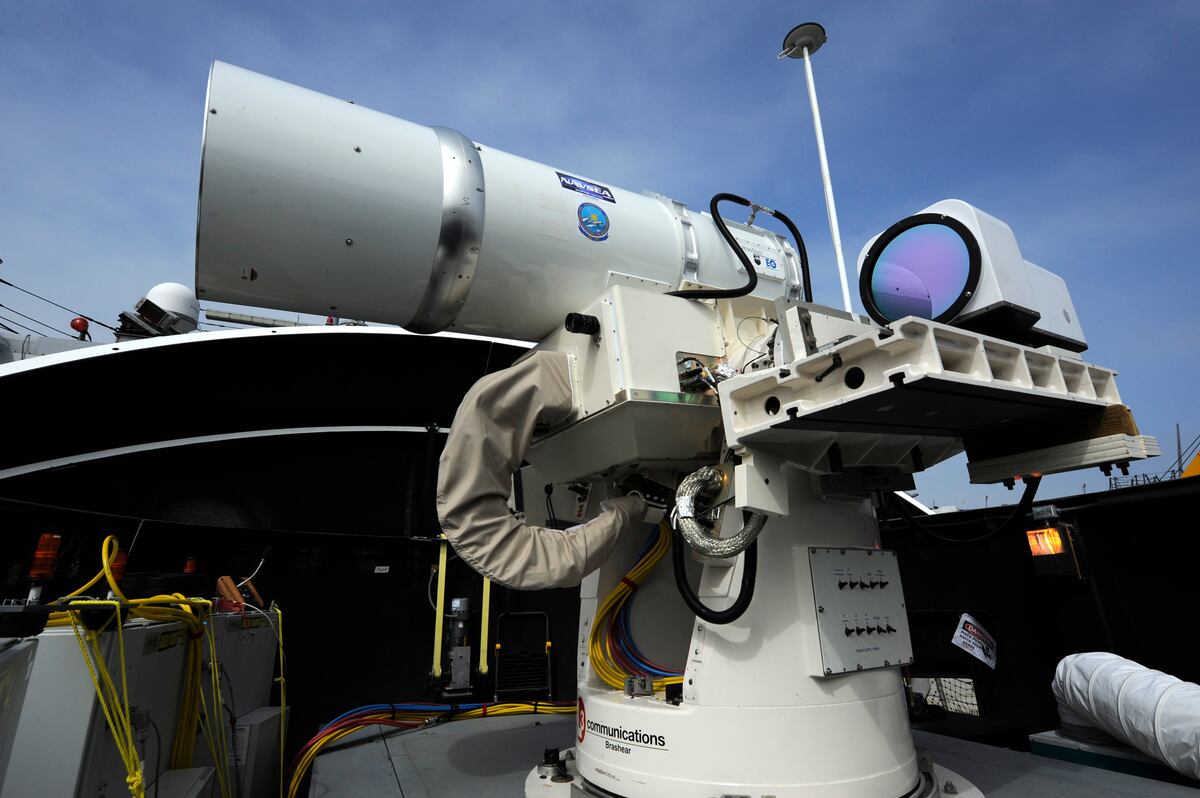
Development and deployment of directed-energy weapons would enhance defense across the Greater Middle East, where Iran-backed militants are targeting U.S. troops with missiles and explosive drones, according to the leader of U.S. Central Command.
Army Gen. Michael Kurilla told lawmakers on March 7 that he would “love” to have the Navy deploy more directed-energy arms capable of downing drones. Having supplemental directed energy on hand, he added, would also mean expending fewer U.S. missiles, which can cost millions of dollars a pop. Iranian drones being funneled to extremist groups can cost thousands of dollars each.
“The bigger concern is if you start talking about swarms. We need to continue to invest in things like high-power microwave to be able to counter a drone swarm that is coming at you,” Kurilla said during the Senate Armed Services Committee hearing in Washington. “Nothing is 100%. At some point the law of statistics will come up. You have to have a layered defense.”
High-energy lasers and microwave weapons are capable of zapping overhead threats in ways dissimilar to traditional munitions and at a fraction of the cost. Lasers can fire at the speed of light and punch holes through material, while microwaves can fry electronics at a distance, rendering tech obsolete. Both are considered a critical element of layered defense, or having multiple countermeasures ready to thwart different threats in different situations.
The Defense Department has for decades pitched money into directed-energy weapons, an average $1 billion annually in the past three years, according to the Government Accountability Office, a federal watchdog.
At least 31 directed-energy initiatives are underway across the department, with some more mature than others. Among them are Lockheed Martin’s High Energy Laser with Integrated Optical-dazzler and Surveillance , or HELIOS, installed aboard the Navy destroyer Preble in 2022, and Epirus’ Leonidas, delivered to the Army in 2023 in furtherance of its Indirect Fire Protection Capability.
Bringing such systems to fruition — let alone mass production — has proven tricky. Aside from their technological complexity, laser- and microwave-based weaponry demand precious components and materials such as germanium and gallium.
Kurilla on Wednesday said the Army “sent us some directed-energy mobile short-range air defense” that are being experimented with. He provided no details about initial results. The service dispatched four Stryker-mounted 50-kilowatt laser prototypes in February, Breaking Defense reported.
Militants across the Greater Middle East have in recent months conducted more than 175 attacks on U.S. and allied forces. A drone strike in Jordan, at the Tower 22 installation near al-Tanf garrison, killed three troops in January. A Houthi missile attack on a commercial ship in the Gulf of Aden this month killed three crew members, as well, and forced an evacuation of the vessel.
“This is not the same central region as last year,” Kurilla said. “Iran’s expansive network of proxies is equipped with advanced, sophisticated weaponry, and threatens some of the most vital terrain in the world with global and U.S. implications.”
Colin Demarest was a reporter at C4ISRNET, where he covered military networks, cyber and IT. Colin had previously covered the Department of Energy and its National Nuclear Security Administration — namely Cold War cleanup and nuclear weapons development — for a daily newspaper in South Carolina. Colin is also an award-winning photographer.
美国中央司令部司令表示,研发和部署定向能武器将加强整个大中东地区的防御,在该地区,伊朗支持的武装分子正使用导弹和爆炸性无人机袭击美军。
陆军上将迈克尔·库里拉3月7日告诉国会议员,他“非常希望”海军部署更多能够击落无人机的定向能武器。他还补充说,拥有额外的定向能武器意味着可以减少美国导弹的消耗,而导弹每次发射的成本可能高达数百万美元。伊朗向极端组织输送的无人机,每架也只需数千美元。
“更令人担忧的是无人机群。我们需要继续投资高功率微波等技术,以便能够应对来袭的无人机群,”库里拉在华盛顿参议院军事委员会的听证会上说。“没有什么是百分之百安全的。统计规律总会在某个时候发挥作用。你必须建立多层防御体系。”
高能激光和微波武器能够以不同于传统弹药的方式,以极低的成本摧毁高空威胁。激光可以以光速发射并穿透材料,而微波则可以远距离烧毁电子设备,使其失效。两者都被认为是多层防御的关键要素,即拥有多种应对措施,以便在不同情况下挫败不同的威胁。
据联邦监督机构政府问责局称,几十年来,国防部一直在定向能武器领域投入资金,过去三年平均每年投入 10 亿美元。
目前,国防部至少有31项定向能武器项目正在进行中,其中一些项目比其他项目更为成熟。其中包括洛克希德·马丁公司的高能激光集成光学眩目和监视系统(HELIOS),该系统于2022年安装在海军驱逐舰“普雷布尔”号上;以及伊庇鲁斯公司的“列奥尼达斯”系统,该系统于2023年交付陆军,以增强其间接火力防护能力。
将此类系统付诸实践——更遑论大规模生产——已被证明十分棘手。除了技术上的复杂性之外,激光和微波武器还需要锗、镓等珍贵部件和材料。
库里拉周三表示,陆军“给我们送来了一些定向能移动式短程防空武器”,目前正在进行试验。他没有透露初步试验结果的细节。据《防务新闻》报道,陆军在二月份向“斯特瑞克”装甲车运送了四套50千瓦的激光原型机。
近几个月来,大中东地区的武装分子对美国及其盟军发动了超过175次袭击。今年1月,在约旦坦夫驻军附近的22号塔楼附近,一架无人机袭击造成三名士兵死亡。本月,胡塞武装向亚丁湾一艘商船发射导弹,同样造成三名船员死亡,并迫使船上人员撤离。
库里拉说:“这里与去年的中部地区已截然不同。伊朗庞大的代理人网络配备了先进的精密武器,对世界上一些最重要的地区构成威胁,其影响遍及全球,甚至波及美国。”
科林·德马雷斯特曾是C4ISRNET的记者,负责报道军事网络、网络安全和信息技术方面的新闻。此前,他曾为南卡罗来纳州的一家日报报道美国能源部及其下属的国家核安全管理局,主要关注冷战后的清理工作和核武器研发。科林还是一位屡获殊荣的摄影师。