B-52s Would Have Nuked Their Way Through Soviet Air Defenses With These MissilesB-52轰炸机如果装备这些导弹,就能突破苏联的防空系统。
The AGM-69 Short Range Attack Missile was a vital, but seldom discussed part of America's airborne deterrent during the last half of the Cold War.
新闻视频
Updated Dec 1, 2019 6:50 AM EST
During the Cold War, it seemed that nuclear warheads were the solution to an alarming number of tactic and strategic challenges. Need to intercept and shoot down formations of nuclear bombers emerging from over the North Pole? Nuclear weapons. Need to sink a naval task force? Nuclear weapons. Need to get your bombers to their targets deep inside enemy territory without being shot down by enemy air defenses? Nuclear weapons, and in this case, Boeing’s AGM-69 Short Range Attack Missile (SRAM), in particular.
Much of this was more to do with limitations of precision guidance and fine-tuned targeting capabilities than anything else. A nuclear warhead has effects that can destroy soft and some fortified targets from the shockwave alone. So, acceptable and effective accuracy could be measured in hundreds or even thousands of feet, not tens of feet or even less as is common today.
SRAM was born in the early 1960s out of the glaring reality that even with nap-of-the-earth flying, America’s bombers were increasingly vulnerable to the Soviet’s ever more capable air defenses. In fact, the requirement for a nuclear-tipped missile capable of taking out enemy air defense sites that could threaten a strategic bomber on its path to its assigned target was already realized in the form of the AGM-28 Hound Dog missile.
B-52 carrying a pair of Hound Dog missiles., USAF
This system entered service in 1960, but it was massive—weighing in at over 10,000lbs and measuring 42 feet long—drastically limiting what type of aircraft could employ it and how many an aircraft could carry at a single time. A better solution was needed for the Air Force to continue to claim its bomber arm of the nuclear triad represented a reliable deterrent.
Enter the AGM-69A SRAM. Entering service in 1972, it weighed in at around 2,200lbs and measured 14 feet in length. It was minuscule compared to the Hound Dog, allowing for large quantities to be stored inside a bomber’s weapons bay. Its primary mission was the destruction of enemy air defenses (DEAD)—to obliterate threatening SAM sites along a bomber’s path—but it was also to be used as a nuclear strike weapon. In this ancillary role, it could vaporize secondary targets as its mothership flew to its primary target set.
SRAM’s range was roughly 50 miles, but could reach out to nearly 100 miles under certain flight profiles. It achieved this using a dual-pulse rocket motor that made it possible for the missile to hit targets behind the launching aircraft and achieve fly-out speeds of up to Mach 3.5. It also had a basic terrain-following feature to add to its own survivability.
Guidance was provided by an onboard inertial navigation unit giving the weapon good enough accuracy—with a circular error probability (CEP) of around 1,400 feet—to deliver its variable yield W69 warhead that could be set from 17kt to 210kt. For comparison, the “Little Boy” nuclear bomb dropped on Hiroshima had a yield of roughly 15kt. The missile was programmed before a mission with its intended target, but it could be reprogrammed in flight as well.
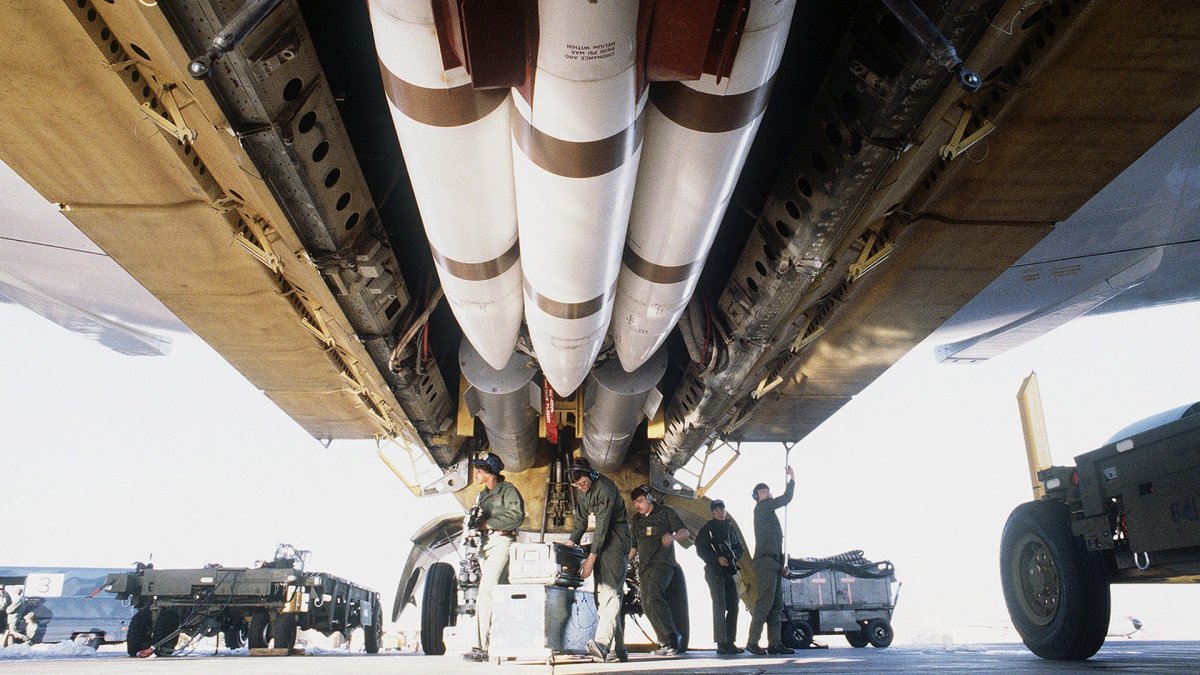
B-52 loaded with SRAMs., USAF
Originally intended for the B-52G and B-52H , SRAM went on to equip the FB-111 and the B-1B. The B-52s could carry up to 20 on its external pylons and in its internal bay. The FB-111 could carry six—two internally and four externally. The B-1B could carry two dozen SRAM—eight each on its three internal rotary launchers.
Eight SRAMs seen on a rotary launcher., Boeing
In reality, a mix of SRAMs and nuclear bombs were to be carried depending on the mission and intended target set. SRAMs would be used by the bombers to blast their way to their primary targets or, later on, to hit strategic targets that were not air defense related at all. This secondary use was especially attractive for vaporizing targets in extremely well-defended airspace.
An inert SRAM being loaded onto an FB-111. , USAF
SRAM was really an amazing invention and one that had a real purpose—helping to keep non-stealthy bombers viable for decades as Soviet air defenses matured. But, in 1982, the introduction of the AGM-86B nuclear-tipped variant of the Air Launched Cruise Missile (ALCM) would allow B-52s—and eventually B-1Bs—to launch nuclear strikes at long standoff ranges, placing them far from threatening air defense sites. Then, with the Cold War winding down towards the end of the decade, the need for SRAM degraded further.
In 1990, then Secretary of Defense Dick Cheney ordered SRAMs taken off all alert bombers . Concerns regarding the warhead’s ability to withstand fires aboard aircraft had become a serious issue. The W69 warheads were not built to the same standards as later designs and a ground fire on an alert bomber that occurred years earlier could have resulted in a massive release of radiation, potentially on a larger scale than Chernobyl, from the flames compromising the shielding around the warhead’s plutonium core if the winds had been blowing in a different direction.
In 1993, the aging stockpile of missiles became an even more pressing concern. Beyond the safety of their warheads, the condition of the SRAM inventory’s rocket motors was called into question. A number of SRAMs were found with cracked propellant sections, likely the result of constant changes in atmospheric temperature over the years. If fired, a cracked motor would likely explode and take the aircraft with it while also scattering nuclear debris and radiation over a huge area. This, along with major reductions in defense spending and America’s nuclear posture, were the final nail in the coffin for SRAM. The weapons were pulled from service in 1993 and destroyed.
SRAMs being loaded into the belly of a B-52., USAF
In the end, roughly 1,500 SRAMs were built, with production ending in 1975. Over the years, a follow-on AGM-69B SRAM was proposed, including one configuration with an upgraded propulsion section and W80 warhead. Other variants that never made it beyond the drawing board included a SRAM outfitted with an anti-radiation seeker to home in on hostile radar sites without programming a specific location into the weapon prior to launch. This weapon was far more reactionary in nature that the AGM-69A and could have effectively deal with ‘pop-up’ threats, but it never came to be. An air-to-air variant was also examined.
A far more robust effort began in the late 1970s to replace SRAM with an upgraded version for the B-1A bomber. When the B-1A was canceled, so was the follow-on SRAM, but once the B-1 was resurrected in B-1B form under the Reagan Administration, development for a new SRAM began again, as well. Dubbed the AGM-131A SRAM II, this weapon was largely a fresh design that featured a new and improved dual-pulse rocket motor. It was also lighter, less complex, and used a purpose-built and more modern W89 nuclear warhead as a payload.
W89 warhead and the SRAM II missile body., DOE/USAF
The program progressed up until 1991. With the fall of the Soviet Union, justifying such a weapon and its costs just wasn’t possible, especially after a number of costly delays in the weapon’s development. The B-1B would lose its nuclear mission in the same decade, underscoring the logic of the decision to end the SRAM II program. In addition, cruise missiles were becoming the delivery method of choice for nuclear bombers and the level of precision of modern air-to-ground weaponry was rapidly increasing, allowing for conventional warheads to take the place of nuclear ones for many applications.
A tactical variant of the SRAM II was also part of the AGM-131 program. This would have equipped F-16s and F-15s that were tasked to deliver tactical nuclear bombs in Europe and the Korean Peninsula. , DoD
Fast forward to today and the SRAM concept is being reborn to a certain degree—albeit not in a nuclear fashion—with the development of standoff missiles uniquely designed to quickly blast enemy air defenses as fighters and bombers press toward their targets. The Advanced Anti-Radiation Guided Missile-Extended Range (AARGM-ER) is now a Navy and Air Force program and will serve as the basis for the USAF’s Stand-In Attack Weapon . Both of these missiles will be capable of internal storage on the F-35A and F-35C. You can bet they will also wind up on the B-21 Raider in the coming decade.
Above all else, the big takeaway here is that USAF bombers were very much set to fight their way to their primary target sets by blasting air defense sites with nuclear weapons along the way. As such, SRAM was a very ineloquent solution to a very real problem facing America’s airborne strategic deterrent before the introduction of highly capable air-launched cruise missiles. SRAM also serves a reminder of just how much destruction a B-52 of the latter Cold War era would have laid down in its wake.
A frightening reality to contemplate indeed.
Contact the author: Tyler@thedrive.com
Comments couldn’t be loaded. Please refresh the page.
更新于美国东部时间2019年12月1日上午6:50
冷战时期,核弹头似乎成了解决众多战术和战略难题的万能钥匙。需要拦截并击落从北极上空起飞的核轰炸机编队?核武器。需要击沉一支海军特遣舰队?核武器。需要让轰炸机深入敌方领空执行任务而不被敌方防空系统击落?核武器,尤其是波音公司的AGM-69短程攻击导弹(SRAM)。
这很大程度上是由于精确制导和精细瞄准能力的局限性造成的,而非其他原因。核弹头的冲击波本身就能摧毁软目标和一些加固目标。因此,可接受且有效的精度可以达到数百甚至数千英尺,而不是像今天这样通常只有几十英尺甚至更小。
SRAM导弹诞生于20世纪60年代初,其根源在于一个显而易见的现实:即使采用超低空飞行技术,美国轰炸机也越来越容易受到苏联日益强大的防空系统的攻击。事实上,当时已经出现了AGM-28“猎犬”导弹,满足了对一种能够摧毁敌方防空设施、威胁战略轰炸机飞行路线的核弹头导弹的需求。
美国空军一架B-52轰炸机,携带两枚“猎犬”导弹。
这套系统于1960年投入使用,但其体积庞大——重达10000磅以上,长42英尺——极大地限制了可使用的飞机类型以及单架飞机一次可搭载的数量。空军需要一种更好的解决方案,才能继续宣称其核三位一体中的轰炸机部队构成了可靠的威慑力量。
AGM-69A SRAM导弹应运而生。它于1972年服役,重约2200磅,长14英尺。与“猎犬”导弹相比,它体积小巧,因此轰炸机的武器舱可以容纳大量该导弹。它的主要任务是摧毁敌方防空系统(DEAD)——即摧毁轰炸机航线上的威胁性地空导弹阵地——但它也可用作核打击武器。在这种辅助任务中,它可以摧毁次要目标,同时其母机飞往主要目标。
SRAM导弹的射程约为50英里,但在特定飞行条件下可达近100英里。它采用双脉冲火箭发动机,使导弹能够击中发射飞机后方的目标,并达到高达3.5马赫的飞行速度。此外,它还具备基本的地形跟踪功能,以增强自身的生存能力。
该武器采用机载惯性导航系统进行制导,精度足够高——圆概率误差(CEP)约为1400英尺——能够投放其可变当量W69弹头,该弹头的当量可在17千吨至210千吨之间设定。作为对比,投掷在广岛的“小男孩”原子弹当量约为15千吨。导弹在执行任务前已预先设定了目标,但也可以在飞行过程中重新编程。
B-52轰炸机装载了SRAM电池,美国空军
SRAM导弹最初是为B-52G和B-52H轰炸机设计的,后来也装备了FB-111和B-1B轰炸机。B-52G和B-52H的外部挂架和内部弹舱最多可携带20枚SRAM导弹。FB-111可携带6枚——内部挂架2枚,外部挂架4枚。B-1B可携带24枚SRAM导弹——其三个内部旋转发射器每个发射器可携带8枚。
波音公司,旋转发射器上发现了八个SRAM。
实际上,根据任务和预定目标,轰炸机将携带SRAM导弹和核弹的混合弹药。轰炸机将使用SRAM导弹炸开通往主要目标的道路,或者在后期用于打击与防空无关的战略目标。这种二次用途对于摧毁防御极其严密空域的目标尤为有效。
一枚惰性SRAM正被装载到FB-111上。(美国空军)
SRAM 确实是一项了不起的发明,而且用途广泛——在苏联防空系统日趋成熟的几十年里,它帮助非隐形轰炸机保持了作战能力。但是,1982 年,AGM-86B 核弹头空射巡航导弹(ALCM)的问世,使得 B-52 轰炸机(以及后来的 B-1B 轰炸机)能够在远距离进行核打击,从而远离威胁性的防空阵地。随后,随着冷战在十年末期逐渐结束,对 SRAM 的需求也进一步降低。
1990年,时任国防部长迪克·切尼下令从所有警戒轰炸机上拆除SRAM(核弹头辐射计)。人们对弹头在飞机上抵御火灾的能力日益担忧。W69型核弹头的制造标准与后来的设计不同,几年前一架警戒轰炸机上的地面火灾,如果当时风向不同,可能会导致大量辐射泄漏,其规模可能超过切尔诺贝利核事故。这是因为火焰会破坏弹头钚芯周围的屏蔽层。
1993年,老化的导弹库存问题变得更加紧迫。除了弹头的安全性之外,SRAM导弹火箭发动机的状况也令人担忧。一些SRAM导弹的推进剂部分被发现出现裂纹,这很可能是多年来大气温度不断变化造成的。如果发射,破裂的发动机很可能会爆炸,不仅会将飞机炸毁,还会将核碎片和辐射散布到大片区域。这种情况,再加上国防开支的大幅削减和美国核态势的调整,最终导致了SRAM导弹的退役。这些武器于1993年退役并被销毁。
美国空军正在将SRAM火箭装入B-52轰炸机的机腹。
最终,大约生产了1500枚SRAM导弹,生产于1975年结束。多年来,曾提出过AGM-69B SRAM的后续改进方案,其中包括一种升级推进系统和W80战斗部的配置。其他一些从未走出图纸的改进型包括:一种配备反辐射导引头的SRAM导弹,无需在发射前预先设定具体位置即可追踪敌方雷达站。这种导弹比AGM-69A更具反应性,能够有效应对突发威胁,但最终未能投入生产。此外,还曾研究过空对空改进型。
20世纪70年代末,一项更为艰巨的计划启动,旨在为B-1A轰炸机研发升级版SRAM导弹以取代现有导弹。B-1A项目取消后,后续的SRAM导弹研发也随之终止。然而,在里根政府时期,B-1轰炸机以B-1B的形式重新投入使用,新型SRAM导弹的研发工作也随之重启。这款被命名为AGM-131A SRAM II的导弹,采用了全新的设计,配备了新型改进的双脉冲火箭发动机。此外,它重量更轻、结构更简单,并使用了专门研制的更先进的W89核弹头作为有效载荷。
W89弹头和SRAM II导弹弹体,美国能源部/美国空军
该项目一直进展到1991年。随着苏联解体,这种武器及其成本的合理性已无法得到认可,尤其是在该武器研发过程中经历了一系列代价高昂的延误之后。B-1B轰炸机在同一时期失去了核打击任务,这更加凸显了终止SRAM II项目的合理性。此外,巡航导弹正逐渐成为核轰炸机的首选运载方式,现代空地武器的精度也在迅速提高,使得常规弹头在许多应用中能够取代核弹头。
SRAM II 的战术改进型也是 AGM-131 项目的一部分。该改进型原本将装备于 F-16 和 F-15 战斗机,用于在欧洲和朝鲜半岛投放战术核弹。
如今,SRAM概念在某种程度上得以复兴——尽管并非以核武器的形式——其核心是研发出一种独特的防区外导弹,旨在战斗机和轰炸机向目标推进时快速摧毁敌方防空系统。先进反辐射导弹增程型(AARGM-ER)目前是海军和空军的联合项目,并将成为美国空军“常备攻击武器”(Stand-In Attack Weapon)的基础。这两种导弹都可内置于F-35A和F-35C战斗机上。可以预见的是,在未来十年内,它们也将装备B-21“突袭者”轰炸机。
最重要的是,这里最重要的启示是,美国空军轰炸机当时完全打算沿途用核武器摧毁防空设施,以此来抵达其主要目标。因此,在高性能空射巡航导弹问世之前,SRAM 方案对于美国空中战略威慑面临的一个非常现实的问题来说,是一个非常笨拙的解决方案。SRAM 方案也提醒我们,一架冷战后期的 B-52 轰炸机所到之处将会造成多么巨大的破坏。
这确实是一个令人不寒而栗的现实。
联系作者:Tyler@thedrive.com
评论加载失败,请刷新页面。