The Forgotten Fireball Made The First Jet-Powered Carrier Landing By Accident“被遗忘的火球”意外完成了首次喷气式飞机航母着陆
Ryan’s mixed-power FR-1 naval fighter was an evolutionary dead-end, but it did make history.
新闻视频
Updated Nov 27, 2020 6:25 PM EST
Nearly 75 years ago, a U.S. Navy pilot was the first to land a jet-powered aircraft on an aircraft carrier, but it wasn’t supposed to happen. The name of the pilot who made that milestone landing, Ensign J. C. “Jake” West, is now little known, as is the aircraft that he was flying, the curious Ryan FR-1 Fireball naval fighter, which had jet and piston engines.
The Fireball was a true oddity with its radial piston engine in the familiar position in the nose, plus a turbojet engine buried in the rear fuselage. The unusual specification was a result of the limitations of early turbine technology. While the turbojet was trusted for a high-speed “boost,” it was not mature enough, and consumed too much fuel, for sustained cruise flight.
Critical carrier landings also required the “insurance” of a trusty piston engine. The first jet engines were not considered responsive enough for a “bolter” — when an aircraft aborts an attempted deck landing after missing the wire, accelerates at full throttle, and takes off again for another attempt.
Ensign West found out the importance of that two-engine insurance policy on November 6, 1945. At the time, he was assigned to the U.S. Navy’s Fighter Squadron 41 (VF-41), the “Firebirds,” which had only begun flying the Fireball the previous month. The squadron’s first task was to conduct carrier trials with the new aircraft aboard the escort carrier USS Wake Island (CVE 65). These carrier qualifications began one day before West’s impromptu jet-powered landing.
On November 6, West was in the landing pattern headed toward the carrier when his Fireball suffered an engine failure. It wasn’t the General Electric J31 turbojet that he lost — the jet had already been shut down, which was the standard procedure for landing — but the Wright R-1820-72W Cyclone piston engine in the fighter’s nose.
An FR-1 Fireball from Fighter Squadron 66 (VF-66), the first operational unit., SAN DIEGO AIR & SPACE MUSEUM ARCHIVES
As the propeller began to windmill in front of him, creating drag, West feathered it to stop it from turning. West now had to make a rapid decision between ditching the FR-1 in the water, bailing out (there was no ejection seat), or attempting to start the jet engine. He chose the last of these options and began the procedure of starting the J31, which required up to around 30 seconds.
The jet engine roared into life and as West climbed, he declared an emergency and carefully managed the throttle to ensure he had sufficient power to get back safely onto the boat. As he ensured he was lined up on the correct approach path, the crew on the deck below set up the barrier net for emergency recovery. The arrester hook caught the last wire before the aircraft ended up in the barrier. West had managed to recover aboard USS Wake Island on jet power alone.
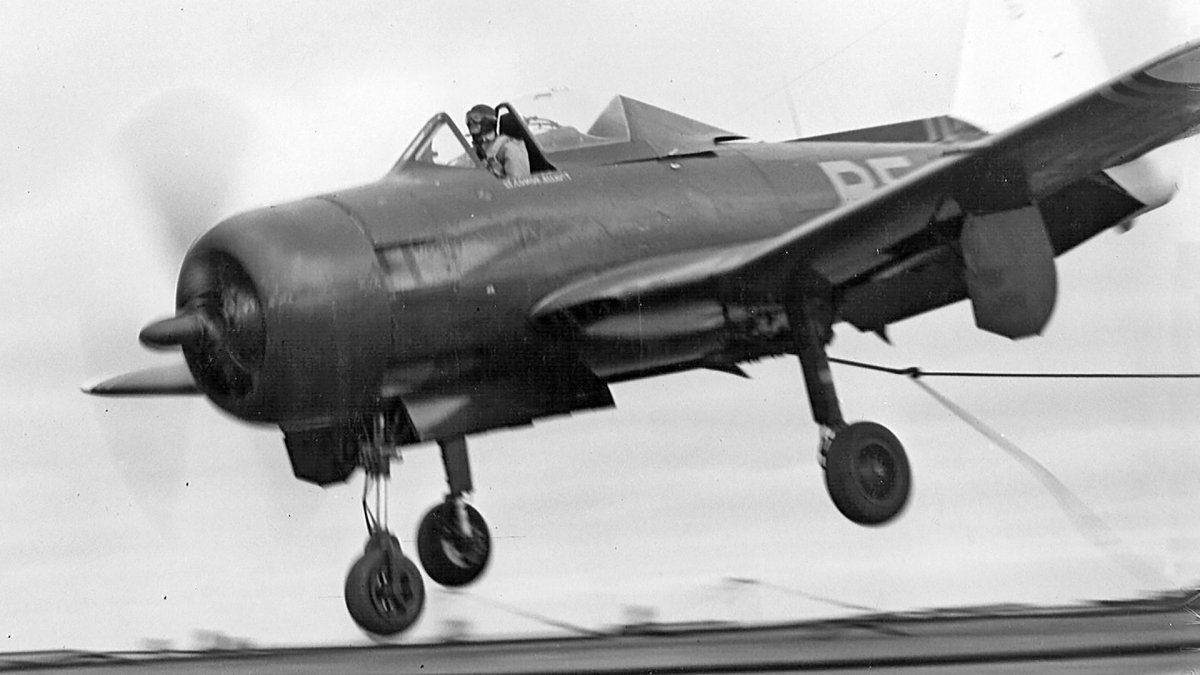
An FR-1 moments before catching the wire., SAN DIEGO AIR & SPACE MUSEUM ARCHIVES
The fact that the FR-1 was a mixed-power aircraft — at least, it was supposed to be — means that West’s debut jet-powered carrier landing is often forgotten. Added to this, only a month after West’s landing, Lieutenant Commander Eric “Winkle’ Brown successfully put a pure-jet de Havilland Vampire fighter onto the deck of the U.K. Royal Navy aircraft carrier HMS Ocean — and this time, it was planned.
Other accounts of West’s landing, including this one by naval historian Norman Polmar, suggest that the Wright Cyclone was still producing at least some power during the landing, although that wouldn’t be possible with the prop feathered.
In his excellent blog , naval aviation historian Matt Willis is also skeptical about whether West recovered aboard the carrier using only turbine power. He points to claims in a book about the Vampire that again reference Norman Polmar, of “residual power in the piston engine.” The same book argues that the Fireball would have struggled to recover “with a dead engine, windmilling propeller, undercarriage, and flaps down” on jet power alone.
Willis points to the 30-second starting procedure for the J31 as being insufficient for the aircraft to remain airborne after the piston engine had cut out. However, other sources explicitly state that West feathered his prop, which would have left no option but to rely on the jet to get back to the carrier.
Whatever the truth, West’s landing was a significant achievement, reflecting the naval aviator’s cool-headed decision-making and flying skills.
Wings folded, a Fireball sits on the wooden deck of an escort carrier. , SAN DIEGO AIR & SPACE MUSEUM ARCHIVES
Much of the rest of the history of the FR-1 Fireball has faded into obscurity, as well. Development of the aircraft began early on in World War II when the U.S. Navy began to identify the potential of the emerging turbojet technology. With the above-mentioned drawbacks of these early turbines in mind, in late 1942 the Navy settled upon a mixed-power carrier-capable fighter before accepting the proposal from Ryan Aeronautical. It was the first time the San Diego, California-based company had built a combat aircraft for the Navy.
In February 1943, Ryan received a contract for three prototype single-seat XFR-1 aircraft and by the end of the same year, orders had been placed for 100 FR-1 production aircraft, too. A first flight was achieved by the initial XFR-1 on June 25, 1944, but without the jet engine installed at that stage. Full mixed-power flying commenced the following month.
The primitive J31 — which was known in-house by General Electric as the I-16 — was the first turbojet engine to see quantity production in the United States. Its origins lay in the General Electric I-A, the first working jet engine in the United States, and which had been developed in turn from the Power Jets W.2B, plans for which had been provided by the United Kingdom. The W.2B was an outgrowth of the Frank Whittle -designed W.1, the first British jet engine to ever power a flying aircraft — the experimental Gloster E.28/39 that made its maiden flight in May 1941.
A flight of Fireballs “intercepts” a Douglas C-54 transport. Note the feathered props on the fighters. , SAN DIEGO AIR & SPACE MUSEUM ARCHIVES
Such were the demands of the war in the Pacific that the Navy eventually ordered another 600 examples. All these were canceled, however, after the end of the war in August 1945, by which time just 66 FR-1s had come out of the factory.
At a time of rapid aeronautical development, the Fireball included several “firsts” for the Navy. It was the service’s first single-engine carrier aircraft with tricycle landing gear, the first to have an entirely flush riveted exterior, and the first carrier aircraft with a low-drag laminar-flow airfoil.
An impressive formation start-up by a line-up of Fireballs assigned to VF-66., SAN DIEGO AIR & SPACE MUSEUM ARCHIVES
As the Navy’s first operational mixed-power carrier aircraft, the FR-1’s powerplant was intended to be fairly straightforward for the pilot to operate. The piston and jet engines used the same fuel and the engine controls allowed the pilot to switch back and forth between piston and jet, using two throttles located side-by-side on the same console. One drawback of having two distinct powerplants was the fact that the air intakes for the jet were in the wing leading edges, reducing the fixed armament to just four Browning 50-caliber machine guns in the center panels of the wings.
All three XFR-1 prototypes were eventually lost in a variety of accidents during tests, but overall the Fireball was judged suitable for frontline service. Moreover, the threat of Japan’s rocket-powered MXY-7 Ohka kamikaze piloted missiles saw FR-1 trials ramped up and the first aircraft were issued to VF-66, the “Firebirds,” in March 1945 for potential service in the Pacific theater.
An overhead view reveals the FR-1’s wide fuselage to accommodate the jet engine, plus the wing leading-edge intakes., SAN DIEGO AIR & SPACE MUSEUM ARCHIVES
The commanding officer of VF-66, Lieutenant Junior Grade (LTJG) “Willie” Schmall’s experiences of flying the FR-1 are presented in Steve Ginter’s book
Ryan FR-1 Fireball and XF2R-1 Darkshark , in which Schmall recalls the Fireball as “a fantastic little airplane. It was smaller and faster than an F6F [Hellcat], and it would maneuver just as quick as a wink. You could slap that stick into the corner of the cockpit and the Ryan would snap right now.” Schmall added: “It could outturn an F6F by far, and it had extremely beautiful visibility compared to other Navy aircraft.”
While a succession of operational units did operate the Fireball, their combat-ready status was strictly limited and they were primarily engaged in qualifying pilots on carriers and further developing procedures for operating first-generation jets.
Fireballs from VF-66 began carrier suitability trials in May 1945, when three examples landed aboard the USS Ranger (CV 4). However, two were damaged on landing (one had a nose wheel collapse, the other hit the crash barrier), bringing the tests to an early end.
A technician signals the thumbs-up from the cockpit of a Fireball., SAN DIEGO AIR & SPACE MUSEUM ARCHIVES
When the war in the Pacific came to an end on August 15, 1945, VF-66 had begun working up, but none of its aircraft had made it to a war zone — an initial operational deployment had been planned for October 1945. That month, the squadron stood down and all of its personnel and aircraft transferred to VF-41.
At this point, the Fireball program was demoted to test status, which revealed that this stopgap fighter was, in many respects, highly impressive. High-speed maneuverability and turning radius were judged excellent, and the FR-1 was more agile than the U.S. Air Force’s P-80 Shooting Star jet fighter at low-level and could out climb it up to 18,000 feet.
VF-41’s time on the carrier — which included “Jake” West’s historic landing — was a little more successful than VF-66’s experience, ending with 14 of the squadron’s 22 pilots qualified, but with many other mishaps experienced too. Above all, the nose gear proved very difficult to master. In March 1946, another round of carrier trials took place when VF-41 went aboard USS Bairoko (CVE 115), and yet more problems, again mainly related to the nose gear, which was still prone to collapse.
The rear-fuselage “power egg” of the FR-1, with the General Electric J31 turbojet installed., SAN DIEGO AIR & SPACE MUSEUM ARCHIVES
In November 1946, VF-41 was redesignated as VF-1E (the “E” suffix denoting assignment to a small-deck escort carrier), and there followed a busy period of carrier qualification on the USS Badoeng Strait (CVE 116). In April 1947, the squadron was aboard the same carrier for anti-submarine exercises, before going aboard the carrier USS Rendova (CVE 114) for a six-day period in June that year. The same month, VF-1E was back on the Badoeng Strait when one of its Fireballs broke in two after a particularly hard three-point landing. After an inspection, it was revealed that the squadron’s aircraft were starting to show structural problems, and the decision was taken to remove the type from frontline service.
Plans for a re-engined FR-2 and FR-3 had been abandoned after the end of the war, but the XFR-4 with a more powerful Westinghouse J34 jet engine did advance to flight testing. There was also the more ambitious XF2R-1 Darkshark, an FR-1 modified with a General Electric TG-100 turboprop in the nose, with the J31 retained in the tail, and first flown in November 1946. Although a turboprop/jet-engine XF2R-2 variant even briefly attracted the interest of the U.S. Air Force, the era of the American mixed-power fighter was destined to be brief, ending when VF-1E gave up its aircraft in August 1947.
The XF2R-1 Darkshark was the Navy’s first combat aircraft with turboprop propulsion (and also retained its rear-fuselage turbojet)., U.S. NAVY
The Navy’s first exclusively jet-powered carrier fighter, the McDonnell FH-1 Phantom (not to be confused with its much more successful namesake ), had first flown in prototype XFD-1 form in January 1945. An example launched from and then touched down on the carrier USS Franklin D. Roosevelt (CVB 42), on July 21, 1946. This was the first takeoff and landing of a jet-powered aircraft from a U.S. Navy aircraft carrier and proved the potential of pure-jet carrier operations.
Still, almost 75 years on, the Ryan Fireball — and Ensign J. C. “Jake” West — deserve to be remembered for their valuable contributions in the pioneering days of jet-powered carrier aviation.
Contact the author: thomas@thedrive.com
Comments couldn’t be loaded. Please refresh the page.
更新于美国东部时间2020年11月27日下午6:25。
近75年前,一位美国海军飞行员首次驾驶喷气式飞机降落在航空母舰上,但这原本并非计划之内的事情。完成这一里程碑式着陆的飞行员,少尉JC·“杰克”·韦斯特,如今鲜为人知,他驾驶的飞机——那架奇特的瑞安FR-1“火球”舰载战斗机——也同样鲜为人知,这架飞机同时配备了喷气式和活塞式发动机。
“火球”战斗机是一款真正的奇特机型,它采用的是位于机头的径向活塞发动机,以及隐藏在后机身内的涡轮喷气发动机。这种不寻常的配置源于早期涡轮技术的局限性。虽然涡轮喷气发动机能够提供高速“增压”,但对于持续巡航飞行而言,它还不够成熟,而且油耗过高。
关键的航母着舰也需要可靠的活塞式发动机作为“保险”。早期的喷气式发动机响应速度不够快,无法应对“脱钩”——即飞机在尝试着舰失败后,加速至全油门,再次起飞进行下一次尝试。
1945年11月6日,少尉韦斯特亲身体会到了双引擎“保险”的重要性。当时,他隶属于美国海军第41战斗机中队(VF-41),绰号“火鸟”,该中队上个月才开始装备“火球”战斗机。中队的首要任务是在护航航母“威克岛”号(CVE 65)上进行新飞机的舰载机试飞。就在韦斯特驾驶喷气式飞机进行即兴着陆的前一天,这些舰载机资格认证测试开始了。
11月6日,韦斯特驾驶的“火球”战斗机在飞往航母的着陆航线上发生发动机故障。他失去的不是通用电气J31涡轮喷气发动机——这台发动机当时已经关闭,这是标准的着陆程序——而是战斗机机头的莱特R-1820-72W“旋风”活塞发动机。
一架来自第66战斗机中队(VF-66)的FR-1“火球”战斗机,该中队是第一个投入作战的部队。(圣地亚哥航空航天博物馆档案馆藏)
当螺旋桨开始在他面前空转,产生阻力时,韦斯特迅速调整桨叶角度,使其停止转动。此时,韦斯特必须迅速做出决定:要么让FR-1迫降在水面上,要么跳伞逃生(飞机上没有弹射座椅),要么尝试启动喷气发动机。他选择了最后一个选项,并开始启动J31发动机,这个过程大约需要30秒。
喷气发动机轰鸣启动,韦斯特在爬升过程中宣布进入紧急状态,并小心翼翼地控制油门,确保有足够的动力安全返回舰艇。当他确认飞机对准正确的进场航线时,下层甲板上的船员架设了紧急回收网。在飞机落入网中之前,阻拦钩钩住了最后一根钢索。韦斯特仅凭喷气发动机的动力就成功返回了“威克岛”号航空母舰。
一架FR-1飞机在钩住电线前的瞬间。(圣地亚哥航空航天博物馆档案馆)
FR-1 是一款混合动力飞机——至少理论上是这样——这一事实意味着韦斯特首次驾驶喷气式飞机在航母上着舰的壮举常常被人遗忘。此外,就在韦斯特着舰一个月后,海军中校埃里克·“温克尔”·布朗成功地驾驶一架纯喷气式德哈维兰“吸血鬼”战斗机降落在英国皇家海军“海洋”号航空母舰的甲板上——而且这一次,它是经过精心策划的。
其他关于韦斯特登陆的记载,包括海军历史学家诺曼·波尔马的记载,都表明莱特旋风发动机在登陆时仍然至少产生了一些动力,尽管螺旋桨处于顺桨状态时这是不可能的。
海军航空史学家马特·威利斯在其精彩的博客中也对韦斯特是否仅靠涡轮动力在航母上成功脱险表示怀疑。他引用了一本关于“吸血鬼”战斗机的书中的说法,该书再次援引了诺曼·波尔马的观点,即“活塞发动机仍有残余动力”。同一本书还指出,“火球”战斗机在“发动机失效、螺旋桨空转、起落架和襟翼放下”的情况下,仅靠喷气动力难以脱险。
威利斯指出,J31发动机30秒的启动程序不足以让飞机在活塞发动机熄火后继续飞行。然而,其他消息来源明确表示,韦斯特当时已经将螺旋桨桨叶调至顺桨状态,这意味着他别无选择,只能依靠喷气式发动机返回航母。
无论真相如何,韦斯特的着陆都是一项重大成就,体现了这位海军飞行员冷静的决策能力和飞行技能。
机翼收拢,一架火球战斗机静静地停放在护航航母的木质甲板上。(圣地亚哥航空航天博物馆档案馆)
FR-1“火球”战斗机的其他大部分历史也已湮没在历史长河中。该机的研发始于二战初期,当时美国海军开始意识到新兴的涡轮喷气发动机技术的潜力。考虑到早期涡轮发动机的上述缺点,海军在1942年末决定研发一种多动力舰载战斗机,最终接受了瑞安航空的方案。这是这家位于加利福尼亚州圣地亚哥的公司首次为海军制造战斗机。
1943年2月,瑞安公司获得三架单座XFR-1原型机的合同;同年年底,100架FR-1量产型飞机的订单也已下达。首架XFR-1于1944年6月25日首飞,但当时尚未安装喷气发动机。次月,该机开始进行全动力混合飞行测试。
早期的J31发动机——通用电气内部称之为I-16——是美国第一款实现批量生产的涡轮喷气发动机。它的前身是通用电气IA发动机,后者是美国第一款投入使用的喷气发动机,而IA发动机又是在英国提供的Power Jets W.2B发动机设计图纸的基础上发展而来。W.2B发动机又是弗兰克·惠特尔设计的W.1发动机的衍生产品,W.1发动机是英国第一款用于飞行器(即1941年5月首飞的实验型格洛斯特E.28/39飞机)的喷气发动机。
一队“火球”战斗机“拦截”了一架道格拉斯C-54运输机。请注意战斗机的桨叶状螺旋桨。,圣地亚哥航空航天博物馆档案馆
由于太平洋战争的需求如此之大,海军最终又订购了600架。然而,所有这些订单在1945年8月战争结束后都被取消了,到那时,工厂只生产了66架FR-1。
在航空技术飞速发展的时代,“火球”战斗机为海军创造了多项“第一”。它是海军第一架采用前三点式起落架的单引擎舰载机,第一架采用全铆接式外壳的飞机,也是第一架采用低阻力层流翼型的舰载机。
圣地亚哥航空航天博物馆档案馆藏品:VF-66中队的一队“火球”战斗机进行了一次令人印象深刻的编队起降。
作为海军首款投入使用的混合动力舰载机,FR-1的动力装置设计得相当简单易用,方便飞行员操作。活塞式发动机和喷气式发动机使用相同的燃料,飞行员可以通过位于同一控制台并排的两个油门在活塞式和喷气式发动机之间切换。采用两种独立动力装置的一个缺点是,喷气式发动机的进气口位于机翼前缘,导致固定武器数量减少,仅在机翼中央翼段安装了四挺勃朗宁50口径机枪。
三架XFR-1原型机最终都在测试过程中因各种事故损失,但总体而言,“火球”战斗机被认为适合一线作战。此外,由于日本MXY-7“樱花”火箭动力神风特攻队导弹的威胁,FR-1的试验力度加大,首批飞机于1945年3月交付给VF-66“火鸟”中队,以备在太平洋战场服役。
从上方俯视图可以看出FR-1宽大的机身是为了容纳喷气式发动机,以及机翼前缘的进气口。(圣地亚哥航空航天博物馆档案馆)
史蒂夫·金特的书中介绍了VF-66中队指挥官“威利”·施马尔少尉驾驶FR-1的经历。
施莫尔回忆起瑞安FR-1“火球”和XF2R-1“暗鲨”时,称“火球”是“一架非常棒的小飞机。它比F6F(地狱猫)更小更快,机动性也极其出色。你只需轻轻一拉操纵杆,瑞安就能立刻做出反应。”施莫尔补充道:“它的转弯性能远胜F6F,而且与其他海军飞机相比,它的视野也极其开阔。”
虽然一些作战部队确实操作过“火球”战斗机,但它们的作战准备状态受到严格限制,它们主要从事在航母上对飞行员进行资格认证以及进一步制定第一代喷气式飞机的操作程序。
VF-66中队的“火球”战斗机于1945年5月开始进行航母适航性试验,当时三架飞机降落在“游骑兵”号航空母舰(CV 4)上。然而,其中两架在着陆时受损(一架前轮折断,另一架撞上防撞墙),导致试验提前结束。
一名技术人员在“火球”战斗机的驾驶舱内竖起大拇指。(圣地亚哥航空航天博物馆档案馆)
1945 年 8 月 15 日太平洋战争结束时,VF-66 中队已经开始进行训练,但其所有飞机都未能抵达战区——原计划于 1945 年 10 月进行首次作战部署。当月,该中队解散,所有人员和飞机都转移到了 VF-41 中队。
此时,“火球”计划被降级为测试阶段,测试结果表明,这款过渡型战斗机在许多方面都表现出色。其高速机动性和转弯半径均被评为优秀,FR-1在低空飞行时比美国空军的P-80“流星”喷气式战斗机更加灵活,爬升高度也超过后者,最高可达18000英尺。
VF-41中队在航母上的训练——包括“杰克”·韦斯特的历史性着陆——比VF-66中队的经历略微成功一些,该中队22名飞行员中有14人获得了飞行资格,但也经历了许多其他事故。其中最主要的问题是,前起落架的操控非常困难。1946年3月,VF-41中队再次登上“拜罗科”号航空母舰(CVE 115)进行航母训练,结果又出现了更多问题,主要还是与前起落架有关,它仍然容易发生故障。
FR-1的后机身“动力蛋”,安装了通用电气J31涡轮喷气发动机。(圣地亚哥航空航天博物馆档案馆)
1946年11月,VF-41中队被重新命名为VF-1E中队(“E”后缀表示被分配到小型护航航母上),随后在“巴东海峡”号航空母舰(CVE 116)上进行了繁忙的航母资格认证训练。1947年4月,该中队再次在该航母上进行反潜演习,之后于同年6月在“伦多瓦”号航空母舰(CVE 114)上进行了为期六天的训练。同月,VF-1E中队返回“巴东海峡”号航母时,一架“火球”战斗机在一次特别猛烈的三点着陆后断成两截。经检查发现,该中队的飞机开始出现结构性问题,因此决定将该机型从一线部队撤出。
二战结束后,FR-2和FR-3的发动机改装计划被搁置,但搭载更强劲的西屋J34喷气发动机的XFR-4却进入了飞行测试阶段。此外,还有更具雄心的XF2R-1“暗鲨”,它是在FR-1的基础上改装而成,机头安装了通用电气TG-100涡轮螺旋桨发动机,尾部则保留了J31发动机,并于1946年11月首飞。尽管涡轮螺旋桨/喷气发动机的XF2R-2改型曾短暂地引起美国空军的兴趣,但美国混合动力战斗机的时代注定短暂,随着VF-1E中队于1947年8月退役而告终。
XF2R-1“暗鲨”是美国海军第一款采用涡轮螺旋桨推进的战斗机(同时保留了后机身涡轮喷气发动机)。
美国海军第一款纯喷气式舰载战斗机——麦克唐纳FH-1“鬼怪”(不要与它更为成功的同名战机混淆)——于1945年1月以原型机XFD-1的形式首飞。1946年7月21日,一架原型机从“富兰克林·罗斯福”号航空母舰(CVB 42)上起飞并降落。这是美国海军喷气式飞机首次从航空母舰上起降,证明了纯喷气式舰载机作战的潜力。
时至今日,近 75 年过去了,“瑞安火球”号飞机和少尉 JC“杰克”韦斯特仍然值得人们铭记,因为他们在喷气式航母航空的开拓时期做出了宝贵的贡献。
联系作者:thomas@thedrive.com
评论加载失败,请刷新页面。