When condo defects emerge years later, who pays?多年后,当公寓出现缺陷时,谁来承担费用?
Learn about the challenges of condo defects, legal limits, and who bears repair costs when developers or contractors are insolvent or disputes drag on. Read more at straitstimes.com.
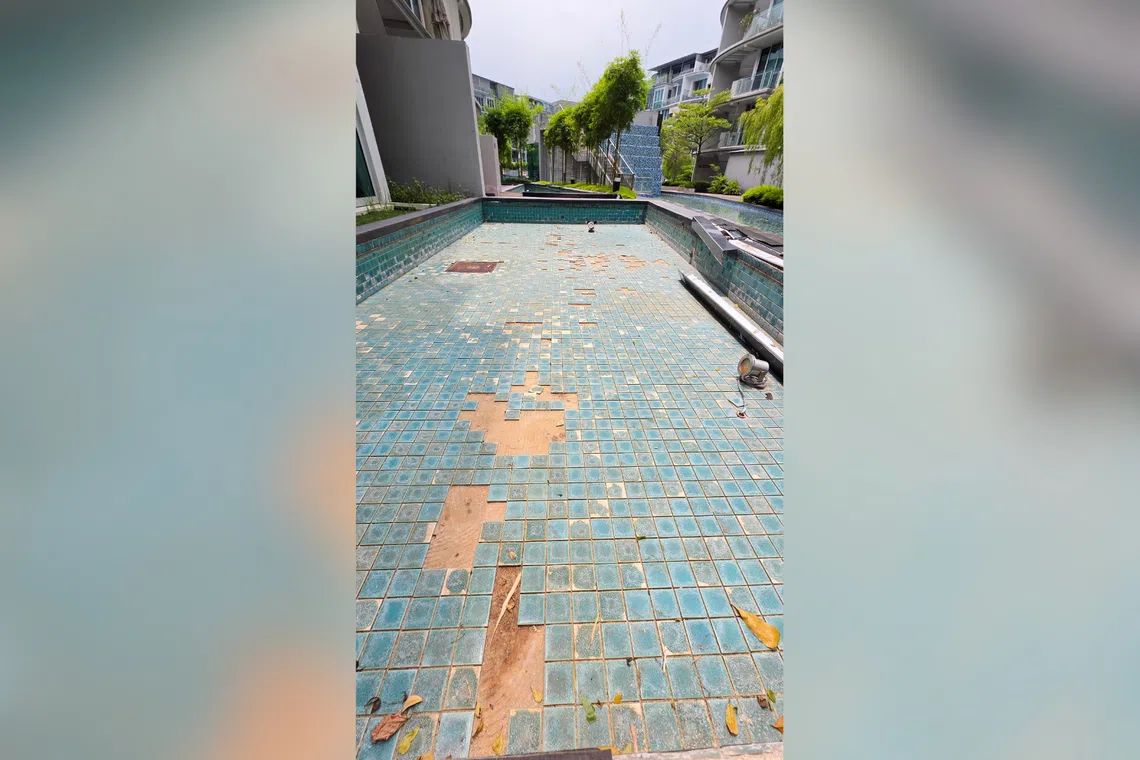
The management corporation of Canberra Residences in Sembawang alleges that some defects remain unresolved despite a settlement agreement reached in 2020 to carry out rectification works.
Published Sep 21, 2026, 05:00 AM
Updated Sep 21, 2026, 05:00 AM
SINGAPORE – A cracked facade, water seeping through the walls or loose concrete may seem like a straightforward building defect. But when such problems emerge years after a condominium was built, it may be difficult to determine who is responsible for fixing them and who should pay.
Disputes can turn into a blame game between developers, architects, engineers, contractors and sub-contractors.
Making matters worse, developers often create separate companies for individual projects and shut them down soon after completion.
This can leave the condos’ management corporations (MCSTs) with no one to sue, potentially saddling them with huge repair bills.
The Straits Times recently reported on lawsuits filed by the MCSTs of Foresque Residences and Canberra Residences over alleged defects.
At Foresque Residences, the alleged problem surfaced about 1 0 years after the development in Petir Road was completed.
In February 2025, a cement-based patch detached from the underside of a unit’s balcony and fell about 20m. An engineer engaged by the MCST later identified 88 balconies in one block as being affected by an alleged defect.
The condo’s developer, architect, structural engineer, railing engineer and sub-contractor said the alleged problem was not their responsibility or had not been proven.
The developer, Wincheer, argued that the claims were brought too late, while the main contractor, Tiong Aik Construction, is undergoing creditors’ voluntary winding-up.
At Canberra Residences in Sembawang, the situation is different. Problems were reported in 2013 soon after residents moved in, and a settlement agreement was reached in 2020 to carry out rectification works.
But its MCST is now back in court, alleging that some of the problems remain unresolved. The main contractor, MCC Engineering, disputes this.
Among the problems that the MCST said residents are still grappling with are water seepage, ponding at lift lobbies and basement areas, defective paintwork and shattered balcony glass panels.
Both lawsuits show that building disputes can remain unresolved long after a condominium has been completed.
In both cases, the cause of the alleged problems and the party that should be responsible are being contested.
A dispute becomes even more complicated when the companies involved in the original construction no longer exist.
At Waterwoods executive condominium in Punggol, residents began discovering defects, including water seepage and cracks in external walls, from around 2019.
The condominium, which obtained its temporary occupation permit in 2015, was a joint development by Sing Holdings and UE E&C. Coral Edge Development was incorporated in 2013 to develop the condo.
The defects emerged as Coral Edge Development was being wound up, and it was dissolved in 2020. The main contractor, Greatearth Corporation, became insolvent in 2021.
In 2021, the Waterwoods MCST, represented by lawyer Daniel Tay, head of building and construction at BR Law Corporation, applied to the High Court to have the developer’s dissolution declared void so that it could bring proceedings over the defects.
It sought to recover about $3.9 million to cover rectification works.
However, the High Court dismissed the application. In its grounds of decision published in 2022, the court said it was “pointless” to restore the developer as it no longer had assets available to meet the MCST’s intended claim.
The three cases illustrate why time could work against home owners. A defect may emerge late or a dispute may drag on for years. In Waterwoods’ case, where owners believe they have a legitimate claim over defects, there is no viable company left from which to seek compensation.
Tay said it is common for larger developers to set up a subsidiary company to develop a project. This company would be wound up after the project is completed and its liabilities settled.
As the subsidiary is a separate entity, claimants will not be able to pursue the parent company for liabilities once its subsidiary has been wound up.
Generally, MCSTs would then have to bear the costs – with the bill ultimately falling on home owners – or pursue claims with sub-contractors responsible for the defects.
The first line of protection for home buyers is usually the one-year defects liability period, which starts when the buyers take possession of their homes.
During this period, they can report defects to the developer, which will carry out rectification works.
After that, the legal time limits under the Limitation Act become increasingly important.
Daniel Chen, a partner at law firm Lee & Lee who specialises in MCST disputes, said claims based on contract or tort are generally subject to a six-year limitation period from when the right to sue arises.
But latent defects – problems that existed but were not discovered earlier – are treated differently once the six-year limitation period has passed.
A shattered balcony glass panel at a penthouse unit in Canberra Residences. The balcony glass had reportedly been replaced twice, and earlier in 2026, a third panel shattered. ST PHOTO: JOYCE LIM
A shattered balcony glass panel at a penthouse unit in Canberra Residences. The balcony glass had reportedly been replaced twice, and earlier in 2026, a third panel shattered.
Chen said an MCST may still bring a claim in tort within three years of discovering a latent defect, subject to a long-stop date of 15 years from the completion of the condominium .
Once 15 years have passed, Chen said an MCST would no longer be able to use the latent-defect exception to claim against the developer, main contractor and sub-contractors for the defects.
Some warranties given by contractors or sub-contractors and later assigned to an MCST may also remain enforceable while they are still in force, he added.
However, defect claims can be technical and time-consuming.
“They will usually take a year or two to conclude, even by settlement. If they proceed to trial, even longer,” said Chen.
In cases where responsibility is clear, disputes are often settled through mediation to avoid going to trial.
What home owners can do
For home owners, the key is to act early.
The legal deadline and the risk that a company may be wound up could complicate recovery.
Problems should be documented and investigated as early as possible.
Many home owners today engage surveyors to inspect their new homes after collecting their keys. Such inspections can help identify defects early so that they can seek rectification from the developer.
But such inspections are limited to individual units and some defects in the common areas may remain hidden for years.
Tay suggested that the insurance industry could consider offering retail coverage against latent defects that emerge years later.
This could give MCSTs and home owners another source of compensation as a fail-safe if the company responsible becomes insolvent.
The idea would be to spread the risk through insurance, rather than leave individual owners or an MCST to bear the full cost when there is no longer a viable developer or contractor to pursue.
The cases show that discovering a defect is only the start. Establishing responsibility can be time-consuming. Even a successful claim may not lead to full recovery.
The longer a problem remains unresolved, the fewer options home owners have to recover their losses.
Redas/Real Estate Developer Association of Singapore
Residential property
三巴旺的堪培拉公寓管理公司声称,尽管在 2020 年达成了一项和解协议,要求进行整改工作,但一些缺陷仍然没有得到解决。
发布于 2026 年 9 月 21 日上午 5:00
更新于2026年9月21日凌晨5:00
新加坡——外墙开裂、墙体渗水或混凝土松动看似是常见的建筑缺陷。但如果这些问题在公寓建成多年后才出现,就很难确定谁应该负责维修以及谁应该支付费用。
纠纷可能会演变成开发商、建筑师、工程师、承包商和分包商之间的互相指责。
更糟糕的是,开发商经常为单个项目创建单独的公司,并在项目完成后不久就关闭这些公司。
这可能导致公寓管理公司 (MCST) 找不到人起诉,并可能因此背负巨额维修费用。
《海峡时报》最近报道了 Foresque Residences 和 Canberra Residences 的业主委员会就所谓的缺陷提起的诉讼。
在 Foresque Residences,据称该问题是在 Petir Road 的开发项目竣工约 10 年后才出现的。
2025年2月,某单元阳台下方的水泥补丁脱落,坠落约20米。市政公司聘请的工程师后来发现,一栋楼的88个阳台都受到了疑似缺陷的影响。
该公寓的开发商、建筑师、结构工程师、栏杆工程师和分包商均表示,所谓的问题并非他们的责任,或者尚未得到证实。
开发商 Wincheer 辩称这些索赔提出得太晚了,而总承包商 Tiong Aik Construction 正在进行债权人自愿清算。
位于三巴旺的堪培拉公寓的情况则有所不同。居民入住后不久,即在2013年,就出现了问题,并在2020年达成了一项和解协议,以进行整改工作。
但其MCST公司现在再次提起诉讼,声称部分问题仍未解决。总承包商MCC工程公司对此提出异议。
MCST 表示,居民们仍在努力解决的问题包括渗水、电梯厅和地下室积水、油漆缺陷和阳台玻璃面板破碎。
这两起诉讼表明,即使公寓楼竣工很久之后,建筑纠纷仍可能得不到解决。
在这两起案件中,所指控问题的起因和责任方都存在争议。
当参与最初建设的公司已经不复存在时,纠纷就会变得更加复杂。
榜鹅 Waterwoods 执行共管公寓的居民从 2019 年左右开始发现缺陷,包括渗水和外墙裂缝。
该公寓于 2015 年获得临时入住许可证,由 Sing Holdings 和 UE E&C 联合开发。Coral Edge Development 于 2013 年成立,负责开发该公寓。
这些缺陷是在 Coral Edge Development 公司解散时暴露出来的,该公司于 2020 年解散。主要承包商 Greatearth Corporation 于 2021 年破产。
2021 年,Waterwoods MCST 由 BR 律师事务所建筑与施工主管 Daniel Tay 律师代表,向高等法院申请宣布开发商的解散无效,以便就缺陷提起诉讼。
它试图追回约 390 万美元,用于支付整改工程费用。
然而,高等法院驳回了该申请。法院在2022年公布的判决理由中表示,恢复开发商的权益“毫无意义”,因为该开发商已无力支付MCST提出的索赔金额。
这三个案例说明了时间为何可能对房主不利。房屋缺陷可能在后期才显现,或者纠纷可能持续数年。在沃特伍兹的案例中,尽管房主认为自己对房屋缺陷拥有合法索赔权,但最终却找不到任何一家可以胜任赔偿的公司。
Tay表示,大型开发商通常会设立子公司来开发项目。项目完成后,子公司会解散,所有债务也会偿清。
由于子公司是独立的实体,一旦子公司解散,索赔人将无法向母公司追究债务。
通常情况下,MCST 需要承担这些费用——最终账单会落到房主身上——或者向造成缺陷的分包商提出索赔。
购房者的第一道防线通常是一年的缺陷责任期,该责任期从购房者接收房屋之日起算。
在此期间,他们可以向开发商报告缺陷,开发商将进行整改工作。
此后,《时效法》规定的法律时效限制变得越来越重要。
专门处理 MCST 纠纷的 Lee & Lee 律师事务所合伙人 Daniel Chen 表示,基于合同或侵权行为的索赔通常受六年诉讼时效的限制,从诉讼权利产生之日起算。
但是,潜在缺陷——即之前存在但未被发现的问题——在六年诉讼时效期过后,将采取不同的处理方式。
堪培拉公寓顶层公寓阳台玻璃破碎。据报道,该阳台玻璃曾更换过两次,2026年初,第三块玻璃也曾破碎。(海峡时报摄影:JOYCE LIM)
堪培拉公寓顶层一间公寓的阳台玻璃面板破碎。据报道,该阳台玻璃曾更换过两次,2026年初,第三块玻璃面板也曾破碎。
陈先生表示,业主仍可在发现潜在缺陷后的三年内提起侵权诉讼,但诉讼时效最长为公寓竣工后 15 年。
陈先生表示,一旦15年过去,MCST将不再能够利用潜在缺陷例外条款向开发商、总承包商和分包商索赔缺陷。
他还补充说,承包商或分包商提供的一些担保,即使后来转让给了 MCST,只要这些担保仍然有效,也可能仍然具有强制执行力。
然而,缺陷索赔可能涉及技术性问题,而且耗时较长。
“即使是和解,这类案件通常也需要一到两年才能结案。如果进入审判阶段,时间会更长,”陈说。
在责任明确的情况下,纠纷通常会通过调解解决,以避免诉讼。
房主可以做什么
对于房主来说,关键在于尽早采取行动。
法律规定的最后期限以及公司可能被清算的风险可能会使追偿变得复杂。
问题应尽早记录并调查。
如今,许多房主在拿到新房钥匙后,都会聘请验房师进行房屋检查。这样的检查有助于及早发现房屋缺陷,以便他们能够向开发商提出整改要求。
但此类检查仅限于单个单元,公共区域的一些缺陷可能多年都无法发现。
Tay建议保险业可以考虑提供零售保险,以应对多年后出现的潜在缺陷。
如果负责的公司破产,这可以为 MCST 和房主提供另一种补偿来源作为保障。
这样做的目的是通过保险来分散风险,而不是在没有可行的开发商或承包商的情况下,让单个业主或 MCST 承担全部费用。
这些案例表明,发现缺陷仅仅是开始。确定责任方可能非常耗时。即使索赔成功,也未必能获得全额赔偿。
问题拖得越久,房主挽回损失的选择就越少。
新加坡房地产发展商协会
住宅物业