King Tut’s Mysterious Black Dagger Was Truly out of This World图坦卡蒙国王那把神秘的黑色匕首,真是非同凡响。
Ok internet, bring on the Ancient Aliens memes.
Updated Jul 2, 2020 2:52 PM EDT
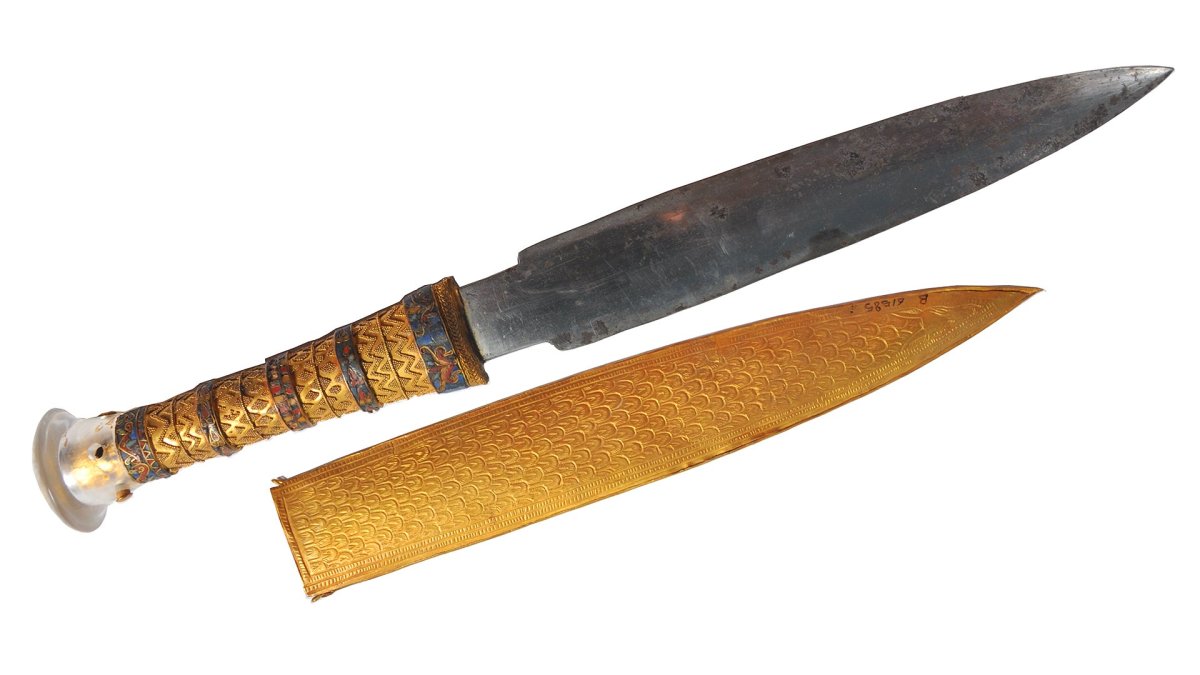
The pharaoh Tutankhamun’s (aka King Tut) tomb has been one of archelogy’s greatest treasure troves. Howard Carter and his team discovered the tomb nearly a century ago, but it’s still revealing secrets. One of the most mysterious objects discovered inside the burial chamber was a black iron dagger encased within the young ruler’s linen burial wrappings . The placement of dagger right at the mummified Tutankhamun’s side, as well as its ornateness, were key indicators that it was among the pharaoh’s most prized possessions.
The thing is, 3,300 years ago smelted iron was almost unheard of in Egypt. That means that well-crafted, rust-free daggers from that era are rare, to say the least. Theories posited the blade’s origin was extraterrestrial—from meteorites, to be exact. Yet there was no conclusive evidence to back it up. Then a group of Egyptian and Italian scientists used a process known as “X-ray fluorescence spectrometry” to define the artifact’s metallurgy more definitively. The results of their scans confirmed that the blade’s material did indeed originate from the heavens.
Steve Evans/wikicommons
The blade’s composition is a mix of nickel, iron and cobalt, which matches the building-blocks of meteorites found around northeastern Africa. This, along with the existence of far less complex but seemingly highly valued meteorite jewelry from the same time period indicates that Egyptians knew these rocks were not terrestrial, and valued them extraordinarily.
We know that ancient Egyptians had an eerily accurate understanding of the heavens . Even the Great Pyramid of Giza and how its construction and unique features are possibly tied to astronomy continues to be debated. During Tutankhamun’s rule, the sun god Ra was primarily worshipped .
So it’s no surprise that possessing a dagger—a preeminent weapon and ceremonial tool at the time—made from material dropped out of the sky would be highly prized. It is literally a weapon sent from God.
Sun God Ra hieroglyphic, Public Domain
Of course, building pieces of jewelry out of meteor fragments and creating a gorgeous, functional dagger out of the material are two entirely different things. At the very least the dagger proves that the ability to work iron to an exacting degree existed during Tutankhamun’s reign.
The scientific report on the subject , which was published in Meteoritics and Planetary Science, concludes:
“As the only two valuable iron artifacts from ancient Egypt so far accurately analyzed are of meteoritic origin, we suggest that ancient Egyptian attributed great value to meteoritic iron for the production of fine ornamental or ceremonial objects up until the 14th C. BCE. Smelting of iron, if any, has likely produced low-quality iron to be forged into precious objects. In this context, the high manufacturing quality of Tutankhamun’s dagger blade is evidence of early successful iron smithing in the 14th C. BCE. Indeed, only further in situ, nondestructive compositional analysis of other time-constrained ancient iron artifacts present in world collections, which include the other iron objects discovered in Tutankhamun’s tomb, will provide significant insights into the use of meteoritic iron and into the reconstruction of the evolution of the metal working technologies in the Mediterranean.”
So yeah, King Tut had a space knife made out of a material that likely seemed totally magical at the time. We shudder to think what he did with this thing while he was alive.
It was a customary in Egyptian culture to be buried with your most prized possessions so that you could take them to the afterlife. But if I had a meteorite dagger I would want be buried with it, too.
Contact the author at tyler@thedrive.com
Comments couldn’t be loaded. Please refresh the page.
更新于美国东部时间2020年7月2日下午2:52
图坦卡蒙(又称图特王)的陵墓一直是考古学史上最伟大的宝藏之一。霍华德·卡特和他的团队在近一个世纪前发现了这座陵墓,但它至今仍在揭示着新的秘密。在墓室中发现的最神秘的物品之一是一把黑色铁匕首,它被包裹在这位年轻法老的亚麻裹尸布中。匕首被放置在木乃伊化的图坦卡蒙身旁,其精美的装饰也表明它是法老最珍贵的宝物之一。
事实上,3300年前的埃及几乎没有冶炼铁的技术。这意味着,那个时代制作精良、不生锈的匕首极为罕见。一些理论认为,匕首的来源是外星——确切地说是陨石。然而,当时并没有确凿的证据支持这一说法。后来,一组埃及和意大利科学家利用一种名为“X射线荧光光谱法”的技术,对这件文物的冶金成分进行了更明确的分析。他们的扫描结果证实,匕首的材质确实来自天体。
史蒂夫·埃文斯/维基共享资源
这把刀刃的成分是镍、铁和钴的混合物,与在非洲东北部发现的陨石的组成成分相符。这一点,再加上同时期一些结构远没有这把刀刃复杂但价值极高的陨石首饰的存在,表明埃及人知道这些岩石并非来自地球,并且极其珍视它们。
我们知道古埃及人对天象有着惊人的准确理解。甚至吉萨大金字塔的建造及其独特特征与天文学之间的可能联系,至今仍是争论的焦点。在图坦卡蒙统治时期,太阳神拉是主要崇拜的对象。
因此,拥有一把由天降之物制成的匕首——在当时既是至高无上的武器又是仪式用具——会备受珍视也就不足为奇了。它简直就是上帝赐予的武器。
太阳神拉的象形文字,公共领域
当然,用陨石碎片制作珠宝和用这种材料打造一把精美实用的匕首是两码事。但至少这把匕首证明,在图坦卡蒙统治时期,人们已经掌握了精湛的铁器加工技术。
发表在《陨石学与行星科学》杂志上的相关科学报告得出结论:
“由于迄今为止,仅有的两件经过精确分析的古埃及珍贵铁器均源自陨石,我们认为,直到公元前14世纪,古埃及人都非常重视陨铁,并将其用于制作精美的装饰品或礼仪用品。即便存在炼铁工艺,也可能仅生产出低品质的铁,用于锻造成贵重物品。在此背景下,图坦卡蒙匕首刀刃的精湛工艺证明了公元前14世纪早期铁器锻造技术的成熟。事实上,只有对世界各地收藏的其他年代相近的古代铁器(包括图坦卡蒙墓中发现的其他铁器)进行更深入的原位、无损成分分析,才能为陨铁的利用以及地中海地区金属加工技术的发展演变提供重要的见解。”
没错,图坦卡蒙国王确实拥有一把太空刀,那把刀的材质在当时看来简直神奇无比。我们不敢想象他生前用这把刀干过什么。
在埃及文化中,人们习惯将最珍贵的物品与自己一同埋葬,以便带入来世。但如果我有一把陨石匕首,我也希望能够与它一同下葬。
请通过 tyler@thedrive.com 联系作者。
评论加载失败,请刷新页面。