Beijing commissions third aircraft carrier, first one made in China北京接收第三艘航空母舰,这是中国制造的第一艘航母。
It is perhaps the most visible example so far of Xi’s massive military overhaul and expansion.
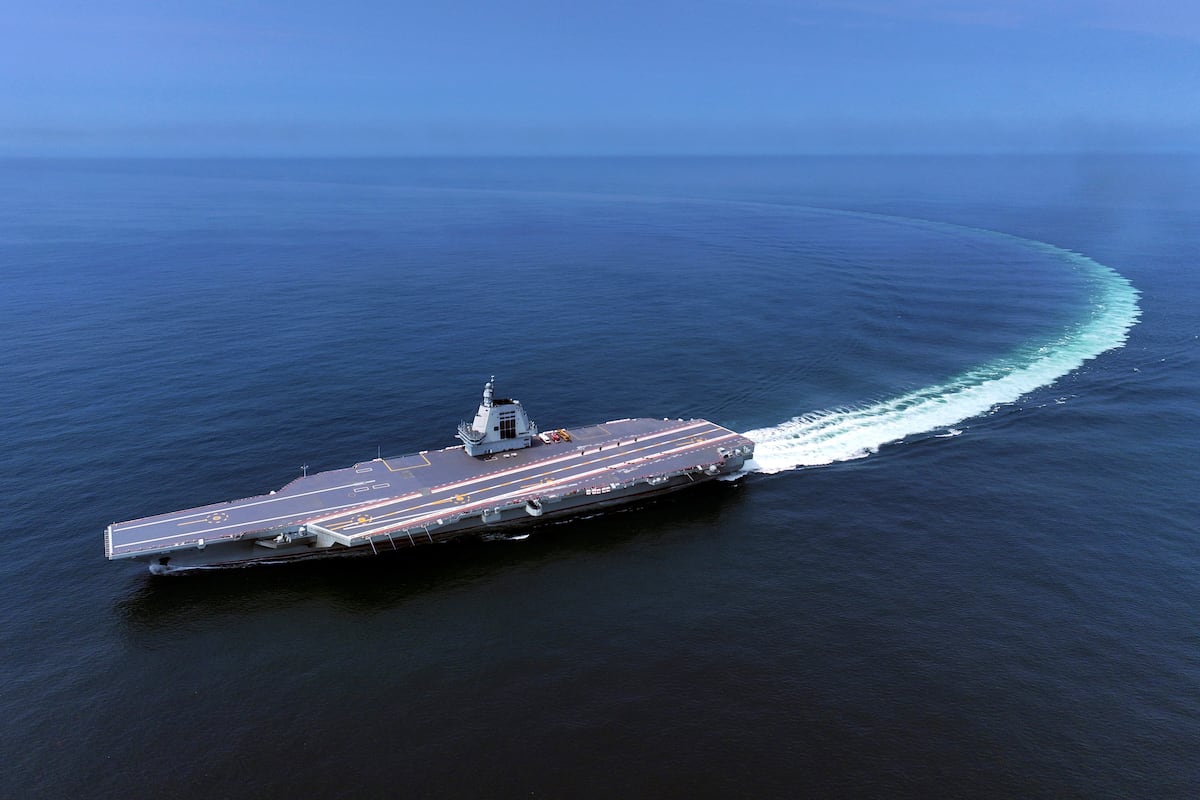
BANGKOK (AP) — China has commissioned its latest aircraft carrier after extensive sea trials, state media reported Friday, adding a ship that experts say will help what is already the world’s largest navy expand its power farther beyond its own waters.
The official Xinhua news agency said the Fujian had been commissioned Wednesday at a naval base on southern China’s Hainan island in a ceremony attended by top leader Xi Jinping.
The Fujian is China’s third carrier and the first that it both designed and built itself. It is perhaps the most visible example so far of Xi’s massive military overhaul and expansion that aims to have a modernized force by 2035 and one that is “world class” by mid century — which most take to mean capable of going toe-to-toe with the United States.
With it, Beijing takes another step toward closing the gap with the U.S. Navy and its carrier fleet and network of bases that allow it to maintain a presence around the world.
“Carriers are key to Chinese leadership’s vision of China as a great power with a blue-water navy,” or one that can project power far from its coastal waters, said Greg Poling, director of the Asia Maritime Transparency Initiative at the Center for Strategic and International Studies.
China wants to contest waters as far as Guam
For China’s navy, one goal is to dominate the near waters of the South China Sea, East China Sea and Yellow Sea around the so-called First Island Chain, which runs south through Japan, Taiwan and the Philippines. But deeper into the Pacific, it also wants to be able to contest control of the Second Island Chain, where the U.S. has important military facilities on Guam and elsewhere, Poling said.
“A carrier doesn’t really help you in the First Island Chain, but it’s key to that contest, if you want one, with the Americans in the wider Indo-Pacific,” Poling said.
China’s “increasingly capable military” and ability to “project power globally” is one of the reasons the Pentagon in its latest report to Congress continued to call it “the only competitor to the United States with the intent and, increasingly, the capacity to reshape the international order.”
At the same time, it is Beijing’s right to “transform its navy into a blue-water strategic navy commensurate with China’s national strength,” said Song Zhongping, a Hong Kong-based military affairs expert.
“China’s carriers cannot just operate near home, they must operate in the distant oceans and far seas to carry out various training and support missions,” Song said. “China is a great power and our overseas interests span the globe; we need to be globally present.”
News that the Fujian had been commissioned was met with wariness in nearby Japan. Minoru Kihara, a former defense minister and now chief cabinet secretary in Prime Minister Sanae Takaichi’s new government, said it underscores that China is “extensively and rapidly strengthening its military power without transparency.”
“We believe that China’s military intends to advance its operational capability at distant sea and air by strengthening sea power,” he told reporters, emphasizing that Japan was watching China’s military activity and would “calmly but decisively respond” if necessary.
One possibility that raises concerns in foreign capitals is a possible Chinese blockade or invasion of the democratically self-governed island of Taiwan, which China claims as its own territory and which leader Xi Jinping has not ruled out taking by force.
Though the island sits right off of China’s coast, if China had the ability to position an aircraft carrier group or groups around the Second Island Chain — between Taiwan and the U.S. Pacific Fleet headquarters in Hawaii — that could delay possible American military assistance in the event of a Chinese attack.
“They want those aircraft carriers to play a part in kind of extending the strategic perimeter farther out from China, and one of the important things that an aircraft carrier can do is extend the range of China’s domain awareness to keep an eye on activities in the air, on the sea, and below the sea,” said Brian Hart, deputy director of CSIS’s China Power Project
With the Fujian, China’s warplanes can deploy far from its shores
China’s first aircraft carrier, the Liaoning, was Soviet made and its second, the Shandong, was built in China but based on the Soviet model. Both use older-style ski-jump type systems to help planes take flight.
The Fujian skips past the steam catapult technology used on most American carriers to employ an electromagnetic launch system found only on the latest U.S. Navy Ford-class carriers.
The system causes less stress to the aircraft and the ship, allows for more precise control over speed and can launch a wider range of aircraft than the steam system. Compared to the ski-jump system, it gives China the ability to launch heavier aircraft, with full fuel loads, like the KJ-600 early warning and control plane, which it successfully tested during its sea trials.
Its latest J-35 stealth fighter and J-15T heavy fighter were also launched from the Fujian, giving the new carrier “full-deck operation capability” according to the Chinese navy.
The ability to carry its own reconnaissance aircraft means unlike its first two carriers, it won’t be operating blind when out of the range of land-based support, giving it the ability to operate its most advanced aircraft far afield including the Second Island Chain.
“The Fujian carrier is a big leapfrog for China in terms of the capabilities of its aircraft carriers compared to the first two,” Hart said .
China’s carriers aren’t nuclear powered, limiting their range
Still, Hart noted, China’s navy lags behind the U.S. in several significant ways.
Numerically it only has three carriers compared to the U.S. Navy’s 11, and while China’s carriers are all conventionally powered, the U.S.’s are all nuclear powered which means they can operate almost indefinitely without being refueled - dramatically increasing their range. The Ford-class carrier, of which only one is currently in service but more are being built, is also larger, can carry more aircraft on its flight deck, and has a third elevator that means it can move more aircraft from lower deck hangars in less time.
China also lags behind the U.S. in guided missile cruisers and destroyers, which are critical in providing air and submarine defense and support for larger naval groups, as well as nuclear-powered submarines.
The U.S. is also ahead in vertical launching system cells - basically the systems for holding and launching missiles from ships - which is a measure of how much firepower vessels can carry, though China is increasing that capacity, Hart said.
Beyond just equipment, China lacks the network of overseas bases that the U.S. has, which are critical for resupplying carriers and also providing alternative runways should aircraft not be able to return safely to the carrier.
China is working on expanding its foreign bases, however, and has a nuclear propulsion system for a carrier in development.
There’s also evidence that China is already building another carrier. Chinese shipyards have the capabilities to build more than one at once and have also been churning out other new vessels at a pace the U.S. can’t currently come close to matching.
“Really across the board, China’s closing the gap,” Hart said.
“They’re fielding and building more aircraft carriers, they’re fielding more nuclear-powered subs, they are fielding more, larger destroyers and other vessels that carry a larger number of missiles. So they’re really catching up.”
The Fujian is just one of China’s latest military assets
China has happily shown off its new military assets, releasing video of the KJ-600, J-35 and J-15T test flights from the Fujian.
A World War II Victory Day parade at the start of September showcased all three aircraft along with hypersonic glide vehicles — whose high-speed, maneuverability and other attributes make them more difficult to intercept than traditional ballistic missiles — aerial and underwater drones and electronic warfare systems.
Sophisticated new equipment does not necessarily translate to military readiness, however, said Singapore-based analyst Tang Meng Kit, who noted that China hasn’t fought a war since 1979 and that the carefully choreographed parade was good at “amplifying perceptions of strength.”
“It is possible that China’s capabilities are overstated, as real-world operational readiness lags behind its showcased arsenal,” he told the AP.
He also cautioned in a recent analysis for the S. Rajaratnam School of International Studies in Singapore that it would be a mistake to see China’s military modernization as simply geared toward a possible Taiwan invasion, which he said is only one part of a “larger mosaic.”
The parade “signaled China’s broader strategic intent, which is to deter major powers, pressure regional actors, expand its global influence, and reinforce its domestic legitimacy,” he said.
Albee Zhang in Washington and Mari Yamaguchi in Tokyo contributed to this report.
曼谷(美联社)——据官方媒体周五报道,中国最新一艘航空母舰经过广泛的海上试验后正式服役。专家表示,这艘航母将有助于中国这支已经是世界最大海军的海军将其力量进一步扩展到本国水域之外。
官方新华社报道称,“福建”号军舰于周三在中国南部海南岛的一个海军基地正式服役,最高领导人习近平出席了服役仪式。
福建号是中国的第三艘航母,也是中国第一艘自主设计建造的航母。它或许是迄今为止习近平大规模军事改革和扩充计划中最引人注目的例证。该计划的目标是到2035年建成一支现代化军队,并在本世纪中叶成为一支“世界一流”的军队——大多数人认为这意味着能够与美国正面抗衡。
通过此举,北京在缩小与美国海军及其航母舰队和基地网络之间的差距方面又迈出了一步,这些优势使其能够在世界各地保持存在。
“航母对于中国领导层将中国打造成为拥有远洋海军的大国这一愿景至关重要,”战略与国际研究中心亚洲海事透明倡议主任格雷格·波林表示,“远洋海军是指能够将力量投射到远离沿海水域的地区。”
中国想对远至关岛的水域提出争端
波林表示,中国海军的目标之一是控制南海、东海和黄海近海海域,即所谓的第一岛链附近海域。第一岛链向南延伸,途经日本、台湾和菲律宾。但更深入太平洋,中国海军也希望能够争夺第二岛链的控制权,美国在关岛和其他地区拥有重要的军事设施。
波林说:“航母在第一岛链上其实帮不了你什么,但如果你想在更广泛的印太地区与美国展开竞争,航母是关键。”
中国“日益强大的军事能力”和“在全球范围内投射力量”的能力,是五角大楼在提交给国会的最新报告中继续称其为“唯一一个有意图且日益具备能力重塑国际秩序的美国竞争对手”的原因之一。
与此同时,常驻香港的军事专家宋忠平表示,北京有权“将海军改造成为与中国国力相称的远洋战略海军”。
宋先生说:“中国的航母不能只在近海活动,它们必须在远洋和远海执行各种训练和支援任务。中国是世界强国,我们的海外利益遍及全球;我们需要在全球范围内保持存在。”
福建号航母服役的消息在日本邻国引起了警惕。前防卫大臣、现任首相高市早苗新内阁官房长官木原稔表示,这凸显出中国正在“在缺乏透明度的情况下,大规模、快速地增强其军事力量”。
“我们认为,中国军队打算通过加强海上力量来提升其在远海和空中的作战能力,”他告诉记者,并强调日本正在密切关注中国的军事活动,如有必要,将“冷静而果断地作出回应”。
令外国首都担忧的一种可能性是,中国可能封锁或入侵实行民主自治的台湾岛。中国声称台湾是其领土的一部分,其领导人习近平也未排除武力夺取台湾的可能性。
虽然该岛位于中国海岸附近,但如果中国有能力在第二岛链(位于台湾和美国太平洋舰队总部夏威夷之间)周围部署一个或多个航空母舰编队,那么一旦中国发动攻击,就可能延缓美国提供军事援助。
“他们希望这些航空母舰在向中国以外更远的地方延伸战略边界方面发挥作用,而航空母舰能够发挥的重要作用之一就是扩大中国的态势感知范围,使其能够监视空中、海上和水下的活动,”战略与国际研究中心(CSIS)中国实力项目副主任布莱恩·哈特表示。
有了福建号,中国的战机就可以部署到远离其海岸的地方。
中国的第一艘航空母舰辽宁舰是苏联制造的,第二艘山东舰虽然是在中国建造的,但也是按照苏联的设计建造的。这两艘航母都采用老式的滑跃式起飞系统。
福建号航母跳过了大多数美国航母使用的蒸汽弹射技术,采用了只有美国海军最新型福特级航母才有的电磁弹射系统。
该系统对飞机和舰艇的压力更小,能够更精确地控制速度,并且比蒸汽弹射系统可弹射更多种类的飞机。与滑跃式弹射系统相比,它使中国能够弹射更重的飞机,例如满载燃料的KJ-600预警机,中国已在海上试验中成功测试了该机型。
中国海军表示,其最新型的歼-35隐形战斗机和歼-15T重型战斗机也从福建号航母下水,使这艘新航母具备了“全甲板作战能力”。
由于能够搭载自己的侦察机,与前两艘航母不同,它在超出陆基支援范围时不会盲目行动,使其能够在包括第二岛链在内的远距离部署最先进的飞机。
哈特说:“与前两艘航母相比,福建号航母在航母能力方面是中国的一次巨大飞跃。”
中国的航母并非核动力,这限制了它们的航程。
不过,哈特指出,中国海军在几个重要方面落后于美国。
中国海军的航母数量只有三艘,而美国海军则有十一艘。此外,中国的航母全部采用常规动力,而美国的航母全部采用核动力,这意味着它们几乎可以无限期地执行任务而无需补充燃料,从而大大增加了航程。福特级航母目前只有一艘在役,但更多航母正在建造中。福特级航母的体型更大,飞行甲板上可以搭载更多飞机,并且配备了第三部升降机,这意味着它可以更快地将更多飞机从下层甲板的机库运送到上层甲板。
中国在导弹巡洋舰和驱逐舰方面也落后于美国,而这些舰艇对于提供空中和水下防御以及为更大的海军舰队和核动力潜艇提供支持至关重要。
哈特表示,美国在垂直发射系统单元方面也处于领先地位——这基本上是指从舰船上装载和发射导弹的系统——这衡量了舰船能够携带多少火力,尽管中国正在提高这种能力。
除了装备之外,中国还缺乏美国拥有的海外基地网络,而这些基地对于为航母提供补给至关重要,并且在飞机无法安全返回航母时也能提供备用跑道。
然而,中国正在努力扩大其海外基地,并且正在研发用于航母的核动力推进系统。
还有证据表明,中国已经在建造另一艘航母。中国造船厂有能力同时建造多艘航母,而且建造其他新型舰艇的速度也是美国目前无法企及的。
“中国在各个方面都在缩小差距,”哈特说。
“他们正在建造和部署更多的航空母舰,更多的核动力潜艇,更多更大的驱逐舰和其他可以携带更多导弹的舰艇。所以他们真的在迎头赶上。”
福建号只是中国最新的军事资产之一。
中国兴高采烈地展示了其新的军事装备,发布了在福建进行的KJ-600、J-35和J-15T试飞的视频。
9 月初举行的二战胜利日阅兵式上,展示了这三款飞机,以及高超音速滑翔飞行器(其高速、机动性和其他特性使其比传统弹道导弹更难拦截)、空中和水下无人机以及电子战系统。
新加坡分析师唐孟杰表示,先进的新装备并不一定意味着军事战备,他指出,中国自 1979 年以来就没有打过仗,精心编排的阅兵式有利于“增强实力认知”。
“中国的能力可能被夸大了,因为其实际作战准备水平落后于其展示的武器库,”他告诉美联社。
他在最近为新加坡拉惹勒南国际研究院撰写的一篇分析文章中也警告说,如果将中国的军事现代化仅仅视为针对可能的台湾入侵,那就大错特错了,他认为这只是“更大图景”的一部分。
他说,阅兵式“表明了中国更广泛的战略意图,即威慑大国,向地区行为体施压,扩大其全球影响力,并巩固其国内合法性”。
华盛顿的张阿尔比和东京的山口真理对本报道亦有贡献。