The A-7 Attack Jet’s Head Up Display Was A Revolution In Air Combat TechA-7攻击机的抬头显示器是空战技术的一项革命性突破。
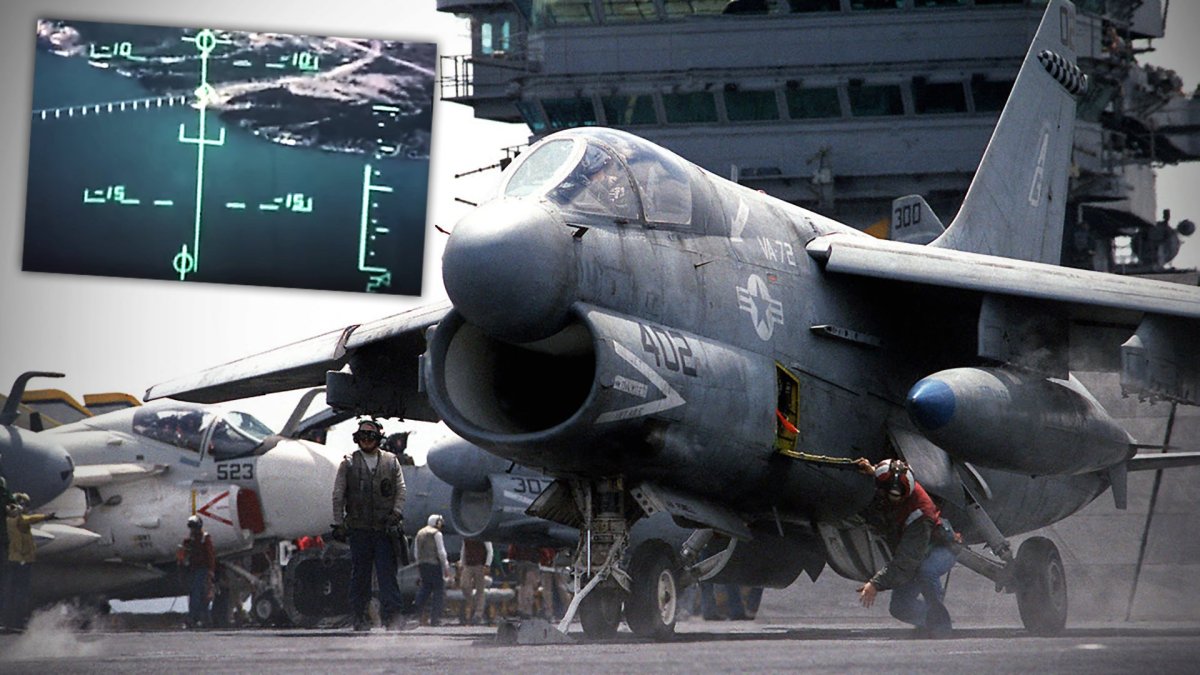
It was the first use of a true Head Up Display on a U.S. combat aircraft and historic videos show just how it worked and how much they got right.
新闻视频
Updated Jun 28, 2020 3:38 AM EDT
The Ling-Temco-Vought A-7 Corsair II wasn’t sexy, it looked like a fat version of the F-8 Crusader from which it drew its lineage, but it sure was smart. It featured a slew of advanced avionics that would make its single pilot’s job easier and their attacks far more precise. One of these features was central to the leap in combat capabilities the stubby aircraft represented—the Head Up Display (HUD).
The A-7 was the first operational American combat aircraft to get a fully instrumented HUD as we understand the concept today. This new addition was a monumental revolution in technology that changed air combat forever.
A-7s with their predecessor, the A-4 Skyhawk, aboard the USS Ticonderoga in 1968., USN
Before the A-7, tactical jets were receiving increasingly complex holographic gunsights with simple symbology, but nothing was tied directly to computers that worked to present all the key weapons delivery and primary flight information right up in front of the pilot’s eyes as they peered through the windscreen.
The A-7 HUD, EU, and PDU shown by Colin Marshall. In October 1967 it was announced from Dallas in Texas U.S.A that Elliott Flight Automation had been awarded a four-year contract to supply LTV with Head Up Displays for the A-7. The initial contract was worth £14million for 1,200 displays and was the largest ever awarded to a British firm., Rochester Avionic Archives
Looking back at the A-7’s AN/AVQ-7(V) HUD, which was made by Elliott Flight Automation along with Marconi, it is amazing what they pulled off in the mid-1960s. Much of the HUD’s general layout and symbology is still in use today, and just how deeply integrated the HUD was with the jet’s radar, navigation, and other systems is absolutely remarkable. Flight data ‘tapes,’ velocity vector, pitch ladder, steering cues, targeting points, bomb azimuth guides, AoA E-bracket, and much more are all there, just as they remain on so many tactical aircraft HUDs today.
A-7 Cockpit, US Government Photo
The aircraft’s HUD and the avionics and sensors that were tied into it greatly helped the A-7 become renowned as an incredibly precise weapons delivery platform in an age that predated the widespread use of precision-guided weapons. Various reports state that the A-7 improved the accuracy of weapons delivery by a multiple over the aircraft that came before it, most notably the plane it was meant to initially replace within the U.S. Navy, the A-4 Skyhawk. The A-7 would go on to serve in the USAF and Hellenic Air Force, as well as with Portugal and Thailand.
Check out the absolutely awesome time capsule-like industry videos below that go over the symbology and functionality of the Corsair II’s revolutionary HUD:
The A-7 would continue to make history in terms of pilot visual and targeting aids with the introduction of the first raster scan/CRT HUD that allowed for video imagery, as well as HUD symbology, to be projected in front of the pilot. As such, video from a forward-looking infrared (FLIR) pod could be projected into the pilot’s forward field of view, giving them a degree of night vision. When tied to terrain-following radar, precision all-weather, day-night attack capability was had. The FLIR pods could also be used to verify targets via a zoom function. This program was known as the A-7E Target Recognition Attack Multisensor (TRAM) configuration.
Roughly over a decade and a half later, this capability would become a staple on many U.S. fighters, especially those that used the LANTIRN system , such as the Block 40 F-16C/D and the F-15E . The F/A-18 Hornet also had this capability via its AAS-38A/B Nite Hawk pod and its raster-scan HUD.
A-7s carrying TRAM FLIR pods. , USN
In many ways, the A-7 was ahead of its time, with its incredible mix of extreme range , payload, avionics, and overall efficiency. What it didn’t have going for it was looks or speed, which can be a deadly mix of deficiencies for a tactical jet trying to survive in a fighter pilot-Pentagon. I often muse that such an aircraft in updated form would have been extremely valuable during the Global War On Terror. And of course, the A-7 could have turned into a higher-performance, even more advanced machine via the A-7F Strikefighter, but this never came to pass. It turned out to be yet another instance of ‘what could have been.’ You can read all about it in this prior feature of mine
Regardless, one has to hand it to Elliott and Marconi, as well as the entire A-7 team, for getting the HUD so right on its first try. They truly changed air combat forever in the process.
Hat tip to Rochester Avionic Archives for being such a cool repository for much of this visual historic info!
Contact the author: Tyler@thedrive.com
Comments couldn’t be loaded. Please refresh the page.
更新于美国东部时间2020年6月28日凌晨3:38
凌-特姆科-沃特A-7“海盗II”攻击机外形并不吸引人,它看起来就像是F-8“十字军战士”的加粗版,但它的性能却非常出色。它配备了一系列先进的航空电子设备,能够减轻飞行员的操控难度,并显著提高攻击的精准度。其中一项至关重要的功能,正是抬头显示器(HUD),它赋予了这架短粗的飞机强大的作战能力。
A-7是美国第一架配备我们今天所理解的全套HUD(平视显示器)的作战飞机。这一新增功能是一项意义重大的技术革命,彻底改变了空战的格局。
1968年,A-7攻击机及其前身A-4“天鹰”攻击机在“提康德罗加”号航空母舰上。(美国海军)
在 A-7 之前,战术喷气机配备了越来越复杂的全息瞄准器,虽然符号简单,但没有任何瞄准器直接与计算机连接,能够将所有关键的武器投放和主要飞行信息直接呈现在飞行员透过挡风玻璃观察的眼前。
科林·马歇尔展示了A-7的平视显示器(HUD)、电子显示器(EU)和电源分配单元(PDU)。1967年10月,美国德克萨斯州达拉斯市宣布,埃利奥特飞行自动化公司(Elliott Flight Automation)获得了一份为期四年的合同,为LTV公司供应A-7的平视显示器。这份初始合同价值1400万英镑,包含1200套显示器,是当时授予英国公司的最大合同。(罗切斯特航空电子档案馆)
回顾A-7攻击机的AN/AVQ-7(V)平视显示器(HUD),这款由埃利奥特飞行自动化公司与马可尼公司联合研制的HUD,其在20世纪60年代中期取得的成就令人惊叹。HUD的大部分布局和符号至今仍在使用,而它与飞机雷达、导航和其他系统的深度集成更是令人叹为观止。飞行数据带、速度矢量、俯仰梯、转向提示、目标点、炸弹方位角引导、迎角E型标尺等等,应有尽有,正如如今许多战术飞机的HUD一样。
A-7 驾驶舱,美国政府照片
A-7的平视显示器(HUD)及其配套的航空电子设备和传感器极大地帮助其在精确制导武器尚未广泛应用的年代,成为一款极其精准的武器投放平台。多份报告指出,A-7的武器投放精度比其前代机型提高了数倍,尤其是它最初在美国海军中取代的A-4“天鹰”攻击机。A-7后来还在美国空军、希腊空军以及葡萄牙和泰国空军服役。
观看下方这些精彩绝伦、如同时光胶囊般的行业视频,了解 Corsair II 革命性 HUD 的符号和功能:
A-7在飞行员视觉和目标指示辅助方面继续创造历史,它引入了首个光栅扫描/CRT平视显示器(HUD),该显示器可以将视频图像和HUD符号投射到飞行员前方。因此,来自前视红外(FLIR)吊舱的视频可以投射到飞行员的前方视野中,使其具备一定的夜视能力。当与地形跟踪雷达配合使用时,A-7具备了全天候、昼夜精确打击能力。FLIR吊舱还可以通过缩放功能用于确认目标。该项目被称为A-7E目标识别攻击多传感器(TRAM)配置。
大约十五年后,这种能力成为许多美国战斗机的标配,尤其是那些使用LANTIRN系统的战斗机,例如Block 40 F-16C/D和F-15E。F/A-18“大黄蜂”战斗机也通过其AAS-38A/B“夜鹰”吊舱和光栅扫描HUD具备这种能力。
A-7攻击机携带TRAM前视红外吊舱。,美国海军
从很多方面来看,A-7 都超前于时代,它拥有惊人的航程、有效载荷、航空电子设备和整体效率。然而,它的外观和速度却略显不足,这对于一架试图在五角大楼的战斗机飞行员竞争中生存的战术喷气机来说,可能是致命的缺陷。我常常想,如果这款飞机能够升级改造,在全球反恐战争中将会发挥极其重要的作用。当然,A-7 也可以通过 A-7F 攻击战斗机发展成为性能更高、更先进的机型,但这最终未能实现。这又是一个“如果当初……”的例子。你可以在我之前的文章中读到关于这方面的详细内容。
无论如何,我们必须赞扬埃利奥特、马可尼以及整个A-7团队,他们第一次就把HUD设计得如此完美。他们在这个过程中真正彻底改变了空战的格局。
感谢罗切斯特航空电子档案馆,它为我们提供了大量精彩的历史视觉信息!
联系作者:Tyler@thedrive.com
评论加载失败,请刷新页面。