What a Limited Russian Incursion Into Estonia Might Look Like: A Narva Scenario俄罗斯有限入侵爱沙尼亚可能呈现的情景:纳尔瓦方案
A Russian invasion of a NATO state is unlikely while Russia at war with Ukraine. But that is not Putin’s only option against a NATO state.
The dramatic visit of US Central Intelligence Agency Director John Ratcliffe to Moscow in August 2026 brought much-needed attention to the increasing danger that Russian President Vladimir Putin could conduct a limited attack on a NATO state in the relatively near term and even while continuing to fight in Ukraine.[1] The reaction of most Baltic States to Ratcliffe’s trip and the resulting discussion and events has been largely to call for calm regarding a Russian invasion and a measured approach to other Russian threats.[2] Estonia and Latvia both reiterated that they have observed no evidence of the buildup of Russian forces near their borders that would be necessary for a full-scale invasion of their countries.[3] Those statements are correct — there is no such buildup, and a full-scale Russian invasion of a NATO state is extremely unlikely while Russia remains fully committed to war against Ukraine. But full-scale invasion is not Putin’s only option to conventionally escalate against a NATO state. He could conduct limited ground operations leveraging tactical- and operational-depth drones against one or more NATO states not for the purposes of conquering them or seizing territory, but rather with the aim of breaking the alliance by causing it to fail to activate and act appropriately on its Article 5 commitments.
Brief sketches of possible Russian actions along those lines have emerged in recent discussions, but scenarios for Russian action have not received the detailed analysis they deserve and require. This paper presents the setup and initial actions of one such scenario — a Russian limited attack on Narva, an Estonian border town near the Baltic Sea. Russian forces could seize other border towns, of course, and can pursue other scenarios including direct drone strikes on European targets as a number of European states, especially Poland, have recently been warning.[4] The purpose of studying a Narva scenario is not to suggest that the Russians will conduct this specific operation, although they have set limited conditions to do so already, but rather to explore in detail what such an attack might look like, how the Kremlin might seek to use it to advance its own domestic objectives and to break the alliance, and how the alliance should act both to deter and to defeat any such attack, whether at Narva or elsewhere. This scenario is notional — it is not an assessment or forecast that the Kremlin will conduct such an operation.
The urgency of this examination has been increased by the September 16, 2026 Russian action suspending movement on the Russian side of the border opposite Narva, which could be an indicator of preparations for such a Russian operation, although it could also be tied to the Estonian announcement that Tallinn will close Estonia’s border with Russia if Russian President Vladimir Putin orders an involuntary mobilization in Russia.[5]
The alliance certainly has the ability to deter and, if necessary, defeat a Russian operation of the sort described in this paper. It is not, at the moment, ready to do so at acceptable risk and cost, however. Ratcliffe’s visit along with other indications that Putin is seriously considering and preparing for options to test and even attack NATO make open and detailed discussion of scenarios such as this one urgent.
Scenario: Limited Russian Ground Incursion in Narva Backed by Russian Drone Elements Based in the Russian Federation
Objectives and Restraints
The objectives of this Russian effort would be:
To create a situation of de facto war with NATO to use for internal mobilization purposes (and to justify a new involuntary reserve mobilization);
To discredit Article 5 by conducting an actual act of aggression and causing NATO not to invoke or act effectively on Article 5 in response;
To create a crisis within NATO with the subsidiary aims of Fracturing the alliance by creating divisions between the United States and Europe and among European member states — explicitly isolating the Baltic States within the alliance to the greatest extent possible; Distracting the alliance from supplying Ukraine and persuading it to reallocate resources to its own defense; Building support within Europe for Russia’s preferred Euroskeptic and NATO-hostile parties in the context of upcoming European elections by painting NATO and Brussels as having triggered a crisis and conflict with Russia; Create a crisis to offer to trade for concessions to be imposed on Ukraine—the Kremlin can offer to back down on Narva if Ukraine accedes to Russian demands, e.g.
Fracturing the alliance by creating divisions between the United States and Europe and among European member states — explicitly isolating the Baltic States within the alliance to the greatest extent possible;
Distracting the alliance from supplying Ukraine and persuading it to reallocate resources to its own defense;
Building support within Europe for Russia’s preferred Euroskeptic and NATO-hostile parties in the context of upcoming European elections by painting NATO and Brussels as having triggered a crisis and conflict with Russia;
Create a crisis to offer to trade for concessions to be imposed on Ukraine—the Kremlin can offer to back down on Narva if Ukraine accedes to Russian demands, e.g.
Russian operations would be designed to avoid:
The requirement to commit large numbers of Russian ground forces to any such effort in a way that would detract from the war in Ukraine;
The emergence of a meaningful NATO offensive threat against Russia, specifically including one that would require the redeployment of Russian assets from Ukraine;
Strengthening the alliance through anything that is widely perceived as a full-scale invasion of a NATO member state;
Triggering a large buildup of NATO military power directly on Russian borders;
Triggering NATO deep strikes against key targets in Russia; and
Causing Ukraine’s supporters to increase supplies of advanced materiel and/or lift restrictions on the Ukrainian use of those already supplied.
It is important to note, however, that Putin is very capable of miscalculating how European leaders and NATO will respond. He may well conduct operations that he believes will lie below key thresholds for triggering the outcomes this scenario is designed to avoid, only to discover that European leaders have lower thresholds than he had thought.
Background and Setup
The Russians have largely set informational conditions to conduct an operation based around the fiction of a Narva People’s Republic at a moment of their choosing.[6] There would likely be a brief period in which Russian agents, openly and covertly, push a narrative of increasing Estonian oppression and mistreatment of Russian citizens in Estonia, as well as accusing Tallinn and NATO of preparing to conduct offensive operations against Russia itself or that Estonian aid to Ukraine is tantamount to direct Estonian participation in Ukrainian strikes against Russia, making Estonia a legitimate target (claims the Kremlin makes all the time). The Russian FSB also announced on September 16, 2026, a 10-day ban on movement along and on the Narva River, a ban on firearms in the vicinity of Narva on the Russian side, and a partial curfew.[7]
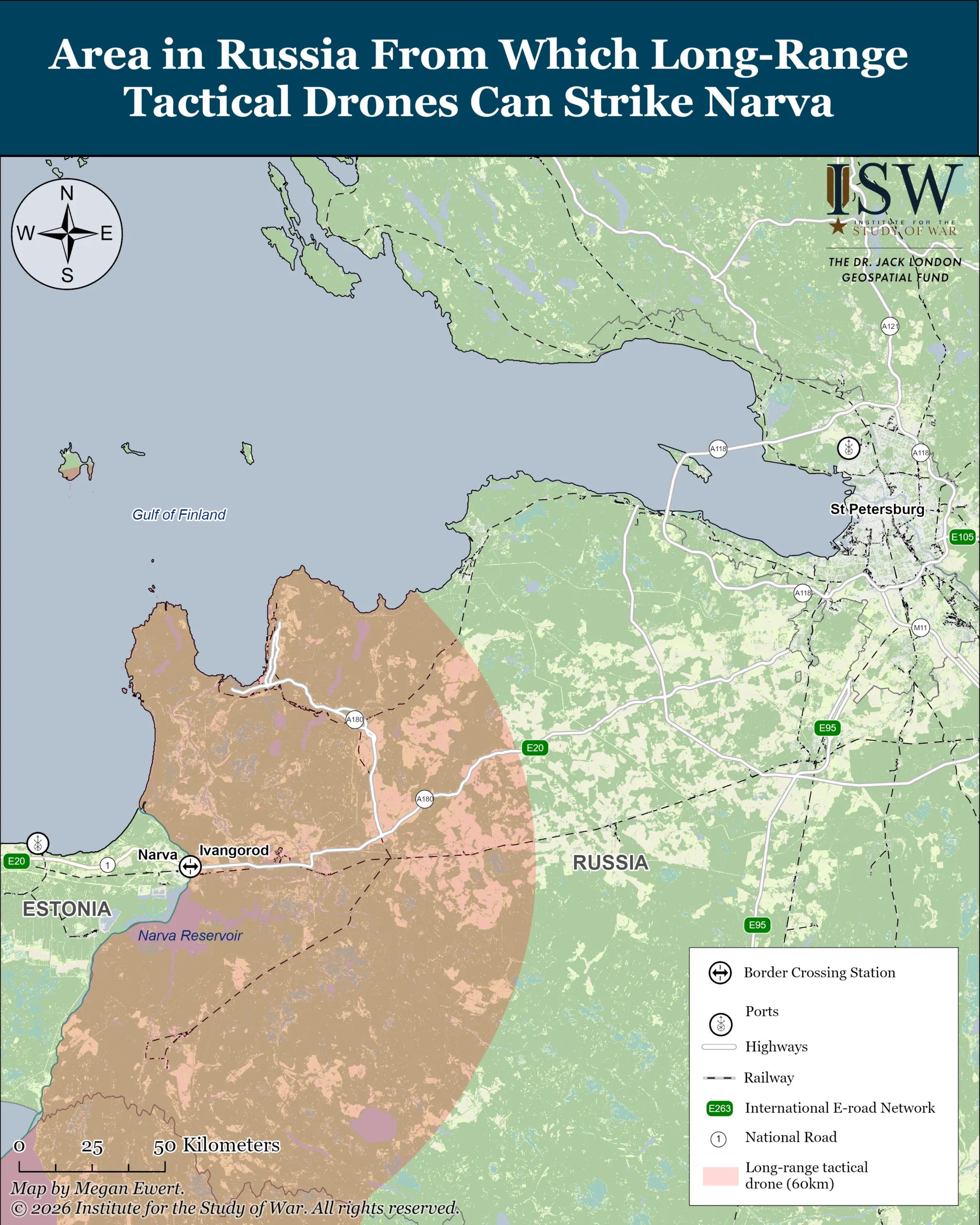
In preparation for this operation, the Russian military quietly concentrates FPV drone elements drawn from the Rubikon Center for Advanced Unmanned Systems and other largely elite Russian drone units within range of Narva and Johvi (the nearest Estonian military base, roughly 40km west of Narva) starting close to the border but echeloned deeply into the rear. The drone elements are equipped with long-range (60+km fiber-optics drones, Molniya fixed-wing drones, Lancet and Kub loitering munitions), and many shorter range (15-25 km) fiber-optic and radio-controlled drones. Drone units prepare hide positions in the arc along the Estonian border and echeloned back at least 60 km from the border (deeper if operational drone ranges support). Russian drone operators using Starlink-equipped drones are echeloned deep in the Russian interior. The Russian military also begins to build up a reserve of Geran and other long-range one-way attack drones for possible use against NATO positions, but the buildup is really only visible in a normal cyclic reduction in the tempo of Russian Geran strikes against Ukraine. (Russian forces reportedly already have stockpiles of Geran drones of various models that could be allocated to support this scenario.) There will be a period in which Geran launchers will need to be set up for (relatively) close-range mesh-network strikes, but the ranges bring that area well to the east of St. Petersburg. Repeater towers will need to go up on the Russian side if they are not already present, although the Russians may also attempt to use repeaters on ships in the Gulf of Finland. Russian ground forces, including Spetsnaz and elements of one or more Airborne or Naval Infantry brigades/regiments, would concentrate in small detachments with limited footprints. There is no large-scale, visible buildup of Russian ground forces in the vicinity of Narva or the Baltic States and specifically no large buildup of combat vehicles, as Kremlin plans do not include a significant ground operation in the area at this time and the Russians are confident that their drone elements and long-range strike capabilities supporting a small group of elite Russian infantry can defend against what limited offensive potential NATO has on the ground in the Baltics and Finland.
The key indicators of Russian preparations for such an operation would include:
Enhanced preparation of the information space, likely specifically including increasing accusations of Estonian persecution of its Russian minority. Preparation of the information space could also include accusations of increasing Estonian “aggression,” particularly if Estonia undertakes measures to secure its borders;
Increased deployment of Russian drone forces in the greater Saint Petersburg area, including preparation of drone launch points in this area;
Activation of repeater stations in Russia or in the Baltic Sea region;
Movement of limited Russian ground forces into the Leningrad Military District;
Increased Russian air defense preparations in the Leningrad Military District (although such preparations could also indicate increased efforts to defend against Ukrainian long-range strikes); and
Activation of covert Russian networks in Estonia.
It may be difficult to observe with confidence most of these indicators if the Kremlin undertakes its preparations slowly and gradually rather than suddenly. Estonia and its allies must be very vigilant in seeking to observe small, gradual changes in the Russian force posture in Estonia’s vicinity and avoid focusing excessively on looking for preparations for a large-scale Russian conventional attack.
Scenario Assumptions
That the Russians already have sufficient agents within Narva with access to the necessary weapons (mainly small arms) to conduct the limited operations described in the scenario;
That Estonian/NATO forces in Estonia are not postured or positioned to defend against a scenario such as this one by preventing the initial seizures of terrain entirely, and are instead postured to conduct counterattacks that may come too late;
That the Russians could order the operation to begin without alerting Estonian authorities in time to prevent the initial seizures; and
That Estonian/NATO forces cannot, in fact, reliably defend against advanced and concentrated Russian FPV and Geran strikes as described in the scenario.
Scenario Assessments
The Russians have sufficient drone elements deployed in Ukraine and in training in Russia that they can divert enough to accomplish the missions outlined in this scenario without notably compromising efforts in Ukraine, likely by downscaling operations in relatively stagnant areas of the front line for a time;
NATO forces permanently positioned in the Baltics are not currently postured to pose a serious ground threat to Russia in the St. Petersburg area in immediate response to a Russian attack and in the face of a determined and prepared drone-based Russian defense relying on small numbers of Russian ground forces.
Russian agents already in position in Narva seize the Narva Museum, the Narva Town Hall, as many of the buildings in between as they can, and as much of the promenade and waterfront north and south of the bridge as they can and declare the establishment of the Narva People’s Republic (NPR). The Narva Museum is a relatively isolated structure that a relatively small group of militants supported by an intensive drone effort could likely hold for a considerable period against ground forces. It is also very close to the Narva Bridge, with the promenade on the other side (in which small, lightly armed groups could dig in quickly, supported by drone cover). The museum is easily destroyed by airpower or long-range strike, of course, for which reason the Russian agents would likely attempt to dig in dispersed defensive positions around it and along the waterfront that would be harder to destroy. But the Estonian requirement will be to reoccupy and regain full control of their territory, which Russian drone elements will attempt to contest regardless of the fate of Russian agents.
The Russian agents identify themselves (truthfully for once) as Russian citizens and call on Moscow to defend them against Estonian efforts to root them out. The request is immediately granted.
The Kremlin announces that Russian drone and air defense units have been assigned the task of defending the Russian citizens of the NPR from bases in Russia and that Russian military forces have not entered and will not enter Estonian territory unless Estonia escalates the crisis.
Estonian police and forces in the area try to clear the positions rapidly but come under small arms fire from NPR fighters (supported by Russian Spetsnaz and other special elements and ground forces prepositioned in Estonia and moving rapidly to cross the bridge from Russia) with infantry weapons but not fighting vehicles.
Russian drone elements based in Russia rapidly begin striking Estonian forces attempting to clear the positions, and the Russian elements in Narva operate their own tactical drones to good effect. The situation quickly becomes a localized stalemate as Estonian personnel immediately in the area are unprepared to defend against large volumes of Russian FPV strike drones, including fiber optic drones, protecting the NPR fighters.
The Kremlin calls for calm and de-escalation on the basis of Estonian recognition of the NPR’s claims to control all of Narva and demands that all Estonian military, police, and government personnel evacuate the territory. Moscow threatens to launch an expanded strike campaign against Estonian forces if fighting continues, and to further expand that strike campaign against any NATO state that involves itself in operations against the NPR.
The NPR and the Kremlin assert that the situation in Narva is an internal matter resulting from Estonia’s mistreatment of Russian citizens and denies that it constitutes a Russian attack on NATO. On the contrary, the Kremlin claims, it is a defensive measure in response to Estonian aggression.
Challenges This Scenario Poses to Estonia and NATO
Immediate Estonian/NATO Response
Assuming that the Russian agents can overcome and/or hold off local security forces, the combined Estonia-NATO force defending Estonia will need to respond to the area. The nearest Estonian military bases are in and near Johvi, approximately 40 km to the west. (Estonia has also begun construction of a company-sized military position in Narva itself, beginning with temporary accommodations in late 2026 planning to start construction of permanent facilities by February 2027, which will likely force a recalibration of Russian plans for this scenario but is not yet considered in this scenario).[8] One possible Russian mitigation could be to bring that garrison under heavy drone fire immediately, potentially claiming that the NPR elements are operating the drones). Russian drone operators can bring forces in Johvi under fire from the Russian side of the border from the first minutes of the operation and can interdict major and minor roads from Johvi to Narva, with an intensity proportional to the proximity to Narva itself. Russian Geran-style drones can attack all fixed bases in Estonia from the start of the operation or at any moment thereafter. Their ability to attack forces on the move will depend on proximity to Russian base-stations and repeaters but will likely remain high.
The initiation of this scenario will likely prompt the Estonian government and its allies in Estonia to try to begin moving forces toward Narva at once in what can rapidly turn into a kind of salt-lick operation for Russian drone operators. The Russian agents who initiate the scenario would be overcome relatively easily with small military forces, so the Russian challenge is to prevent those forces from getting to Narva. The Estonian/NATO challenge will be getting them there with acceptable losses.
Strategic Challenges for NATO
This scenario will immediately present a series of strategic challenges to the alliance.
Estonia will likely seek an Article 5 activation unless Tallinn has reason to believe that such a vote will fail, although Estonia might seek to force the matter even in that case. Estonia could, alternatively, avoid seeking Article 5 activation and instead seek help from individual NATO member states — but failing to seek Article 5 activation in the face of a clear Russian attack on NATO territory would also seriously damage the utility and significance of Article 5.
Russian cognitive warfare efforts seeking to portray the Russian attack as an internal matter resulting from Estonian persecution of its own Russian minority will likely fail to shape NATO policy but could become a distraction and cause delays.
A number of NATO states will likely be very hesitant to invoke Article 5 over a limited incursion, fearing the consequences of appearing to launch the alliance into a full-scale war with Russia. Russian cognitive warfare efforts are already playing on these fears and will intensify before and during the Russian attack.[9] Recent statements by Slovakian Prime Minister Robert Fico along these lines are concerning in this regard.[10]
Tensions between the US and European governments over their relative responsibilities for defending NATO territory and airspace, especially in the face of such a limited attack, may delay or preclude US involvement. Negotiations between the US and its European allies could lead to significant delays and hinder prompt votes and prompt military action. Russian cognitive warfare efforts will continue to focus on driving the wedge between the US and Europe even deeper.
Non-Estonian NATO forces in Estonia will force troop-contributing states to decide rapidly whether or not to support Estonian forces in repulsing the Russian attack, and may need to make such decisions before the North Atlantic Council has voted to invoke Article 5. Russian cognitive warfare efforts will focus on paralyzing such action.
Military and operational challenges for NATO
This scenario will present a series of complicated challenges and decisions to NATO military structures. Assuming that Estonia has not already prepositioned large numbers of drone interceptors, interceptor drones, advanced electronic warfare systems, and kinetic counter-tactical-drone systems in the immediate vicinity of Narva, both Estonia and NATO would be challenged to get such systems into place once Russian drone operators begin striking ground lines of communication into and through Estonia toward Narva. NATO states collectively may have sufficient amounts of such systems to handle the relatively small-scale scenario described above, but Russian interdiction efforts can disrupt or preclude them from arriving in the combat area even once a decision to send them has been taken.
The absence of sufficient counter-drone systems in the combat area will impose on NATO forces the requirement to target Russian drone operators in their dispersed hide positions in Russian territory and to deny Russian communications technology in Estonia (such as cutting Russian forces off from Starlink in Estonia as SpaceX did in Ukraine in 2026).[11] That requirement will interact with the political dynamics of an Article 5 debate and vote, as some member states will likely balk at the prospect of attacking Russian territory directly. The military challenge will also be very significant, however. Well-prepared hide positions are very difficult to identify rapidly, and NATO forces do not currently have their own highly trained and well-equipped drone units on par with those fielded by the Ukrainian and Russian militaries able to find and rapidly strike those positions.[12] NATO forces will likely default to using JDAMs and other conventional munitions to attack hide positions, assuming they can obtain political permission to do so. Russian drone operators using Starlink-equipped drones can be echeloned far from the physical area of operations, requiring coordination with SpaceX to rapidly enforce a whitelisting solution as SpaceX introduced in Ukraine in early 2026 to deny Russian forces’ ability to use Starlink in Estonia. The efficacy of such attacks will depend heavily on the number of hide positions, the rapidity with which NATO forces can find them and then strike them, the speed at which Russian forces can be deprived of Starlink, and the ability of Russian drone units to regenerate combat capability.
The Russians cannot prevent NATO 5 th Generation aircraft from conducting precision strikes on their positions, but Russian air defenses in this area (the immediate environs of Saint Petersburg) would likely require the use of 5 th Generation aircraft during the initial phases of aerial operations. The NATO military command in conjunction with the NAC would need to decide rapidly whether to conduct a full suppression of enemy air defense (SEAD) operation in order to permit non-stealthy aircraft to operate in this area, but such an operation would require striking targets in and near Saint Petersburg and would take some time to complete. If the NATO military command chooses to rely on 5 th Generation aircraft to conduct all strike missions, then the number and rate of such strikes will be determined by the number of such aircraft immediately available and munitions available to maintain a high sortie rate. That question, in turn, makes the issue of US involvement in operations paramount, as only the US has a large enough inventory of such aircraft to maintain intensive operations against a large number of dispersed positions.
Recent discussions by the militaries of frontline NATO states have focused on their intention of conducting deep strike operations to repel Russian attacks, but such operations are very unlikely to have a material military effect on attacks such as the one considered in this scenario.[13] The Russian forces involved in a limited attack on Narva have a very small logistics footprint that long range strikes are very unlikely to destroy or disrupt. NATO capitals will also face considerable political pressure to avoid what the Russians will portray as an escalation by conducting strikes away from the immediate area of operations. Nor is there any solid basis for an assessment that limited NATO long-range strikes would force a Russian capitulation any more than the intensive Ukrainian long-range strike campaign has done. NATO could, of course, conduct a massive long-range strike campaign to cripple the Russian military in general, but the alliance is very unlikely to move rapidly to such a campaign in the face of an initially limited Russian attack.
Russian Escalation Options and Their Limitations
Russian forces have limited options to escalate this crisis in the short term. The Russian military is not prepared to conduct large-scale conventional ground operations against NATO forces, is not preparing to do so, and would be seriously challenged to do so while also prosecuting the full-scale invasion of Ukraine. Limited Russian ground forces could possibly initiate other small-scale incursions elsewhere in the Baltic States or against Poland, but their ability to do so without compromising the Kremlin’s priority efforts in Ukraine will likely be very constrained. The Kremlin is highly unlikely to successfully pressure Belarusian President Lukashenko to involve the small Belarusian military in offensive operations, though the threat of Belarusian forces could pin some NATO elements in place away from the Narva theater. A large-scale mobilization of Russia’s reserves, rumors of which have been circulating for some time, could in principle support such incursions as well as increasing Russian force levels in Ukraine.[14] But Russian mobilization and training practices are currently optimized for getting large numbers of civilians rapidly to front line units with very low levels of training.[15] Such forces would be unsuitable for operations against NATO states, a fact that would likely constrain the Kremlin to redirect experienced and likely elite combat forces from operations in Ukraine for the purpose. Such a redirection of experienced forces would likely have significant detrimental effects on Russian efforts in Ukraine, and the Kremlin will likely seek to avoid them.
Conventional Russian air and naval power is no serious match for NATO capabilities, especially if the US commits to the defense of the alliance. A significant Russian conventional air or maritime campaign would very probably increase the likelihood of US support to its European allies. It is far from clear, moreover, that a concerted effort by the European members of NATO would be insufficient to defeat such Russian operations as long as the US permitted them to use existing NATO command-and-control infrastructure.
The most probable Russian escalation measures would therefore rely on long-range strike drones of the Geran variety, possibly in conjunction with ground-launched ballistic missiles and very probably coordinated with an expanded campaign of sabotage and cyber attacks. NATO is currently unprepared to defend against large Geran strike packages, certainly over an extended period of time, and reported shortages of interceptors capable of defending against ballistic missiles could pose a serious challenge.
A significant Russian escalation along these lines, however, would very likely increase the willingness of NATO member states to engage in long-range strikes and even an air campaign over Russia to attack launchers. NATO long-range strike is very likely able to inflict serious damage on Russian ballistic missile launch systems and to degrade the ability of Russian forces to launch large Geran strike packages. The author does not have the basis to assess the likely effectiveness of NATO member states in defeating or responding to sabotage and cyber campaigns.
Any such Russian campaigns against NATO would materially detract from Russian efforts to defeat Ukraine, however, as Russia’s ability to produce Gerans and ballistic missiles is both limited and subject to NATO attack. The Kremlin is unlikely to choose such an escalation path unless its leadership becomes persuaded that this path will very likely break the alliance.
The calculations shaping possible Russian escalation scenarios are thus complex and, in general, daunting for the Kremlin as long as Russian leaders believe that NATO is likely to fight in a coherent fashion. Putin is very unlikely to choose military options against NATO that badly undermine his efforts in Ukraine unless he is confident that such military action will destroy the alliance or end European support for Ukraine. The danger to Putin of initiating a scenario along the lines described above, in fact, is the possibility that NATO will escalate in ways that compel him to choose between effective responses to NATO and continuing effective operations in Ukraine. This scenario is designed, however, precisely to minimize the risk that Putin will be forced to undermine his efforts in Ukraine.
Conclusion and Recommendations
NATO’s best option in this scenario is, of course, to deter it. The alliance as a whole retains superiority in escalation scenarios as long as the United States is fully committed to defending its European allies and Putin remains committed to the war against Ukraine. US commitment is, obviously, the primary variable in that calculation. The US should thus take every measure possible to demonstrate its commitment to its alliance obligations in the face of even limited Russian aggression of the sort described above. Strategic ambiguity invites Russian adventurism and significantly increases the odds that Putin might gamble on such a scenario hoping to invalidate Article 5 at a low cost and risk to himself. Discussions of the withdrawal of US forces from Europe at this time, regardless of their framing or of other messaging, undermine US credibility and therefore increase the likelihood of Putin initiating conflict with NATO.
European member states can also increase the likelihood of deterring scenarios such as this one by dramatically accelerating preparations to disrupt and to meet them symmetrically. Keys to such efforts include developing indigenous counter-drone capabilities including advanced electronic warfare systems, interceptor drones to defeat both tactical and long-range strike UAVs, kinetic counter-drone systems, and skilled drone units of their own that can rapidly identify and strike Russian drone operator positions.
Too much of the European defense discourse today focuses on options that would amount to escalation, particularly long-range strike, rather than on rapidly developing the kinds of symmetrical capabilities that Ukrainian forces have, although there are European efforts along those lines, to be sure. NATO member states must internalize the reality that, unattractive as escalation scenarios are to Putin, they are likely to be much more challenging for NATO states themselves from a political perspective. Russian cognitive warfare efforts will go all out to dissuade one or more states from voting to support long-range strikes into or air campaigns against Russian territory in such a scenario, and NATO should not rely on winning those fights in every member capital. The ability to defend against low-level scenarios such as those described above with tactical capabilities whose use does not require either the mobilization or the permission of the entire alliance is an essential component of deterrence as well as of defeat mechanisms.
But NATO must also internalize the challenges of moving such tactical capabilities to forward positions after the Russians have initiated attacks at a moment of their choosing. Russian drone units are highly effective at interdicting ground lines of communication unless their own operators can be regularly and rapidly located and eliminated. Front line states must not only rapidly field their own drone and counter-drone capabilities, but must also deploy them to their borders even in the face of the inevitable Russian accusations of NATO aggression and threat.
NATO must deter and, if necessary, defeat a limited Russian incursion such as this one at both the political and the military levels. If military conditions are properly set and necessary preparations are made in advance, then success in the political arena becomes much more likely. Clear statements that NATO will honor its defense commitments even against such limited attacks are needed, but so are clear preparations to do so at levels that do not impose massive political costs and risks on the alliance.
[1] https://www.politico.com/news/2026/08/26/cia-russia-nato-moscow-ratcliffe-01051848 [2] https://www.wsj.com/world/europe/the-baltic-country-calling-for-calm-in-the-face-of-russian-threat-afdcfa2f; https://eng.lsm dot lv/article/politics/president/20.05.2026-keep-calm-carry-on-examine-algorithms-says-latvian-president.a647989/ [3] https://vm dot ee/en/news/foreign-minister-tsahkna-estonias-threat-assessment-has-not-changed ; https://www.delfi dot ee/artikkel/120606361/lati-kaitsevae-juhataja-cia-juhi-venemaa-reisist-kui-oleks-marke-ohust-siis-ma-ei-istuks-siin [4] Poland’s Tusk warns of Russian drone or rocket attacks on Europe | AP News [5] Russian Offensive Campaign Assessment, Sept. 20, 2026 | ISW; https://balticflank.substack.com/p/curfew-on-russias-border-with-estonia [6] https://understandingwar.org/research/defense-of-europe/the-russian-military-campaign-against-europe-defining-the-threat/; https://www.dw.com/en/does-the-estonian-city-of-narva-really-want-to-join-russia/a-76663710; https://euromaidanpress dot com/2026/03/17/narva-peoples-republic-estonia/; https://www.politico dot eu/article/how-a-fake-russian-story-became-a-real-problem-for-estonia/ [7] https://kingisepplo dot ru/index.php/pogranichnaya-zona.html; https://www.mk-lenobl dot ru/social/2026/09/16/v-slancevskom-i-kingiseppskom-rayonakh-proydet-profmeropriyatie-pogranichnikov.html [8] https://news.err dot ee/1610045225/construction-of-defense-force-s-narva-base-will-start-this-year [9] https://understandingwar.org/research/defense-of-europe/the-russian-military-campaign-against-europe-defining-the-threat/ [10] https://www.reuters.com/world/slovak-pm-fico-says-some-west-seek-war-between-russia-nato-2026-09-19/; https://www.facebook.com/reel/2624062444713051. [11] https://understandingwar.org/research/russia-ukraine/russian-offensive-campaign-assessment-february-2-2026/ [12] https://www.wsj.com/politics/national-security/u-s-and-ukrainian-forces-went-head-to-head-in-an-exercise-ukraines-drones-won-cc3663d5; https://www.businessinsider.com/ukraine-beating-nato-teams-in-exercises-says-unsurprising-2026-6 [13] https://www.nato.int/en/news-and-events/articles/news/2026/07/07/allies-meet-strike-capability-requirements-with-multinational-initiatives; https://www.gov.uk/government/news/joint-statement-on-the-deep-precision-strike-capability-investment-initiative-8-july-2026 [14] https://understandingwar.org/research/russia-ukraine/russian-offensive-campaign-assessment-august-12-2026/; https://understandingwar.org/research/russia-ukraine/russian-offensive-campaign-assessment-july-29-2026/; https://understandingwar.org/research/russia-ukraine/russian-offensive-campaign-assessment-july-28-2026/; https://understandingwar.org/research/russia-ukraine/russian-offensive-campaign-assessment-july-22-2026/; https://understandingwar.org/research/russia-ukraine/russian-offensive-campaign-assessment-july-9-2026/ [15] https://understandingwar.org/research/defense-of-europe/the-russian-military-campaign-against-europe-defining-the-threat/
2026年8月,美国中央情报局局长约翰·拉特克利夫对莫斯科的戏剧性访问,使人们更加关注俄罗斯总统弗拉基米尔·普京可能在相对较短的时间内,甚至在继续乌克兰战争的同时,对北约成员国发动有限攻击的日益增长的危险。[1] 大多数波罗的海国家对拉特克利夫此行及其引发的讨论和事件的反应,主要是呼吁对俄罗斯入侵保持冷静,并对俄罗斯的其他威胁采取审慎的态度。[2] 爱沙尼亚和拉脱维亚都重申,他们没有发现任何证据表明俄罗斯在其边境附近集结了足以发动全面入侵的兵力。[3] 这些说法是正确的——俄罗斯确实没有进行这样的兵力集结,而且在俄罗斯仍然全力投入对乌克兰的战争的情况下,俄罗斯全面入侵北约成员国的可能性极低。但是,全面入侵并非普京对北约成员国进行常规升级的唯一选择。他可以利用战术纵深和作战纵深无人机对一个或多个北约国家进行有限的地面行动,其目的不是为了征服或夺取领土,而是为了破坏北约,使其无法履行其《条约》第五条规定的义务。
近期的讨论中出现了一些关于俄罗斯可能采取此类行动的简要设想,但这些设想并未得到应有的详细分析。本文介绍了其中一种设想的设定和初始行动——俄罗斯对波罗的海附近爱沙尼亚边境城镇纳尔瓦发动有限攻击。当然,俄罗斯军队也可能占领其他边境城镇,并可能采取其他行动,例如像一些欧洲国家(尤其是波兰)近期警告的那样,对欧洲目标进行直接无人机打击。[4] 研究纳尔瓦设想的目的并非暗示俄罗斯会实施此次行动(尽管他们已经为此设定了一些条件),而是为了详细探讨此类攻击的具体形式,克里姆林宫可能如何利用此次攻击推进其国内目标并瓦解联盟,以及联盟应如何采取行动来威慑和挫败任何此类攻击,无论攻击地点是在纳尔瓦还是其他地方。此设想仅为假设,并非对克里姆林宫是否会实施此类行动的评估或预测。
2026 年 9 月 16 日,俄罗斯暂停了纳尔瓦对面边境俄罗斯一侧的通行,这加剧了此次审查的紧迫性。这可能是俄罗斯为此类行动做准备的迹象,尽管这也可能与爱沙尼亚宣布如果俄罗斯总统弗拉基米尔·普京下令在俄罗斯进行强制动员有关。[5]
北约当然有能力威慑,并在必要时击败本文所述的俄罗斯行动。然而,目前北约尚未做好以可接受的风险和成本采取此类行动的准备。拉特克利夫的访问以及其他迹象表明普京正在认真考虑并准备试探甚至攻击北约的选项,使得就此类情景展开公开而详细的讨论变得迫在眉睫。
情景:俄罗斯地面部队在纳尔瓦发动有限入侵,并得到驻扎在俄罗斯联邦境内的俄罗斯无人机部队的支持。
目标与限制
俄罗斯此次行动的目标是:
为了制造与北约事实上的战争局面,以便进行内部动员(并为新的非自愿预备役动员提供正当理由);
通过实施实际侵略行为来诋毁第五条,并导致北约不援引或有效执行第五条作为回应;
制造北约危机,其次要目标是:通过制造美国与欧洲之间以及欧洲成员国之间的分歧来分裂北约——尽可能地孤立波罗的海国家;分散北约对乌克兰的援助,并说服其将资源重新分配到自身防御;在即将到来的欧洲议会选举中,通过将北约和布鲁塞尔描绘成引发与俄罗斯的危机和冲突的始作俑者,来争取欧洲对俄罗斯支持的疑欧派和敌视北约政党的支持;制造危机,以此换取对乌克兰的让步——例如,如果乌克兰接受俄罗斯的要求,克里姆林宫可以提出在纳尔瓦问题上让步。
通过在美国和欧洲之间以及欧洲成员国之间制造分裂来破坏联盟——尽可能地将波罗的海国家孤立在联盟之内;
分散盟军对乌克兰的援助注意力,并说服其将资源重新分配到自身防御上;
在即将到来的欧洲选举中,通过将北约和布鲁塞尔描绘成引发与俄罗斯的危机和冲突的罪魁祸首,来争取欧洲对俄罗斯支持的疑欧派和敌视北约的政党的支持;
制造危机,以此换取对乌克兰的让步——例如,如果乌克兰接受俄罗斯的要求,克里姆林宫可以提出在纳尔瓦问题上让步。
俄罗斯的行动旨在避免:
任何此类行动都需要投入大量俄罗斯地面部队,这将分散人们对乌克兰战争的注意力;
北约对俄罗斯构成实质性进攻威胁,特别是需要俄罗斯从乌克兰重新部署资产的威胁;
通过任何被广泛视为对北约成员国进行全面入侵的行为来加强联盟;
直接在俄罗斯边境集结大量北约军事力量;
触发北约对俄罗斯关键目标的纵深打击;
导致乌克兰的支持者增加先进物资的供应和/或解除对乌克兰使用已供应物资的限制。
然而,值得注意的是,普京完全有可能误判欧洲领导人和北约的反应。他很可能发动一些他认为不会触发该方案旨在避免的后果的关键行动,结果却发现欧洲领导人的底线比他预想的要低。
背景和设置
俄罗斯方面已基本设定好信息条件,以便在他们选择的时机,围绕虚构的“纳尔瓦人民共和国”展开行动。[6] 届时,俄罗斯特工可能会短暂地公开或秘密地散布一种说法,即爱沙尼亚对在爱沙尼亚的俄罗斯公民的压迫和虐待日益加剧,并指责塔林和北约正准备对俄罗斯发动进攻行动,或者指责爱沙尼亚对乌克兰的援助等同于爱沙尼亚直接参与乌克兰对俄罗斯的袭击,从而使爱沙尼亚成为合法的攻击目标(克里姆林宫经常提出这种说法)。俄罗斯联邦安全局(FSB)还于2026年9月16日宣布,在纳尔瓦河沿岸及河面上实施为期10天的行动禁令,在俄罗斯一侧的纳尔瓦附近地区禁止携带枪支,并实施部分宵禁。[7]
为准备此次行动,俄军悄悄地将来自鲁比孔先进无人系统中心和其他俄罗斯精锐无人机部队的FPV无人机力量集结在纳尔瓦和约赫维(最近的爱沙尼亚军事基地,位于纳尔瓦以西约40公里处)附近,从靠近边境的位置开始,纵深部署到后方。这些无人机部队配备了远程(60公里以上光纤无人机、闪电固定翼无人机、柳叶刀和库布巡飞弹)以及大量短程(15-25公里)光纤和无线电遥控无人机。无人机部队在爱沙尼亚边境沿线的弧形区域设置隐蔽阵地,并向后撤退至少60公里(如果作战无人机航程得到支持,则撤退距离更远)。使用配备星链系统的无人机的俄罗斯无人机操作员则深入俄罗斯内陆腹地部署。俄罗斯军方也开始储备“格朗”(Geran)和其他远程单向攻击无人机,以备可能用于打击北约阵地。但这种储备实际上只体现在俄罗斯对乌克兰使用“格朗”无人机进行打击的频率出现周期性下降。(据报道,俄军已经储备了各种型号的“格朗”无人机,可用于支持这种情况。)在一段时间内,需要架设“格朗”无人机发射装置,以进行(相对)近距离的网状网络打击,但这些发射装置覆盖的区域远在圣彼得堡以东。如果俄方尚未架设中继塔,则需要架设;不过,俄方也可能尝试在芬兰湾的舰船上使用中继塔。包括特种部队和一个或多个空降或海军陆战旅/团在内的俄罗斯地面部队将以小规模分遣队的形式集中部署,限制其活动范围。在纳尔瓦或波罗的海国家附近,没有大规模、明显的俄罗斯地面部队集结,特别是没有大规模的作战车辆集结,因为克里姆林宫的计划目前不包括在该地区进行重大地面行动,俄罗斯人相信,他们的无人机部队和远程打击能力,以及一小群精锐的俄罗斯步兵,足以抵御北约在波罗的海和芬兰有限的地面进攻潜力。
俄罗斯为此类行动做准备的关键指标包括:
加强信息空间准备,可能具体包括加大对爱沙尼亚迫害其俄罗斯少数族裔的指控力度。信息空间准备也可能包括加大对爱沙尼亚“侵略性”的指控,尤其是在爱沙尼亚采取措施加强边境安全的情况下;
俄罗斯加大在大圣彼得堡地区的无人机部队部署力度,包括在该地区准备无人机发射点;
在俄罗斯或波罗的海地区启用中继站;
少量俄军地面部队调入列宁格勒军区;
列宁格勒军区加强了俄罗斯的防空部署(尽管这种部署也可能表明俄罗斯加大了防御乌克兰远程打击的力度);
俄罗斯在爱沙尼亚的秘密网络被激活。
如果克里姆林宫采取缓慢渐进而非突然行动的方式进行准备,那么要准确观察这些指标中的大多数可能就比较困难。爱沙尼亚及其盟友必须保持高度警惕,密切关注俄军在爱沙尼亚附近兵力部署的细微变化,避免过度关注俄军是否正在准备发动大规模常规攻击。
情景假设
俄罗斯方面已经在纳尔瓦安插了足够多的特工,这些特工能够获得必要的武器(主要是小型武器),以执行设想中描述的有限行动;
爱沙尼亚境内的爱沙尼亚/北约部队并没有做好防御此类情况的准备,无法完全阻止敌方最初占领领土,而是做好了进行反击的准备,但反击可能为时已晚;
俄罗斯人可以在没有及时通知爱沙尼亚当局的情况下下令开始行动,从而导致最初的扣押行动无法进行;
事实上,爱沙尼亚/北约部队无法像场景中描述的那样,可靠地防御俄罗斯先进且集中的FPV和Geran打击。
情景评估
俄罗斯在乌克兰部署了足够的无人机部队,并在俄罗斯境内进行了训练,因此可以调动足够的无人机部队来完成本方案中概述的任务,而不会明显损害在乌克兰的行动,可能会暂时缩减前线相对停滞地区的行动规模;
目前,北约常驻波罗的海地区的部队尚未做好在圣彼得堡地区对俄罗斯构成严重地面威胁的准备,无法对俄罗斯的攻击做出直接反应,也无法应对俄罗斯坚定而有准备的、以无人机为基础、依靠少量俄罗斯地面部队的防御。
已在纳尔瓦就位的俄罗斯特工占领了纳尔瓦博物馆、纳尔瓦市政厅以及两者之间的尽可能多的建筑物,并尽可能多地控制了桥南北两侧的滨水区和海滨地带,然后宣布成立纳尔瓦人民共和国(NPR)。纳尔瓦博物馆相对孤立,一小群武装分子在无人机的强力支援下,很可能能够长期坚守,抵御地面部队的进攻。博物馆距离纳尔瓦桥很近,桥的另一侧就是滨水区(小型轻装武装团体可以在无人机掩护下迅速构筑防御工事)。当然,博物馆很容易被空中力量或远程打击摧毁,因此俄罗斯特工可能会尝试在博物馆周围和海滨地带构筑分散的防御工事,以增加摧毁难度。但爱沙尼亚的要求是重新占领并完全控制其领土,而俄罗斯无人机部队无论俄罗斯特工的命运如何,都会试图阻止爱沙尼亚的行动。
这些俄罗斯特工(难得一次说了实话)表明了自己的俄罗斯公民身份,并呼吁莫斯科保护他们免受爱沙尼亚的驱逐。这一请求立即得到批准。
克里姆林宫宣布,俄罗斯无人机和防空部队已奉命从俄罗斯境内的基地保卫爱沙尼亚人民共和国的俄罗斯公民,并且除非爱沙尼亚升级危机,否则俄罗斯军队没有也不会进入爱沙尼亚领土。
爱沙尼亚警方和该地区的部队试图迅速清除阵地,但遭到俄罗斯北方人民军(NPR)武装分子的轻武器射击(这些武装分子得到了预先部署在爱沙尼亚的俄罗斯特种部队和其他特种部队和地面部队的支持,并迅速从俄罗斯过桥),他们使用步兵武器,但没有战斗车辆。
驻扎在俄罗斯境内的俄军无人机迅速开始打击试图清除阵地的爱沙尼亚部队,而驻扎在纳尔瓦的俄军也有效地运用了自己的战术无人机。由于爱沙尼亚方面对大量俄军FPV攻击无人机(包括用于保护NPR战斗机的光纤无人机)毫无防备,局势很快陷入局部僵局。
克里姆林宫呼吁各方保持冷静,缓和局势,前提是爱沙尼亚承认北约人民共和国对纳尔瓦全境的主权声索,并要求所有爱沙尼亚军警和政府人员撤离该地区。莫斯科威胁称,如果战斗继续,将对爱沙尼亚军队发动更大规模的打击行动,并进一步扩大打击范围,打击任何参与针对北约人民共和国行动的北约国家。
俄罗斯国家公共广播电台(NPR)和克里姆林宫声称,纳尔瓦局势是爱沙尼亚虐待俄罗斯公民造成的内政问题,并否认这是俄罗斯对北约的攻击。相反,克里姆林宫声称,这是对爱沙尼亚侵略行为的防御性回应。
此情景对爱沙尼亚和北约构成的挑战
爱沙尼亚/北约的立即回应
假设俄罗斯特工能够击败或阻挡当地安全部队,那么负责保卫爱沙尼亚的爱沙尼亚-北约联合部队就需要对该地区做出反应。最近的爱沙尼亚军事基地位于约赫维及其周边地区,距离约赫维以西约40公里。(爱沙尼亚也已开始在纳尔瓦市内建设一个连级规模的军事据点,计划于2026年底开始建设临时设施,并于2027年2月开始建设永久性设施,这可能会迫使俄罗斯重新调整其应对此情景的计划,但目前尚未在本情景中考虑。)[8] 俄罗斯可能采取的一种应对措施是立即对该驻军进行猛烈的无人机火力打击,并可能声称是北约人民共和国(NPR)人员在操控无人机。俄罗斯无人机操作员可以在行动开始后的最初几分钟内从俄方一侧对约赫维的部队进行火力打击,并可以封锁从约赫维通往纳尔瓦的主要和次要道路,火力强度与距离纳尔瓦的远近成正比。俄罗斯的格朗式无人机可以在行动开始后的任何时刻攻击爱沙尼亚境内的所有固定基地。它们攻击移动部队的能力取决于与俄罗斯基站和中继器的距离,但预计会保持较高水平。
这一情景的启动很可能会促使爱沙尼亚政府及其盟友立即向纳尔瓦调集兵力,这很可能迅速演变成俄罗斯无人机操作员的“盐碱地”行动。发起这一情景的俄罗斯特工相对容易被少量兵力击败,因此俄罗斯面临的挑战是阻止这些部队抵达纳尔瓦。而爱沙尼亚/北约面临的挑战则是如何在可接受的损失范围内将他们送达纳尔瓦。
北约面临的战略挑战
这种情况将立即给联盟带来一系列战略挑战。
除非塔林有理由相信启动第五条会失败,否则爱沙尼亚很可能会寻求启动该条款;即便如此,爱沙尼亚也可能试图强行推进此事。爱沙尼亚也可以选择不启动第五条,而是寻求北约成员国的个别援助——但如果面对俄罗斯对北约领土的明确攻击而选择不启动第五条,也会严重损害第五条的效用和意义。
俄罗斯试图通过认知战将此次袭击描绘成爱沙尼亚迫害其境内俄罗斯少数族裔所导致的内政,这种做法可能不会影响北约的政策,反而可能造成干扰和延误。
一些北约成员国可能非常不愿意就有限的入侵行动援引第五条,担心此举会被视为将北约拖入与俄罗斯的全面战争。俄罗斯的认知战行动已经开始利用这些担忧,并且在俄罗斯发动攻击前后将会加剧。[9] 斯洛伐克总理罗伯特·菲佐最近发表的类似言论令人担忧。[10]
美国和欧洲各国政府在保卫北约领土和领空方面的责任划分问题上的紧张关系,尤其是在面对如此有限的攻击时,可能会延迟或阻止美国的介入。美国与其欧洲盟友之间的谈判可能导致重大延误,并阻碍迅速进行投票和军事行动。俄罗斯的认知战努力将继续致力于进一步加剧美国和欧洲之间的隔阂。
驻扎在爱沙尼亚的非爱沙尼亚北约部队将迫使出兵国迅速决定是否支持爱沙尼亚军队击退俄罗斯的进攻,并且可能需要在北大西洋理事会投票决定援引《北约》第五条之前做出此类决定。俄罗斯的认知战努力将集中于瘫痪此类行动。
北约面临的军事和作战挑战
这种情况将给北约军事机构带来一系列复杂的挑战和决策。假设爱沙尼亚尚未在纳尔瓦附近预先部署大量无人机拦截器、拦截无人机、先进电子战系统和动能反战术无人机系统,一旦俄罗斯无人机操作员开始打击通往纳尔瓦的地面交通线,爱沙尼亚和北约都将面临部署这些系统的挑战。北约成员国或许拥有足够数量的此类系统来应对上述相对小规模的场景,但即使已经决定派遣这些系统,俄罗斯的拦截行动也可能干扰或阻止它们抵达战区。
战区内反无人机系统不足将迫使北约部队必须打击俄罗斯无人机操作员在俄罗斯境内分散的隐蔽阵地,并切断俄罗斯在爱沙尼亚的通信技术(例如,像SpaceX在2026年对乌克兰所做的那样,切断俄罗斯军队在爱沙尼亚的星链服务)。[11] 这一要求将与第五条辩论和投票的政治动态产生互动,因为一些成员国可能会对直接攻击俄罗斯领土的前景有所顾虑。然而,军事挑战也将非常巨大。精心准备的隐蔽阵地很难快速识别,而北约部队目前没有像乌克兰和俄罗斯军队那样训练有素、装备精良的无人机部队,能够发现并迅速打击这些阵地。[12] 假设能够获得政治许可,北约部队很可能会默认使用联合直接攻击弹药(JDAM)和其他常规弹药来攻击隐蔽阵地。使用配备星链系统的无人机的俄罗斯无人机操作员可以部署在远离实际作战区域的梯队中,这就需要与SpaceX公司协调,迅速实施白名单机制。SpaceX公司曾在2026年初在乌克兰推出该机制,以阻止俄罗斯军队在爱沙尼亚使用星链系统。此类攻击的有效性将很大程度上取决于隐蔽位置的数量、北约部队发现并打击这些位置的速度、俄罗斯军队失去星链系统的速度,以及俄罗斯无人机部队恢复作战能力的能力。
俄罗斯无法阻止北约第五代战机对其阵地进行精确打击,但该地区(圣彼得堡周边)的俄罗斯防空系统很可能需要在空袭行动初期阶段使用第五代战机。北约军事指挥部需与北约司令部(NAC)共同决定是否开展全面压制敌方防空系统(SEAD)行动,以允许非隐形战机在该地区作战。然而,此类行动需要打击圣彼得堡及其周边地区的目标,且耗时较长。如果北约军事指挥部选择依靠第五代战机执行所有打击任务,那么打击次数和频率将取决于可立即使用的战机数量以及维持高出击率所需的弹药储备。反过来,这个问题也凸显了美国参与行动的重要性,因为只有美国拥有足够数量的此类战机,能够对大量分散的阵地进行高强度作战。
北约前线国家的军队近期讨论的重点是其意图开展纵深打击行动以击退俄罗斯的进攻,但此类行动极不可能对类似本情景中设想的进攻产生实质性的军事效果。[13] 参与对纳尔瓦有限进攻的俄罗斯军队后勤保障能力非常有限,远程打击几乎不可能将其摧毁或扰乱。北约各国首都也将面临巨大的政治压力,以避免因在作战区域外进行打击而被俄罗斯视为局势升级。此外,也没有任何确凿的证据表明,北约有限的远程打击行动能够比乌克兰的密集远程打击行动更有效地迫使俄罗斯投降。当然,北约可以发动大规模的远程打击行动来全面削弱俄罗斯的军事力量,但面对最初规模有限的俄罗斯进攻,北约不太可能迅速采取此类行动。
俄罗斯的升级选项及其局限性
短期内,俄罗斯军队升级这场危机的选择有限。俄军既没有能力,也没有做好对北约部队发动大规模常规地面作战的准备,而且在全面入侵乌克兰的同时,这样做将面临严峻挑战。俄罗斯有限的地面部队或许可以对波罗的海其他国家或波兰发动小规模入侵,但他们这样做而不影响克里姆林宫在乌克兰的优先行动的能力很可能受到极大限制。克里姆林宫极不可能成功迫使白俄罗斯总统卢卡申科动用规模较小的白俄罗斯军队参与进攻行动,尽管白俄罗斯军队的威胁可能会将部分北约部队牵制在纳尔瓦战区之外。关于俄罗斯大规模动员预备役部队的传闻已流传一段时间,原则上,这既可以支持此类入侵,也可以增加俄罗斯在乌克兰的兵力。[14]但俄罗斯目前的动员和训练方式旨在将大量平民迅速送入一线部队,而这些平民的训练水平却非常低。[15] 这样的部队并不适合对北约国家作战,这一事实很可能迫使克里姆林宫将经验丰富且可能是精锐的作战部队从乌克兰调往北约。这种对经验丰富的部队的调动很可能会对俄罗斯在乌克兰的行动造成重大不利影响,克里姆林宫很可能会竭力避免这种情况。
俄罗斯的常规空军和海军力量不足以与北约的能力匹敌,尤其是在美国承诺保卫北约的情况下。俄罗斯若发动大规模的常规空中或海上行动,很可能会加大美国支持其欧洲盟友的可能性。此外,只要美国允许俄罗斯使用现有的北约指挥控制基础设施,北约欧洲成员国的联合行动是否足以击败俄罗斯的此类行动,这一点也远未可知。
因此,俄罗斯最有可能采取的升级措施将依赖于“格朗”系列远程攻击无人机,可能还会配合陆基弹道导弹,并且极有可能与扩大的破坏和网络攻击行动相协调。北约目前尚未做好防御大规模“格朗”攻击编队的准备,尤其是在较长时间内,而且据报道,能够拦截弹道导弹的拦截器短缺,这可能会构成严峻挑战。
然而,如果俄罗斯在这方面采取重大升级行动,很可能会增强北约成员国对俄罗斯进行远程打击甚至空袭以攻击其导弹发射设施的意愿。北约的远程打击很可能对俄罗斯的弹道导弹发射系统造成严重破坏,并削弱俄罗斯军队发射大规模“大红”导弹的能力。作者目前尚无依据评估北约成员国在应对或打击破坏和网络攻击方面的有效性。
然而,任何此类针对北约的俄罗斯军事行动都将严重削弱俄罗斯击败乌克兰的努力,因为俄罗斯生产“格朗”导弹和弹道导弹的能力有限,而且容易受到北约的攻击。除非克里姆林宫领导层确信此举极有可能破坏北约联盟,否则克里姆林宫不太可能选择这样的升级路线。
因此,影响俄罗斯可能升级冲突的种种考量十分复杂,而且只要俄罗斯领导人认为北约可能会采取协调一致的行动,这些考量对克里姆林宫而言通常都是令人畏惧的。除非普京确信此类军事行动会摧毁北约或终止欧洲对乌克兰的支持,否则他极不可能选择会严重破坏其在乌克兰行动的针对北约的军事选项。事实上,普京启动上述方案的危险在于,北约可能会以某种方式升级冲突,迫使他在有效应对北约和继续在乌克兰开展有效行动之间做出选择。然而,这一方案的设计目的正是为了最大限度地降低普京被迫破坏其在乌克兰行动的风险。
结论与建议
在这种情况下,北约的最佳选择当然是威慑。只要美国全力捍卫其欧洲盟友,普京继续对乌克兰发动战争,北约整体在局势升级的情况下就能保持优势。显然,美国的承诺是这一考量中的首要因素。因此,面对俄罗斯哪怕是有限的、如上所述的侵略行为,美国也应采取一切可能的措施来表明其对联盟义务的承诺。战略上的模糊性会助长俄罗斯的冒险主义,并显著增加普京可能赌上这种局面,企图以较低的成本和风险使《北约》第五条失效的可能性。此时讨论从欧洲撤军,无论其措辞或其他信息如何,都会损害美国的信誉,从而增加普京挑起与北约冲突的可能性。
欧洲成员国还可以通过大幅加快应对此类事件的准备工作,提高遏制此类事件发生的可能性。关键在于发展本土反无人机能力,包括先进的电子战系统、能够拦截战术和远程打击无人机的拦截无人机、动能反无人机系统,以及能够快速识别并打击俄罗斯无人机操作员阵地的专业无人机部队。
如今,欧洲防务话语过多地聚焦于可能导致局势升级的选项,尤其是远程打击,而非迅速发展乌克兰军队所具备的那种对称能力——尽管欧洲在这方面也做出了一些努力。北约成员国必须正视这样一个现实:尽管普京不愿看到局势升级,但从政治角度来看,这对北约成员国自身而言可能更具挑战性。俄罗斯的认知战力量将竭尽全力阻止一个或多个成员国投票支持对俄罗斯领土发动远程打击或空袭,因此北约不应指望在每个成员国首都都赢得这些斗争。利用无需动员或获得整个联盟许可的战术能力来防御上述低级别冲突,是威慑和反击机制的重要组成部分。
但北约也必须正视在俄罗斯选择发动攻击后,将此类战术能力部署到前沿阵地所面临的挑战。除非能够定期、迅速地定位并消灭俄罗斯无人机操作员,否则俄罗斯无人机部队在切断地面交通线方面非常有效。前线国家不仅必须迅速部署自身的无人机和反无人机能力,而且即使面对俄罗斯必然会指责北约侵略和威胁,也必须将这些能力部署到边境地区。
北约必须在政治和军事层面遏制并必要时击败此类俄罗斯的有限入侵。如果军事条件设置妥当,并提前做好必要准备,那么在政治领域取得成功的可能性将大大增加。北约需要明确表态,表明即使面对此类有限攻击,也将履行其防御承诺;同时,也需要做好充分的准备,以确保这些准备不会给联盟带来巨大的政治代价和风险。
[1] https://www.politico.com/news/2026/08/26/cia-russia-nato-moscow-ratcliffe-01051848 [2] https://www.wsj.com/world/europe/the-baltic-country-calling-for-calm-in-the-face-of-russian-threat-afdcfa2f; https://eng.lsm dot lv/article/politics/president/20.05.2026-keep-calm-carry-on-examine-algorithms-says-latvian-president.a647989/ [3] https://vm dot ee/en/news/foreign-minister-tsahkna-estonias-threat-assessment-has-not-changed ; https://www.delfi dot ee/artikkel/120606361/lati-kaitsevae-juhataja-cia-juhi-venemaa-reisist-kui-oleks-marke-ohust-siis-ma-ei-istuks-siin [4] 波兰图斯克警告俄罗斯无人机或火箭袭击欧洲 |美联社新闻 [5] 俄罗斯进攻战役评估,2026 年 9 月 20 日 |信息安全工作者; https://balticflank.substack.com/p/curfew-on- Russias-border-with-estonia [6] https://understandingwar.org/research/defense-of-europe/the- Russian-military-campaign-against-europe-defining-the-threat/; https://www.dw.com/en/does-the-estonian-city-of-narva-really-want-to-join-russia/a-76663710; https://euromaidanpress dot com/2026/03/17/narva-peoples-republic-estonia/; https://www.politico dot eu/article/how-a-fake-russian-story-became-a-real-problem-for-estonia/ [7] https://kingisepplo dot ru/index.php/pogranichnaya-zona.html; https://www.mk-lenobl dot ru/social/2026/09/16/v-slancevskom-i-kingiseppskom-rayonakh-proydet-profmeropriyatie-pogranichnikov.html [8] https://news.err 点ee/1610045225/construction-of-defense-force-s-narva-base-will-start-this-year [9] https://understandingwar.org/research/defense-of-europe/the- Russian-military-campaign-against-europe-defining-the-threat/ [10] https://www.reuters.com/world/slovak-pm-fico-says-some-west-seek-war- Between-Russia-nato-2026-09-19/; https://www.facebook.com/reel/2624062444713051. [11] https://understandingwar.org/research/russia-ukraine/russian-offensive-campaign-assessment-february-2-2026/ [12] https://www.wsj.com/politics/national-security/us-and-ukrainian-forces-went-head-to-head-in-an-exercise-ukraines-drones-won-cc3663d5; https://www.businessinsider.com/ukraine-beating-nato-teams-in-exercises-says-unsurprising-2026-6 [13] https://www.nato.int/en/news-and-events/articles/news/2026/07/07/allies-meet-strike-capability-requirements-with-multinational-initiatives; https://www.gov.uk/government/news/joint-statement-on-the-deep-precision-strike-capability-investment-initiative-8-july-2026 [14] https://understandingwar.org/research/russia-ukraine/russian-offensive-campaign-assessment-august-12-2026/; https://understandingwar.org/research/russia-ukraine/russian-offensive-campaign-assessment-july-29-2026/; https://understandingwar.org/research/russia-ukraine/russian-offensive-campaign-assessment-july-28-2026/; https://understandingwar.org/research/russia-ukraine/russian-offensive-campaign-assessment-july-22-2026/; https://understandingwar.org/research/russia-ukraine/russian-offensive-campaign-assessment-july-9-2026/ [15] https://understandingwar.org/research/defense-of-europe/the-russian-military-campaign-against-europe-defining-the-threat/