Watch A Russian Tu-95MS Bear Bomber Unleash Its Cold War-Era Tail Guns观看俄罗斯图-95MS“熊”式轰炸机使用其冷战时期的尾炮
The defensive weapons were put through their paces during the course of large-scale long-range bomber maneuvers.
Updated Jul 9, 2021 6:03 PM EDT
The Russian Ministry of Defense’s latest video presenting its now-regular long-range bomber drills includes a relatively rare in-action view of the tail guns of the Tupolev Tu-95MS Bear-H spitting out 23mm rounds. The Tu-95MS — which, despite its antiquated looks, is actually a good deal younger than the U.S. Air Force’s B-52H — is one of very few frontline aircraft still equipped with a tail gunner’s position, something you can read about in detail here .
The video, which appeared recently on the Russian Ministry of Defense’s YouTube channel, shows Tu-160 Blackjack and Tu-95MS strategic missile carriers, during the course of drills in which they practiced launched cruise missiles against ground targets on a range in the Arctic, and which were scheduled to end today. So far, however, there has been no evidence of any live cruise missile launches, with the only visible weapons employment relating to the Bear’s tail guns.
A Tu-95MS unleashes 23mm cannon fire from its tail turret., Youtube Screencap/Russian Ministry of Defense
According to the defense ministry, at least some of the bombers seen in this video took off from an airfield in the Saratov region, in southwest Russia, and flew more than 2,400 miles, aided by aerial refueling.
“In addition, in the Irkutsk region, the crews of the Tu-95MS of the Amur Long-Range Aviation formation practiced firing from the tail aircraft cannons,” the ministry explained. The accompanying video shows several bursts fired from a Bear’s tail turret, but it’s not clear what, if any targets, are being engaged.
The official statement suggests that this particular Tu-95MS was from Ukrainka Air Base, in the Amur region in the Russian Far East. This is a major strategic aviation hub with almost 40 individual revetments for three squadrons of Bear-Hs.
While the Tu-95MS is undergoing a process of modernization and is adding advanced weapons including low-observable subsonic cruise missiles , with both nuclear and conventional warheads, the tail turret is, admittedly, a throwback to the aircraft’s original design origins in the 1950s.
A rotary launcher in the weapons bay of one of the Russian bombers, carrying a cruise missile training round., Youtube Screencap/Russian Ministry of Defense
A Tu-95MS takes off, with a Kh-101/102 series cruise missile carried on an underwing pylon., Youtube Screencap/Russian Ministry of Defense
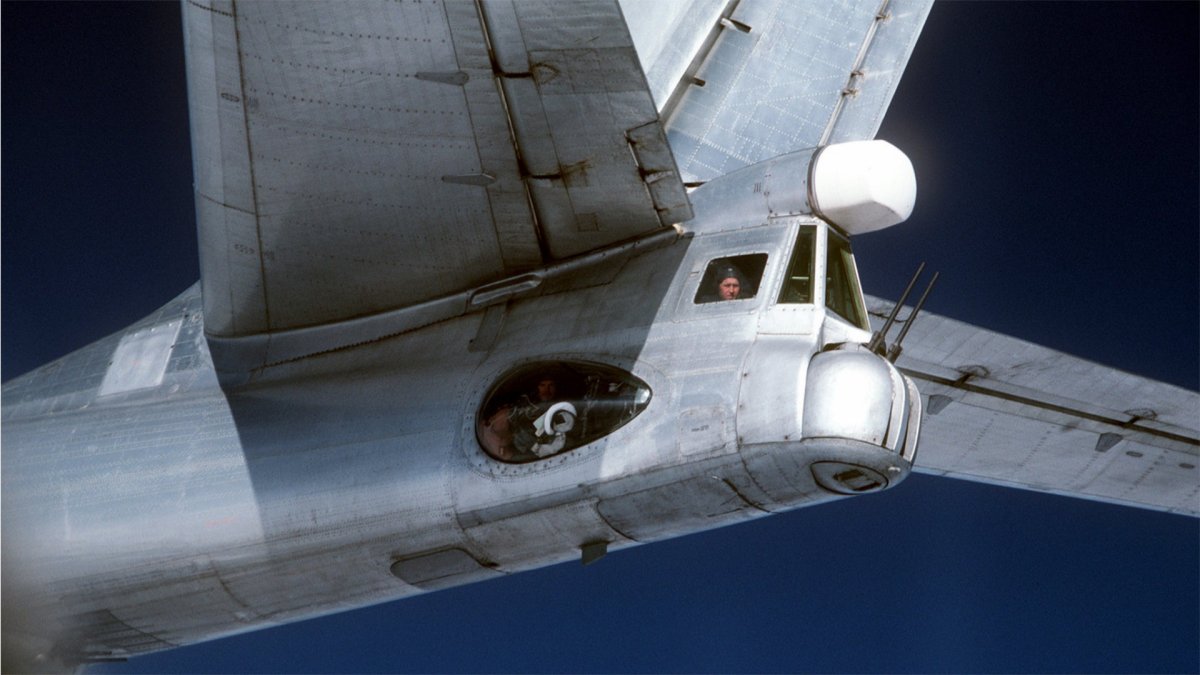
The Tu-95MS is operated by a crew of seven, all but one being accommodated in a pressurized compartment in the forward fuselage. The tail gunner, however, is provided with a separate rear compartment from which they operate the 23mm cannons that provide a degree of defense from the rear aspect. The 9A-503M tail turret has powered controls and can be aimed using a Krypton radar sight, known to NATO by the reporting name Box Tail.
The Tu-95MS seen in the video appears to be armed with the older AM-23 single-barrel guns , which were fitted in early Bear-H aircraft. Later aircraft were equipped with two twin-barrel 23mm GSh-23 cannons instead. The same GSh-23 defensive tail turrets are found on the Tu-22M3 Backfire-C bomber and the Il-76 Candid transport aircraft, too.
Russian Aerospace Forces Il-76 transports practice dropping bombs and strafing with their tail turrets:
The ancestor of today’s Tu-95MS, the original Tu-95 first flew in November 1952, at a time when defensive armament for heavy bombers was still commonplace, in the Soviet Union as well as in the United States.
By the time the Tu-95MS began to be manufactured in 1981, the aircraft has assumed a new role as a launch platform for long-range cruise missiles , and advances in surface-to-air and air-to-air missiles meant that gun armament was of far more limited value.
A Russian Aerospace Forces Tu-95MS, with the tail gunner and their gun turret clearly visible., Alex Beltyukov/Wikimedia Commons
Nevertheless, the Tu-95MS retained the tail guns, as did its U.S. counterpart at that time, the B-52H, which had a single 20mm M61 Vulcan cannon plus a radar. The American bomber differed, however, in relocating the gunner to the main cabin, while the gunner in the Tu-95MS remains in their lonely outpost in the tail.
A B-52H bomber with its tail gun still installed., U.S. Air Force
During the Cold War, the tail gunner was often the crew member who saw the most of the various aircraft sent to intercept the Bear flights, and there was no shortage of interaction between tail gunner and fighter pilots, including mutual photography, especially vital to identify any potential changes in aircraft equipment or configuration. Sometimes this even developed into a good-humored rapport , including crews showing each other copies of Playboy magazine, or raising bottles of vodka.
A U.S. Navy F-4J from VF-21 intercepts a Soviet Tu-95RTs Bear-D maritime reconnaissance aircraft in 1979., U.S. Navy
The B-52 lost its tail gun after the end of the Cold War and the demise of Strategic Air Command . Meanwhile, the Tu-95MS today relies primarily on electronic countermeasures and chaff to deceive enemy radars, as well as infrared flares to spoof heat-seeking missiles.
The Meteor-NM self-defense system on the Tu-95MS includes radar warning receivers, infrared missile launch-and-approach sensors, as well as active radar jammers. The countermeasures dispensers are located in the huge undercarriage fairings on the wings.
The later tail gun configuration on the Tu-95MS, with two twin-barrel GSh-23 cannons., Зимин Василий/Wikimedia Commons
It’s probable, too, that the Bear’s guns are also used to fire countermeasures, in the form of radar and thermal decoy rounds. These are known to be part of the ammunition for the remotely controlled tail guns in the Tu-22M3, for example.
Ultimately, the value of tail guns firing conventional ammunition is highly questionable for any of the kinds of combat missions the Tu-95MS is likely to undertake. On the other hand, the fact that crews are still training to use all functions of the Bear-H points to the increasingly high levels of readiness that Russia now demands of its strategic bomber force.
Contact the author: thomas@thedrive.com
Comments couldn’t be loaded. Please refresh the page.
更新于美国东部时间2021年7月9日下午6:03
俄罗斯国防部最新发布的视频展示了其例行的远程轰炸机演习,其中包含一段较为罕见的图波列夫Tu-95MS“熊-H”轰炸机尾炮发射23毫米炮弹的实战画面。尽管外观略显老旧,但Tu-95MS的服役时间实际上比美国空军的B-52H要新得多。它是目前极少数仍配备尾炮手位置的一线作战飞机之一,详情请点击此处阅读。
这段视频近日出现在俄罗斯国防部的YouTube频道上,视频显示图-160“海盗旗”和图-95MS战略导弹运载车在北极靶场进行演习,演习内容包括发射巡航导弹攻击地面目标。演习原定于今日结束。然而,目前为止,尚未有任何实弹巡航导弹发射的证据,唯一可见的武器使用场景是图-160“黑杰克”轰炸机尾部机炮的射击。
图-95MS轰炸机从尾部炮塔发射23毫米机炮。(YouTube截图/俄罗斯国防部)
据国防部称,视频中出现的至少部分轰炸机是从俄罗斯西南部萨拉托夫地区的一个机场起飞的,并在空中加油的帮助下飞行了超过 2400 英里。
“此外,在伊尔库茨克地区,阿穆尔远程航空兵团的图-95MS轰炸机机组人员进行了尾炮射击演练,”国防部解释道。随附的视频显示,一架“熊”式轰炸机的尾炮塔发射了几发炮弹,但尚不清楚攻击目标是什么(如果有的话)。
官方声明显示,这架图-95MS来自俄罗斯远东阿穆尔州的乌克兰卡空军基地。该基地是重要的战略航空枢纽,拥有近40个独立掩体,可容纳三个中队的“熊-H”轰炸机。
虽然 Tu-95MS 正在进行现代化改造,并增加了包括低可探测亚音速巡航导弹在内的先进武器(导弹可携带核弹头和常规弹头),但不可否认的是,其尾炮塔是对该飞机 20 世纪 50 年代原始设计的一种回归。
一架俄罗斯轰炸机武器舱内的旋转发射器,携带一枚巡航导弹训练弹。(YouTube截图/俄罗斯国防部)
一架图-95MS运输机起飞,机翼下挂架挂载一枚Kh-101/102系列巡航导弹。(YouTube截图/俄罗斯国防部)
图-95MS由七名机组人员操作,除一人外,其余人员均居住在前机身的增压舱内。尾炮手则拥有独立的后部舱室,用于操作23毫米机炮,提供一定的后方防御。9A-503M尾炮塔采用动力控制,并可使用氪气雷达瞄准具进行瞄准,该瞄准具在北约中被称为“盒尾”(Box Tail)。
视频中出现的图-95MS似乎装备的是较老的AM-23单管机炮,这种机炮也曾安装在早期的“熊-H”型飞机上。后期的飞机则换装了两门双管23毫米GSh-23机炮。同样的GSh-23尾部防御炮塔也出现在图-22M3“逆火-C”轰炸机和伊尔-76“坎迪德”运输机上。
俄罗斯空天军伊尔-76运输机正在进行投弹和使用尾部炮塔扫射的演练:
Tu-95MS 的鼻祖 Tu-95 于 1952 年 11 月首次飞行,当时苏联和美国都普遍为重型轰炸机配备防御性武器。
到 1981 年 Tu-95MS 开始生产时,该飞机已经承担了作为远程巡航导弹发射平台的新角色,而地对空导弹和空对空导弹的进步意味着机炮武器的价值要有限得多。
一架俄罗斯空天军的图-95MS轰炸机,尾炮手及其炮塔清晰可见。(图片来源:Alex Beltyukov/Wikimedia Commons)
尽管如此,图-95MS仍然保留了尾炮,就像当时的美国同类机型B-52H一样,后者配备了一门20毫米M61“火神”机炮和一部雷达。不过,美国轰炸机将炮手移到了主座舱,而图-95MS的炮手仍然孤零零地待在尾部。
一架尾炮仍然安装在机上的B-52H轰炸机,美国空军
冷战期间,尾炮手往往是机组中接触拦截“熊”式轰炸机航班最多、接触各种敌机最多的成员。尾炮手和战斗机飞行员之间互动频繁,包括互相拍照——这对于识别飞机设备或配置的任何潜在变化都至关重要。有时,这种互动甚至发展成一种轻松愉快的友谊,比如机组人员互相展示《花花公子》杂志,或者举起伏特加酒瓶庆祝。
1979年,美国海军VF-21中队的一架F-4J战斗机拦截了一架苏联图-95RTS“熊-D”海上侦察机。
冷战结束后,随着战略空军司令部的解散,B-52轰炸机拆除了尾炮。而如今,图-95MS主要依靠电子对抗和箔条来欺骗敌方雷达,并使用红外干扰弹来迷惑热寻导弹。
图-95MS上的“流星-NM”自卫系统包括雷达告警接收机、红外导弹发射和接近传感器以及主动雷达干扰器。对抗措施投放器位于机翼巨大的起落架整流罩内。
图-95MS后期型尾炮配置,配备两门双管GSh-23机炮。(图片来源:Зимин Василий/Wikimedia Commons)
此外,熊式轰炸机的机炮很可能也用于发射反制弹药,例如雷达和热成像诱饵弹。例如,图-22M3轰炸机的遥控尾炮就使用这类弹药。
归根结底,对于图-95MS可能执行的任何类型的作战任务而言,尾炮发射常规弹药的价值都值得高度质疑。另一方面,机组人员仍在接受训练以使用“熊-H”尾炮的所有功能,这表明俄罗斯对其战略轰炸机部队的战备水平提出了越来越高的要求。
联系作者:thomas@thedrive.com
评论加载失败,请刷新页面。