Torpedo Fired From Uncrewed Submarine For The First Time By U.S., U.K.美国和英国首次从无人潜艇发射鱼雷
Uncrewed underwater vehicles that can launch attacks on other vessels open up new tactical possibilities and could help fill gaps in traditional submarine coverage.
新闻视频
By Joseph Trevithick
Published Sep 22, 2026 1:09 PM EDT
A British Excalibur uncrewed underwater vehicle (UUV) has fired a U.S. Mk 48 heavyweight torpedo in what is said to be a first-of-its-kind test for both countries. Though just a proof-of-concept so far, this is a significant new step for the United States and the United Kingdom toward future operational fleets of armed UUVs.
The U.S. Navy and the Royal Navy conducted the armed UUV test at the British Underwater Test & Evaluation Center (BUTEC), a maritime test range in Scotland, on September 13. Personnel from the Pentagon’s Defense Innovation Unit (DIU) and the Naval Undersea Warfare Center Keyport Division (NUWC Keyport), as well as unspecified industry partners, also took part, per a U.S. Navy press release .
📰 U.S. NAVY UPDATE: U.S. Navy and Royal Navy Successfully Test Fire Torpedo from Unmanned Undersea Vehicle 📍WASHINGTON – On September 13, 2026, the U.S. Navy and the Royal Navy successfully conducted the proof-of-concept launch of an exercise U.S. Mk 48 Heavyweight Torpedo… pic.twitter.com/lVB4wYSwC0 — Office of the Chief of Naval Operations (@USNavyCNO) September 22, 2026
📰 U.S. NAVY UPDATE: U.S. Navy and Royal Navy Successfully Test Fire Torpedo from Unmanned Undersea Vehicle 📍WASHINGTON – On September 13, 2026, the U.S. Navy and the Royal Navy successfully conducted the proof-of-concept launch of an exercise U.S. Mk 48 Heavyweight Torpedo… pic.twitter.com/lVB4wYSwC0
The test was also carried out under the umbrella of Pillar 2 of the trilateral Australia-United Kingdom-United States (AUKUS) defense cooperation agreement, which was first announced in 2021. AUKUS’ Pillar 2 covers a wide range of advanced technology cooperation, with particular focus on uncrewed platforms and autonomy . Pillar 1 of the agreement centers on support for Australia’s establishment of a nuclear submarine force .
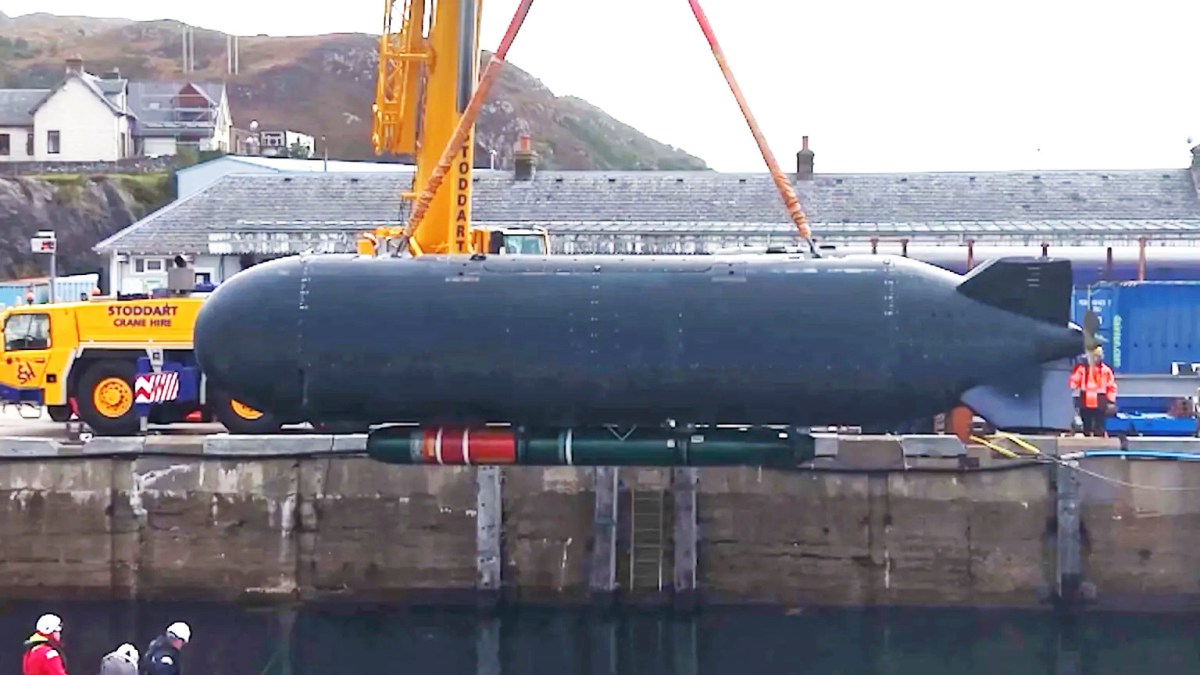
For the September 13 test, the Mk 48 torpedo was slung under the Excalibur UUV. The nearly 40-foot (12-meter) long, 19-metric-ton submersible drone has a large internal payload bay, but it is reportedly not large enough to accommodate the Mk 48, which is the standard heavyweight torpedo in U.S. Navy service today. The 19-foot-long, 21-inch-diameter weapon has been successively upgraded over the years to expand its capabilities and improve its resistance to enemy countermeasures.
Screen captures from a video the US Navy released today showing the release of the Mk 48 torpedo from the Excalibur UUV during the test earlier this month. USN captures
A stock picture of a Mk 48-series torpedo. DOD
A US Navy infographic detailing just some of the upgrades to the Mk 48 series over the decades. The Navy has now moved on to the further improved Mk 48 Mod 8 variant. USN
The Royal Navy officially unveiled Excalibur , which was developed by U.K.-based MSubs under Project Cetus , last year. The external torpedo launch capability was the result of two additional efforts, called Project Broadsword and Trial Iron, according to the U.S. Navy release.
A picture of an Excalibur UUV at the time of its unveiling in 2025, giving a good general sense of its size. Royal Navy
The September 13 test “successfully validated the mechanical, electrical, and software integration of a U.S. kinetic payload onto an allied autonomous vessel, proving that allied forces can rapidly achieve weapon interchangeability,” the Navy’s release adds. “Approved in February 2026 by the Department of the Navy Rapid Capabilities Office (DONRCO), the project was executed in less than seven months.”
How the Excalibur UUV was controlled during the test and whether the torpedo was launched at a test target of some kind are unknown. TWZ has reached out for more information.
A look at the Excalibur UUV submerged, from the video the US Navy released today. USN capture
“BROADSWORD is a great example of how AUKUS Pillar II drives interoperability in across the alliance. Demonstrating the launch of a US torpedo from a UK extra-large unmanned underwater vehicle (XLUUV) is an important early step in developing lethality in our undersea autonomous systems,” U.S. Navy Vice Adm. Robert Gaucher, Director of Submarine Programs, did say in a statement. “We look forward to continuing to leverage the AUKUS partnership to keep pushing the potential warfighting advantages of unmanned undersea systems.”
“This successful test marks a historic first for allied undersea warfare,” U.S. Navy Adm. Daryl Caudle, Chief of Naval Operations, also said in a statement. “Proving that we can seamlessly launch a U.S. heavyweight torpedo from a Royal Navy autonomous underwater vehicle validates our shared vision for true interchangeability.
“This is a really important moment in our journey towards building a hybrid navy, which is where the Royal Navy will sail with crewed ships and submarines alongside uncrewed and autonomous vessels,” Luke Pollard, U.K. Minister of State for Defence Readiness and Industry, separately said in an interview with LBC radio . “It is a substantial increase in our lethality, to show that torpedoes can be fired not just by the Astute class hunter-killer submarines that we have in the Royal Navy, but also now by our uncrewed systems.”
A Royal Navy Astute class nuclear-powered attack submarine. UK Ministry of Defense
The U.S. Navy and the Royal Navy employ various tiers of UUVs operationally today , but primarily for mine-sweeping and reconnaissance and surveillance missions. Future fleets of submersible drones capable of carrying out attacks on other vessels will create entirely new operational possibilities. Operated closely together with crewed surface warships and submarines, torpedo-toting UUVs could be sent ahead into riskier environments and offer an immediate option for engaging any threats they might find. Even a bigger UUV like Excalibur would also be more challenging for opponents to spot and track than a traditional attack submarine.
Excalibur is also in a category of larger and more capable submersible drones that offer significant endurance and higher degrees of autonomy. Adding in the ability to launch torpedoes, in turn, then opens the door to new concepts for employing these UUVs in groups more independently of crewed companions. In the future, for instance, armed Excaliburs or similar UUVs might be deployed to a particular maritime choke point to not just monitor for enemy movements, but actively hold them at risk.
In addition, in general, UUVs offer a way to expand total undersea warfare capacity in a more cost-effective manner compared to acquiring and fielding more traditional submarines. The ability to have more presence below the waves at a lower price point also translates to more persistence across large areas, something that could be especially valuable across the broad expanses of the Pacific , as well as other bodies of water globally. This presents additional targeting challenges and uncertainty for opponents.
“In securing the North Atlantic, especially against those nations that wish to do us harm, like Russia, the ability for us to now say it’s not just where our submarines are that you need to worry about – it is about how we create greater deterrence and question marks in the eyes of our adversary, with uncrewed systems there as well,” U.K. Minister Pollard said in speaking with LBC .
Pollard’s remarks here speak to particular considerations the British government is faced with just in its backyard. This includes the so-called Greenland-Iceland-United Kingdom (GIUK) Gap , which is the main path through which Russian Navy submarines transit to and from bases in the northwestern end of that country and the Atlantic proper. There is also the English Channel and the nearby Baltic Sea . The Royal Navy has limited capacity with its crewed submarines to monitor this and other critical regional chokepoints. UUVs could then help take pressure off its fleet of jus sixt Astute class submarine, helping free those boats up for the myriad other missions they are tasked with, including carrier escort and special operations support.
“By converting commercial and allied uncrewed undersea hulls into high-end strike assets, the partnership drastically alters the cost-exchange ratio in contested maritime environments,” the U.S. Navy’s press release today notes, as well.
There are still many questions still to be answered about future larger UUV operations, including just how they will be deployed and recovered. Video the U.S. Navy released today shows that the torpedo-armed Excalibur was launched into the water in Scotland using a commercial truck-mounted crane. U.S. shipbuilders Huntington Ingalls Industries (HII) and General Dynamics National Steel and Shipbuilding Company (NASSCO) , among others, have been working on new options for launching and retrieving larger drone submersibles from surface warships. External carriage on the hulls of ships and/or submarines might also be an option in the future.
A picture from a test in 2022 of a prototype portable cradle for launching large UUVs developed by HII. The UUV seen here is that company’s Proteus design. HII
Additional torpedo and other munition options for UUVs beyond the full-size Mk 48 could also be on the horizon. The U.S. Navy has invested heavily in compact and lightweight torpedo designs that could be well suited for employment from underwater drones like Excalibur.
The U.S. Navy says it is working with its international partners on another similar UUV capability demonstration, but this time involving an Anduril Dive-XL , under what is dubbed Project Cutlass. This effort “will tackle advanced payload integration data, command and control architectures, and tactical employment scenarios to further mature uncrewed undersea capabilities,” according to the U.S. Navy’s release.
The Royal Australian Navy is already in the process of acquiring and fielding a militarized version of the Dive-XL, called Ghost Shark . It’s also worth noting that the Dive-XL evolved from the earlier Dive-LD design. The Dive-LD is in at least limited operational U.S. Navy service now, a fact that was revealed by Iran’s capture of one of these submersible drones earlier this month, as you can read more about here .
The U.S. Navy is also continuing to push ahead with plans to field a force of Orca XLUUVs from Boeing . In August, the service announced that an Orca had conducted a 1,000-nautical-mile transit in the Pacific the preceding month as part of the ongoing development of that design.
Other countries are pursuing larger UUVs, as well. China has been making strides in this regard and is in some ways ahead of other competitors globally.
Excalibur’s ability to launch a standard Mk 48 heavyweight torpedo is already an important show of progress now toward a shared goal of a future underwater ecosystem that includes submersible drones that are able to attack other vessels.
Contact the author: joe@twz.com
Comments couldn’t be loaded. Please refresh the page.
作者:约瑟夫·特雷维西克
发布于美国东部时间2026年9月22日下午1:09
英国“神剑”(Excalibur)无人水下航行器(UUV)成功发射了一枚美国Mk 48重型鱼雷,据称这是两国首次进行此类测试。尽管目前仅是概念验证,但这对于美国和英国而言,是朝着未来部署武装UUV舰队迈出的重要一步。
9月13日,美国海军和英国皇家海军在苏格兰的英国水下测试与评估中心(BUTEC)——一个海上测试场——进行了武装无人水下航行器(UUV)测试。根据美国海军的新闻稿,五角大楼国防创新部门(DIU)和海军水下作战中心基波特分部(NUWC Keyport)的人员以及未指明的行业合作伙伴也参与了此次测试。
📰 美国海军最新消息:美国海军和英国皇家海军成功测试无人水下航行器发射鱼雷 📍华盛顿——2026年9月13日,美国海军和英国皇家海军成功进行了美国Mk 48重型鱼雷的概念验证发射演习…… pic.twitter.com/lVB4wYSwC0 — 美国海军作战部长办公室 (@USNavyCNO) 2026年9月22日
📰 美国海军最新消息:美国海军和英国皇家海军成功测试无人水下航行器发射鱼雷 📍华盛顿——2026年9月13日,美国海军和英国皇家海军成功进行了美国Mk 48重型鱼雷的概念验证发射演习…… pic.twitter.com/lVB4wYSwC0
此次测试也是在澳大利亚、英国和美国(AUKUS)三方防务合作协议第二支柱框架下进行的,该协议于2021年首次宣布。AUKUS协议第二支柱涵盖广泛的先进技术合作,尤其侧重于无人平台和自主作战能力。该协议的第一支柱则侧重于支持澳大利亚建立核潜艇部队。
在9月13日的测试中,Mk 48鱼雷被悬挂在“神剑”(Excalibur)无人水下航行器下方。这艘长近40英尺(12米)、重19吨的无人水下航行器拥有一个大型内部有效载荷舱,但据报道,其空间不足以容纳Mk 48鱼雷——目前美国海军的标准重型鱼雷。这种长19英尺、直径21英寸的武器经过多年的不断升级,以扩展其性能并提高其抵抗敌方反制措施的能力。
美国海军今天发布的一段视频截图显示了本月初测试期间“神剑”(Excalibur)无人水下航行器释放Mk 48鱼雷的过程。
一张Mk 48系列鱼雷的库存照片。美国国防部
美国海军制作了一张信息图,详细介绍了Mk 48系列坦克几十年来的一些升级。目前,海军已升级至性能更优的Mk 48 Mod 8型。
英国皇家海军去年正式发布了“亚瑟王之剑”(Excalibur)潜艇,该潜艇由英国MSubs公司在“鲸鱼座计划”(Project Cetus)下研发。据美国海军发布的消息,其外部鱼雷发射能力是另外两项研发工作的成果,这两项工作分别名为“阔剑计划”(Project Broadsword)和“铁试计划”(Trial Iron)。
一张“神剑”(Excalibur)无人水下航行器在2025年首次亮相时的照片,可以很好地展现其大致尺寸。英国皇家海军
海军发布的新闻稿补充道,9月13日的测试“成功验证了美国动能有效载荷与盟军自主舰艇的机械、电气和软件集成,证明盟军能够快速实现武器互换性”。“该项目于2026年2月获得海军部快速能力办公室(DONRCO)批准,并在不到7个月的时间内完成。”
目前尚不清楚“神剑”无人水下航行器在测试期间是如何控制的,也不清楚鱼雷是否发射击中了某种测试目标。TWZ已联系相关部门以获取更多信息。
这是美国海军今天发布的视频,展示了“神剑”(Excalibur)无人水下航行器(UUV)的水下航行状态。美国海军捕获
“‘宽剑’演习充分展现了‘奥库斯’第二支柱如何推动联盟内部的互操作性。演示从英国超大型无人水下航行器(XLUUV)发射美国鱼雷,是提升我们水下自主系统杀伤力的重要早期步骤。”美国海军潜艇项目主管罗伯特·高彻中将在声明中表示,“我们期待继续利用‘奥库斯’伙伴关系,不断提升无人水下系统的潜在作战优势。”
“这次成功的测试标志着盟军水下作战历史上的一个里程碑,”美国海军作战部长达里尔·考德尔海军上将在声明中表示。“证明我们可以从英国皇家海军的自主水下航行器上无缝发射美国重型鱼雷,验证了我们对真正互换性的共同愿景。”
英国国防战备与工业国务大臣卢克·波拉德在接受LBC电台采访时表示:“这是我们构建混合型海军征程中的一个重要时刻,届时皇家海军将同时拥有有人舰艇和潜艇以及无人自主舰艇。这大大提升了我们的杀伤力,表明鱼雷不仅可以由皇家海军现有的机敏级攻击型潜艇发射,现在也可以由我们的无人系统发射。”
英国皇家海军“机敏”级核动力攻击潜艇。英国国防部
目前,美国海军和英国皇家海军都在作战中使用不同级别的无人水下航行器(UUV),但主要用于扫雷、侦察和监视任务。未来,能够对其他舰艇进行攻击的水下无人航行器舰队将创造全新的作战可能性。携带鱼雷的UUV可以与有人驾驶水面舰艇和潜艇紧密配合,被派往风险更高的区域,并能立即应对任何可能遇到的威胁。即使是像“神剑”(Excalibur)这样更大的UUV,也比传统的攻击型潜艇更难被对手发现和追踪。
“神剑”也属于更大、性能更强的潜水无人机范畴,这类无人机拥有更长的续航时间和更高的自主性。而如果再加上发射鱼雷的能力,就能为这类无人水下航行器(UUV)的集群部署开辟新的思路,使其能够更加独立于载人舰艇执行任务。例如,未来可以将武装的“神剑”或类似的无人水下航行器部署到特定的海上咽喉要道,不仅用于监视敌方动向,还能主动威胁敌方安全。
此外,与采购和部署传统潜艇相比,无人水下航行器(UUV)通常能以更经济高效的方式扩展水下作战能力。以更低的成本获得更强的水下存在感,也意味着在更大范围内拥有更强的持续作战能力,这在广袤的太平洋以及全球其他水域尤为重要。这给对手带来了更大的目标定位挑战和不确定性。
英国大臣波拉德在接受LBC采访时表示:“在确保北大西洋安全方面,尤其是在防范像俄罗斯这样想要伤害我们的国家方面,我们现在能够说,你们需要担心的不仅仅是我们的潜艇在哪里——而是我们如何利用无人系统,在对手眼中制造更大的威慑和疑虑。”
波拉德的这番话恰恰反映了英国政府在其周边地区面临的一些特殊考量。这其中包括所谓的格陵兰-冰岛-英国(GIUK)海峡,俄罗斯海军潜艇往返于格陵兰西北部基地和大西洋主海域的主要通道。此外,还有英吉利海峡和附近的波罗的海。英国皇家海军的有人潜艇能力有限,难以监控这些以及其他关键的区域咽喉要道。无人水下航行器(UUV)可以有效缓解其仅有的六艘机敏级潜艇的压力,使这些潜艇能够腾出手来执行其他众多任务,例如航母护航和特种作战支援。
“通过将商用和盟国的无人水下船体改造成高端打击资产,这种合作关系极大地改变了竞争激烈的海上环境中的成本交换比率,”美国海军今天发布的新闻稿也指出。
关于未来更大规模的无人水下航行器(UUV)作战,仍有许多问题亟待解答,包括它们的部署和回收方式。美国海军今天发布的视频显示,装备鱼雷的“神剑”(Excalibur)无人水下航行器在苏格兰使用商用车载起重机下水。包括亨廷顿·英格尔斯工业公司(HII)和通用动力国家钢铁造船公司(NASSCO)在内的美国造船企业一直在研究从水面舰艇上投放和回收大型无人水下航行器的新方案。未来,舰艇和/或潜艇的船体外部挂载也可能成为一种选择。
这是一张2022年HII公司研发的用于发射大型无人水下航行器(UUV)的便携式原型发射架的测试照片。图中所示的UUV是该公司设计的Proteus型UUV。
除了全尺寸的Mk 48鱼雷之外,未来可能还会推出更多适用于无人水下航行器(UUV)的鱼雷和其他弹药。美国海军已投入巨资研发紧凑轻便的鱼雷,这些鱼雷可能非常适合像“神剑”(Excalibur)这样的水下无人机使用。
美国海军表示,正与国际合作伙伴开展另一项类似的无人水下航行器(UUV)能力演示,此次将使用Anduril Dive-XL型无人水下航行器,该项目代号为“弯刀计划”(Project Cutlass)。美国海军发布的消息称,这项工作“将着重研究先进有效载荷集成数据、指挥控制架构以及战术运用场景,以进一步提升无人水下作战能力”。
澳大利亚皇家海军目前正在采购并部署Dive-XL的军用版本,代号“幽灵鲨”(Ghost Shark)。值得一提的是,Dive-XL是由早期的Dive-LD发展而来。Dive-LD目前已在美国海军有限服役,伊朗本月初捕获了一架该型潜水无人机,证实了这一点,详情请点击此处阅读。
美国海军也在继续推进部署波音公司生产的“虎鲸”(Orca)超大型无人水下航行器(XLUUV)的计划。今年8月,海军宣布,作为该设计持续研发的一部分,“虎鲸”号在上个月完成了1000海里(约1600公里)的太平洋航行。
其他国家也在研发更大的无人水下航行器。中国在这方面取得了长足进步,并在某些方面领先于全球其他竞争对手。
“神剑”号能够发射标准的 Mk 48 重型鱼雷,这已经是一个重要的进步,表明我们在朝着共同目标迈出了重要一步,即构建一个包括能够攻击其他船只的潜水无人机在内的未来水下生态系统。
联系作者:joe@twz.com
评论加载失败,请刷新页面。