Time, not capital, is the constraint on the defense industrial base制约国防工业基础的并非资金,而是时间。
Here are three changes to speed things up without lowering standards.
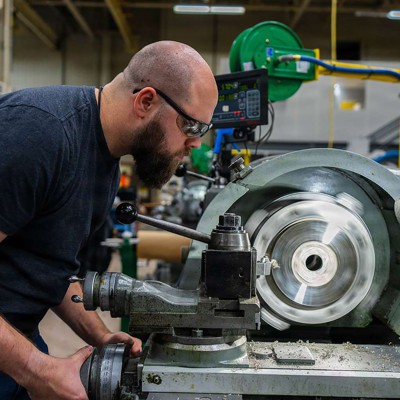
U.S. Navy / Petty Officer 2nd Class Jonathan Estrada-Eguizabal
Here are three changes to speed things up without lowering standards.
The Pentagon's industrial-base problem is no longer a shortage of capital. It is the time required to turn that capital into qualified suppliers, suppliers into parts, and parts into weapons in warfighters’ hands.
Three changes would shorten that timeline more than the next hundred billion dollars in appropriations. First, let defense suppliers that have earned a qualification for one program—that is, proven through testing and quality review that they meet its requirements—keep that qualification when seeking work in another program with similar requirements. Second, fund qualification as its own budget line. And third, increase multiyear acquisition to create the kind of demand that lower-tier suppliers can use to secure financing. None of these require new authority. None lowers a standard.
The Department began fiscal 2026 holding $382.4 billion in unexpired, unobligated appropriations, the One Big Beautiful Bill Act added $152.3 billion more, and in June the administration asked for another $67.1 billion . Unfortunately, appropriations don’t shorten lead time. Boeing builds the active radar seeker for every PAC-3 MSE interceptor in Huntsville, and in April the Pentagon signed a seven-year framework to triple that output. A finished interceptor takes about two years to build, but qualifying a new component supplier takes even longer . Consequently, rounds bought this year are unlikely to reach the field before 2028.
Capacity that cannot produce a qualified part for two or three years is not yet military capacity. It is potential capacity. The gap between the two is mobilization latency, and qualification has become one of its largest hidden components. Double demand for a critical munition tomorrow and Congress can appropriate the money within weeks, industry can buy equipment within months, but every new supplier then enters an 18- to 36-month qualification cycle. Appropriated capacity and combat capacity are not the same thing.
I should say plainly where I sit. Seurat makes metal parts under contract using our own high-speed additive process, dubbed Area Printing , and we sell the parts rather than the printers. We are one of 25 awardees under JAQS-SQ , a $10.5-million Pentagon-funded America Makes project call. We would benefit directly if the government spent more on supplier qualification. My industry spent two decades promising more than it delivered. Additive manufacturing was going to replace machining, then reinvent the supply chain, and mostly it printed prototypes and low-volume parts. A program office skeptical of claims from the additive industry is applying a lesson we taught it.
Program offices are where the first change happens. A supplier that passed an audit for one program generally starts from zero for the next. A program office is accountable for its own program, so accepting another office's audit means taking on a risk judgment it did not make. Every program manager is behaving rationally, and the result is a system optimized to minimize program-level risk rather than mobilization time and qualification costs. The fix is a doctrine of qualify once, use many. Part qualification stays program-specific; what becomes portable is the evidence about the factory, so no office re-proves the shop before it begins proving the part. JAQS-SQ is building that framework now. What is missing is a decision by acquisition leaders to accept each others’ results.
Second, fund qualification as its own budget line. Inside industrial-base accounts, qualification competes against tooling and usually loses, because a machine tool can be bought and installed inside one budget cycle and a qualification package cannot. That line would cost about one percent of industrial base appropriations, or roughly $82 million against the $8.2 billion the Reconciliation Act routed through the Industrial Base Fund.
Third, give the supplier layer —that is, the companies that supply prime contractors—demand it can borrow against. The Department estimates it has lost more than 40 percent of its small-business suppliers over the past decade, and survivors are running at capacity. That sounds like health but is not, because a shop with no idle capacity must pull engineering hours from paying work to qualify a part that may never be ordered. The government does not need to finance every expansion; private capital will fund defense capacity when it can see durable demand. Multiyear procurement is one of the few instruments that turns stated intent into a contract a small shop can take to a lender. The ask is not more grants but enough contractual certainty that banks and investors do the financing.
The strongest argument against all of this is that qualification is rigorous for a reason. A motor case that fails in flight kills people, and additive processes deserve more scrutiny than conventional ones because a part's microstructure depends on parameters that vary by machine. That argument is correct, and I am not advocating faster approvals or looser standards. Instead, the infrastructure for running that standard rigorously, meaning trained auditors, shared process control documents, and material databases, is funded like an afterthought.
There is a fourth change worth making, and it would cost us—that is, my company and others like it. There should be no additive-specific set-asides. Fund qualified production rather than technologies: define the outcome and the standard and let manufacturers compete to meet it. If a conventional manufacturer can hold the spec at the rate and schedule, it should win the work, and on many high-volume part numbers today, it will.
None of this addresses what happens to a qualified supplier that waits two years without an order, a harder problem deserving its own argument. In a protracted conflict, the decisive industrial question will be how quickly the United States can turn manufacturing capacity into qualified production because deterrence rests on an adversary believing the United States can replace what it expends. The next phase of rebuilding the arsenal should be measured not in dollars obligated or factories expanded, but in something much harder to game: how many additional qualified suppliers can produce critical parts, and how quickly they can begin delivering them.
James DeMuth is CEO and co-founder of Seurat Technologies, a metal-parts contract manufacturer in Wilmington, Massachusetts
NEXT STORY: Pete Hegseth is rebuilding the military's ‘brass ceiling’
美国海军/二级士官乔纳森·埃斯特拉达-埃吉萨巴尔
以下三项改变可以在不降低标准的前提下加快速度。
五角大楼的工业基础问题不再是资金短缺,而是将资金转化为合格供应商、将供应商转化为零部件、将零部件转化为作战人员手中的武器所需的时间。
三项改革措施比接下来一千亿美元的拨款更能缩短工期。首先,允许已获得某项国防项目资质(即通过测试和质量审查证明符合项目要求)的供应商在申请其他类似项目时保留该资质。其次,将资质认证作为一项独立的预算项目。第三,增加多年期采购,以创造低级别供应商可以利用的需求来获得融资。这些措施均无需新的授权,也不会降低标准。
国防部在2026财年开始时拥有3824亿美元的未到期未动用拨款,一项名为《一项宏伟法案》(One Big Beautiful Bill Act)的拨款又增加了1523亿美元,而今年6月,政府又申请追加671亿美元。然而,拨款并不能缩短交付周期。波音公司在亨茨维尔工厂为每枚PAC-3 MSE拦截弹生产主动雷达导引头,而五角大楼在4月份签署了一项为期七年的框架协议,旨在将该产量提高三倍。一枚完整的拦截弹大约需要两年时间才能制造完成,但对新的零部件供应商进行资质认证则需要更长时间。因此,今年采购的导弹不太可能在2028年之前投入使用。
两三年内无法生产合格零部件的产能还不能称之为军事产能,而只是潜在产能。两者之间的差距在于动员延迟,而资质认证已成为其中最大的隐性环节之一。如果明天对某种关键弹药的需求翻倍,国会可以在几周内拨款,工业界可以在几个月内采购设备,但每个新供应商随后都必须经历18到36个月的资质认证周期。已拨款的产能和作战产能并非同一概念。
我应该坦诚地说明我的立场。Seurat公司利用我们自主研发的高速增材制造工艺——区域打印(Area Printing),承接金属零件的代工生产,我们销售的是零件本身,而不是打印机。我们是JAQS-SQ项目的25家获奖企业之一,该项目是五角大楼资助的“美国制造”(America Makes)计划的一部分,总投资1050万美元。如果政府在供应商资质认证方面投入更多资金,我们将直接受益。过去二十年,我的行业承诺远多于实际交付。增材制造曾被寄予厚望,认为它将取代机械加工,重塑供应链,但实际上它主要只是打印原型和小批量零件。一个对增材制造行业的说法持怀疑态度的项目办公室,正在吸取我们曾经给它的教训。
项目办公室是变革发生的第一个环节。一家供应商如果通过了某个项目的审核,那么在下一个项目中通常就得从零开始。项目办公室对其自身的项目负责,因此接受其他办公室的审核结果意味着承担其并未做出的风险判断。每个项目经理的行为都基于理性,最终形成的系统旨在最大限度地降低项目层面的风险,而不是优化启动时间和认证成本。解决之道在于“一次认证,多用途”的原则。零部件认证仍然针对特定项目;可移植的是工厂的认证信息,因此任何办公室都不必在开始认证零部件之前重新认证工厂。JAQS-SQ 目前正在构建这一框架。目前缺失的是采购领导者之间相互接受彼此审核结果的共识。
其次,应将资格认证作为单独的预算项目。在工业基础账户中,资格认证与工具购置竞争,通常处于劣势,因为机床可以在一个预算周期内完成购买和安装,而资格认证方案则无法做到这一点。该项目将耗资约占工业基础拨款的百分之一,即约8200万美元,而根据《预算协调法案》,工业基础基金的拨款总额为82亿美元。
第三,要赋予供应商层——也就是为主要承包商供货的公司——以可作为抵押进行贷款的需求。国防部估计,过去十年里,其小型企业供应商流失了超过40%,而幸存下来的企业也已满负荷运转。这听起来像是经济状况良好,但实际上并非如此,因为没有闲置产能的企业必须从已完成的工作中抽出工程工时来验证一个可能永远不会被订购的零件。政府无需为每一次扩张提供资金;当私人资本看到持续的需求时,它们就会为国防能力建设提供资金。多年期采购是为数不多的能够将既定意向转化为小型企业可以向贷款机构申请的合同的工具之一。我们需要的不是更多的拨款,而是足够的合同确定性,从而让银行和投资者愿意提供融资。
反对这一切的最有力论点是,认证流程之所以严格是有原因的。飞行中发动机外壳故障会造成人员伤亡,而增材制造工艺比传统工艺更值得严格审查,因为零件的微观结构取决于因机器而异的参数。这个论点是正确的,我并非提倡加快审批速度或放宽标准。相反,用于严格执行这些标准的必要基础设施,例如训练有素的审核员、共享的流程控制文件和材料数据库,却被忽视了,仿佛是事后才考虑的。
还有第四项值得做的改变,但这会让我们付出代价——也就是说,我的公司以及其他类似的公司都会付出代价。不应该设立任何针对增材制造的专项配额。应该资助合格的生产,而不是技术:明确最终成果和标准,让制造商竞相达到这些标准。如果一家传统制造商能够按时按质完成生产,就应该赢得订单;而如今,在许多大批量生产的零件中,传统制造商也确实能够胜出。
以上内容并未涉及合格供应商等待两年未接到订单的情况,这是一个更为棘手的问题,值得单独探讨。在旷日持久的冲突中,决定性的产业问题将是美国如何迅速将制造能力转化为合格产品,因为威慑力取决于对手是否相信美国能够弥补其损失。下一阶段的军火库重建不应以投入的资金或扩建的工厂数量来衡量,而应以更难操纵的指标来衡量:有多少合格供应商能够生产关键零部件,以及他们能够以多快的速度开始交付。
詹姆斯·德穆斯是Seurat Technologies的首席执行官兼联合创始人,该公司是一家位于马萨诸塞州威尔明顿的金属零件合同制造商。
下一篇报道:皮特·赫格塞斯正在重建军队的“铜天花板”