US Marines roam far and wide from temporary Darwin base美国海军陆战队员从达尔文临时基地出发,四处巡逻。
This year's Marine Rotation Force-Darwin is the first in its 15-year history to be certified as a Marine Air-Ground Task Force.
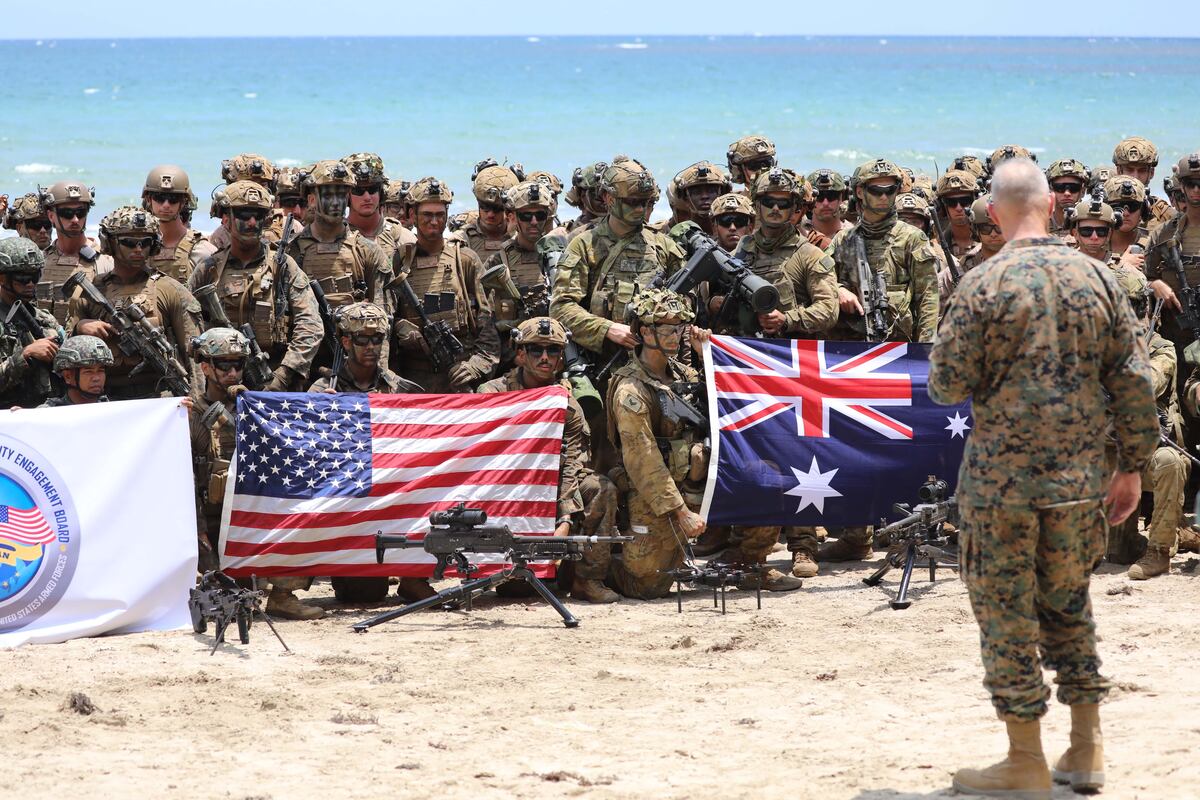
This year marked the 15th deployment of U.S. Marines to Australia under the Marine Rotation Force-Darwin (MRF-D) initiative, but this year’s rotation looked different from the rest because of its certification as a Special Purpose Marine Air-Ground Task Force (SPMAGTF).
“This is the first rotation in the 15-year history of the program to be certified as a MAGTF, and that’s a big deal,” Col. George Flynn, commanding officer of MRF-D 2026, explained to Defense News.
Flynn noted that being certified validates the MAGTF’s credibility and proficiency because, if called upon, a commander “knows the force is going to be able to accomplish all those tasks it’s assigned as part of its task order to facilitate operations in the theater.”
“What makes it special purpose is just the uniqueness of how it’s placed here in Darwin in support of the Pacific theater,” Flynn continued. “We’re responsible for being ready for the full spectrum of operations from full-scale combat to humanitarian assistance and disaster relief.”
This certification process was completed in early May during an exercise in the Philippines, making “an incredible statement” on its ability to respond to crises.
Flynn said MRF-D is authorized to have 2,500 personnel, but he typically has around 2,000 in his SPMAGTF. They arrived in Darwin in March, with his task force including, among others, the California-based 1/5 Marines and MV-22B Ospreys from the Hawaii-based VMM-268.
Flynn pointed out that “the Marine Corps, we always seek to deploy.”
MRF-D has maintained a heavy operational tempo, with the commander saying personnel had traveled to six or seven different countries to date.
“We’re busy, but Marines are having a great time. For this deployment, we’ve had 13 planned operations, activities, investments or exercises,” Flynn said. “We’ve been in the Philippines, we have forces in Indonesia right now, and we have forces that are getting ready to go to Tahiti to do training with the French. And we’ve certainly been all over the Australian continent.”
The latter includes major exercises with the Australian Army’s Darwin-based 1st Brigade and Townsville-based 3rd Brigade. Operating with the 1st Brigade is particularly helpful to both parties, since that formation now specializes in littoral warfare.
“We get to share good practices,” Flynn noted. “We have a great relationship with 1st Brigade.”
Asked about difficulties operating in such far-flung locations, often simultaneously, Flynn acknowledged, “It’s a good challenge to have. It allows us to demonstrate our ability to be distributed, and how well we can achieve operational reach throughout the region.
“I think it goes to demonstrate that, where needed, Marines can show up and provide the support that Marines are capable of providing.”
He said the SPMAGTF’s expeditionary mindset, its ability to get to locations quickly and to sustain itself, has “really been eye-watering to watch.” Flynn noted formations typically “spend their workup getting to their max level of readiness and then, once that deployment starts, that readiness starts to degrade over time.”
However, this is not the case with MRF-D, as “we have the unique ability to gain and maintain readiness throughout the deployment,” he said. This is due in part to “the expansive training areas throughout the continent that give us some wonderful opportunities to be most ready when called upon.”
“We have a robust C2 [command-and-control] capability down to our supporting elements as well, and we’ve been able to work with those systems and demonstrate … the ability to go up and down on different communication systems using satellite capabilities down to high-frequency capabilities and the like,” Flynn told Defense News. “At no point have I ever felt challenged with being able to command and control the force based on the capabilities that we’re working with.”
The Marine Corps continues to evolve for modern combat, too.
Marines of MRF-D 2026 react to a simulated ambush during Exercise Southern Jackaroo in Townsville, Australia, in June. (U.S. Marine Corps)
“Our Sec War has been adamant about increasing capabilities of the force with regards to small UAS [unmanned aerial systems] and first-person-view, one-way attack drones. We’ve had the opportunity to experiment with those systems out here, and you saw some of that at the counter-landing live-fire in the Philippines,” Flynn said. “So, we’re definitely using those. We’ve also used others like logistics-based unmanned aerial systems to facilitate movement of logistical requirements throughout the training areas here in Australia.”
However, he noted the Marine Corps “is actively still working through to increase capabilities” in counter-drone systems.
Perhaps one of the biggest helps to the SPMAGTF would be more assets for “lift and the ability to move the force around the theater,” Flynn shared.
Nevertheless, he said, “I’m beyond happy with what we’ve been able to demonstrate with our operational reach, and I think it’s just the opportunities that exist to further achieve interoperability with our allies and partners with moving the force around the theater is something that we should continue to look at going forward.”
Asked about what he has gained from leading the deployment, Flynn said, “Every day, I get a chance to lead all these Marines and sailors that are under my command, and how they generally seem to understand their purpose, and they operate with happy hearts out here.
“The relationships we’ve built with the Australians and with other nations, allies and partners we’ve got a chance to work with — and just a demonstration of what it means to be a MAGTF operating in the Pacific theater — has just been really powerful for me personally.”
Flynn said MRF-D has contributed to a free and open Indo-Pacific theater.
“I think our presence, our posture and our ability to demonstrate that we can get into locations and be responsive to countries in need facilitates that free and open Indo-Pacific. All countries in this area have their own sovereignty and we respect that, and we stand by to support and protect that sovereignty as required.”
Each MRF-D deployment lasts six months. The current one ends in October, just before the wet season arrives in northern Australia.
Gordon Arthur is an Asia correspondent for Defense News. After a 20-year stint working in Hong Kong, he now resides in New Zealand. He has attended military exercises and defense exhibitions in about 20 countries around the Asia-Pacific region.
今年是美国海军陆战队根据“海军陆战队轮换部队-达尔文 (MRF-D)”计划第 15 次部署到澳大利亚,但今年的轮换与其他轮换有所不同,因为它被认证为特种用途海军陆战队空地特遣部队 (SPMAGTF)。
“这是该项目 15 年历史上第一个获得 MAGTF 认证的轮换部队,这意义重大,”MRF-D 2026 指挥官乔治·弗林上校向《防务新闻》解释道。
弗林指出,获得认证可以证明海军陆战队空地特遣部队的信誉和能力,因为如果接到命令,指挥官“知道这支部队能够完成其任务指令中分配的所有任务,以促进战区的行动”。
弗林继续说道:“它的特殊用途就在于它位于达尔文的特殊位置,旨在支援太平洋战区。我们负责做好应对各种行动的准备,从全面作战到人道主义援助和救灾。”
这项认证过程于 5 月初在菲律宾的一次演习中完成,这“令人难以置信地表明”了该国应对危机的能力。
弗林表示,MRF-D的编制人员为2500人,但他通常只派出约2000人组成特别机动部队(SPMAGTF)。他们于3月抵达达尔文,他的特遣部队成员包括驻扎在加利福尼亚州的第1/5海军陆战队和来自夏威夷VMM-268中队的MV-22B“鱼鹰”倾转旋翼机。
弗林指出,“海军陆战队总是寻求部署。”
MRF-D 一直保持着高强度的作战节奏,指挥官表示,迄今为止,人员已前往六七个不同的国家。
“我们很忙,但海军陆战队员们过得很充实。这次部署期间,我们计划了13项行动、活动、投资或演习,”弗林说。“我们去过菲律宾,目前在印度尼西亚也有部队,还有部队正准备前往塔希提岛与法国进行联合训练。当然,我们也几乎走遍了整个澳大利亚大陆。”
后者包括与驻扎在达尔文的澳大利亚陆军第1旅和驻扎在汤斯维尔的第3旅进行大规模演习。与第1旅的联合行动对双方都特别有帮助,因为该旅现在专门从事近岸作战。
弗林指出:“我们可以分享一些好的做法。我们与第一旅的关系非常好。”
当被问及在如此遥远的地区同时开展业务的困难时,弗林承认:“这是一个很好的挑战。它使我们能够展示我们的分布式能力,以及我们在整个地区实现业务覆盖范围的能力。”
“我认为这表明,在需要的地方,海军陆战队员可以挺身而出,提供他们有能力提供的支持。”
他表示,特种作战部队的远征思维、快速抵达目标地点和自我维持的能力“着实令人惊叹”。弗林指出,部队通常“在部署前会进行充分的准备,以达到最高战备水平,但一旦部署开始,这种战备水平就会随着时间的推移而逐渐下降”。
然而,MRF-D的情况并非如此,他表示,“我们拥有在整个部署期间保持战备状态的独特能力。”这部分归功于“遍布整个非洲大陆的广阔训练区域,为我们提供了绝佳的机会,使我们能够在接到命令时做好最充分的准备。”
弗林告诉《防务新闻》:“我们拥有强大的指挥控制能力,覆盖到我们的支援部队,我们已经能够使用这些系统并展示……在不同通信系统之间灵活切换的能力,从卫星通信到高频通信等等。” 他还表示:“就我们目前所掌握的能力而言,我从未感到在指挥和控制部队方面存在任何挑战。”
海军陆战队也在不断发展以适应现代战争。
2026年6月,在澳大利亚汤斯维尔举行的“南方杰克鲁”演习中,美国海军陆战队远征部队(MRF-D 2026)的陆战队员们对模拟伏击做出反应。(美国海军陆战队)
弗林说:“我们的国防部一直坚持提升部队在小型无人机系统和第一人称视角单向攻击无人机方面的能力。我们有机会在这里试验这些系统,你们在菲律宾的反登陆实弹演习中也看到了一些成果。所以,我们肯定会使用这些系统。我们还使用了其他类型的无人机系统,例如后勤无人机系统,以方便在澳大利亚的训练区域内运送后勤物资。”
但他指出,海军陆战队“仍在积极努力提高”反无人机系统的能力。
弗林表示,对特别军事行动特遣部队来说,或许最大的帮助之一就是获得更多“运输和在战区内调动部队的能力”所需的资源。
不过,他表示:“我对我们目前在作战能力方面所展现出的能力感到非常满意,我认为我们应该继续关注的是,如何进一步与我们的盟友和伙伴实现互操作性,以及如何在战区内调动部队。”
当被问及领导此次部署的收获时,弗林说:“每天,我都有机会领导所有这些在我指挥下的海军陆战队员和水兵,他们似乎普遍理解自己的目标,并且在这里愉快地执行任务。”
“我们与澳大利亚以及其他国家、盟友和伙伴建立的关系,让我们有机会与他们合作——这充分展现了在太平洋战区作战的海军陆战队空地特遣部队的意义——对我个人而言意义非凡。”
弗林表示,MRF-D 为自由开放的印太地区做出了贡献。
我认为,我们的存在、我们的姿态以及我们展现出的进入特定区域并对有需要的国家做出响应的能力,有助于维护自由开放的印太地区。该地区所有国家都拥有各自的主权,我们尊重这一点,并将在必要时随时准备支持和保护这些主权。
每次MRF-D部署持续六个月。目前的部署将于十月结束,正好在澳大利亚北部雨季到来之前。
戈登·阿瑟是《防务新闻》的亚洲特派记者。在香港工作20年后,他现居新西兰。他曾到访亚太地区约20个国家,参加过军事演习和防务展览。