'Super Intelligence': the president’s new term for AI, explained“超级智能”:总统对人工智能的新称呼,详解
A look at President Donald Trump’s relabel from artificial intelligence to ‘Super intelligence,’ and the phrase’s original meaning
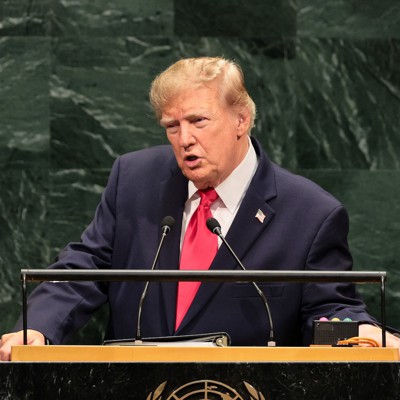
President Donald Trump speaks during the 81st session of the United Nations General Assembly on September 22, 2026, in New York City. Getty Images / Michael M. Santiago
A look at President Donald Trump’s relabel from artificial intelligence to ‘Super intelligence,’ and the phrase’s original meaning
Artificial Intelligence
President Donald Trump on Tuesday announced a rebranding of the term “artificial intelligence,” saying during the United Nations General Assembly that from now on, it will be called “super intelligence.”
“From this point forward, all of United States’ documents, and hopefully the world’s, will be changed to use the much more accurate term, ‘super,’ as opposed to ‘artificial’,” he said.
Though the rebrand may have been a surprise to many, superintelligence is already an established term in AI literature. It was popularized in philosopher Nick Bostrom’s 2014 bestseller Superintelligence , which defines the term as “any intellect that greatly exceeds the cognitive performance of humans in virtually all domains of interest.” Artificial superintelligence, or ASI, thus refers to future AI systems that could be much smarter than humans, and contrasts with the weaker forms of AI that exist today.
ASI is a step beyond AGI, or artificial general intelligence, which OpenAI defines as “highly autonomous systems that outperform humans at most economically valuable work.” By this definition, today’s AI isn’t AGI yet, much less ASI, since we can’t yet hire AI as a reliable virtual employee.
Some experts dislike the term superintelligence, or question whether it’s a coherent concept. In the influential 2025 paper “AI as Normal Technology,” authors Sayash Kapoor and Arvind Narayanan write, “We do not think there is a useful sense of the term ‘intelligence’ in which AI is more intelligent than people acting with the help of AI.”
But others say the possible renaming contributes to an ongoing conversation about AI’s growing abilities.
“‘Super’ does align well with the fact that AI is exceeding human capabilities in a growing range of tasks and by increasing margins, which can have distinct national security implications beyond simply matching human performance,” said Caleb Withers, a research associate for the Technology and Security Program at the Center for a New American Security.
For example, in early September, OpenAI announced a solution to the Navier-Stokes Millennium Prize problem, one of the most important open problems in math.
As AI becomes more capable, it has grown increasingly central to the U.S.-China relationship. Trump and Chinese president Xi Jinping are slated to meet this week to discuss trade and AI issues. Bostrom, who has warned of the dangers of fully superintelligent AI systems, said an all-out AI race increases the risk that the technology gets out of control . “If competitors are convinced that coming second [in the AI race] means the total loss of everything they care about, they will take whatever risk necessary to bypass their rivals,” he said.
Trump reportedly worries that an AI slowdown could cause a market crash, and sees “super intelligence” as a critical sector for America to stay ahead of China. “Whoever wins AI, you have to remember this, and now I say, whoever wins SI, whoever wins super intelligence, wins. That’s the group that wins.”
NEXT STORY: NATO’s thumbs-up for AWS shows Europe still needs America
2026年9月22日,美国总统唐纳德·特朗普在纽约举行的第81届联合国大会上发表讲话。图片来源:Getty Images / Michael M. Santiago
本文将探讨唐纳德·特朗普总统将人工智能重新定义为“超级智能”的过程,以及该词组的最初含义。
人工智能
美国总统唐纳德·特朗普周二宣布对“人工智能”一词进行重新命名,他在联合国大会上表示,从现在起,它将被称为“超级智能”。
他说:“从现在开始,美国的所有文件,以及希望全世界的文件,都将改为使用更准确的术语‘超级’,而不是‘人造的’。”
尽管这一名称的重新命名可能令许多人感到意外,但“超级智能”在人工智能领域早已是一个成熟的术语。哲学家尼克·博斯特罗姆在其2014年的畅销书《超级智能》中普及了这一概念,该书将超级智能定义为“在几乎所有感兴趣的领域中,认知能力都远远超过人类的任何智能”。因此,人工超级智能(ASI)指的是未来可能比人类智能得多的人工智能系统,这与当今存在的较弱的人工智能形式形成鲜明对比。
ASI 比 AGI(通用人工智能)更进一步,OpenAI 将 AGI 定义为“在最具经济价值的工作中超越人类的高度自主系统”。按照这个定义,今天的 AI 还不是 AGI,更不是 ASI,因为我们目前还无法将 AI 作为可靠的虚拟员工来使用。
一些专家不喜欢“超级智能”这个词,或者质疑它是否是一个连贯的概念。在颇具影响力的2025年论文《人工智能作为常规技术》中,作者萨亚什·卡普尔和阿文德·纳拉亚南写道:“我们认为,‘智能’一词并不存在一个有意义的含义,即人工智能比借助人工智能行动的人类更智能。”
但也有人认为,此次可能的更名有助于引发关于人工智能日益增长的能力的持续讨论。
“‘超级’这个词确实与人工智能在越来越多的任务中超越人类能力,并且超越幅度越来越大这一事实非常吻合,这除了能与人类的表现相媲美之外,还可能对国家安全产生独特的影响,”新美国安全中心技术与安全项目研究员卡莱布·威瑟斯说道。
例如,9 月初,OpenAI 宣布了纳维-斯托克斯千年大奖问题的解决方案,这是数学领域最重要的未解难题之一。
随着人工智能能力的不断提升,它在美中关系中扮演的角色日益重要。特朗普和中国国家主席习近平计划本周会晤,讨论贸易和人工智能问题。博斯特罗姆曾警告过完全超级智能人工智能系统的危险性,他表示,一场全面的人工智能竞赛会增加这项技术失控的风险。“如果竞争对手确信,在人工智能竞赛中屈居第二意味着失去他们所珍视的一切,那么他们会不惜一切代价超越对手,”他说道。
据报道,特朗普担心人工智能发展放缓可能导致市场崩盘,并将“超级智能”视为美国保持对中国领先地位的关键领域。“无论谁赢得人工智能,你们都必须记住这一点,现在我要说,无论谁赢得超级智能,无论谁赢得超级智能,谁就赢了。那才是最终的赢家。”
下一篇报道:北约对AWS的认可表明欧洲仍然需要美国