Shedding Some Light On The Pentagon’s Most Shadowy Aviation Units揭开五角大楼最神秘的航空部队的面纱
When officials in Washington need air support the most complex and secretive military missions, this is who they call in.
By Joseph Trevithick
Updated Jul 3, 2020 4:14 AM EDT
On May 2, 2011, a group of special operators from the top secret Joint Special Operations Command (JSOC) descended on an unassuming compound in Abbottabad, Pakistan. In an ensuing fire-fight, members of SEAL Team Six shot and killed infamous Al Qaeda leader Osama Bin Laden. Due to an accident during the operation, the elite troops had to leave behind evidence of previously unknown stealthy transport helicopter , likely related at least in part to the ubiquitous UH-60 Black Hawk.
The incident offered a rare window into the activities of the U.S. military’s most secret aviators and a look at their unique aircraft. Although the secretive 160th Special Operations Air Regiment , otherwise known as the “Nightstalkers,” may get all the attention, layers of clandestine units far more obscure exist. Some of them are silently blazing the path for special operations aviation’s future.
Though they often involve various military units and personnel from intelligence agencies, these sort of “black ops” are most commonly associated with the nebulous JSOC. When planning America’s most demanding military operations, which officials in Washington might never admit even occurred, these elements sometimes need very specialized aerial support.
So, with help primarily from the U.S. Army and Air Force, the Pentagon has steadily formed a permanent and secretive infrastructure to provide aircraft and helicopters for these missions. As of January 2017, this included at least four different units across the services and within JSOC itself: the joint Aviation Tactics Evaluation Group (AVTEG), the Army’s Flight Concepts Division and the Air Force’s 66th Air Operations Squadron and 427th Special Operations Squadron.
The bland-sounding AVTEG is situated at Fort Bragg, North Carolina, the home of the U.S. Army Special Operations Command and JSOC. While little is known about this organization, thanks to the Freedom of Information Act, we can now present its official organization. The U.S. Special Operations Command (SOCOM) provided the following chart in response to a request for information about the group’s organizational structure.
The breakdown is almost completely standard. A unit made up of individuals from across the services, AVTEG has a command group and seven “joint” offices, including typical administrative, operational and supporting elements.
The numbering scheme is standard across the Pentagon and the absence of a “J7” – usually set aside for a group in charge of creating joint operational plans, doctrine, training materials and exercises – is not necessarily notable. The sections specifically for Command, Control, Communications, Computers, and Intelligence (C4I) and Intelligence, Surveillance and Reconnaissance (ISR) – distinct from the common operational and intelligence components – are more unusual.
With no description of the functions of these offices or details about their size and associated equipment, the chart provokes more questions than it answers. We have no idea whether or not it is even complete. Of course, none of that is surprising.
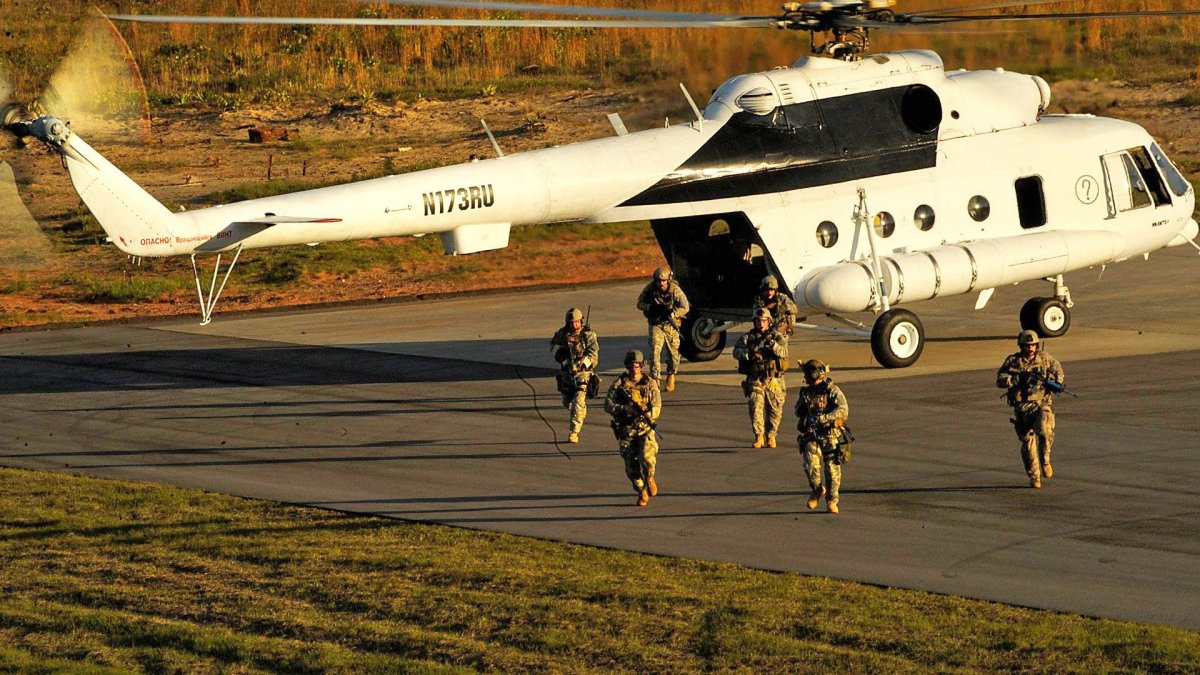
A Russian-made Mi-17 helicopter from 6th Special Operations Squadron, also seen at top, which is the kind of foreign aircraft top-secret aviators might have, too., USAF
Details about the other units are similarly scant. The Air Force Historical Research Agency, which had official records on every unit in the service, has nothing in its file for the 427th after 1972. It does not list the 66th among active squadrons on its website, either.
It is possible that these are unofficial or cover designations rather than the formal nomenclature. However, the 427th resides at Pope Airfield in North Carolina and “provides U.S. Army [special operations forces] personnel opportunities to train on various types of aircraft for infiltration and exfiltration that they may encounter in lesser-developed training,” according to an official mission description that aviation researcher Andreas Parsch obtained through his own Freedom of Information Act request.
The only readily available public mention of the 66th is from an Air Force manual on forward-area refueling point (FARP) operations, which also name drops AVTEG. Both units are exempted from over-arching rules regarding pre-site surveys and “for short-notice exercises and contingencies, AVTEG and 66 AOS may authorize the use of temporary FARP sites” based on the service’s approved parameters, according to the handbook. Oh, and there’s also its awesome patch .
Researchers and journalists have found evidence that these Air Force squadrons fly a mix of traditional military type aircraft like the C-130 and less common types, including Cessna C-208 Grand Caravans, Pilatus PC-6s, and CASA 212s and C-295s, over the years. The service went so far as to assign the official designations U-27A and C-41A to the Caravan and 212, respectively.
There is even less information about the Flight Concepts Division or what aircraft it has in its inventory. But it would be reasonable to expect its fleet includes a diverse collection of American and foreign aircraft.
In his 2015 book Relentless Strike , Sean Naylor said this unit had quietly transformed into the E Squadron of the Army’s equally secret 1st Special Forces Operational Detachment D, more commonly known Delta Force. However, on July 8, 2015, Army Colonel Paul Olsen briefed Virginia Governor Terry McAuliffe on the U.S. Army Corps of Engineers’ Norfolk District’s work, in which he described work on the Flight Concepts Division’s hangar as something “you will soon see.” Again, its possible that one or more cover names is in use to refer to these units.
The obscure building itself sits secluded at Fort Eustis, Virginia behind multiple layers of fencing. The base’s fire chief isn’t even allowed in to check things out for emergency planning purposes. “Research activities are also conducted by the Flight Concepts Division that is highly secret and access for pre-planning purpose is non-existent,” an undated job posting explains. “Nature of their work is known to be hazardous.”
A rare shot of a C-41A, believed to be assigned to the 427th Special Operations Squadron, at Andrews Air Force Base in 1993., USAF
The exact relationship between these units, as well as AVTEG, remains unclear. There is, understandably, little official information available. A cursory Google search of .mil websites mainly turns up biographies of officers who list one of the elements among their previous positions, as well as vague job postings. Titles like “ operations officer ,” “ troop commander ,” and “ fire support officer ” are just standard military positions that offer no obvious clues as to the specific nature of the missions – no doubt by design.
Of course, the U.S. military has had these types of units for decades. However, by and large, they had historically been ad hoc formations that lasted only as long as specific conflicts. During World War II, in Europe, what was then the Army Air Forces used modified attack planes and medium and heavy bombers to drop intelligence agents behind enemy lines, insert Office of Strategic Services (OSS) teams – a precursor to both the Central Intelligence Agency and Army Special Forces – and resupply those efforts and friendly partisan troops.
From the United Kingdom, the Eighth Air Force’s used the nicknamed “Carpetbagger” for its component of these operations. The 801st Bomb Group (Provisional) and then the 492nd Bomb Group flew the actual missions with a mix fleet of B-24 Liberators, C-47 Skytrains, A-26C Invaders and British Mosquitoes.
Another unit, which ultimately became the 885th Bomb Squadron (Heavy) (Special), conducted its own sorties first from sites in North Africa and then from bases in Italy. Similar “air commandos” supported operations in China, India and Southeast Asia, including providing dedicated air support for allied guerrilla units such as Merrill’s Marauders – the predecessors of the 75th Ranger Regiment – and the British Chindits .
Modified B-24 Liberators, similar to these standard bombers, were among the U.S. military’s first special operations transports., USAF
When the war ended, the Pentagon shut them down, only to have to bring them back for the Korean War. This procedure continued for covert and clandestine missions around the world for much of the Cold War. The CIA created its own network of cover companies, including the famous Air America, for similar duties.
By the time America’s war in Southeast Asia was in full swing, things had not changed dramatically. To support an explosion of so-called “special activities” – covert and clandestine missions requiring the United States to be able to plausible deny involvement – in South Vietnam, Laos and then Cambodia, the Pentagon rushed to stand up new secretive aviation units.
In 1964, the top U.S. military headquarters in Vietnam created a single entity to handle these top-secret operations, blandly titled the Military Assistance Command, Vietnam – Studies and Observation Group (MACV-SOG). Though regular and special operations units worked with MACV-SOG, the Airborne Studies Group (OPS-36) was responsible for dropping agents and propaganda leaflets into North Vietnam and Laos, as well as parachuting supplies to teams already on the ground.
The group’s First Flight Detachment at Nha Trang had six specially modified twin-engine C-123 Provider transports sporting a special dark-colored camouflage paint job and equipped with special navigational and communications gear. To help conceal American involvement in this operation, nicknamed Heavy Hook, American personnel trained Taiwanese and Vietnamese crews to fly the actual missions. Special brackets on the sides allowed personnel on the ground to swap out American and South Vietnamese Air Force insignia as necessary.
An MC-130E Combat Talon in flight in 1991., USAF
The C-123s were not particularly popular for the demanding missions. “The C-123 load capacity, operating range, and inability to fly in adverse weather greatly hampered airborne operations,” one 1964 review explained, according to a subsequent Air Force study of special missions. After initially resorting to shorter range helicopters, in 1965, the Pentagon approved plans to convert a number of four-engine C-130Es for specialized missions in Vietnam and elsewhere. These aircraft were the forerunners of the MC-130E Combat Talon and arrived at Nha Trang in 1966, where they joined the 15th Special Operations Squadron.
For a time, both the 15th and First Flight Detachment flew together. MACV-SOG used the codename “Heavy Chain” for missions involving C-130s. Air Force and Army UH-1, CH-3, and CH-53 helicopters, along with Air America and other private companies working for the CIA also provided support to MACV-SOG and other clandestine units in the region.
But “throughout the Vietnam conflict, [unconventional warfare] operations were tainted with the constant infusion of conventional military thinking,” the Air Force complained in its post-war review of special activities. “‘Dedicated air assets’ was a concept antithetical to the Air Force concept of the Single Manager – centralized control.”
So, despite these activities, when the Pentagon decided to launch Operation Ivory Coast in 1970, the daring raid on the Son Tay prison camp in North Vietnam, officials had to craft yet another temporary task force. This process repeated itself nearly a decade later for Operation Eagle Claw, the attempt to rescue American hostages in Iran who had been swept up in the country’s revolution.
An MH-6 Little Bird of the U.S. Army’s 160th Special Operations Aviation Regiment, similar to the civilian Hughes 500s that Seaspray reportedly flew., US Army
That embarrassing debacle, which left eight Americans dead at a remote site named Desert One, provoked a significant amount of soul searching in Washington and increased support for developing a standing set of special operations units to respond to various crises. International terrorism, the War on Drugs, and continued Soviet-backed insurgencies had already contributed to the Army’s decision to create Delta Force in 1979 and the U.S. Navy forming SEAL Team Six the following year. This in turn led the U.S. military to ultimately create new secretive aviation elements to support those forces.
The most notable of these was a shared CIA and Army special operations element codenamed Seaspray , which reportedly had a mixed fleet of Hughes 500D helicopters and Cessna Grand Caravan and Beechcraft King Air fixed-wing aircraft. The Agency already had significant experience with flying specialized helicopters on top-secret missions, having crafted a pair of ultra-quiet, long-range, night-flying Hughes 500Ps as part of a project to tap phone lines in North Vietnam.
Based at Fort Eustis, the group flew covert and clandestine missions from the Middle East to Latin America, routinely working with Delta Force, SEAL Team Six and the Army’s Intelligence Support Activity. Authorities in Washington ultimately decided to clearly delineate the responsibilities of intelligence agencies from the military and gave the Army full control of the unit, who renamed it the Flight Concepts Division. The force has continued to operate since then, shielding its operations for at least for a time under the codename Quasar Talent, according to Michael Smith’s Killer Elite .
An Iraqi Air Force Cessna C-208, similar to the U-27As the 427th Special Operations Squadron has reportedly operated., USAF
Though there is no official public record, it is likely the Air Force established the 427th and the 66th after Seaspray came under full military control as part of the Pentagon expanding these aviation capabilities. But there is little doubt these special operations aviators have been busy since the 1990s, though it may take decades for any formal information about their latest operations to come out into the light.
I n December 2001 , Russian authorities arrested a group of contractors working for the Army – reportedly for the Flight Concepts Division – and the CIA in the far-eastern city of Petropavlovsk. The group was trying to surreptitiously buy Mi-17 transport helicopters for operations in Afghanistan.
Nearly a decade later, there was the Bin Laden raid in Pakistan. Though members of the Army’s elite 160th Special Operations Aviation Regiment reportedly flew the stealthy chopper, this was precisely the sort of product one could expect to see come out AVTEG or the Flight Concepts Division.
There’s also the matter of these shadowy Sikorsky S-92 helicopters operating in northern Syria surfaced on social media . For more than a year, these mysterious choppers had made appearances first at a major U.S. military base in Djibouti, then in Erbil in northern Iraq, and finally near the city of Kobani in Syria.
No one seems to know who owns these rotorcraft, which have been devoid of any national markings, but they could belong to various U.S. government outfits or another regional actor. Officially the Pentagon does not operate the S-92, but it is exactly the kind of “non-standard” or “off-the-books” aircraft AVTEG or another of the secret aviation elements might provide for discreet operations.
The fact that we don’t know for sure is the entire point of having these groups in the first place. We may just have to wait for another tidbit to turn up through FOIA – and hopefully not another accident during an actual operation – for the next set of new details to emerge.
Contact the author: joe@thedrive.com
Comments couldn’t be loaded. Please refresh the page.
作者:约瑟夫·特雷维西克
更新于美国东部时间2020年7月3日凌晨4:14
2011年5月2日,一支来自高度机密的联合特种作战司令部(JSOC)的特种作战人员突袭了巴基斯坦阿伯塔巴德一处不起眼的院落。在随后的交火中,海豹突击队第六分队的成员击毙了臭名昭著的基地组织领导人奥萨马·本·拉登。由于行动中发生的一起意外,这些精锐部队不得不留下此前未知的隐形运输直升机的痕迹,这架直升机很可能至少与常见的UH-60“黑鹰”直升机有部分关联。
此次事件罕见地揭开了美国军方最神秘飞行员的活动面纱,并让我们得以一窥他们独特的战机。虽然神秘的第160特种作战航空团(又称“夜行者”)备受瞩目,但实际上还有许多更为隐秘的部队存在。其中一些正在默默地为特种作战航空的未来开辟道路。
尽管这类“秘密行动”通常涉及多个军事单位和情报机构人员,但最常与神秘的联合特种作战司令部(JSOC)联系在一起。在策划美国最艰巨的军事行动时——华盛顿官员可能永远不会承认这些行动曾经发生过——这些行动有时需要非常专业的空中支援。
因此,主要在美国陆军和空军的协助下,五角大楼稳步建立了一套永久性的秘密基础设施,为这些任务提供飞机和直升机。截至2017年1月,这套基础设施至少包括来自各军种和联合特种作战司令部(JSOC)内部的四个不同单位:联合航空战术评估小组(AVTEG)、陆军飞行概念处以及空军第66空中作战中队和第427特种作战中队。
听起来平淡无奇的AVTEG组织位于北卡罗来纳州布拉格堡,这里也是美国陆军特种作战司令部和联合特种作战司令部的所在地。虽然人们对这个组织知之甚少,但得益于《信息自由法》,我们现在可以公布其官方组织结构。美国特种作战司令部(SOCOM)应信息请求提供了以下图表,以展示该组织的组织架构。
其组成几乎完全符合标准。AVTEG是一个由各军种人员组成的单位,下设一个指挥组和七个“联合”办公室,包括典型的行政、作战和支援部门。
五角大楼的编号体系是统一的,缺少“J7”(通常指负责制定联合作战计划、条令、训练材料和演习的部门)并不一定值得注意。相比之下,专门负责指挥、控制、通信、计算机和情报(C4I)以及情报、监视和侦察(ISR)的部门——与常见的作战和情报部门有所区别——则更为特殊。
由于图表并未描述这些办公室的功能,也未提供其规模和相关设备的详细信息,因此它引发的问题比解答的问题还要多。我们甚至不知道它是否完整。当然,这一切都在意料之中。
图中上方还可以看到一架隶属于美国空军第6特种作战中队的俄制米-17直升机,这种外国飞机也是一些顶级飞行员可能拥有的机型。
其他部队的详细信息同样匮乏。空军历史研究局拥有该部队所有单位的官方记录,但其档案中却找不到1972年以后第427中队的资料。该机构的网站上也没有将第66中队列入现役中队名单。
这些名称可能并非正式名称,而是非正式的或临时性的代号。然而,根据航空研究员安德烈亚斯·帕尔施通过《信息自由法》申请获得的官方任务描述,第427特种作战中队驻扎在北卡罗来纳州的波普机场,其“为美国陆军特种作战部队人员提供机会,让他们在训练欠发达地区可能遇到的各种类型的飞机上进行渗透和撤离训练”。
关于第66空中作战中队(66th)的唯一公开资料出自空军的一份前沿区域加油点(FARP)操作手册,该手册也提到了AVTEG。手册指出,这两个单位都不受关于前期场地勘测的总体规定的约束,“对于紧急演习和突发事件,AVTEG和第66空中作战中队可以根据空军批准的参数授权使用临时FARP场地”。哦,对了,他们还有个很酷的臂章。
研究人员和记者发现证据表明,多年来,这些空军中队使用的飞机既有传统的军用机型,例如C-130,也有不太常见的机型,包括塞斯纳C-208“大篷车”、皮拉图斯PC-6、CASA 212和C-295。空军甚至为“大篷车”和CASA 212分别赋予了正式的U-27A和C-41A编号。
关于飞行概念部门及其拥有的飞机种类,我们所知甚少。但可以合理推测,其机队应包含各种美国和外国飞机。
肖恩·内勒在其2015年出版的《无情打击》(Relentless Strike)一书中提到,这支部队已悄然转型为陆军同样高度保密的特种部队第一作战分遣队D(即更为人熟知的三角洲部队)的E中队。然而,2015年7月8日,陆军上校保罗·奥尔森向弗吉尼亚州州长特里·麦考利夫汇报了美国陆军工程兵团诺福克区的工作,其中他提到飞行概念分部机库的建设工作“很快就会有结果”。由此可见,这些部队可能使用了一个或多个掩护名称。
这座隐蔽的建筑坐落在弗吉尼亚州尤斯蒂斯堡,被多层围栏严密包围。就连基地的消防队长都无权进入查看情况,以制定应急预案。“飞行概念部门也在此开展高度机密的研究活动,事先规划所需的权限根本不存在,”一份日期不详的招聘启事解释道,“他们的工作性质众所周知具有危险性。”
一张罕见的C-41A运输机照片,据信该机隶属于美国空军第427特种作战中队,拍摄于1993年安德鲁斯空军基地。
这些单位与AVTEG之间的确切关系仍然不明朗。可以理解的是,官方信息寥寥无几。在.mil网站上进行简单的谷歌搜索,主要结果都是一些军官的个人简介,他们在之前的职位中列出了其中一个单位,以及一些含糊不清的招聘启事。“作战官”、“部队指挥官”和“火力支援官”之类的头衔只是标准的军事职位,无法提供任何关于具体任务性质的明显线索——这无疑是刻意为之。
当然,美军拥有这类部队已有数十年历史。然而,总的来说,这些部队历来都是临时组建的,其存在时间仅限于特定冲突时期。二战期间,在欧洲战场上,当时的陆军航空兵使用改装后的攻击机以及中型和重型轰炸机,将情报人员空投到敌后,派遣战略情报局(OSS)小组——该机构是中央情报局和陆军特种部队的前身——并为这些行动和友军游击队提供补给。
来自英国的第八航空队用绰号“地毯大亨”(Carpetbagger)来指代其参与这些行动的部队。第801轰炸大队(临时)和后来的第492轰炸大队使用B-24“解放者”、C-47“空中列车”、A-26C“入侵者”和英国“蚊”式轰炸机的混合机队执行了实际任务。
另一支部队,最终发展成为第885轰炸机中队(重型)(特种),最初从北非的基地执行任务,后来又从意大利的基地执行任务。类似的“空中突击队”支援了在中国、印度和东南亚的行动,包括为盟军游击队提供专门的空中支援,例如梅里尔突击队(第75游骑兵团的前身)和英国钦迪特部队。
改装后的B-24“解放者”轰炸机与这些标准轰炸机类似,是美国军方最早的特种作战运输机之一。(美国空军)
战争结束后,五角大楼关闭了这些公司,但朝鲜战争爆发后,又不得不重新启用它们。在冷战的大部分时间里,这种秘密行动模式一直沿用至今。中央情报局也建立了自己的掩护公司网络,其中包括著名的“空中美国”(Air America),执行类似的任务。
当美国在东南亚的战争全面爆发时,情况并没有发生显著变化。为了支持在南越、老挝以及后来的柬埔寨迅速展开的所谓“特殊行动”(即需要美国能够合理否认参与的秘密行动),五角大楼匆忙组建了新的秘密航空部队。
1964年,驻越美军最高司令部设立了一个专门负责这些绝密行动的机构,名称平淡无奇,叫做“驻越军事援助司令部——研究观察组”(MACV-SOG)。虽然常规部队和特种作战部队都与MACV-SOG合作,但空降研究组(OPS-36)负责向北越和老挝空投特工和宣传单,以及向地面部队空投补给。
该部队驻扎在芽庄的第一飞行分遣队拥有六架经过特殊改装的双引擎C-123运输机,机身涂有深色迷彩,并配备了特殊的导航和通信设备。为了掩盖美军参与这项代号为“重钩”的行动,美军人员训练了台湾和越南的机组人员执行实际任务。机身两侧的特殊支架允许地面人员根据需要更换美国和南越空军的标志。
1991年,一架MC-130E“战斗爪”运输机正在飞行中,美国空军。
C-123运输机并不适合执行高强度任务。“C-123的载货量、航程以及在恶劣天气下无法飞行,极大地阻碍了空中作战行动,”一份1964年的评估报告解释道,该报告也出现在空军随后的一项特种任务研究中。最初只能使用航程较短的直升机,但在1965年,五角大楼批准了将一批四引擎C-130E改装用于越南及其他地区特种任务的计划。这些飞机是MC-130E“战斗爪”运输机的雏形,于1966年抵达芽庄,并加入了第15特种作战中队。
一段时间内,第15飞行分遣队和第一飞行分遣队曾协同作战。驻越美军司令部特种作战群(MACV-SOG)使用“重链”(Heavy Chain)作为C-130运输机执行任务的代号。空军和陆军的UH-1、CH-3和CH-53直升机,以及美国航空公司和其他为中央情报局工作的私营公司,也为驻越美军司令部特种作战群和该地区的其他秘密部队提供支持。
但空军在战后对特种作战行动的评估报告中抱怨道:“在整个越南战争期间,(非常规战争)行动始终受到传统军事思维的渗透。” “‘专用空中资产’的概念与空军的单一管理者——集中控制的理念背道而驰。”
因此,尽管开展了这些活动,当五角大楼决定在1970年发起“象牙海岸行动”(即对北越山西战俘营的大胆突袭)时,官员们不得不再次组建一支临时特遣队。近十年后,在营救被卷入伊朗革命的美国人质的“鹰爪行动”中,这一过程再次上演。
美国陆军第160特种作战航空团的一架MH-6“小鸟”直升机,与据报道“海浪”驾驶过的民用休斯500型直升机类似。
那次令人尴尬的惨败导致八名美国人在名为“沙漠一号”的偏远地点丧生,引发了华盛顿的深刻反思,并促使人们更加支持建立一套常备特种作战部队以应对各种危机。国际恐怖主义、禁毒战争以及苏联支持的持续叛乱,早已促使陆军在1979年组建了三角洲部队,海军也在次年组建了海豹突击队第六分队。而这最终又促使美军创建了新的秘密航空部队来支援这些部队。
其中最引人注目的是中央情报局和陆军联合组建的代号为“海浪”(Seaspray)的特种作战部队,据报道,该部队拥有一支由休斯500D型直升机、塞斯纳大篷车(Cessna Grand Caravan)和比奇空中国王(Beechcraft King Air)固定翼飞机组成的混合机队。中央情报局此前已积累了丰富的特种直升机执行绝密任务的经验,曾为窃听北越电话线路的项目研制了两架超静音、远程、夜间飞行的休斯500P型直升机。
该部队驻扎在尤斯蒂斯堡,执行从中东到拉丁美洲的秘密任务,经常与三角洲部队、海豹突击队第六分队和陆军情报支援活动部门合作。华盛顿当局最终决定明确划分情报机构和军方的职责,并将该部队完全交由陆军控制,陆军将其更名为飞行概念部。据迈克尔·史密斯的《杀手精英》一书所述,该部队此后一直继续运作,至少在一段时间内,其行动以“类星体人才”(Quasar Talent)为代号进行掩护。
据报道,伊拉克空军的一架塞斯纳C-208运输机,与第427特种作战中队曾使用过的U-27A型飞机类似。
虽然没有官方公开记录,但很可能是在海浪空军基地完全置于军方控制之后,作为五角大楼扩大航空能力的一部分,空军才组建了第427和第66特种作战航空团。毫无疑问,这些特种作战飞行员自20世纪90年代以来一直活跃在战场上,尽管他们最近的行动的正式信息可能需要数十年才能公之于众。
2001年12月,俄罗斯当局在远东城市彼得罗巴甫洛夫斯克逮捕了一群为俄罗斯陆军(据报道为飞行概念部门)和美国中央情报局工作的承包商。该团伙试图秘密购买米-17运输直升机,用于在阿富汗的行动。
近十年后,发生了在巴基斯坦击毙本·拉登的行动。虽然据报道,驾驶这架隐形直升机的是陆军精锐的第160特种作战航空团的成员,但这正是人们预期会从AVTEG或飞行概念部门看到的那种产品。
此外,社交媒体上还出现了有关在叙利亚北部活动的神秘西科斯基S-92直升机的消息。一年多来,这些神秘直升机先是在吉布提的一个美国主要军事基地出现,然后出现在伊拉克北部的埃尔比勒,最后出现在叙利亚科巴尼市附近。
这些旋翼机没有任何国籍标识,似乎无人知晓其所有者,但它们可能属于美国政府的各个部门或其他地区性组织。官方说法是,五角大楼并未装备S-92,但这种“非标准”或“未列入编制”的飞机正是AVTEG或其他秘密航空机构可能用于秘密行动的那种。
正因为我们无法确切知晓真相,这些小组存在的意义才在于此。或许我们只能等待《信息自由法》披露更多细节——希望不要再发生行动中的意外——才能获得新的信息。
联系作者:joe@thedrive.com
评论加载失败,请刷新页面。