China’s robots make it to ‘America’s Got Talent’, now comes the harder act中国的机器人成功登上“美国达人秀”的舞台,现在更难的挑战来了。
BEIJING, Sept 23 — Chinese street dancer Wu Yufei has spent most of his 13-year career performing solo, but this year, he found some new partners — a crew of robots with sleek...
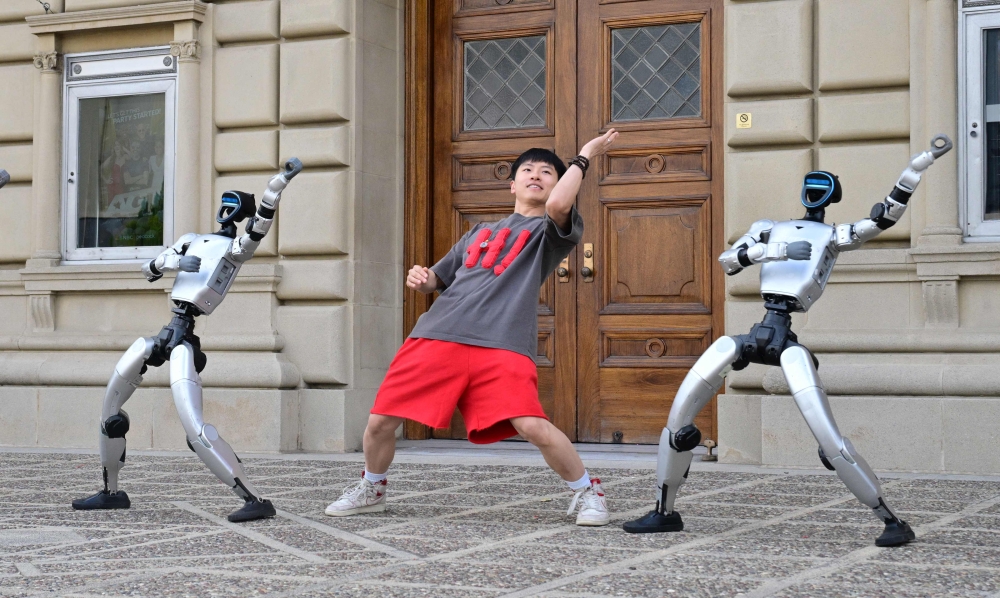
Chinese street dancer Wu Yufei, known for his solo performances, has reached the finals of "America's Got Talent" with his robot dance crew, Homies, showcasing collaboration between human dancers and robots.
Robot dancing, highlighted by the superior precision and synchronization capabilities of Unitree robots, has become increasingly popular in China.
As the robotics industry seeks to expand beyond entertainment, challenges related to musicality and movement flexibility remain, despite significant advancements in programming and choreography.
Industry leaders anticipate gradual progress toward broader applications as they navigate commercial viability and market expansion challenges.
BEIJING, Sept 23 — Chinese street dancer Wu Yufei has spent most of his 13-year career performing solo, but this year, he found some new partners — a crew of robots with sleek moves.
The 27-year-old Sichuan native, together with his fellow robot performers, has made it to the final of “America’s Got Talent” (AGT), a stage he had been hoping to reach for years.
A longstanding science-fiction fan, Wu told AFP from Pasadena, California, that dancing with robots in the group Homies gave him a “very magical feeling”.
After months of training with them, his robot dancers now feel like more than just “cold, lifeless machines”, he said.
“It almost feels as if there’s a kind of team spirit there,” Wu told AFP, as he and the dance crew of humanoids — made by Chinese robotics group Unitree — prepared for the AGT final this week.
Robot dancing has become a huge craze in China after Unitree robots performed in a breakout performance at China’s annual Spring Festival gala performance, the country’s most-watched television extravaganza.
Businesses and event planners across the country have since rushed to hire robots to perform and attract visitors.
Training robots to dance involves capturing intricate human movements, running computer simulations, and then transferring results to the robots, said industry insiders.
For Fang Zhenghua, the art director behind Wu and Unitree’s AGT performances, training a robot to dance resembles “creating a soul”.
“The impact of AI on dance performances, or the impact of robots on dancing — I was quite against it all at the beginning,” he told AFP from Shanghai.
But over time, working with the skilled engineers — who he describes as the “mothers” of the robots — changed his perspective.
Scripted choreography
Training robots requires input from human dancers and relies heavily on engineers to troubleshoot problems, particularly in real-time during performances.
“It takes a lot of fine-tuning,” Liu Zhiquan, commercialisation lead at robotics motion-capture firm BridgeDP, told AFP.
A 30-second dance routine could take days, sometimes weeks, to perfect, he added, and performers need to be willing to compromise.
“If the dancers are not tech-savvy, there will be a lot of re-takes,” he said.
Wegers Wei, from Shanghai-based dance studio Limit Crew, said that when he designs routines for robots, he avoids movements that he knows will be difficult for them.
“If we find that some routines don’t look good for robots or if they look like the robots are making mistakes, we would change them,” said Wei, whose robots won first and second places for street dance at this year’s World Humanoid Robot Games.
Robots are good at rotating moves, or what street dancers call power moves, Wei said, as it is “just a matter of adjusting the motor power and the torque of the arms”.
However, routines that require body flexibility are extremely difficult for robots, he said.
Another blind spot is musicality.
Robot dancing is mostly scripted playback.
Unlike humans, the machines cannot improvise or “make on-the-spot adjustments” if the music changes suddenly, Wu Yufei added.
Beyond entertainment
While the general public in China mostly sees robot dancing as entertainment, industry insiders see it as a chance to show off robotic designs, capabilities and reliability.
“That’s why everyone is keen to perform these kinds of high-skill dances,” said Guo Renjie, founder and CEO of robotics engineering company Zeroth.
A recent Morgan Stanley report forecast that China’s humanoid robotics market could reach US$2 billion (RM8 billion) in value this year.
Accounting for more than 97 per cent of humanoid robot shipments in the first half of 2026 globally, the Chinese industry also faces increasing scrutiny from investors and policymakers.
Many companies are struggling to find commercially viable uses for their humanoids beyond entertainment.
Executives at humanoid robotics companies have publicly acknowledged that the industry is still years away from its own “ChatGPT moment” — the point at which robots become useful to ordinary people.
“I think everyone should give this industry time to reach its full potential,” said Zeroth’s Guo.
Unitree made a blistering debut on the Shanghai stock market in August, surging 629 per cent through the first day’s trading.
Its market capitalisation has since fallen by around half from its peak.
Back at the AGT filming studio in Pasadena, Wu pointed to another robot benefit — how quickly his robot crew could learn routines.
“Their knowledge can be replicated extremely quickly,” he said.
“Not only does a single robot learn quickly, but they can all learn the same things at the same time, which is quite terrifying.” — AFP
New MyKad rolls out, but digital services are still catching up
China shifts focus as AI hacking fears put WeChat and national security under spotlight
AI guessed the password: Gemini breached multiple systems during evaluation, Google says
Overseas markets key to growing Malaysia’s oil and gas services sector in next three years, says economy minister
New Beijing-Kota Kinabalu route on the cards as China Eastern eyes more Sabah flights
Health Ministry van carrying trainee nurses ends up on its side in Ipoh crash, nine injured
以个人表演闻名的中国街舞舞者吴宇飞,携其机器人舞团 Homies 闯入“美国达人秀”决赛,展现了人类舞者和机器人之间的合作。
以优尼特机器人卓越的精准度和同步能力为特色的机器人舞蹈在中国越来越受欢迎。
尽管机器人行业在编程和编舞方面取得了重大进步,但随着机器人行业寻求向娱乐以外的领域扩展,与音乐性和动作灵活性相关的挑战仍然存在。
行业领导者预计,随着他们应对商业可行性和市场扩张方面的挑战,更广泛的应用将逐步取得进展。
北京,9月23日——中国街舞舞者吴宇飞在其13年的职业生涯中大部分时间都是独自表演,但今年,他找到了一些新的伙伴——一群动作流畅的机器人。
这位27岁的四川小伙和他的机器人表演伙伴们一起,成功晋级“美国达人秀”(AGT)决赛,这是他多年来一直渴望达到的舞台。
吴是一位资深的科幻迷,他从加利福尼亚州帕萨迪纳告诉法新社,在 Homies 乐队中与机器人一起跳舞给了他一种“非常神奇的感觉”。
他说,经过几个月的训练,他的机器人舞者现在感觉不再只是“冰冷、没有生命的机器”。
“感觉他们之间有一种团队精神,”吴先生告诉法新社,他和由中国机器人集团优尼特里制造的人形机器人舞蹈队正在为本周的《美国达人秀》决赛做准备。
在中国一年一度的春节联欢晚会上,Unitree 机器人凭借精彩的表演一鸣惊人,机器人舞蹈在中国掀起了一股热潮。春节联欢晚会是中国收视率最高的电视盛会。
此后,全国各地的企业和活动策划者纷纷竞相雇用机器人进行表演和吸引游客。
业内人士表示,训练机器人跳舞需要捕捉复杂的人类动作,运行计算机模拟,然后将结果传递给机器人。
对于吴和优妮特瑞在《美国达人秀》上的表演的艺术指导方正华来说,训练机器人跳舞就像“创造灵魂”。
“人工智能对舞蹈表演的影响,或者机器人对舞蹈的影响——一开始我非常反对这一切,”他在上海接受法新社采访时说道。
但随着时间的推移,与这些技术精湛的工程师们(他称他们为机器人的“母亲”)一起工作,改变了他的看法。
剧本编排的舞蹈
训练机器人需要人类舞者的指导,并且很大程度上依赖工程师来解决问题,尤其是在表演期间的实时问题。
“这需要大量的微调,”机器人动作捕捉公司 BridgeDP 的商业化负责人刘志泉告诉法新社。
他还补充说,一段 30 秒的舞蹈动作可能需要几天甚至几周的时间才能完善,表演者需要愿意做出妥协。
他说:“如果舞者们不熟悉技术,就会有很多次重拍。”
来自上海舞蹈工作室 Limit Crew 的魏伟表示,当他为机器人设计舞蹈动作时,他会避免那些他知道对机器人来说很困难的动作。
“如果我们发现某些动作对机器人来说不够好,或者机器人看起来犯了错误,我们会改变它们,”魏说道。他的机器人在今年的世界人形机器人大赛街舞项目中获得了第一名和第二名。
魏说,机器人擅长旋转动作,或者街舞演员所说的力量动作,因为这“只是调整电机功率和手臂扭矩的问题”。
他说,但对于机器人来说,需要身体灵活性的动作是非常困难的。
另一个盲点是音乐性。
机器人舞蹈大多是预先编写好的播放脚本。
吴宇飞补充说,与人类不同,如果音乐突然变化,机器无法即兴发挥或“现场调整”。
娱乐之外
虽然中国普通民众大多将机器人跳舞视为一种娱乐,但业内人士却将其视为展示机器人设计、功能和可靠性的机会。
“这就是为什么每个人都热衷于表演这类高难度舞蹈的原因,”机器人工程公司 Zeroth 的创始人兼首席执行官郭仁杰说道。
摩根士丹利最近的一份报告预测,今年中国的人形机器人市场规模可能达到 20 亿美元(80 亿令吉)。
预计到 2026 年上半年,中国的人形机器人出货量将占全球的 97% 以上,但与此同时,中国机器人产业也面临着来自投资者和政策制定者的日益严格的审查。
许多公司都在努力寻找除了娱乐之外,人形机器人的商业用途。
人形机器人公司的高管们公开承认,该行业距离自己的“ChatGPT时刻”(即机器人对普通人有用的时刻)还有数年之久。
“我认为大家应该给这个行业时间,让它充分发挥潜力,”Zeroth公司的郭先生说。
Unitree 于 8 月在上海股市强势上市,首日股价飙升 629%。
其市值已从峰值下跌了约一半。
回到帕萨迪纳的《美国达人秀》拍摄现场,吴指出了机器人的另一个优势——他的机器人团队可以很快学会各种套路。
他说:“他们的知识可以非常迅速地被复制。”
“单个机器人不仅学习速度快,而且所有机器人还能同时学习相同的内容,这相当可怕。”——法新社
新版MyKad卡已全面推出,但数字服务仍在跟进中。
随着人工智能黑客攻击担忧加剧,中国调整关注重点,微信和国家安全成为关注焦点
谷歌称,人工智能Gemini在评估过程中破解了多个系统,并猜出了密码。
经济部长表示,海外市场是马来西亚未来三年油气服务业发展的关键。
中国东方航空计划开通北京至哥打基纳巴卢的新航线,并计划增加飞往沙巴的航班。
一辆载有实习护士的卫生部厢式货车在怡保发生车祸侧翻,造成9人受伤。