Commentary: Return of tensions in the South China Sea was a matter of time评论:南海局势再度紧张只是时间问题。
Clashes on the water between China and the Philippines have become sharper and more frequent after two years of relative quiet, says Andrew Chubb from the Asia Society Policy Institute.
新闻视频
Clashes on the water between China and the Philippines have become sharper and more frequent after two years of relative quiet, says Andrew Chubb from the Asia Society Policy Institute.
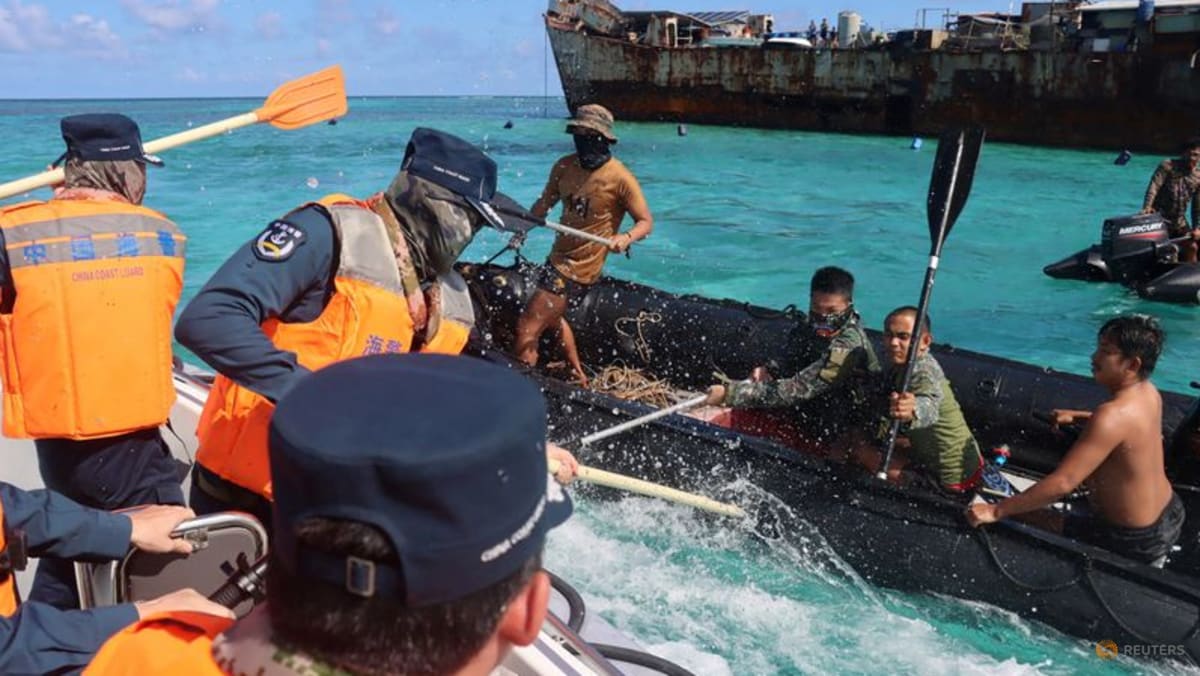
Philippine Navy personnel and China Coast Guard personnel clash near a grounded Philippine warship at Second Thomas Shoal, in the South China Sea, Jul 20, 2026. (cnsphoto via REUTERS)
This audio is generated by an AI tool.
LANCASTER, England: Tensions are once again on the rise in Asia’s most contentious waterway, after a period of relative quiet in the South China Sea .
Clashes on the water have become sharper and more frequent since July. The most serious confrontation was on Jul 20, when Chinese Coast Guard personnel and Philippine marines fought with batons and paddles near Second Thomas Shoal, with a Filipino marine receiving a serious blow to the head. Most recently on Friday (Sep 18), Chinese and Philippine vessels collided near Sabina Shoal.
The return of such regular clashes was all but inevitable.
China has long sought control in the disputed waters and its level of activity has notably increased across multiple sites this year. Its efforts appear more and more to be about turning its presence into what the Chinese Coast Guard calls more systematic “management and control” of the waters.
CNA Games Guess Word Crack the word, one row at a time Buzzword Create words using the given letters Mini Sudoku Tiny puzzle, mighty brain teaser Mini Crossword Small grid, big challenge Word Search Spot as many words as you can Show More Show Less
WHY CLASHES ARE RETURNING
Renewed confrontation was only a matter of time. The arrangement that allowed relative calm to prevail around Second Thomas Shoal since July 2024 managed disputes without resolving them.
Under that tacit agreement, the Philippines was able to complete 13 rotation and resupply missions to Second Thomas Shoal without physical interference. However, a reported condition was that Manila refrain from significant construction work to reinforce the rusting outpost, the grounded WWII-era transport ship BRP Sierra Madre which is in danger of falling into the sea.
Videos indicate the Jul 20 incident was triggered when Philippine marines confronted a Chinese Coast Guard vessel that had approached the Sierra Madre. China’s ambassador in Manila explicitly stated that the vessel had approached to surveil “some kind of construction work in the ship”.
China's Foreign Ministry reiterated on Jul 21 that it would permit humanitarian resupply missions – provided the Philippines provided prior notification – but would “resolutely stop” any attempt to “build fixed facilities or a permanent outpost”.
The Philippines cannot put off such work indefinitely if it wants to maintain its position at the shoal. Given the rapid decay of the Sierra Madre in the salty maritime environment, doing so could in effect entail abandoning a reef that lies squarely within the Philippines’ Exclusive Economic Zone under the United Nations Convention on the Law of the Sea (UNCLOS).
FILE - A dilapidated but still active Philippine Navy ship BRP Sierra Madre sits at the Second Thomas Shoal, locally known as Ayungin Shoal, at the disputed South China Sea on Aug. 22, 2023. (AP Photo/Aaron Favila, File)
The latest clashes also come around the time of the 10th anniversary of the 2016 arbitration ruling that China’s nine-dash line was unlawful as a claim to maritime space. Beijing has never accepted the ruling.
The broader direction is even clearer at Scarborough Shoal, where China has achieved practical on-water control by setting new rules, expanding its ability to enforce them and restricting access to the shoal.
China telegraphed its intent in 2025 with its announcement of a “Huangyan Dao National Nature Reserve” covering significant sections of the shoal. Since then, Beijing has been steadily building the administrative and legal frameworks to make comprehensive “management and control” of the disputed atoll a reality.
On Aug 1, the Ministry of Natural Resources, National Forestry and Grassland Administration, China Coast Guard, and Hainan provincial government jointly issued management rules reserve. The rules establish a routine patrol system, authorise investigation and punishment of violations, prohibit unauthorised fishing and other activities – which in effect prevent Philippine fisherman from entering the reserve except under specified circumstances.
Data from the Asia Maritime Transparency Initiative show China has doubled its Coast Guard patrolling presence around Scarborough Shoal in 2025 compared to the previous year. The same data indicate it’s on track to double it again in 2026. In April, China reinstalled a floating barrier across the entrance of the shoal.
Nor is all this an isolated episode. This is occurring alongside efforts to strengthen Chinese physical presence elsewhere in the South China Sea, including major new reclamation at Antelope Reef in the Paracel Islands.
CHALLENGE OF PUSHING BACK
The question then is whether China will face any pushback.
Although the United States has reaffirmed an “ironclad” commitment to the Philippines’ defence, credibility of US deterrence in the South China Sea has been called into question. Not only has the war on Iran weakened the US military posture in East Asia, US President Donald Trump himself has repeatedly shown a willingness to negotiate with China over American regional security issues.
The last reported Freedom of Navigation Operations (FONOPs) – to challenge excessive maritime claims – in the South China Sea was in August 2025. There have been no publicly known US FONOPs since then.
This pause mirrors a pattern seen during Mr Trump’s first term when he sought to build a relationship with Chinese President Xi Jinping.
There are, however, signs that other countries with an interest in a balance of power in the region may be stepping up. Earlier this month, the UK said it had conducted a joint FONOP with Australia in the South China Sea. In May, the UK sailed a naval vessel through the Spratly Islands, as did the Dutch navy through the Paracel Islands.
Amid budgetary squeezes, whether European navies can sustain such deployments and meaningfully compensate for the US’ reduced attention is far from clear.
There will likely be no shortage of clashes in the coming years to test such commitments.
Andrew Chubb is a Fellow on Chinese Foreign Policy and National Security at the Asia Society Policy Institute’s Center for China Analysis, and a Senior Lecturer at Lancaster University.
An automated curation of our top stories to start your day.
Our chief editor shares analysis and picks of the week's biggest news every Saturday.
Get our pick of top stories and thought-provoking articles in your inbox
Stay updated with notifications for breaking news and our best stories
Join our channel for the top reads for the day on your preferred chat app
亚洲协会政策研究所的安德鲁·丘布表示,经过两年的相对平静之后,中国和菲律宾之间的水域冲突变得更加激烈和频繁。
2026年7月20日,在南海仁爱礁附近,菲律宾海军人员与中国海警人员在一艘搁浅的菲律宾军舰旁发生冲突。(图片来自路透社)
这段音频由人工智能工具生成。
英国兰开斯特:在南海经历了一段相对平静的时期后,亚洲最具争议的水道——南海的紧张局势再次升级。
自7月以来,海上冲突愈演愈烈,频率也更高。最严重的一次冲突发生在7月20日,当时中国海警人员和菲律宾海军陆战队员在第二仁爱礁附近海域使用警棍和桨进行搏斗,一名菲律宾海军陆战队员头部受到重击。最近一次冲突发生在9月18日(星期五),中国和菲律宾船只在萨比纳礁附近海域发生碰撞。
这种频繁冲突的再次发生几乎是不可避免的。
中国长期以来一直寻求控制争议水域,今年以来,其在多个地点的活动强度显著增加。其努力似乎越来越倾向于将其存在转化为中国海警所称的对该水域更加系统的“管理和控制”。
CNA游戏 猜词游戏 逐行破解单词 流行词游戏 用给定的字母组成单词 迷你数独 小小谜题,挑战你的大脑 迷你填字游戏 小方格,大挑战 单词搜索 尽可能多地找出单词 显示更多 显示更少
冲突为何卷土重来?
再次发生冲突只是时间问题。自2024年7月以来,围绕仁爱礁维持相对平静的安排,虽然管控了争端,但并未真正解决问题。
根据这项默契协议,菲律宾得以在不受实际干扰的情况下完成对第二托马斯礁的13次轮换和补给任务。然而,据报道,该协议的一个条件是马尼拉方面不得进行任何大规模的加固工程,包括对这座锈迹斑斑的前哨基地以及搁浅的二战时期运输船“塞拉马德雷”号(BRP Sierra Madre)的加固,该船随时可能沉入大海。
视频显示,7月20日的事件起因是菲律宾海军陆战队员与一艘靠近“塞拉马德雷”号的中国海警船发生冲突。中国驻马尼拉大使明确表示,该船靠近是为了监视“船上的某种施工活动”。
中国外交部7月21日重申,将允许人道主义物资补给任务——前提是菲律宾事先通知——但将“坚决制止”任何“修建固定设施或永久哨所”的企图。
如果菲律宾想要保住其在该浅滩的地位,就不能无限期地推迟这项工作。鉴于马德雷山脉在咸水海洋环境中迅速衰败,这样做实际上可能意味着放弃一个完全位于菲律宾根据《联合国海洋法公约》(UNCLOS)享有的专属经济区内的礁石。
(档案照片)2023年8月22日,一艘破旧但仍在服役的菲律宾海军舰艇“马德雷山号”(BRP Sierra Madre)停泊在南海争议海域的第二托马斯礁(当地称为阿云金礁)。(美联社照片/Aaron Favila,档案照片)
最近的冲突恰逢2016年仲裁裁决十周年,该裁决认定中国提出的“九段线”主张对海洋空间构成非法。北京方面从未接受该裁决。
在黄岩岛,这一大方向更加清晰。中国通过制定新规则、扩大执法能力和限制进入黄岩岛,实现了对黄岩岛的实际水上控制。
中国在2025年宣布设立“黄岩岛国家级自然保护区”,涵盖黄岩岛的大部分区域,此举表明了其意图。此后,北京一直在稳步构建行政和法律框架,以期将对这一争议环礁的全面“管理和控制”变为现实。
8月1日,自然资源部、国家林业和草原局、中国海警局和海南省人民政府联合发布了保护区管理条例。该条例建立了例行巡逻制度,授权对违规行为进行调查和处罚,禁止未经授权的捕鱼和其他活动——实际上,除特定情况外,菲律宾渔民不得进入保护区。
亚洲海事透明倡议组织的数据显示,与上一年相比,中国2025年在黄岩岛附近的海警巡逻力度增加了一倍。同样的数据显示,2026年巡逻力度有望再次翻番。今年4月,中国在黄岩岛入口处重新设置了一道浮标。
这并非孤立事件。与此同时,中国还在南海其他地区加强自身存在,包括在西沙群岛羚羊礁进行大规模填海造陆。
反击的挑战
那么问题来了,中国是否会面临任何阻力。
尽管美国重申了对菲律宾防务的“坚定”承诺,但美国在南海的威慑力却备受质疑。不仅对伊朗的战争削弱了美国在东亚的军事态势,美国总统特朗普本人也多次表示愿意就美国在地区安全问题上与中国进行谈判。
据报道,美国最后一次在南海开展航行自由行动(FONOPs,旨在挑战过度的海洋主张)是在2025年8月。此后,美国再未开展过任何公开的航行自由行动。
这一停顿与特朗普第一任期内寻求与中国国家主席习近平建立关系时所采取的模式如出一辙。
然而,有迹象表明,其他一些对该地区力量平衡感兴趣的国家可能正在加大力度。本月初,英国表示已与澳大利亚在南海进行了联合航行自由行动。5月,英国海军舰艇驶入南沙群岛,荷兰海军也驶入了西沙群岛。
在预算紧缩的情况下,欧洲海军能否维持这样的部署,并有效地弥补美国减少的关注,目前还远不明朗。
未来几年,此类承诺很可能面临诸多冲突的考验。
安德鲁·丘布是亚洲协会政策研究所中国分析中心的中国外交政策和国家安全研究员,也是兰卡斯特大学的高级讲师。
每天清晨,我们都会自动为您推送最热门的新闻资讯,助您开启美好的一天。
我们的主编每周六都会分享对本周重大新闻的分析和精选。
订阅我们的邮件,即可获取精选热点新闻和引人深思的文章。
订阅通知,第一时间获取突发新闻和精彩报道。
加入我们的频道,即可在您常用的聊天应用上获取当日热门文章。