How a new conciliation route can resolve years of unpaid divorce maintenance beyond the courtroom一种新的调解途径如何能在法庭之外解决多年未支付的离婚赡养费问题
Aiming to set ex-spouses on a stable footing and avoid future disputes, maintenance enforcement officers have attended to more than 1,500 cases as of Jul 29.
Aiming to set ex-spouses on a stable footing and avoid future disputes, maintenance enforcement officers have attended to more than 1,500 cases as of Jul 29.
Chloe (not her real name) went through the new maintenance enforcement process to recover support payments her ex-husband owed. (Photo: CNA/Alyssa Tan)
This audio is generated by an AI tool.
SINGAPORE: For over a decade after her 2014 divorce, Chloe (not her real name) never received the monthly court-ordered maintenance payments owed to her.
The monthly sums were already modest, set at S$200 (US$155) for their son and a nominal S$1 in spousal support for herself. But the arrears crept up over the years, accruing to about S$28,000 in total.
The thought of chasing her ex-husband for payment – which would have involved applying for a court order – felt daunting, so Chloe let it slide to focus on rebuilding her life.
It was only this year, when her son turned 17 and entered a polytechnic, that Chloe decided that she wanted to enforce the maintenance order.
CNA Games Guess Word Crack the word, one row at a time Buzzword Create words using the given letters Mini Sudoku Tiny puzzle, mighty brain teaser Mini Crossword Small grid, big challenge Word Search Spot as many words as you can Show More Show Less “It was a weight in my heart that I didn’t do enough for my son,” said the 45-year-old administrative assistant, who earns S$2,800 a month. “He’s growing, and I’m still not really in my financial stability yet. Even this little amount actually will still go to him and help with his expenses.” To enforce the payments, Chloe filed her case with the Maintenance Enforcement Division of the Ministry of Law (MinLaw) and underwent conciliation with her ex-husband. It turned out he had been out of work for many years. He was overwhelmed by the situation and in need of support himself, said Ms Istyana Putri Ibrahim, the maintenance enforcement officer who handled their case. Comprising 30 officers, the Maintenance Enforcement Division is a new outfit that opened in January last year.
“It was a weight in my heart that I didn’t do enough for my son,” said the 45-year-old administrative assistant, who earns S$2,800 a month.
“He’s growing, and I’m still not really in my financial stability yet. Even this little amount actually will still go to him and help with his expenses.”
To enforce the payments, Chloe filed her case with the Maintenance Enforcement Division of the Ministry of Law (MinLaw) and underwent conciliation with her ex-husband.
It turned out he had been out of work for many years. He was overwhelmed by the situation and in need of support himself, said Ms Istyana Putri Ibrahim, the maintenance enforcement officer who handled their case.
Comprising 30 officers, the Maintenance Enforcement Division is a new outfit that opened in January last year.
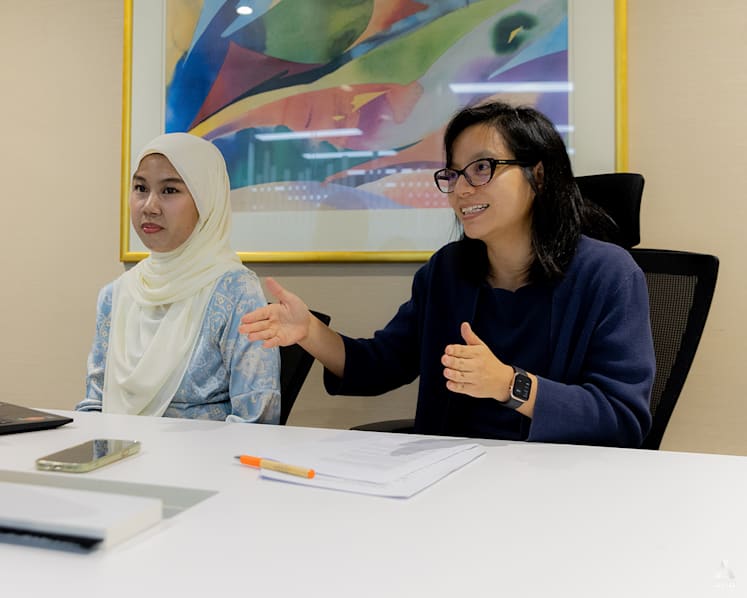
Maintenance enforcement officers Istyana Putri Ibrahim (right) and Nur Khalishah Roslan on Aug 19, 2026. (Photo: CNA/Ili Mansor)
Replacing mediation in the Family Justice Courts, the conciliation process offers a less adversarial alternative to enforcing payments through a court hearing.
Unlike Family Justice Courts mediators – who can be staff, volunteers and specially appointed judges – maintenance enforcement officers are MinLaw staff who are given fact-finding powers and play a more active role in recommending solutions.
And unlike lawyers, they are neutral parties who talk to both ex-spouses to help them reach an agreement about what to do going forward.
Although Chloe was owed more than 10 years of maintenance, claims are subject to a three-year time bar.
Through the conciliation, her ex-husband agreed to pay off arrears of about S$7,800 in instalments of S$100 a month. He also recommitted to paying the ongoing monthly maintenance of S$201.
In Chloe’s case, her ex-husband was not defiant or defensive, said Ms Istyana, who is the acting director for maintenance enforcement.
“He was just someone who also needed some guidance and support on his end,” she said.
“We needed to get him to acknowledge that, yes, he has a responsibility towards his son, and he needs to commit to a structured plan. And he also needs to commit to a plan for himself.”
Ms Istyana facilitated his referral to the National Trades Union Congress’ Employment and Employability Institute to help him find work, and also directed him to social support services.
Chloe and her ex-husband were able to reach agreement within one conciliation session.
“I felt the weight in my heart actually lighten a bit, and I felt I did something very right,” said Chloe of her experience in the conciliation.
“I really didn't know that I had that courage to actually do something so well for the first time, I think, in my life.”
"It was a weight in my heart that I didn't do enough for my son," said Chloe (not her real name), about the years of unpaid child support. (Photo: CNA/Alyssa Tan)
HANDLED MORE THAN 1,500 CASES
In response to CNA’s queries, MinLaw said more than 1,500 cases of maintenance enforcement have been referred to the division as of Jul 29 this year.
This is a sizeable share of the roughly 1,700 maintenance enforcement applications the Family Justice Courts receive annually in recent years.
The division covers claims under the Women’s Charter, the Guardianship of Infants Act, the Administration of Muslim Law Act and the Maintenance of Parents Act. Applicants include both men and women.
Its work began in phases from Jan 16, 2025. Since Jul 1 this year, the mechanism has been open to all enforcement applications under these Acts.
This new route, dubbed the “maintenance enforcement process”, was introduced to fill persistent gaps, MinLaw told CNA.
Before, maintenance claimants often had to return to court multiple times to enforce orders, and outcomes were not always durable.
The new process is forward-looking and meant to put both sides on a stable footing to prevent future disputes, said chief maintenance enforcement officer Leong Kwang Ian.
“Rather than looking at past breaches, it seeks to understand the underlying issues bringing about non-payment of maintenance, and then it helps parties with practical and sustainable solutions.”
In the traumatic process of a family breaking apart, this helps to reduce emotional difficulties for all involved, including the children who tend to bear the most impact, said Mr Leong.
Chief maintenance enforcement officer Leong Kwang Ian at the Ministry of Law on Aug 19, 2026. (Photo: CNA/Ili Mansor)
WHAT HAPPENS IN CONCILIATION
The highest arrears recouped in a single case under the maintenance enforcement process so far amounted to over S$400,000, with ongoing monthly maintenance of S$4,000.
The median amount of arrears collected is about S$8,400, while the mean amount is about S$17,700.
But the process extends beyond financial recovery, offering support to both parties rather than just the receiving ex-spouse.
Generally, cases conclude within just over a month – less than the time needed to prepare for a court hearing, said MinLaw. The settlement rate for conciliation cases is around 70 per cent, meaning that a majority do not proceed to a full hearing.
Emotions can run high during conciliation as people come in with past grievances and hurts. But the officer’s job is to steer the conversation towards the future, said Ms Istyana.
“It’s really important that I try to make them feel heard, so give them some airtime to let off some steam,” said maintenance enforcement officer Nur Khalishah Roslan.
Once this happens, people tend to open up and the meeting can become an occasion to work through their misunderstandings.
She recalled one case where it emerged that an ex-husband was not paying maintenance not just due to financial difficulty, but also because he was disappointed that he could not meet his children.
This turned out to be a misunderstanding, and the conciliation became an opportunity for him and his ex-wife to clarify his access to the kids.
“I think that was the turning point. That’s when he realised, actually he could have maybe tried harder to have a relationship with the children,” said Ms Khalishah.
The new maintenance enforcement process builds in fact-finding powers that allow officers to seek information about an individual’s financial situation without requiring court orders.
Balanced by legal safeguards, these powers help to keep the enforcement process non-adversarial, said chief maintenance enforcement officer Mr Leong.
This is because a neutral party is openly retrieving the information, as opposed to lawyers covertly digging for data as they would for a court hearing, he said.
Officers typically seek information from the Central Provident Fund Board to understand individual income; the Housing and Development Board and Singapore Land Authority for property ownership; the Land Transport Authority for vehicle ownership; the Accounting and Corporate Regulatory Authority for business shareholdings; and the Ministry of Social and Family Development to find out if the individual is receiving financial assistance.
They can also obtain records on investment holdings from the Central Depository, and on bankruptcy administration from the Official Assignee.
They must still seek a court order to obtain information from the Inland Revenue Authority of Singapore and banks.
Lawyer Nur Liyana Kamaludin, senior legal counsel at Titanium Law Chambers, said the fact-finding powers are a key distinction of the new maintenance enforcement process.
When a case goes to court and an ex-spouse who is supposed to pay maintenance tries to hide his or her true financial position, lawyers have to file an application to unearth assets in a process called discovery.
“Multiple rounds of discovery would mean a lot of costs for our clients,” said Ms Liyana. She has had clients decide not to seek enforcement in court because they expect their ex-spouses to be uncooperative and the costs to add up.
Under the maintenance enforcement process, applicants are not charged any fees for conciliation or fact-finding services.
If a settlement is not reached in conciliation, the information found through fact-finding will be submitted to the Family Justice Courts for the full hearing.
This will help the court to make more targeted and effective enforcement orders to recover the arrears, said MinLaw. It has already happened in some cases heard by the courts.
Ms Liyana is particularly hopeful for middle-income claimants sandwiched between the lower income ceiling for legal aid, and the higher income levels needed to afford their own legal representation.
“If it’s going to be that simple, that they can just file the application and then immediately they get help from the maintenance enforcement officer, I can literally just do an advisory role,” she said.
This means she can charge as little as S$500 if a client still wants a legal consultation on what to expect and what they are entitled to, and for her to look through their application documents to make sure all is sound.
While the amounts of maintenance recouped through this process may not all be immense, they still make a difference to the families involved.
“It affects the lives of ex-spouses and children, brings about certainty for people to carry on with school, classes, the ability to see the doctor if they’re ill,” said Mr Leong.
“The break-up of a family is itself a sufficiently traumatic experience for everybody concerned,” he added.
“The ability for us to perhaps ‘hand-hold’ applicants through this journey to make it easier is one big factor that we should view as a big advantage to having this programme.”
Get our pick of top stories and thought-provoking articles in your inbox
Stay updated with notifications for breaking news and our best stories
Join our channel for the top reads for the day on your preferred chat app
为使前配偶关系稳定下来,避免未来发生纠纷,截至 7 月 29 日,赡养费执行人员已处理了 1500 多起案件。
克洛伊(化名)通过新的赡养费强制执行程序追讨前夫拖欠的赡养费。(图片:CNA/Alyssa Tan)
这段音频由人工智能工具生成。
新加坡:克洛伊(化名)在 2014 年离婚后的十多年里,从未收到法院判决每月应支付给她的赡养费。
每月给的金额本来就不多,儿子每月200新元(约合155美元),妻子象征性地每月只给1新元赡养费。但多年来,拖欠的金额逐渐增加,累计已达约28000新元。
想到要追讨前夫的欠款——这需要申请法院命令——克洛伊就感到畏惧,所以她决定暂时搁置此事,专注于重建自己的生活。
直到今年,儿子年满 17 岁并进入理工学院学习后,克洛伊才决定要强制执行抚养令。
CNA游戏 猜词游戏 逐行破解单词 流行词游戏 用给定的字母组成单词 迷你数独 小谜题,脑力挑战 迷你填字游戏 小方格,大挑战 单词搜索 尽可能多地找出单词 显示更多 显示更少 “我一直很愧疚,觉得自己为儿子做得不够,”这位45岁的行政助理说道,她每月收入2800新元。“他正在长大,而我的经济状况仍然不稳定。即使是这点钱,也能帮他支付一些开销。” 为了确保前夫支付抚养费,克洛伊向律政部赡养费执行部门提交了案件,并与前夫进行了调解。结果发现,他已经失业多年。负责处理此案的赡养费执行官员伊斯蒂亚娜·普特里·易卜拉欣女士表示,他被这种情况压得喘不过气来,自己也需要帮助。维护执法部门由 30 名警员组成,是去年 1 月成立的新部门。
“我心里一直很愧疚,觉得我为儿子做得不够,”这位45岁的行政助理说道,她每月收入2800新元。
“他正在长大,而我的经济状况还没有完全稳定下来。即使是这点钱,也能帮他支付一些开销。”
为了强制执行付款,克洛伊向律政部赡养费执行处提起诉讼,并与前夫进行了和解。
原来他已经失业多年。负责处理此案的房屋维护执法官员伊斯蒂亚娜·普特里·易卜拉欣女士说,他被眼前的状况压得喘不过气来,自己也需要帮助。
维护执法部门由 30 名警员组成,是去年 1 月成立的新部门。
维护执法人员 Istyana Putri Ibrahim(右)和 Nur Khalishah Roslan,摄于 2026 年 8 月 19 日。(照片:CNA/Ili Mansor)
调解程序取代了家庭司法法院的调解程序,为强制执行付款提供了一种对抗性较小的替代方案,无需通过法庭听证会。
与家庭司法法院的调解员(可以是工作人员、志愿者和特聘法官)不同,赡养费执行官是律政部工作人员,他们被赋予了事实调查权,并在提出解决方案方面发挥了更积极的作用。
与律师不同,他们是中立的第三方,会与双方前配偶交谈,帮助他们就未来的安排达成协议。
尽管 Chloe 应获得超过 10 年的赡养费,但索赔需遵守三年的时效限制。
通过调解,她的前夫同意分期偿还约7800新元的欠款,每月支付100新元。他还重申了每月支付201新元赡养费的承诺。
赡养费强制执行代理主任伊斯蒂亚娜女士说,克洛伊的前夫并没有表现出反抗或防御的态度。
“他也需要一些指导和支持,”她说。
“我们需要让他认识到,是的,他对儿子负有责任,他需要制定一个有条理的计划。同时,他也需要为自己制定一个计划。”
伊斯蒂亚娜女士协助他转介至全国工会大会的就业和就业能力研究所,以帮助他找到工作,并指导他获得社会支持服务。
克洛伊和她的前夫在一次调解会议后就达成了协议。
“我感觉心里的重担减轻了一些,我觉得我做了一件非常正确的事情,”克洛伊在谈到她的调解经历时说道。
“我真的不知道自己有勇气把一件事做得这么好,这大概是我人生中的第一次。”
“多年来我一直感到愧疚,觉得自己没能为儿子做得足够多,”克洛伊(化名)谈到未支付的子女抚养费时说道。(图片:CNA/Alyssa Tan)
处理了超过1500起案件
针对 CNA 的询问,律政部表示,截至今年 7 月 29 日,已有超过 1500 起赡养费强制执行案件移交至该部门。
近年来,家庭司法法院每年收到约 1700 起赡养费强制执行申请,而这其中有很大一部分是此类申请。
该部门负责处理依据《妇女宪章》、《未成年人监护法》、《穆斯林法律管理法》和《父母赡养法》提出的索赔申请。申请人包括男性和女性。
该机制自 2025 年 1 月 16 日起分阶段启动。自今年 7 月 1 日起,该机制已向所有依据这些法案提出的强制执行申请开放。
律政部告诉亚洲新闻台,引入这条被称为“维护执法程序”的新途径是为了填补长期存在的漏洞。
以前,赡养费申请人往往需要多次回到法庭才能强制执行判决,而且结果并不总是持久的。
首席维修执法官梁光彦表示,新流程具有前瞻性,旨在使双方处于稳定的基础之上,以防止未来发生纠纷。
“它不着眼于过去的违约行为,而是力求了解导致拖欠赡养费的根本原因,然后帮助各方找到切实可行的可持续解决方案。”
梁先生表示,在家庭破裂的痛苦过程中,这有助于减轻所有相关人员的情感痛苦,包括那些往往受到最大影响的儿童。
2026年8月19日,首席维修执法官梁光彦在律政部。(图片:CNA/Ili Mansor)
和解过程中会发生什么
迄今为止,在赡养费强制执行程序下,单起案件中追回的最高欠款超过 40 万新元,每月赡养费为 4000 新元。
收回的欠款金额中位数约为 8,400 新元,而平均金额约为 17,700 新元。
但这个过程不仅限于经济补偿,还会为双方提供支持,而不仅仅是接受补偿的前配偶。
律政部表示,一般来说,案件会在一个月多一点的时间内结案——比准备庭审所需的时间还要短。调解案件的和解率约为70%,这意味着大多数案件无需进入正式庭审阶段。
调解过程中,由于人们带着过去的怨恨和伤痛前来,情绪可能会非常激动。但伊斯蒂亚娜女士表示,调解员的职责是引导谈话朝着未来发展。
“让他们感到被倾听非常重要,所以要给他们一些发泄的时间,”维修执法人员努尔·哈利沙·罗斯兰说道。
一旦这种情况发生,人们往往会敞开心扉,会议也可以成为消除误会的机会。
她回忆起一个案例,其中一位前夫不支付赡养费不仅是因为经济困难,还因为他无法见到自己的孩子而感到失望。
结果证明这是一场误会,和解也成了他和前妻澄清他探视孩子权利的机会。
“我认为那是个转折点。那时他意识到,其实他本可以更努力地与孩子们建立关系,”卡利沙女士说。
新的赡养费强制执行程序赋予执法人员调查权,允许其在无需法院命令的情况下获取有关个人财务状况的信息。
首席维修执法官梁先生表示,在法律保障的平衡下,这些权力有助于保持执法过程的非对抗性。
他说,这是因为中立的第三方公开地获取信息,而不是像律师在法庭听证会上那样秘密地挖掘数据。
官员通常会向中央公积金局查询个人收入;向建屋发展局和新加坡土地管理局查询房产所有权;向陆路交通管理局查询车辆所有权;向会计与企业管理局查询企业持股情况;以及向社会及家庭发展部查询个人是否正在接受经济援助。
他们还可以从中央证券存管机构获取投资持有记录,从官方受托人获取破产管理记录。
他们仍需向法院申请命令,才能从新加坡税务局和银行获取信息。
钛金律师事务所高级法律顾问努尔·利亚娜·卡马鲁丁律师表示,事实调查权是新的赡养费强制执行程序的一个关键区别。
当案件进入法庭审理阶段,而本应支付赡养费的前配偶试图隐瞒其真实的财务状况时,律师必须提交申请,通过称为“发现”的程序来挖掘资产。
“多轮取证会给我们的客户带来巨大的成本,”莉亚娜女士说。她有些客户因为预计前配偶不会配合,而且诉讼费用会不断累积,所以决定放弃通过法律途径强制执行。
在赡养费强制执行程序中,申请人无需支付任何调解或事实调查服务费用。
如果调解未能达成和解,则通过事实调查发现的信息将提交给家庭司法法院进行全面听证。
律政部表示,这将有助于法院发出更有针对性、更有效的强制执行令,以追回欠款。在一些已审理的案件中,这种情况已经出现。
莉亚娜女士尤其对那些收入处于法律援助较低收入上限和自行承担法律代理费用所需较高收入水平之间的中等收入申请人抱有希望。
“如果事情真像他们说的那么简单,他们只要提交申请就能立即得到维修执法人员的帮助,那我就可以只扮演顾问的角色了,”她说。
这意味着,如果客户仍然希望获得法律咨询,了解预期结果和自身权益,并让她审核申请文件以确保一切妥当,她可以只收取 500 新元的费用。
虽然通过这一过程追回的维护费用可能并不巨大,但对相关家庭来说仍然意义重大。
梁先生说:“这会影响前配偶和孩子的生活,让人们能够安心地继续上学、上课,生病时也能去看医生。”
“家庭破裂本身对所有相关人员来说都是一种足够痛苦的经历,”他补充道。
“我们或许能够全程指导申请者,让他们更容易完成申请流程,这是我们应该视为该项目一大优势的因素。”
订阅我们的邮件,即可获取精选热点新闻和引人深思的文章。
订阅通知,第一时间获取突发新闻和精彩报道。
加入我们的频道,即可在您常用的聊天应用上获取当日热门文章。