This ’80s Promo Video Will Make You Want A F-20 Tigershark So Freaking Bad这段80年代的宣传片会让你无比渴望拥有一架F-20虎鲨战斗机
Take it from General Yeager, it was a damn good jet.
新闻视频
Updated Jul 3, 2020 4:14 AM EDT
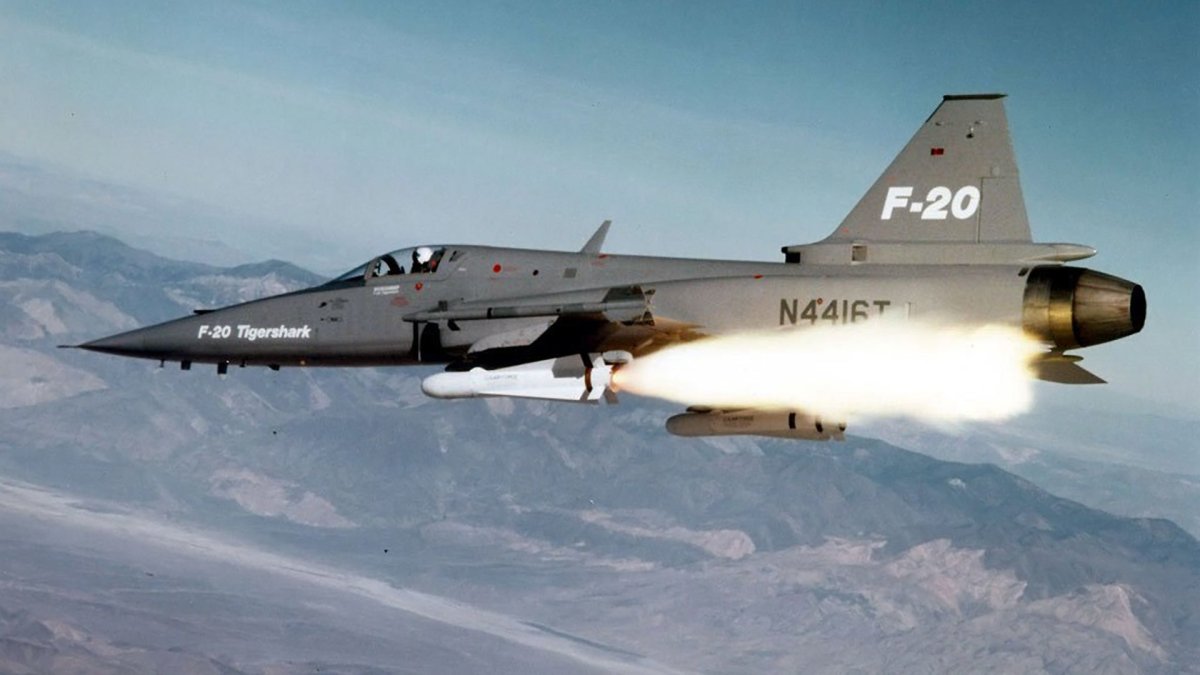
Northrop’s F-20 Tigershark, an evolution of the company’s highly successful F-5E Tiger II—which itself was an evolution of the F-5A/B Freedom Fighter and The T-38 Talon—never made it into production, but many thought it should have. The aircraft provided high performance and multi-role capability on the cheap, both in terms of procurement and operating costs. But the Reagan administration’s loosening of export rules on military equipment, including fighters, allowed the already deep into production, larger and more advanced F-16 to edge out the F-20 on the world-wide fighter jet marketplace.
There were still a few opportunities for Northrop to get its self-funded fighter into production, with the Navy’s Fighter Weapons School—better known as Topgun—being in the market for a new highly maneuverable “4th generation” dissimilar adversary aircraft. In the end, here too the F-16 won out, giving birth to the hotrod F-16N (make sure to read all about F-16N and Topgun’s proposed F-20s here ). By 1986, after over a billion dollars invested and the failure to produce a single customer, along with a spate of high-profile crashes, Northrop’s “people’s fighter” of sorts that was born out of the “ Fighter Mafia” of the 1970s was finally put to rest.
The marketing surrounding the F-20 was somewhat unique. Seeing as it was a company program, with few government dollars invested, Northrop went about demoing the jet around the world and building some pretty awesome promotional materials around it. They even hired retired General Chuck Yeager to become the spokesperson for the program, which included him flying and personally endorsing the jet.
Maybe the best thing remaining of the F-20 is this awesome long-format promotional video that goes into the features of the jet. It does an awesome job at selling why the Tigershark was its own breed of fighter, and how it could get so much done without a large logistical footprint and with low operating costs.
Today the Tigershark concept lives on to a certain degree in aircraft like the JAS-39, JF-17, and advanced fighter-trainers like the FA-50. Some of the F-5E/F Tigers IIs still in service have been extensively upgraded to give them similar if not superior avionics to the F-20. But even with these upgrades, these jets lack the Tigershark’s upgraded mechanical systems and extreme performance. Maybe the closest thing to a modern F-20 was Northrop Grumman now defunct T-X contender , the Model 400 . Sadly we may never know what this jet’s true performance capabilities were.
In some ways the F-20 makes more sense now than it did 30 plus years ago. As fighter aircraft have become so expensive to procure and maintain, some countries are left with fleets that are just a shadow of their previous selves. Not just that, but the digital avionics revolution has resulted in a higher focus on sensors and sensor fusion than on an aircraft’s size or raw performance. And many of these systems have shrunk considerably in recent years making them lighter and more adaptable to smaller fighter aircraft designs.
For instance, today a small but powerful AESA radar can easily fit into the F-20’s tight nose cone. Additionally, the almost total reliance on smart weapons by western air forces, which are becoming ever smaller and more accurate, mean that aircraft that could carry large payloads are not as useful for most missions as they once were. A single F-20 carrying four 1,000lb GPS guided bombs can take out four targets in any weather conditions reliability. The same jet could be loaded up with 16 Small Diameter Bombs , giving it a high-volume, rapidly targetable, standoff precision striking capability. Such striking potential was just a dream back in the mid 1980s.
Simply put, the old days of needing multiple fighters to attack a single target are long gone, and a single fighter can now attack multiple targets on a single sortie, regardless of the jet’s size. Finally, the F-20 is a small target, both visually and on radar. Combined with the latest electronic warfare systems, far less capable aircraft have been proven to be a handful for even America’s F-15C/Ds . While an aircraft like the F-20 may not be able to go “downtown” into a “triple-digit” SAM engagement zone with ease, for most all other missions, including providing air sovereignty, an upgraded F-20 would be more than good enough.
Who knows, maybe we’ll see the rebirth of the lightweight fighter even here in the US. There is a chance that the winner of the T-X competition could end up being bought also as a light multi-role fighter much akin to the F-20. On a lower-end of the spectrum the USAF will be kicking off its light air support experiment this summer, which will be populated mainly by turbo-prop powered “mud movers,” although Textron’s adaptable, “no frills” jet-powered Scorpion will also be attending. Although it will never feature the blistering performance of the F-20, the Scorpion’s simplicity and cost effective approach to air warfare is relatable to the F-20 program’s original goals.
In the end the F-20 just never got the breaks, and just a handful of years later, a much more advanced Northrop creation—YF-23 Black Widow—would also impress but be passed over for another (now) Lockheed product—the F-22 Raptor. Although there seems to be more regret about YF-23’s rejected than the F-20’s, both aircraft seemed to hit the nail almost too hard on the head, and together would have been quite the perfect pair that defines a “high-low” capability force structure mix.
Contact the author: Tyler@thedrive.com
Comments couldn’t be loaded. Please refresh the page.
更新于美国东部时间2020年7月3日凌晨4:14
诺斯罗普公司的F-20“虎鲨”战斗机是该公司大获成功的F-5E“虎II”战斗机的改进型,而F-5E“虎II”本身又是F-5A/B“自由战士”和T-38“鹰爪”教练机的改进型。尽管F-20最终未能投入生产,但许多人认为它本应如此。这款飞机性能卓越,用途广泛,而且采购和运营成本都很低。然而,里根政府放宽了包括战斗机在内的军用装备出口管制,使得当时已经投入生产的更大、更先进的F-16战斗机得以在全球战斗机市场上击败F-20。
诺斯罗普公司仍有一些机会将其自筹资金研发的战斗机投入生产,当时海军战斗机武器学校(更广为人知的名称是“Topgun”)正在寻找一种新型高机动性的“第四代”异型假想敌飞机。最终,F-16再次胜出,并由此衍生出高性能的F-16N(请务必点击此处阅读有关F-16N和Topgun提出的F-20项目的全部内容)。到1986年,在投入超过10亿美元却未能交付任何客户,以及一系列备受瞩目的坠机事故之后,诺斯罗普公司这款诞生于20世纪70年代“战斗机黑手党”时代的“人民战斗机”最终走向了终结。
F-20的营销策略颇为独特。由于这是一个公司项目,政府投入资金有限,诺斯罗普公司便在全球各地进行战机演示,并制作了一系列非常出色的宣传材料。他们甚至聘请了退役将军查克·耶格尔担任该项目的代言人,包括让他亲自驾驶并代言这款战机。
或许F-20留下的最宝贵的遗产就是这段精彩的长篇宣传片,它详细介绍了这款战机的各项特性。这段宣传片出色地展现了“虎鲨”战机的独特之处,以及它如何在后勤保障需求小、运营成本低的情况下完成如此多的任务。
如今,虎鲨战斗机的概念在一定程度上得以延续,例如JAS-39、JF-17以及FA-50等先进战斗教练机。一些仍在服役的F-5E/F“虎II”战斗机也经过了大规模升级,使其航电性能与F-20相当甚至更优。但即便如此,这些战机仍然缺乏虎鲨战斗机所拥有的先进机械系统和极致性能。或许最接近现代F-20的机型是诺斯罗普·格鲁曼公司现已停产的TX竞标机型——Model 400。可惜的是,我们可能永远无法得知这款战机的真实性能究竟如何。
在某些方面,F-20战斗机现在比30多年前更有意义。由于战斗机的采购和维护成本日益高昂,一些国家的战斗机机队实力大不如前。不仅如此,数字航空电子革命也使得人们更加关注传感器和传感器融合技术,而非飞机的尺寸或原始性能。近年来,许多此类系统的尺寸都大幅缩小,使其重量更轻,也更适合小型战斗机的设计。
例如,如今小型但功能强大的有源相控阵雷达(AESA雷达)可以轻松装入F-20紧凑的机头锥内。此外,西方空军几乎完全依赖智能武器,而这些武器正变得越来越小巧、越来越精确,这意味着能够携带大载荷的飞机在大多数任务中已不如以往那样有用。一架携带四枚1000磅GPS制导炸弹的F-20可以在任何天气条件下可靠地摧毁四个目标。同样的战机还可以装载16枚小直径炸弹,使其具备高容量、快速定位、防区外精确打击能力。这种打击潜力在20世纪80年代中期还只是一个梦想。
简而言之,过去需要多架战斗机攻击单个目标的时代早已过去,如今一架战斗机无论大小,都能在一次出击中攻击多个目标。此外,F-20 的体积小巧,无论目视还是雷达探测,都是一个难以发现的目标。结合最新的电子战系统,即使是性能远逊于它的飞机,也足以让美国的 F-15C/D 难以招架。虽然像 F-20 这样的飞机可能无法轻松进入“三位数”空空导弹交战区,但对于包括维护领空主权在内的绝大多数其他任务而言,升级后的 F-20 已经绰绰有余。
谁知道呢,或许我们甚至会在美国看到轻型战斗机的复兴。TX竞标的获胜者有可能最终也会被采购为一款类似于F-20的轻型多用途战斗机。在轻型战斗机领域,美国空军将于今年夏天启动轻型空中支援试验,该试验将主要由涡轮螺旋桨动力的“泥地移动者”组成,不过德事隆公司灵活多变、“朴实无华”的喷气式“蝎子”战斗机也将参与其中。虽然“蝎子”战斗机永远无法达到F-20那样惊人的性能,但它在空战中的简洁性和成本效益与F-20项目的最初目标不谋而合。
最终,F-20始终未能获得成功。仅仅几年后,诺斯罗普公司研发的更为先进的YF-23“黑寡妇”战斗机也同样令人印象深刻,但却被另一款(如今的)洛克希德·马丁公司的产品——F-22“猛禽”战斗机——所取代。尽管人们对YF-23的落选似乎比对F-20的落选更加惋惜,但这两款战机都几乎完美地契合了当时的需求,如果它们能够并肩作战,将会是“高低结合”能力型部队结构的完美组合。
联系作者:Tyler@thedrive.com
评论加载失败,请刷新页面。