Back to life: How Shield AI’s future unmanned fighter made decades-old tech new again重获新生:Shield AI的未来无人战斗机如何让数十年前的技术焕发新生
The original GE Aerospace engine nozzle, designed for the F-16, is key to building a vertical takeoff robotic jet prototype.
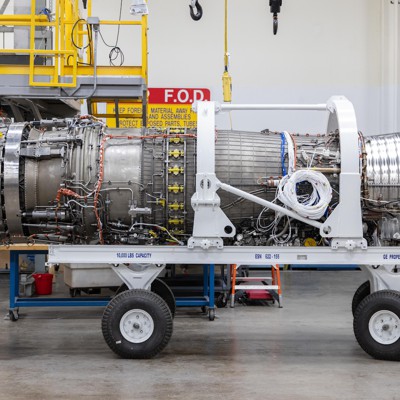
Courtesy / GE Aerospace
The original GE Aerospace engine nozzle, designed for the F-16, is key to building a vertical takeoff robotic jet prototype.
LYNN, Mass.— Three decades ago, GE Aerospace tested a technology that could’ve made the F-16 more agile. It worked, but was never fielded. Instead, it sat in a box in a warehouse—until defense tech startup Shield AI called.
“They reached out to us and said…‘Do you still have that capability ? And the truth is, we hadn't fielded it. After we did the demonstration, it basically went into storage,” said Steve “Doogie” Russell, VP and general manager of GE’s Edison Works. “And the solution that we've offered to Shield on that is an F110 engine with a nozzle in the back that we call the axisymmetric vectoring exhaust nozzle , or AVEN.”
Not having to start from scratch on the technology was critical for saving time and speeding up flight testing for its collaborative combat aircraft, X-BAT, an autonomous fighter jet designed to take off and land vertically, Shiva Vallabhaneni , senior propulsion engineer for Shield AI, told Defense One .
“X-BAT always needed to have a thrust vector controlled capability to do vertical flight,” Vallabhaneni. “So we really went out and said…where can we get one? Is there technology that already exists?”
The aircraft “needs to be able to move quickly…in any direction,” GE’s Russell told reporters during a visit to the company’s factory here in Lynn.
That comes with a special set of propulsion requirements, so GE paired its 30-year-old AVEN nozzle with its F110 engine found in the F-16 fighter jet for the X-BAT.
The aircraft needs a high-thrust propulsion system “because you've got to be able to have that aircraft take off vertically and then, when it comes back, land at high thrust mode. It also needs to have really good gas mileages. So [thrust-specific fuel consumption], once it's up and away, needs to be able to hit the range requirements that they're trying to get,” Russell said.
And, he said, when it lands, it needs a nozzle “on the back that can move around to balance the aircraft as it's coming in to maneuver into position to dock back up. That's a pretty significant propulsion challenge and pretty unique.”
In under a year, the companies dusted off the AVEN nozzle, refurbished the original hardware, completely rewrote the software code, and have been testing it with the engine.
The hardware was in very good condition, and AVEN One, which is being used for the X-BAT prototype, has “close to 100 percent of the same hardware that was flown from the 90s,” Vallabhaneni said. “That was the biggest key unlock for getting us to an X-BAT prototype flight test this year—100 percent. In some ways, building that thrust vector control nozzle, verifying its technology, and doing it at the speed that we needed to is probably harder than getting an engine.”
The companies recently completed testing the engine integrated with the full AVEN nozzle at GE Aerospace’s test facility in Peebles, Ohio.
Now, the goal is to complete a tethered vertical flight test of the aircraft by the end of the year, to demonstrate that it can hover and remain stable.
Through data collected during testing, engineers can create models that will help develop vertical flight control laws, Vallabhaneni said.
During the planned test, the prototype aircraft will hang from a 180-foot crane to minimize risk. The test will be successful if slack in the tether is created during the hover.
“Shield AI—much like SpaceX, Rocket Lab, all of these other new space companies—the mindset is: be hardware rich, take risks because the faster we get to test, the faster we can learn what the real problems are. And so the tether gives peace of mind that we're buying off risk, but we're not buying off risk irresponsibly,” Vallabhaneni said.
But the AVEN nozzle won’t just be in the prototype—Shield AI plans to make more and eventually tweak the technology along the way. Building additional AVEN nozzles that keep the legacy design will help increase testing effort. And any future changes will likely focus on performance, Vallabhaneni said.
“Lighter, faster, more performance, right? Those are the things that we're going to go and chase and achieve on the future version of AVEN. So the journey doesn't stop here. This is the starting point, and it's really great that GE gave us a pretty great starting point back in the '90s,” he said.
“AVEN sat on the shelf for 30 years. I was born in Cincinnati, so I drive by the hospital I was born in every time I'm at GE—and…AVEN was built before I was born. So for me, it's very important to recognize all of the people who went and did that and built that within a year…We are giving those people their flowers and being able to pay that forward.”
NEXT STORY: White House pressure for US firms to skip French space summit is ‘unfortunate,’ insiders say
图片由通用电气航空航天公司提供
最初为 F-16 设计的通用电气航空航天发动机喷嘴是制造垂直起降机器人喷气式飞机原型机的关键。
马萨诸塞州林恩市——三十年前,通用电气航空航天公司测试了一项可以提升F-16战斗机机动性的技术。这项技术确实有效,但从未投入使用。它一直被封存在仓库的箱子里——直到国防科技初创公司Shield AI联系了他们。
“他们联系我们,问:‘你们还有这项能力吗?’ 说实话,我们还没有部署过这项技术。演示结束后,它基本上就被封存了,”通用电气爱迪生工厂副总裁兼总经理史蒂夫·“杜吉”·罗素说道。“我们为Shield公司提供的解决方案是在F110发动机后部加装一个喷嘴,我们称之为轴对称矢量排气喷嘴,简称AVEN。”
Shield AI 的高级推进工程师 Shiva Vallabhaneni 告诉 Defense One,无需从零开始研发这项技术对于节省时间、加快其协同作战飞机 X-BAT 的飞行测试至关重要。X-BAT 是一款自主战斗机,设计用于垂直起降。
“X-BAT 要想进行垂直飞行,就必须具备推力矢量控制能力,”瓦拉巴内尼说。“所以我们真的开始四处寻找……哪里能找到这种技术?是否存在现成的技术?”
通用电气公司的罗素在参观该公司位于林恩的工厂时告诉记者,这架飞机“需要能够快速地向任何方向移动”。
这带来了一套特殊的推进要求,因此通用电气将其 30 年前的 AVEN 喷嘴与 F-16 战斗机上的 F110 发动机结合,用于 X-BAT。
拉塞尔说:“这架飞机需要高推力推进系统,因为它必须能够垂直起飞,然后在返回时以高推力模式着陆。它还需要非常高的燃油效率。因此,一旦起飞,其推力比油耗必须能够达到他们想要达到的航程要求。”
他说,飞机着陆时,需要在尾部安装一个“可以移动的喷嘴,以便在接近对接位置时保持飞机平衡。这是一个相当大的推进挑战,而且非常独特。”
不到一年时间,这些公司就重新启用了 AVEN 喷嘴,翻新了原始硬件,完全重写了软件代码,并一直在用发动机进行测试。
硬件状况非常好,用于X-BAT原型机的AVEN One“几乎100%保留了90年代飞行时使用的硬件”,Vallabhaneni说道。“这是我们今年能够进行X-BAT原型机飞行测试的最大关键——100%的硬件保留。在某种程度上,制造推力矢量控制喷嘴、验证其技术并以我们所需的速度完成,可能比制造一台发动机还要难。”
这些公司最近在位于俄亥俄州皮布尔斯的通用电气航空航天测试设施完成了与完整 AVEN 喷嘴集成的发动机的测试。
现在的目标是在年底前完成该飞机的系留垂直飞行测试,以证明它可以悬停并保持稳定。
Vallabhaneni表示,通过测试过程中收集的数据,工程师可以创建模型,这将有助于开发垂直飞行控制律。
在计划的测试中,原型机将悬挂在180英尺高的起重机上,以最大程度地降低风险。如果悬停期间系绳出现松弛,则测试成功。
“Shield AI——就像SpaceX、Rocket Lab以及所有其他新兴太空公司一样——其理念是:拥有雄厚的硬件实力,敢于承担风险,因为我们测试得越快,就能越快了解真正的问题所在。因此,系绳让我们安心,因为我们是在降低风险,但我们并非在不负责任地承担风险,”Vallabhaneni说道。
但AVEN喷嘴并非仅用于原型机——Shield AI计划生产更多,并最终根据实际情况对技术进行改进。制造更多沿用原有设计的AVEN喷嘴将有助于加大测试力度。Vallabhaneni表示,未来的任何改进都可能侧重于性能提升。
“更轻、更快、性能更强,对吧?这些正是我们将在未来版本的AVEN上追求和实现的目标。所以,征程并未止步于此。这只是一个起点,非常感谢GE在90年代为我们提供了一个如此出色的起点,”他说道。
“AVEN项目搁置了30年。我出生在辛辛那提,所以每次来通用电气上班,我都会开车经过我出生的那家医院——而……AVEN项目在我出生之前就已经建成了。因此,对我来说,非常重要的是要感谢所有为此付出努力并在一年内完成这项工程的人……我们要向他们致敬,并将这份恩情传递下去。”
下一篇报道:知情人士称,白宫施压美国企业不参加法国太空峰会“令人遗憾”。