Navy launches Robotics and Autonomous Systems Warfighting Development Center海军启动机器人与自主系统作战发展中心
RASWDC is in the process of developing a phased implementation plan to tackle issues like command structure, mission relationships and resource requirements.
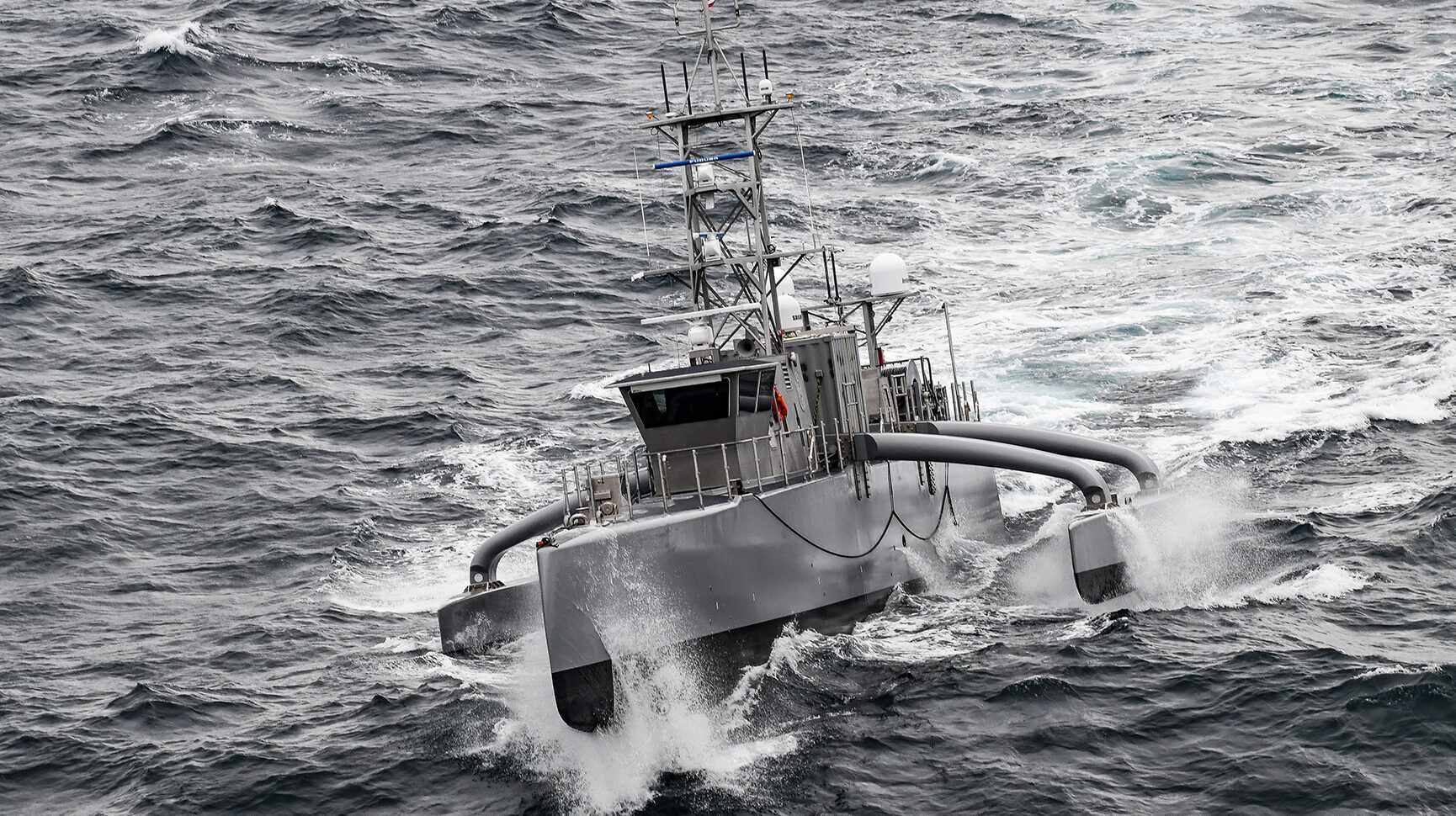
A Seahawk medium displacement unmanned surface vessel participates in U.S. Pacific Fleet’s Unmanned Systems Integrated Battle Problem (UxS IBP) 21. (U.S. Navy photo by Chief Mass Communication Specialist Shannon Renfroe)
VIRGINIA BEACH, Va. — The Navy is launching a new Robotics and Autonomous Systems Warfighting Development Center (RASWDC) that is tasked with creating the tactics, techniques, and procedures for unmanned systems in the Navy, the service announced today.
“RASWDC will draw on expertise from across the Navy — and across the country — in places that may not always be associated with naval power, but will be increasingly important to it,” RASWDC Commander Rear Adm. Melvin Smith said today during a ribbon-cutting ceremony establishing the command, according to a copy of his prepared remarks.
Headquartered at Joint Expeditionary Base Little Creek-Fort Story in Virginia, RASWDC is in the process of developing a phased implementation plan to tackle issues like command structure, mission relationships and resource requirements. The command is also responsible for overseeing the operational employment of RAS capabilities, according to the service.
“The goal is not to replace the hard-earned expertise already resident across our Navy. It is to connect it. To bring separate efforts into a more coherent operational enterprise,” Smith added. “To make sure that the work underway in one part of the Fleet informs the work being done elsewhere. And to ensure the sailors and operators who employ these systems remain at the center of the conversation.”
The creation of the warfighting development center coincides with the establishment of the Direct Reporting Portfolio Manager for Robotic and Autonomous Systems (DRPM RAS) in August in an effort to advance RAS acquisition and fielding across the Navy and Marine Corps, the Navy said. The two bodies are designed to work in lockstep, with testing and training information from the development center to support fielding the systems.
Chief of Naval Operations Adm. Daryl Caudle has indicated for months a desire to open a warfighting and development center for RAS, just like the Navy has for other communities like aviation, and surface and mine warfighting. For example, Caudle told reporters at the Sea Air Space Exposition in April that the Navy must move unmanned capabilities from individual units into composite mission sets.
“To maintain our decisive maritime advantage, we must rapidly integrate robotic and autonomous systems into how we operate, train, and deploy,” Caudle said in a statement today. “The establishment of RASWDC ensures our Sailors are equipped with the tactical edge, advanced training, and specialized doctrine required to win the high-end fight.
One of the world’s most versatile attack planes is taking on the counter-UAS mission
An airborne layer pushes drone engagements farther from defended assets and changes the cost-per-kill equation.
“RASWDC is the critical bridge between capability development and operational employment,” Caudle added. “By forging a direct feedback loop, we are accelerating the delivery of unmanned capabilities from the foundry directly to the Fleet, ensuring our forces are postured to meet any challenge.”
The move comes after Caudle released his “ Fighting Instructions ” framework in February, where he unveiled his “ hedge force strategy ” that aims to pair unmanned systems with traditionally manned platforms to create a range of tailored options for combatant commanders.
Additionally, the “Fighting Instructions” ordered the Navy to establish how fleet commanders and the joint force will integrate RAS into “service decisions like strategic laydown, dispersal, and global force management” since no model exists for RAS capabilities yet, per the guidance.
一艘“海鹰”中型排水量无人水面舰艇参加了美国太平洋舰队的无人系统综合作战演练(UxS IBP)21。(美国海军首席大众传播专家香农·伦弗罗摄)
弗吉尼亚海滩,弗吉尼亚州——美国海军今天宣布,海军将成立一个新的机器人和自主系统作战发展中心(RASWDC),其任务是为海军的无人系统制定战术、技术和程序。
根据梅尔文·史密斯少将的讲话稿,RASWDC指挥官今天在成立该司令部的剪彩仪式上表示:“RASWDC将借鉴海军乃至全国的专业知识,这些专业知识可能并不总是与海军力量联系在一起,但对海军力量而言将变得越来越重要。”
RASWDC总部位于弗吉尼亚州小溪-斯托里联合远征基地,目前正在制定分阶段实施计划,以解决指挥结构、任务关系和资源需求等问题。据军方称,该司令部还负责监督RAS能力的作战运用。
“我们的目标并非取代海军各部门已有的来之不易的专业知识,而是要将它们连接起来,把分散的努力整合为一个更加协调一致的作战体系,”史密斯补充道,“确保舰队某一部门正在进行的工作能够为其他部门的工作提供借鉴,并确保使用这些系统的水兵和操作人员始终处于讨论的中心。”
海军方面表示,为推进海军和海军陆战队机器人与自主系统(RAS)的采购和部署,作战发展中心的成立与8月份成立的机器人与自主系统直接报告项目组合经理(DRPM RAS)的设立同步进行。这两个机构旨在紧密协作,利用发展中心提供的测试和训练信息来支持系统的部署。
海军作战部长达里尔·考德尔上将几个月来一直表示,希望为无人作战系统(RAS)建立一个作战和发展中心,就像海军为其他领域(例如航空、水面作战和水雷作战)建立的那样。例如,考德尔在四月份的海空航天博览会上告诉记者,海军必须将无人作战能力从单个单位转移到综合任务单元中。
考德尔今天在一份声明中表示:“为了保持我们决定性的海上优势,我们必须迅速将机器人和自主系统融入到我们的作战、训练和部署方式中。RASWDC的成立确保我们的水兵拥有赢得高端战争所需的战术优势、先进训练和专业理论。”
世界上用途最广泛的攻击机之一正在执行反无人机系统任务。
空中力量使无人机交战距离防御资产更远,并改变了每次击杀的成本计算方式。
考德尔补充道:“RASWDC是能力发展与作战运用之间的关键桥梁。通过建立直接反馈机制,我们正在加速无人能力从研发部门直接交付给舰队,确保我们的部队能够应对任何挑战。”
此前,考德尔于 2 月份发布了他的“作战指令”框架,其中他提出了“对冲部队战略”,旨在将无人系统与传统有人平台相结合,为作战指挥官创造一系列量身定制的选择。
此外,《作战指令》命令海军确定舰队指挥官和联合部队将如何把 RAS 整合到“战略部署、分散和全球兵力管理等服务决策”中,因为根据该指南,目前还没有 RAS 能力的模型。