Russian hybrid attacks likely to increase in coming months: Danish intel assessment丹麦情报机构评估:未来几个月俄罗斯混合攻击可能增加
The nine-page document said that although the risk is low, the likelihood of Moscow launching a "limited military attack" is increasing against one or several NATO countries.
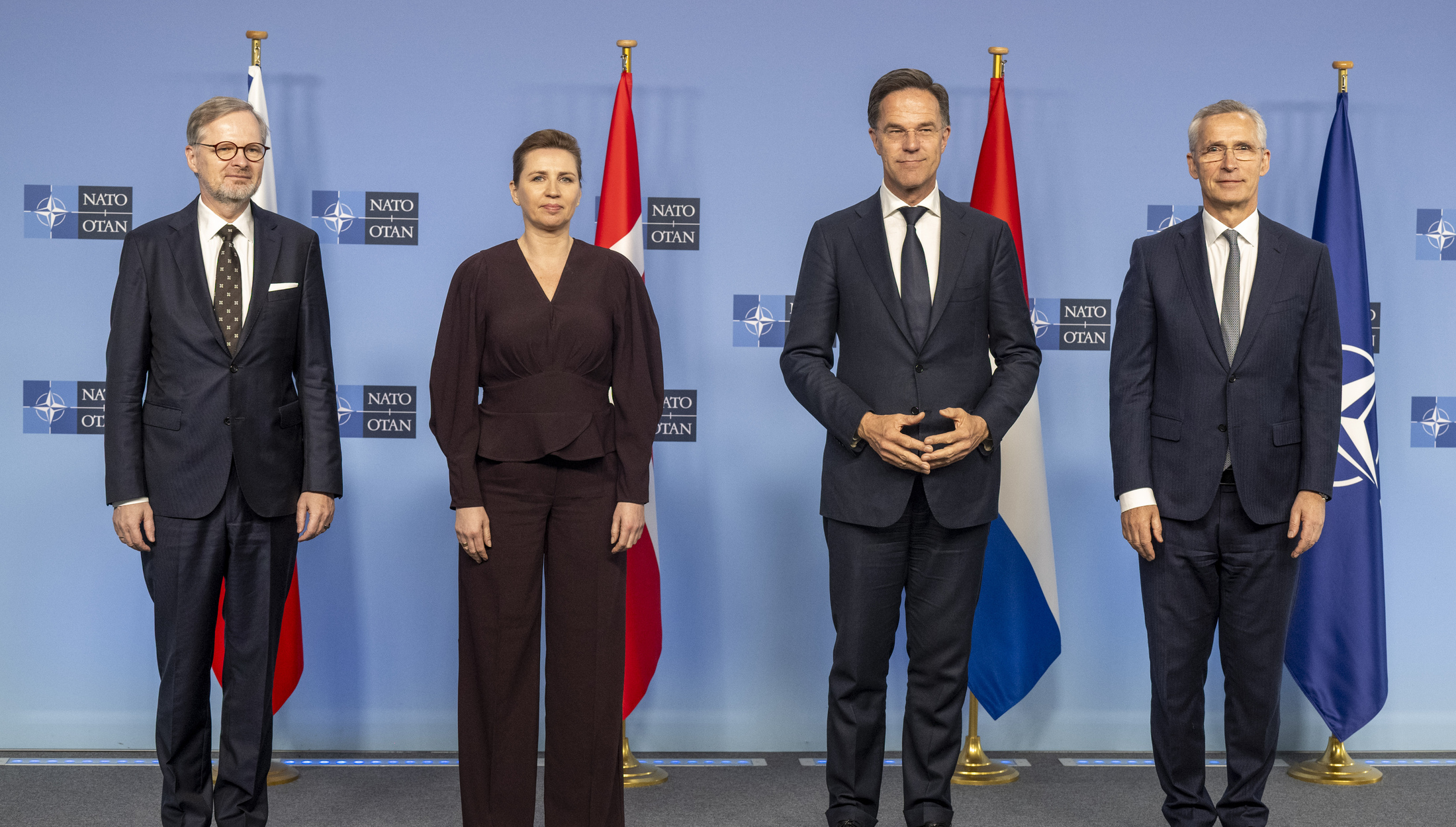
NATO Secretary General Jens Stoltenberg meets with the Prime Minister of Czech Republic, Petr Fiala (far left), the Prime Minister of Denmark Mette Frederiksen (second from the left), and the Prime Minister of the Netherlands, Mark Rutte - third from the left (NATO)
LVIV, Ukraine — Russia is expected to carry out hybrid attacks at a greater frequency against NATO member states in the coming months, and there is a growing risk of a limited military attack, according to a new report from the Danish intelligence service.
This assessment is part of the DDIS’ latest intelligence threat report, published today and focused on the deteriorating security landscape across Europe.
“DDIS assesses that Russia will intensify its hybrid war by carrying out more frequent attacks against the West and NATO, with greater consequences for the targeted countries than in the past. This could include cyber attacks that cripple societal functions as well as sabotage attacks that carry a high risk of casualties,” the report said.
The nine-page document further emphasized that although the risk is low, the likelihood of Moscow launching a “limited military attack” against one or several NATO countries is increasing. It noted that this could take the form, for instance, of isolated strikes carried out by long-range weapons on infrastructure vital to support Ukraine.
“In this situation, Russia might claim that the weapons only struck NATO territory because they were jammed by Ukraine,” the report said.
Over the last few months, there has been a string of unexplained incidents including fires, explosions or damage, frequently at defense-linked facilities across Europe. Most recently, on Sept 14., a Russian frigate fired flares at a Danish military helicopter, which DDIS referred to as the “most serious” example of Moscow’s increasingly aggressive attitude towards NATO militaries located in the Baltic Sea.
Earlier this month, a spokesperson from the Aerospace, Security & Defense Industries Association (ASD) of Europe told Breaking Defense that, due to the uptick in sabotage incidents and attempted targeting of defense-related industries, there was an urgent need to be more vigilant across the sector and for industry, governments and security agencies to cooperate to mitigate such attacks.
Europe’s military advantage depends on sovereign command of the ground truth
As NATO and European governments accelerate investment in space-based intelligence, decision advantage will depend on how quickly sovereign and commercial capabilities can be fused into a trusted operational picture.
Despite the dire warnings, the Danish intelligence branch found that there is still no indication that the Kremlin is planning an “outright invasion” of a NATO state, and that even if it did, this would likely take a minimum of six months of planning to build-up the required number of forces. Similarly, “there is no prospect” of Russian forces accomplishing any significant breakthrough in Ukraine over the next six months, the assessment said.
北约秘书长延斯·斯托尔滕贝格会见了捷克共和国总理彼得·菲亚拉(最左)、丹麦首相梅特·弗雷德里克森(左二)和荷兰首相马克·吕特(左三)(北约)
乌克兰利沃夫——丹麦情报部门的一份新报告称,预计俄罗斯将在未来几个月内更频繁地对北约成员国发动混合攻击,而且发生有限军事攻击的风险也在不断增加。
这项评估是DDIS今天发布的最新情报威胁报告的一部分,该报告重点关注欧洲日益恶化的安全形势。
报告称:“国防情报局评估认为,俄罗斯将通过更频繁地对西方和北约发动攻击来加剧其混合战争,对目标国家造成的后果将比以往更加严重。这可能包括瘫痪社会功能的网络攻击,以及可能造成大量人员伤亡的破坏性攻击。”
这份长达九页的文件进一步强调,尽管风险较低,但莫斯科对一个或多个北约国家发动“有限军事打击”的可能性正在增加。文件指出,这可能采取例如使用远程武器对乌克兰重要基础设施进行孤立打击的形式。
报告称:“在这种情况下,俄罗斯可能会声称这些武器之所以只袭击北约领土,是因为受到了乌克兰的干扰。”
过去几个月,欧洲各地国防相关设施频频发生不明原因的火灾、爆炸或损坏事件。最近一起事件发生在9月14日,一艘俄罗斯护卫舰向一架丹麦军用直升机发射照明弹。丹麦国防情报局(DDIS)称,这是莫斯科对驻波罗的海北约军事力量日益咄咄逼人态度的“最严重”例证。
本月初,欧洲航空航天、安全和国防工业协会 (ASD) 的一位发言人告诉 Breaking Defense,由于破坏事件和针对国防相关行业的袭击企图有所增加,因此迫切需要在整个行业提高警惕,并且行业、政府和安全机构需要合作以减轻此类袭击。
欧洲的军事优势取决于其对实际情况的主权掌控。
随着北约和欧洲各国政府加快对天基情报的投资,决策优势将取决于主权能力和商业能力能够多快地融合到一个可信的作战图景中。
尽管警告严峻,丹麦情报部门发现,目前仍没有任何迹象表明克里姆林宫计划对北约成员国发动“全面入侵”。即便真的有此计划,也至少需要六个月的筹备时间才能集结所需兵力。评估报告还指出,同样地,“未来六个月内,俄罗斯军队在乌克兰取得任何重大突破的可能性都为零”。