Canadian military aims to show it can go it alone in the Arctic加拿大军方旨在证明其能够在北极地区独立行动。
Prime Minister Mark Carney has vowed to ensure that Canada can protect the Arctic without any outside help.
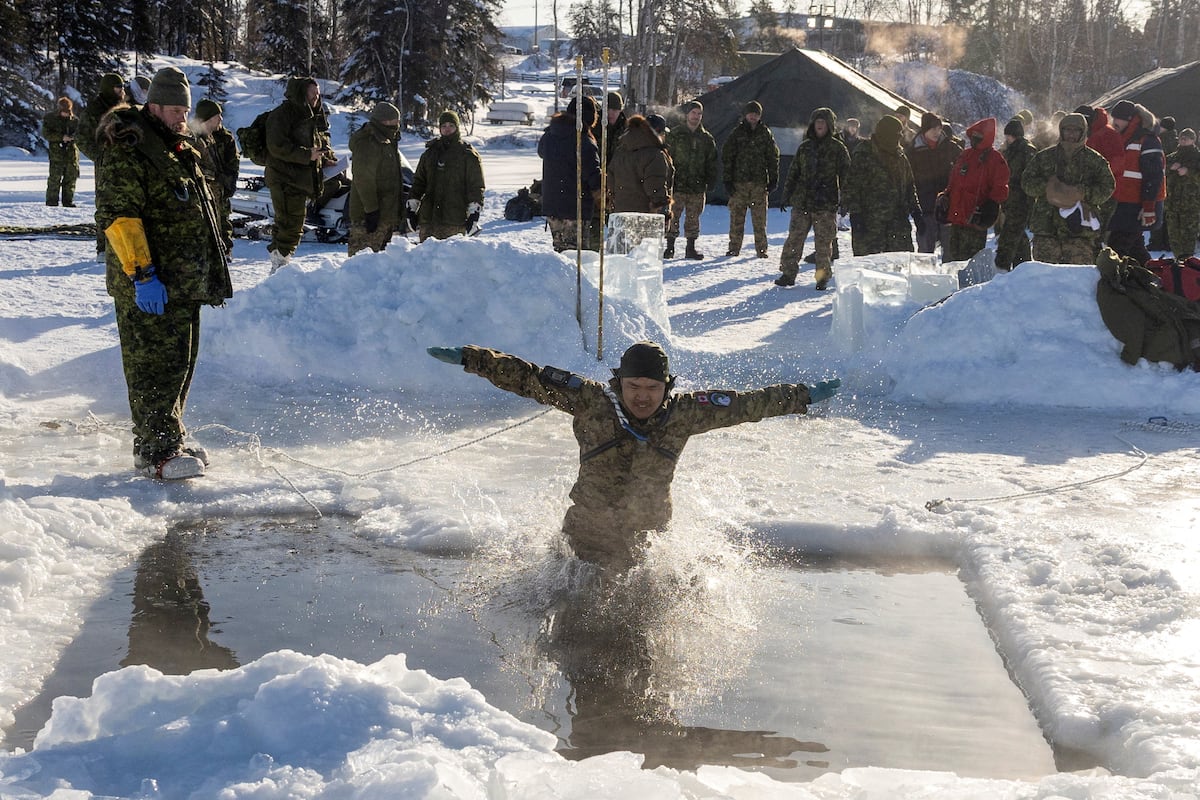
CAMBRIDGE BAY, Nunavut — Over the past three months, Canadian soldiers conducted a more than 5,000-kilometer snowmobile patrol in extreme Arctic conditions traveling from Inuvik, Northwest Territories, to Churchill, Manitoba, braving blizzards and minus-60 degree Celsius temperatures in military exercises designed to prepare for a foreign threat – and demonstrate Canada’s ability to take care of itself.
That’s a tall order. The political climate has changed since U.S. President Donald Trump’s repeated threats to make Canada an American state, take control of Greenland and withdraw from NATO, but the harsh realities of operating in Canada’s frozen north have not.
“There are Canadians up here defending (the country) at all times of the day,” said Travis Hanes, a commanding officer of the 1st Canadian Ranger Patrol Group, a special unit of the Canadian Armed Forces’ reserve. “They’re stretching their abilities across some of the most inhospitable terrain and climate that you can possibly imagine.”
He spoke to Reuters while recovering from a frostbitten nose after weeks of being on the snowmobile patrol.
To Hanes and many of his fellow Rangers, the idea that any foreign power might challenge Canada’s sovereignty in a region that is about 40% the size of continental Europe is baffling. “We are the landowners and it’s hard to see how someone thinks it could be taken away,” he said.
NATO members Canada and the United States have worked together for decades in the Arctic. They officially formed NORAD, the North American Aerospace Defense Command, in 1958 because neither country could independently respond to a threat by the Soviet Union.
Trump’s jibes about making Canada the 51st U.S. state and his growing tensions with NATO, only heightened by the U.S. war in Iran, have prompted Canadians to rethink their reliance on their southern neighbor.
Prime Minister Mark Carney has vowed to ensure that Canada can protect the Arctic without any outside help. As he unveiled a new plan last month detailing how Canada would spend C$35 billion reinforcing its military in the far north, Carney said Canada was now taking “full responsibility” for its Arctic sovereignty.
“We will no longer depend on any one nation ,” he declared.
In interviews with nearly two dozen people including Canadian military leaders in the Arctic, government ministers, diplomats, analysts and serving members of the armed forces during a nine-day trip to the Arctic, Reuters found that despite the prime minister’s pledge, the deep ties between the Canadian and American militaries remain unchanged and the challenges to defending the Arctic are formidable. Not only is it highly unlikely that Canada could be completely self-reliant, but the U.S. too depends on Canada for its own security.
Skis, planes and snowmobiles
During the months-long exercises, approximately 1,300 members of the Canadian Armed Forces conducted patrols on skis, practiced landing planes on the frozen Arctic Ocean and transported artillery to the most northern point ever in Cambridge Bay, Nunavut. It was the largest number of Canadian Armed Forces involved since the exercise began in 2007; the snowmobile patrol finished last week in Churchill, Manitoba.
A few observers and participants were present from the armed forces of the United States, Greenland, Belgium and France, but it was overwhelmingly a Canadian affair.
Canada’s foreign affairs minister Anita Anand told Reuters the government was moving as quickly as possible to make sure Canada can assume full responsibility for defending its Arctic, but did not offer a timeline.
“The gravest threat to Canada … comes from the increased movement of Russian infrastructure further and further north towards the Arctic Circle,” she said, adding that the entire geopolitical landscape has become “much more volatile.” She said working with the U.S. on the security and defense of North America via NORAD remains “fundamental.”
A senior White House official said the U.S. and its allies would continue to ensure the Arctic remains “free and open for peaceful purposes.”
“We welcome Canada’s efforts to take responsibility for securing its own territory,” the official said in an email.
The Russian foreign ministry has said repeatedly that Moscow is doing its best to maintain peace and stability in the region and has cast blame elsewhere for increased militarization in the Arctic.
“Western countries have transformed the Arctic into an area of geopolitical rivalry,” said Maria Zakharova, a spokeswoman for the foreign ministry in March. “This turn of events is not in Russia’s interests. We are open to mutually respectful dialogue with our foreign partners.”
Russia’s foreign ministry did not respond to a request for comment.
Whitney Lackenbauer, an Arctic expert at Trent University in Peterborough, said neither the U.S. nor Canada have the capability alone to monitor the vast Canadian Arctic, which comprises roughly 4 million square kilometers and more than 36,000 islands.
Brig. Gen. Daniel Riviere, Commander of Canada’s Joint Task Force North, said this year’s military exercises proved the military has the ability to move specialized weapons and equipment that might be needed in the unlikely possibility of a land attack.
“We need to be prepared for the worst,” Riviere told Reuters from his base in Yellowknife, where Canada’s Arctic defenses are headquartered.
Still, Riviere emphasized that Canada’s military partnership with the U.S. is critical, saying Canadian Armed Forces stand “shoulder to shoulder” with American soldiers.
On the coastline, Canadian authorities have “far more presence in Arctic waters” compared to the Americans, according to Neil O’Rourke, Director General for Fleet and Maritime Services at Canada’s Coast Guard. He said Canadian icebreakers are regularly used to escort U.S. ships heading to the Arctic and pointed out that Canada has the world’s second-biggest fleet of icebreakers, after Russia.
In other areas, Canada lags. Across the country, there are 47 radar sites that form the North Warning System, a network from western Yukon to Labrador.
Pierre Leblanc, a former commander of the Canadian forces in the north, said the system is increasingly obsolete and questioned if Canada would have the ability to independently respond if any serious threats were picked up.
The sites are remotely monitored by NORAD and the Canadian military but are managed by Nasittuq, a private Canadian company that won a C$592 million government contract in 2022.
Nasittuq described the radar network as “a legacy system” in an email and acknowledged that it was “aging and limited against modern threats.”
At the Cambridge Bay site, which also serves as a logistics center, there are no military staff, but a gift store selling branded radar system merchandise.
“Canada and the U.S. need each other because there’s lots of gaps in the north,” said Troy Bouffard, a former Arctic adviser to U.S. Senator Lisa Murkowski who represents Alaska. Washington depends on Canada to provide intelligence about potential threats in the Arctic, and the strategically located region also serves as a buffer zone between the U.S. and adversaries like Russia, China and Iran, Bouffard said.
Much of the airport and radar infrastructure across the Canadian Arctic was conceived, built and paid for by the U.S. during the Cold War. After years of underfunding its defenses in the Arctic, and following numerous complaints by Trump, Canada hit the NATO target of spending 2% of its GDP on defense last year.
Evan Bloom, a former U.S. diplomat who focused on the Arctic, said that despite bellicose statements from Trump, the working relationship between Canada and the U.S. in the far north remains largely unchanged.
“Russia is carrying out this hybrid warfare that is a threat to Western democracies and China is now also cooperating more militarily with Russia,” he said. “Those are bigger threats than the relationship problems Canada and the U.S. are having.”
Last month, for example, NORAD scrambled a half dozen Canadian and U.S. fighters to intercept two Russian airplanes that nearly entered Canadian airspace, said Kevin Knight, head of intelligence for Canada’s Joint Task Force North.
Knight said the incident was notable for how close Russian aircraft came to Canadian airspace.
Maj. Matt Wookey, a pilot with the Canadian Air Force who practiced landing a Twin Otter plane on frozen Arctic sea ice, said flying there was different to almost anywhere else in the world.
“Everything is just snow and drifts, and it all looks the same, even the shoreline,” Wookey said. “Nothing is built to properly function when the thermometer goes below minus 40, including humans.”
努纳武特剑桥湾——在过去的三个月里,加拿大士兵在极端北极条件下进行了超过 5000 公里的雪地摩托巡逻,从西北地区的伊努维克一路行至曼尼托巴省的丘吉尔,冒着暴风雪和零下 60 摄氏度的严寒,参加了旨在应对外国威胁并展示加拿大自卫能力的军事演习。
这的确是一项艰巨的任务。自从美国总统唐纳德·特朗普一再威胁要将加拿大变成美国的一个州、控制格陵兰岛并退出北约以来,政治气候已经发生了变化,但在加拿大冰天雪地的北部地区开展行动的严峻现实却依然存在。
“加拿大军队日夜在这里保卫国家,”加拿大武装部队预备役特种部队——加拿大第一游骑兵巡逻队指挥官特拉维斯·海恩斯说道,“他们在你能想象到的最恶劣的地形和气候条件下执行任务,竭尽全力。”
在雪地摩托巡逻数周后,他鼻子被冻伤,正在康复中,期间他接受了路透社的采访。
对哈内斯和他的许多游骑兵战友来说,任何外国势力都可能挑战加拿大在面积约占欧洲大陆40%的地区的主权,这种想法令人费解。“我们是这片土地的所有者,很难想象有人会认为这片土地可以被夺走,”他说。
北约成员国加拿大和美国在北极地区合作已有数十年之久。由于两国都无法独立应对苏联的威胁,它们于1958年正式成立了北美防空司令部(NORAD)。
特朗普关于将加拿大变成美国第 51 个州的嘲讽,以及他与北约日益紧张的关系(美国在伊朗的战争更是加剧了这种紧张关系),促使加拿大人重新思考他们对南部邻国的依赖。
加拿大总理马克·卡尼誓言,加拿大将确保自身能够在无需任何外部援助的情况下保护北极地区。上个月,卡尼公布了一项新计划,详细阐述了加拿大将如何斥资350亿加元加强其在北极地区的军事力量。卡尼表示,加拿大现在将“全面负责”维护其北极主权。
“我们将不再依赖任何一个国家,”他宣称。
路透社在为期九天的北极之旅中采访了近二十位人士,其中包括加拿大驻北极军事领导人、政府部长、外交官、分析人士和现役军人。采访结果显示,尽管加拿大总理做出了承诺,但加美两国军队之间根深蒂固的联系依然如故,保卫北极的挑战依然艰巨。加拿大不仅极不可能完全实现北极地区的自给自足,而且美国自身的安全也依赖于加拿大。
滑雪板、飞机和雪地摩托
在长达数月的演习中,约1300名加拿大武装部队成员进行了滑雪巡逻,在冰封的北冰洋上练习飞机着陆,并将火炮运送到努纳武特地区剑桥湾的最北端。这是自2007年该演习开始以来,加拿大武装部队参与人数最多的一次;雪地摩托巡逻已于上周在曼尼托巴省丘吉尔结束。
虽然有来自美国、格陵兰、比利时和法国武装部队的一些观察员和参与者出席,但这基本上是一场加拿大的活动。
加拿大外交部长阿妮塔·阿南德告诉路透社,加拿大政府正在尽快采取行动,确保加拿大能够承担起保卫北极的全部责任,但她没有给出时间表。
她表示,“对加拿大而言,最严重的威胁……来自俄罗斯基础设施不断向北推进,逼近北极圈”,并补充说,整个地缘政治格局已变得“更加动荡”。她还表示,通过北美防空司令部(NORAD)与美国合作,维护北美安全与防御仍然“至关重要”。
一位白宫高级官员表示,美国及其盟友将继续确保北极保持“自由开放,用于和平目的”。
“我们欢迎加拿大努力承担起保障自身领土安全的责任,”这位官员在一封电子邮件中表示。
俄罗斯外交部多次表示,莫斯科正在尽最大努力维护该地区的和平与稳定,并将北极地区军事化加剧的责任归咎于其他方面。
“西方国家已将北极地区变成了地缘政治竞争的场所,”俄罗斯外交部发言人玛丽亚·扎哈罗娃3月份表示,“这种事态发展不符合俄罗斯的利益。我们愿与外国伙伴开展相互尊重的对话。”
俄罗斯外交部未回应置评请求。
彼得伯勒特伦特大学的北极专家惠特尼·拉肯鲍尔表示,美国和加拿大都没有能力单独监测广袤的加拿大北极地区,该地区面积约 400 万平方公里,拥有超过 36000 个岛屿。
加拿大北方联合特遣部队指挥官丹尼尔·里维埃准将表示,今年的军事演习证明,军方有能力调动在不太可能发生的陆地袭击中可能需要的专用武器和装备。
“我们需要做好最坏的打算,”里维埃在位于黄刀镇的基地告诉路透社,加拿大北极防御部队的总部就设在那里。
不过,里维埃强调加拿大与美国的军事伙伴关系至关重要,并表示加拿大武装部队与美国士兵“并肩作战”。
加拿大海岸警卫队舰队和海事服务总监尼尔·奥罗克表示,与美国相比,加拿大当局在北极水域的影响力“要大得多”。他指出,加拿大破冰船经常为前往北极的美国船只护航,并强调加拿大拥有仅次于俄罗斯的世界第二大破冰船队。
在其他领域,加拿大则相对落后。全国共有47个雷达站,组成了北部预警系统,该系统覆盖范围从育空西部延伸至拉布拉多。
加拿大北方部队前指挥官皮埃尔·勒布朗表示,该系统日益过时,并质疑如果发现任何严重威胁,加拿大是否有能力独立应对。
这些站点由北美防空司令部和加拿大军方远程监控,但由加拿大私营公司 Nasittuq 管理,该公司在 2022 年赢得了价值 5.92 亿加元的政府合同。
纳西图克在一封电子邮件中将雷达网络描述为“一个遗留系统”,并承认它“已经老化,无法应对现代威胁”。
剑桥湾基地同时也是一个后勤中心,那里没有军事人员,但有一家礼品店出售品牌雷达系统商品。
“加拿大和美国需要彼此,因为北方存在很多信息空白,”曾担任阿拉斯加州参议员丽莎·穆尔科斯基北极事务顾问的特洛伊·布法德说道。布法德表示,华盛顿依赖加拿大提供有关北极潜在威胁的情报,而且北极地区地理位置优越,也是美国与俄罗斯、中国和伊朗等对手之间的缓冲区。
加拿大北极地区的大部分机场和雷达基础设施都是冷战时期由美国构思、建造和出资的。多年来,加拿大在北极地区的防御投入不足,加上特朗普的多次抱怨,去年加拿大终于达到了北约设定的国防开支占GDP 2%的目标。
曾专注于北极事务的美国前外交官埃文·布鲁姆表示,尽管特朗普发表了好战言论,但加拿大和美国在遥远北方的工作关系基本保持不变。
他说:“俄罗斯正在进行这种混合战争,这对西方民主国家构成威胁,而中国现在也与俄罗斯加强了军事合作。这些威胁比加拿大和美国之间的关系问题更大。”
例如,加拿大北方联合特遣部队情报主管凯文·奈特表示,上个月,北美防空司令部紧急出动了六架加拿大和美国的战斗机,拦截了两架几乎进入加拿大领空的俄罗斯飞机。
奈特表示,此次事件的显著之处在于俄罗斯飞机与加拿大领空距离如此之近。
加拿大空军少校马特·伍基是一名飞行员,他曾在北极冰冻海冰上练习驾驶双水獭飞机降落。他说,在那里飞行与世界上几乎任何其他地方的飞行都不同。
“到处都是雪和积雪,看起来都一样,就连海岸线也是如此,”伍基说。“气温低于零下40度时,包括人类在内,没有什么东西能够正常运转。”