Iran war exposes weakened state of Britain’s armed forces伊朗战争暴露了英国武装部队的虚弱状态
Explainer: Here are some details regarding the scale of the decline and the country’s current capabilities.
LONDON — The Iran war has left Britain’s armed forces exposed, heaping pressure on Prime Minister Keir Starmer to act on his promises to invest in defense, after years of warnings from military bosses about the U.K.’s shrinking capabilities.
When a British military base in Cyprus was hit by a drone early on in the Iran conflict in March, Britain, whose navy was the largest in the world at the start of World War Two, took three weeks to deploy one warship to the eastern Mediterranean.
France, Greece and Italy sent warships to Cyprus within days.
Britain’s diminished military capacity has registered with U.S. President Donald Trump. He has dismissed Britain’s two aircraft carriers as “toys” while his defense secretary, Pete Hegseth, mocked what he called the “big, bad Royal Navy.”
Defending his record on the armed forces, Starmer said on Wednesday his government, in power for nearly two years, had put in place the biggest sustained increase in military spending since the Cold War.
Britain’s military now is about half the size it was then and its army is the smallest it has been since the early 19th century.
Below are details regarding the scale of the decline and the country’s current capabilities.
Britain’s Royal Navy has 38,000 personnel. It operates two aircraft carriers and a combined fleet of 13 destroyers and frigates.
This has shrunk from about 62,000 personnel, three aircraft carriers and about 50 destroyers and frigates in 1991.
The delays in sending a warship to Cyprus prompted criticism of the navy’s available surface fleet.
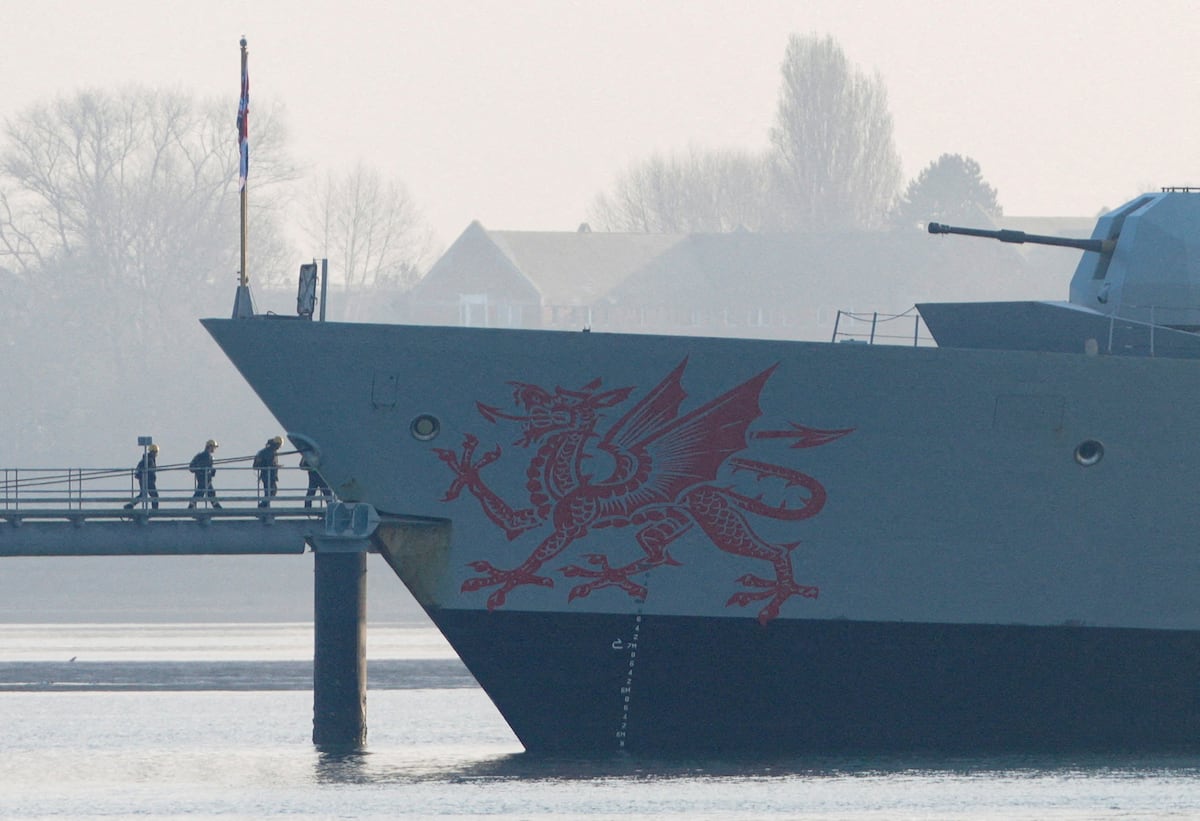
HMS Dragon, a Type 45 air defense destroyer, arrived in the eastern Mediterranean on March 23, while the Royal Navy has said since the outbreak of the Iran war that it is upgrading RFA Lime Bay to improve its mine-hunting and autonomous tech capabilities.
That deployment compares to the Gulf War in 1990-91, when the Royal Navy sent 21 surface ships and two submarines plus 11 Royal Fleet Auxiliary ships to the region.
The smaller fleet comes after decades of cuts to defense funding since the early 1990s, when about 3.8% of gross domestic product was spent on the military compared to the 2.3% spent in 2024.
Britain until December 2025 had a warship present in the Middle East for decades but that ended when HMS Lancaster was decommissioned in Bahrain just weeks before the start of the Iran war.
The Royal Navy’s aging frigates need to be retired before replacements become available, while its destroyers are undergoing maintenance work. A fleet of 13 new Type 26 and Type 31 frigates is due to enter service in the coming years.
The Royal Navy is also being stretched by Russian threats closer to home, with British warships recently spending a month in the North Atlantic tracking Russian submarines.
About a fifth of Britain’s defense budget is spent on nuclear submarines. This includes the Trident nuclear deterrent, comprising four Vanguard-class submarines. Under the Continuous At-Sea Deterrence policy, at least one of those submarines is on patrol at sea at any time.
The Vanguard-class submarines will be replaced by the Dreadnought-class in the early 2030s.
The RAF has over 150 fighter jets in service, two-thirds of which are Eurofighter Typhoons and the remainder Lockheed Martin F‑35s. It has a permanent staff of around 31,000 people.
In 1991, the RAF had about 700 fast-jet fighter aircraft and about 88,000 people. During the 1990-1991 Gulf War, it deployed 157 aircraft to the region, including over 80 fighter jets.
Before the start of the Iran war, Britain sent six F-35s to Cyprus and four Typhoons from 12 Squadron, a joint RAF and Qatar unit, to Qatar. It then sent four extra Typhoons to Qatar in early March after the U.S. and Israeli strikes on Iran began.
Unlike the Gulf War, when Britain was an active member of the U.S.-led coalition fighting Saddam Hussein’s Iraq, it is not directly involved in the current conflict with Iran, though Starmer has allowed what he calls defensive missions aimed at protecting residents of the region, including British citizens.
Britain’s army strength is currently 74,000 full-time personnel, down from 148,000 in 1991.
The number of main battle tanks has dropped from a fleet of about 1,200 at the end of the Cold War to around 150 that are currently operational.
伦敦——伊朗战争使英国武装部队暴露在危险之中,给首相基尔·斯塔默带来了巨大压力,迫使他兑现投资国防的承诺。此前,军方高层多年来一直警告英国的军事能力正在萎缩。
今年 3 月,在伊朗冲突初期,英国在塞浦路斯的一个军事基地遭到无人机袭击。二战初期,英国海军是世界上最大的海军,但英国却花了三周时间才向东地中海部署了一艘军舰。
几天之内,法国、希腊和意大利就向塞浦路斯派遣了军舰。
英国军事能力的下降已经引起了美国总统唐纳德·特朗普的注意。他称英国的两艘航空母舰为“玩具”,而他的国防大臣皮特·赫格塞斯则嘲讽他所谓的“强大而可怕的皇家海军”。
斯塔默周三为自己在军队方面的政绩辩护说,他领导的政府执政近两年,实现了冷战以来规模最大的持续性军费开支增长。
英国现在的军队规模大约只有当时的一半,其陆军规模也是自 19 世纪初以来最小的。
下面详细介绍衰落的规模和该国目前的实力。
英国皇家海军拥有38000名人员,旗下拥有两艘航空母舰和13艘驱逐舰及护卫舰组成的联合舰队。
与 1991 年的约 62,000 名人员、3 艘航空母舰和约 50 艘驱逐舰和护卫舰相比,规模已经缩减。
向塞浦路斯派遣军舰的延误引发了人们对海军现有水面舰队的批评。
45 型防空驱逐舰“龙”号于 3 月 23 日抵达东地中海。与此同时,自伊朗战争爆发以来,英国皇家海军一直表示正在升级皇家辅助舰队“莱姆湾”号,以提高其扫雷和自主技术能力。
这次部署与 1990-91 年的海湾战争类似,当时英国皇家海军向该地区派遣了 21 艘水面舰艇、2 艘潜艇以及 11 艘皇家舰队辅助舰。
舰队规模缩小是由于自 20 世纪 90 年代初以来国防经费持续削减所致。当时,军费开支约占国内生产总值的 3.8%,而 2024 年这一比例为 2.3%。
英国在中东地区驻扎军舰长达数十年,直到 2025 年 12 月才结束,但随着兰开斯特号军舰在伊朗战争爆发前几周在巴林退役,这种情况就结束了。
英国皇家海军老旧的护卫舰需要在新舰服役前退役,而驱逐舰目前正在进行维护保养。一支由13艘新型26型和31型护卫舰组成的舰队预计将在未来几年内投入使用。
英国皇家海军也因来自俄罗斯的威胁而疲于奔命,俄罗斯的威胁甚至波及到英国本土。英国军舰最近在北大西洋花费了一个月时间追踪俄罗斯潜艇。
英国国防预算约五分之一用于核潜艇,其中包括由四艘先锋级潜艇组成的“三叉戟”核威慑力量。根据“持续海上威慑”政策,任何时候都至少有一艘潜艇在海上巡逻。
先锋级潜艇将于 2030 年代初被无畏级潜艇取代。
英国皇家空军拥有超过150架现役战斗机,其中三分之二是欧洲台风战斗机,其余为洛克希德·马丁F-35战斗机。其常驻人员约31000人。
1991年,英国皇家空军拥有约700架快速喷气式战斗机和约88000名人员。在1990-1991年的海湾战争期间,英国皇家空军向该地区部署了157架飞机,其中包括80多架战斗机。
在伊朗战争爆发前,英国向塞浦路斯派遣了六架F-35战斗机,并从英国皇家空军和卡塔尔联合组建的第12中队向卡塔尔派遣了四架台风战斗机。3月初,在美国和以色列开始对伊朗发动空袭后,英国又向卡塔尔增派了四架台风战斗机。
与海湾战争时期英国作为美国领导的打击萨达姆·侯赛因伊拉克的联盟的积极成员不同,英国并未直接参与目前与伊朗的冲突,尽管斯塔默允许开展他所谓的旨在保护该地区居民(包括英国公民)的防御性任务。
英国军队目前有74000名全职人员,低于1991年的148000人。
冷战结束时,主战坦克的数量约为 1200 辆,而目前仍在服役的坦克数量约为 150 辆。