France puts mobile corps command to the test in major war scenario法国在重大战争场景中检验机动军团指挥能力
The small forward command post lets commanders “be in contact with the divisions, to be as close as possible to the engagement zone,” said a top general.
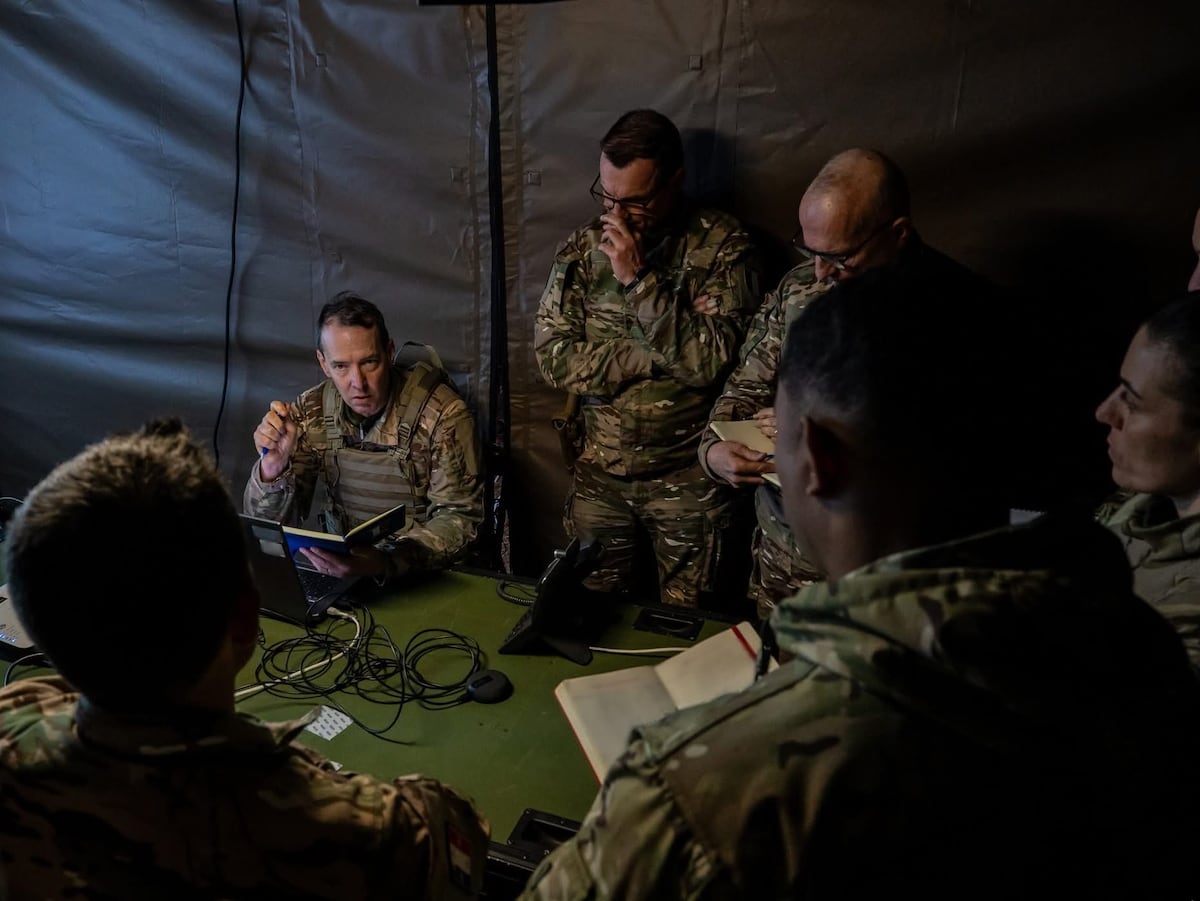
PARIS — On the edge of a meadow in western France, Gen. Benoît Desmeulles moves between two closely-parked armored personnel carriers tucked against a cover of trees and shrubs to reach his makeshift office, a patch of grass covered by a tent and multi-spectral camouflage netting.
It’s war, France is in charge, and Desmeulles for the first time is deploying the new mobile command structure of the French 1st Army Corps in its full configuration, as part of the Orion 26 exercise .
“Welcome to CP1,” says Desmeulles , taking a dark metal chair at a scuffed green-topped table, from where he oversees some 120,000 troops in the exercise as commander of the army corps.
Command Post 1 was set up in a few hours the day before, centered around six APCs packed with computing and communications gear, and will relocate shortly to follow five divisions maneuvering eastwards through ‘Arnland,’ a fictional country in the exercise suspiciously shaped like France.
With Orion 26, France is validating its ability to lead a corps-level European force in high-intensity conflict, acting as framework nation at a time when the United States is pushing NATO allies to take on more of their own defense. In the exercise, the 1st Army Corps commands French, Polish, British, Italian and Spanish divisional headquarters.
French Army Gen. Benoît Desmeulles speaks to reporters during the Orion 26 military exercise near Poitiers, France, in April 2026. (Rudy Ruitenberg/staff)
Desmeulles is testing a tiered command structure with a mobile forward post some 80 to 100 kilometers from the engagement zone, deployed under armor for mobility and survival. It’s a departure from NATO’s usual fixed corps commands in the rear, and designed to optimize the observe-orient-decide-act (OODA) loop for decision-making.
The small forward command post allows commanders “to be in contact with the divisions, to be as close as possible to the engagement zone,” Desmeulles said in a briefing with three reporters on April 11 at the Montmorillon training camp . “Hence this remilitarization, these armored capabilities, survivability features.”
A second command node farther back provides host-nation support and logistics, with a data-heavy headquarters in Lille in northern France.
Desmeulles, wearing combat fatigues, jokes one thing gained with the new setup is “a lot less hassle,” with about 50 people at the mobile headquarters instead of 500.
Ukraine has been a major source of reflection and inspiration but not a template for the rethink, with Desmeulles saying he also looked at the Gulf Wars and World War II. “We mustn’t lose sight of the fact that one day we might be engaged in something completely different.”
The 1st Army Corps general, in a previous command at the 11th Parachute Brigade, already worked “to put an end to these command posts that don’t move, that can’t move. That was the same logic.”
In Ukraine, distance no longer protects command and control, creating a need for mobility, dispersion and “digital hygiene,” Ukrainian Maj. Gen. Volodymyr Horbatiuk said in a Modern War Institute interview this month.
U.S. Army Lt. Gen. Curtis Buzzard, who helps coordinate Western aid to Ukraine, said in the same interview the forward line “is so lethal, but yet commanders have to get out there to feel and understand what’s occurring on the battlefield.”
France's 1st Army Corps deploys a mobile command post during exercise Orion 26 near Poitiers, France, in April 2026. (État-major des armées)
Setting up CP1 under cover takes about 20 minutes, and two hours with improved camouflage and a defensive perimeter, according to Capt. Charles of the 41st Signal Regiment, attached to the corps. He said a challenge of the command overhaul was fitting the armored vehicles with the required kit, in the venerable Véhicule de l’Avant Blindé for now and the new Griffon APC at a yet-to-be-determined date in the future.
“The main thing we’ve gained is the ability to be as close as possible to the divisions leading the battle,” Desmeulles said. “As corps commander, that to me is the most important. If I were at war, I’d be with the divisions rather than here to see how things are going. The structures in place before didn’t allow for that at all.”
Desmeulles said Orion 2026 is the first tactical deployment of NATO command networks, taking devices, networks and data flows usually confined to fixed buildings into the field. He recalled the fixed command compounds of past NATO deployments, with the International Security Assistance Force in Afghanistan “a city in itself; it was out of the question to imagine it moving.”
“The threat was different. Now, we’re preparing to fight a different battle, so the tools evolve.”
The forward post is linked to CP2 in the rear and CP3 in Lille through a hybrid network of satellite, radio and mobile networks, “because none of this makes any sense unless it’s connected,” said Desmeulles. The corps headquarters in the 17th-century Lille citadel houses about 90% of the command staff and the main data infrastructure, allowing the forward posts to remain mobile.
France in coming months will add its own “true distributed working capability” with artificial intelligence-enabled data processing, similar in function to the U.S. Project Maven, according to Desmeulles.
In addition to armored mobility, the new forward command relies on anti-drone measures and electronic warfare to survive. For Saturday’s deployment, the 41st Signal Regiment set up a decoy command post, including fake emissions.
“We’ve strengthened the military aspect,” Desmeulles said. “At a NATO training center, people are in buildings, they work with phones, at night they go to a hotel. It’s a different approach that puts us a little ahead of other NATO units in terms of the command post, a commitment to really create a tool that can be realistically deployed.”
As the 1st Army Corps practices field deployment, there’s still work to be done on electromagnetic emissions and decoys, according to Desmeulles.
Three lieutenants from reconnaissance, signals and artillery regiments acting as the opposing force said they found the forward command post with relative ease on Thursday, first tracking electromagnetic emissions and then using a Parrot drone for visual confirmation.
On Saturday, the search was more difficult, with the red team losing time due to tracking a decoy command post.
During Orion 26’s offensive phase, Desmeulles places himself closer to the front to support division commanders “who, like any leader, suffer from the loneliness of leadership,” saying his presence provides reassurance.
France is one of a handful of NATO countries with fully national corps headquarters that can be integrated into alliance operations. The corps deployed from Lille to Dunkirk by A400M transport aircraft and barge, then onward by roll-on/roll-off ship to La Rochelle on the Atlantic coast.
As the exercise scenario escalates to a larger-scale conflict, integrating the deployed French-led corps into a NATO structure for the first time is “technically quite complex,” according to Desmeulles. Orion 26 includes parallel French and NATO command chains to expose the friction between national sovereignty and alliance operations.
There’s no actual mass troop movement through France, with divisions represented by their commands, and combat simulated using software from French firm Masa Group, which Desmeulles described as “somewhere between Call of Duty and full-scale global strategy games.” A next phase this month will see 12,500 French troops deploy in a live exercise including wet-gap crossings.
After decades of counterinsurgency focus, the French Army has resumed training for high-intensity warfare, and the country aims to field a division ready for war in 2027 and a combat-ready corps by 2030. Reflecting the changing times, the 1st Army Corps was renamed from Rapid Reaction Corps-France in January, reviving a Cold War-era designation.
“We are now envisaging deploying the entire army corps for a much shorter period, but in a way that is obviously far more intensive, with real high-intensity combat,” Desmeulles said. “This shift from one operational framework to another has in fact led to a shift in the approach to command posts, in how we train, and in what an army corps actually is.”
The command-post overhaul positions France as a driver of NATO land force transformation, according to Desmeulles, who says he’s seeing “a lot of interest” from fellow NATO commanders.
“Though everyone agrees with the idea, only we have made the effort to implement it,” the general said. “We’ve invested money to completely reorganize the army corps command structure. Before we started our transformation, by and large everyone agreed with the principle. Now that we’ve done it, everyone sees that’s the direction we need to go.”
The 1st Army Corps can deploy without U.S. support, with sovereign communications, according to Desmeulles, who said the biggest capability gap for a European or French army corps deploying without American support would be firepower. French lawmakers for years have raised concerns about a capability gap in rocket artillery and a lack of sufficient howitzers.
“I’m not saying it would be as easy,” Desmeulles said. “But overall, we’re good.”
Transforming corps-level command took less than 18 months after putting the plan on paper, and while CP1 is only a small part, “it’s one that is quite representative of the evolution we’ve led,” according to Desmeulles. He said changing the command structure meant transforming everything from operating procedures to equipment and the people serving.
“It’s easy to say, ‘We’re going to set up three CPs, that’s it, piece of cake.’ And I grab a checkbook and buy vehicles,” Desmeulles said. “That’s actually the easiest part. The real challenge lies in how you’re going to implement this change across all areas.”
Asked about the strategic signal of Orion 26, Desmeulles responds the idea is simply to telegraph that France’s land forces are ready.
“Whatever happens, France has an army corps ready for deployment,” he said. “It’s not perfect, the firepower, all that. But in fact, it is deployable.”
Rudy Ruitenberg is a Europe correspondent for Defense News. He started his career at Bloomberg News and has experience reporting on technology, commodity markets and politics.
巴黎——在法国西部一片草地的边缘,贝努瓦·德默勒将军穿过两辆紧挨着停放的装甲运兵车,这两辆运兵车紧贴着树木和灌木丛,到达了他的临时办公室——一块被帐篷和多光谱伪装网覆盖的草地。
这是战争时期,法国处于主导地位,德斯默勒首次以完整配置部署法国第一军的新型移动指挥结构,作为“猎户座 26”演习的一部分。
“欢迎来到CP1,”德斯梅勒说着,坐到一张磨损的绿色桌面上的黑色金属椅子上,他作为军团指挥官,在这里指挥着演习中的约12万名士兵。
指挥所 1 在前一天几个小时内就已建成,以六辆装满计算机和通信设备的装甲运兵车为中心,并将很快搬迁,跟随五个师向东穿过“阿恩兰”(演习中的一个虚构国家,其形状与法国惊人地相似)。
通过“猎户座26”演习,法国正在验证其在高强度冲突中领导军级欧洲部队的能力,并在美国敦促北约盟国承担更多自身防御责任之际,扮演框架国的角色。在这次演习中,美国陆军第一军指挥了法国、波兰、英国、意大利和西班牙的师级司令部。
2026年4月,法国陆军上将贝努瓦·德默勒在法国普瓦捷附近举行的“猎户座26”军事演习期间接受记者采访。(鲁迪·鲁伊滕贝格/摄)
德斯默勒正在测试一种分层指挥结构,其机动前沿哨所位于距离交战区约80至100公里处,并由装甲车辆掩护以增强机动性和生存能力。这与北约通常在后方设立的固定军级指挥部有所不同,旨在优化观察-判断-决策-行动(OODA)循环,从而提升决策效率。
德斯默勒4月11日在蒙莫里隆训练营向三名记者通报情况时表示,小型前沿指挥所可以让指挥官“与各师保持联系,尽可能靠近交战区”。“因此才有了这种重新军事化、装甲能力和生存能力。”
第二个指挥节点位于更靠后的位置,为东道国提供支持和后勤保障,其数据密集型总部位于法国北部的里尔。
身穿作战服的德斯梅勒开玩笑说,新方案带来的一个好处是“麻烦少了很多”,移动总部只有大约 50 人,而不是 500 人。
乌克兰局势一直是反思和启发的重要来源,但并非重新思考的模板。德斯梅勒表示,他还研究了海湾战争和第二次世界大战。“我们绝不能忘记,有一天我们可能会卷入完全不同的事件。”
第一军的这位将军此前曾在第11伞兵旅担任指挥官,他当时就致力于“结束这些无法移动、无法移动的指挥所。这和现在的逻辑是一样的。”
乌克兰少将弗拉基米尔·霍尔巴丘克本月在接受现代战争研究所采访时表示,在乌克兰,距离不再能保护指挥和控制,这就需要机动性、分散性和“数字卫生”。
负责协调西方对乌克兰援助的美国陆军中将柯蒂斯·巴扎德在同一次采访中表示,前线“非常致命,但指挥官们仍然必须到那里去感受和了解战场上正在发生的事情”。
2026 年 4 月,法国普瓦捷附近的猎户座 26 演习中,法国第一军团部署了一个移动指挥所。 (État-major desarmées)
据隶属于该军团的第41信号团查尔斯上尉称,在隐蔽条件下设置CP1指挥所大约需要20分钟,如果伪装效果更好并设置防御圈,则需要两个小时。他表示,指挥所改组的一大挑战是为装甲车辆配备所需装备,目前使用的是老旧的装甲车(Véhicule de l'Avant Blindé),而新型的“狮鹫”(Griffon)装甲运兵车则要等到未来某个尚未确定的日期才能换装。
德斯默勒说:“我们最大的收获是能够尽可能地贴近前线作战的师级单位。作为军长,这对我来说至关重要。如果我身处战区,我会和各师并肩作战,而不是待在这里观望战况。之前的体制根本无法做到这一点。”
德斯梅勒表示,“猎户座2026”是北约指挥网络的首次战术部署,它将通常局限于固定建筑物内的设备、网络和数据流带到了野外。他回忆起北约以往部署的固定指挥中心,例如驻阿富汗国际安全援助部队,“它本身就是一座城市;根本无法想象它会移动。”
“当时的威胁不同。现在,我们准备打一场不同的仗,所以应对工具也在不断更新。”
前沿哨所通过卫星、无线电和移动网络组成的混合网络与后方的CP2和位于里尔的CP3相连,“因为如果不能联网,这一切都毫无意义,”德斯默勒说道。位于17世纪里尔城堡的军团总部容纳了约90%的指挥人员和主要数据基础设施,这使得前沿哨所能够保持机动性。
据德斯梅勒称,法国将在未来几个月内增加自己的“真正的分布式工作能力”,利用人工智能进行数据处理,其功能类似于美国的 Maven 项目。
除了装甲机动能力外,新的前沿指挥部还依靠反无人机措施和电子战来生存。为了周六的部署,第41通信团设立了一个诱饵指挥所,包括模拟信号发射。
德斯梅勒说:“我们加强了军事方面。在北约训练中心,人们待在建筑物里,用电话工作,晚上去酒店。我们采取了不同的方法,这使我们在指挥所方面比其他北约部队略胜一筹,我们致力于真正打造一个可以实际部署的工具。”
德斯梅勒表示,随着第一军进行实地部署演练,电磁辐射和诱饵方面仍有许多工作要做。
扮演假想敌的侦察兵团、通信兵团和炮兵团的三名少尉表示,他们在周四相对轻松地找到了前线指挥所,他们先是追踪电磁辐射,然后使用 Parrot 无人机进行目视确认。
周六的搜索更加困难,红队因为追踪一个诱饵指挥所而浪费了时间。
在猎户座 26 的进攻阶段,德斯梅勒斯把自己部署到更靠近前线的位置,以支持师长们,“他们像任何领导者一样,都会感到领导的孤独”,他说他的存在能给人以安慰。
法国是少数几个拥有完全自主的军团司令部、能够融入联盟行动的北约国家之一。该军团从里尔出发,先由A400M运输机和驳船运至敦刻尔克,然后换乘滚装船抵达大西洋沿岸的拉罗谢尔。
据德斯梅勒称,随着演习场景升级为更大规模的冲突,首次将部署的法国领导的军团整合到北约架构中“技术上相当复杂”。“猎户座26”演习设置了平行的法国和北约指挥链,旨在暴露国家主权与联盟行动之间的摩擦。
此次演习中,法国境内并无大规模部队调动,各师仅由其指挥部代表,战斗模拟则使用法国Masa集团的软件进行,德斯梅勒将其描述为“介于《使命召唤》和大型全球战略游戏之间”。本月将进行下一阶段的演习,届时将有12500名法国士兵部署到位,参与包括穿越湿地通道在内的实战演习。
在经历了数十年的反叛乱作战之后,法国陆军已恢复高强度战争训练,并计划在2027年组建一支随时可以投入战争的师,在2030年组建一支随时可以作战的军。为了适应时代的变化,第一军于1月份由“法国快速反应军”更名而来,恢复了冷战时期的番号。
德斯默勒说:“我们现在计划在更短的时间内部署整个军团,但部署强度显然要大得多,将进行真正的高强度战斗。这种从一种作战框架到另一种作战框架的转变,实际上导致了指挥所运作方式、训练方式以及军团本质的转变。”
德斯梅勒表示,指挥所的改革使法国成为北约陆军转型的推动者,他还表示,他看到了其他北约指挥官对此的“浓厚兴趣”。
“虽然大家都认同这个想法,但只有我们真正付诸实践,”将军说。“我们投入资金彻底重组了军团指挥结构。在改革开始之前,大家基本上都认同这个原则。现在改革完成了,大家都明白这才是我们应该前进的方向。”
德斯梅勒表示,第一军可以在没有美国支援的情况下独立部署,并拥有自主通信能力。他还指出,对于一个没有美国支援的欧洲或法国陆军军团而言,最大的能力缺口将是火力。多年来,法国议员一直对火箭炮能力不足和榴弹炮短缺表示担忧。
“我不是说这会很容易,”德斯穆勒说。“但总的来说,我们情况良好。”
从计划制定到完成军级指挥体系的改革,只用了不到18个月的时间。德斯梅勒表示,虽然CP1只是整个改革的一小部分,但“它却能很好地代表我们所引领的变革”。他指出,改变指挥结构意味着要对从操作程序到装备再到人员配置等方方面面进行改革。
“很容易说,‘我们要设立三个控制点,就这么简单,小菜一碟。’然后我就拿支票簿去买车,”德斯梅勒斯说。“这其实是最简单的部分。真正的挑战在于如何将这种改变推广到所有领域。”
当被问及“猎户座26”的战略信号时,德斯梅勒回应说,其目的只是为了表明法国陆军已经做好准备。
他说:“无论发生什么,法国都有一支随时可以部署的军团。火力什么的还不完美,但实际上,它是可以部署的。”
鲁迪·鲁伊滕贝格是《防务新闻》的欧洲记者。他的职业生涯始于彭博新闻社,拥有报道科技、大宗商品市场和政治方面的经验。