The Air Force Almost Got A Near Hypersonic Radar Plane Killing Cruise Missile Decades Ago几十年前,美国空军几乎研制出了一种近乎高超音速的雷达拦截巡航导弹,可以拦截飞机。
The primary goal was to give bombers, such as the B-52, a means to destroy Soviet air defense sites and airborne early warning and control aircraft.
By Joseph Trevithick
Published Jul 1, 2020 4:17 PM EDT
Throughout the Cold War, the U.S. Air Force continually faced questions about whether its strategic bombers could make it past Soviet defenses to drop their nuclear payloads if World War III were to break out. The service experimented with and fielded a variety of different weapons and adopted different tactics over the years, all with the aim of ensuring these aircraft were as protected as possible from enemy aircraft and anti-aircraft threats as they flew to their targets.
In the 1970s, the Air Force began work on a new nuclear-tipped stand-off missile, a design in many ways far ahead of its time and capable of near hypersonic speeds. Its purpose was to nuke enemy air defenses as the bombers snaked their ways to their targets, but it also had a relatively exotic secondary role—shooting down Soviet airborne early warning and control aircraft.
The Air Force awarded the initial design study contract for this new weapon concept, eventually known as the Advanced Strategic Air-Launched Missile (ASALM), in 1971, according to an official history . At that time, the AGM-69A Short Range Attack Missile (SRAM), which you can read about in more detail in this past War Zone piece , was in the final stages of development. The SRAMs, each of which had a W69 thermonuclear warhead with a yield of around 200 kilotons, gave the Air Force’s B-52 bombers and FB-111 Aardvark combat jets an immediate means of engaging Soviet surface-to-air missile sites along their flight paths when they entered service the following year.
Coupled with low-level flight profiles, the SRAMs would hopefully make sure the B-52s and FB-111s successfully penetrated through Soviet defenses. The SRAMs themselves could also be used to conduct more general strikes if any were left over by the time the planes reached their designated target areas.
A pair of inert AGM-69A SRAMs., USAF
However, even as work on the AGM-69A progressed, the Air Force was already looking ahead to successors. The Nuclear Weapons Databook, Volume 1 , published in 1994, says that ASALM, at least in concept, dated back to at least 1968, a year before the first powered flight of a SRAM prototype. It was an outgrowth of earlier projects referred to as the Bomber Defense Missile (BDM) and Multi-Purpose Missile (MPM), according to that book.
After awarding the initial design contract for the missile in 1971, the Air Force further hired contractors to explore ramjet propulsion options that would give the missile at least near-hypersonic speed, according to The Evolution of the Cruise Missile , which the Air Force itself published in 1985. Hypersonic speed is defined as anything above Mach 5.
The ASALM concept, also sometimes referred to as the Advanced Supersonic Air-Launched Missile, promised a missile with a higher top speed and greater range than the SRAM. This, in turn, would allow bombers and strike aircraft to engage threats from further away and faster, making it more difficult for the enemy to react and expanding the decision-making time and survivability of the launching aircraft’s crew.
The Air Force ultimately settled on some form of rocket ramjet as the desired propulsion method. ASALM used a rocket ramjet configuration in which a rocket booster propels the overall system to an optimal speed for a air-breathing ramjet engine to takeover. The empty rocket motor casing serves as the combustion chamber for the ramjet.
A graphic from later in the ASALM program’s history showing how the propulsion system would function in sequence, from top to bottom. The first image shows the rocket motor igniting, while the second shows the fairing covering the air intake for the ramjet engine breaking away as the rocket burns out. The third image shows the tail section falling away, while the fourth shows ramjet functioning by using the now-empty rocket motor casing as its combustion chamber., Public Domain
The eventual goal was for the ASALM to be able to cruise at around Mach 4.5 and have a maximum range of up to 300 miles. The SRAM had a top speed of Mach 3 and a range of 100 miles.
In 1972, the Air Force issued more contracts for studies of the propellants that the ASALM would use, as well as to explore guidance system options. Two years later, the service held a competition to select a defense contractor to put all of the system’s components together into an actual missile. A key requirement was for the final design to have the same general form factor as the SRAM and be able to use the same launchers without any modification, including a rotary launcher that fits inside the B-52’s bomb bay. The B-1A bomber , then in development, was also expected to be able to carry this same internal launcher.
Eight SRAMs on the internal rotary launcher for the B-52 bomber., Boeing
Martin Marietta ultimately beat out a competing proposal from McDonnell Douglas. Both companies had previously run their own internal competitions to select a subcontractor to build the rocket ramjet propulsion system, with both settling on Marquardt, an established name in ramjet development, according to a 1976 Aviation Week article on the project. Between 1976 and 1977, the Air Force also restructured the program in order to try to accelerate it.
A comparative look the Martin Marietta ASALM design, at bottom left, and the McDonnell Douglas proposal, at top right, from the front aspect., Public Domain
Despite not being selected as the prime contractor, McDonnell Douglas joined Martin Marietta’s division in Orlando, Florida, along with Boeing, in the development of the missile’s airframe and other associated technology, according to the 1979-1980 edition of Jane’s Weapon Systems . Raytheon and Rockwell International also contributed to the development of the guidance systems.
It’s not clear exactly when this occurred, or if it had been the case from the very beginning, but by that time the program had also gained the requirement for the missile to be able to perform a secondary air-to-air mission. However, the available sources, primary and secondary, do generally agree that the ASALM was primarily intended to be a direct replacement or follow-on to the SRAM.
In 1977, the Senate Armed Services Committee even reportedly asked the Air Force if it might be a viable successor to the subsonic AGM-86 Air-Launched Cruise Missile (ALCM), which was also in development at the time, according to an article that year in Aviation Week . It’s hard to see how this would’ve been possible given that the ALCM’s maximum range was significantly greater.
The Soviet Union’s development of a more capable airborne early warning and control aircraft in the 1970s as a replacement for the Tupolev Tu-126 Moss , a derivative of the Tu-114 airliner that had first entered service in 1965, seems to have been an important driver behind the additional air-to-air requirement.
The new Beriev A-50 Mainstay , based on the Ilyushin Il-76 Candid airlifter , flew for the first time in 1978. The Vega radar on the A-50 notably had a look-down capability, unlike the Tu-126’s Liana radar, which NATO also referred to as Flat Jack. This meant the Mainstays would be able to spot and track bombers and other strike aircraft flying at low levels among the ground clutter, the established U.S. Air Force infiltration tactic at the time, and vector fighters to intercept them and otherwise alert the rest of the Soviet air defense network. Knocking out or otherwise negating enemy early warning capabilities in the air, as well as those on the ground and in space, early in a major conflict was, and remains, an important task, in general, to ensure that the initial waves of strikes are as successful as possible.
A low-quality image of one of the approximately 12 Tu-126 Moss airborne warning and control aircraft that the Soviet Union built., amon goeths via Wikimedia
A Beriev A-50 Mainstay, the replacement for the Tu-126, seen in 1995., Rob Schleiffert via Wikimedia
“One of the purposes of this missile would be to destroy the projected SUAWACS [Soviet Union Airborne Warning And Control System Aircraft], thereby degrading the Soviet Union’s potentially effective forward defense against both bombers and cruise missile carriers,” then-Secretary of Defense Harold Brown told members of Congress in a report in January 1980. “In addition, the ASALM would provide an air-to-ground capability to be used in the primary strike mission as a possible replacement or follow-on to the currently deployed short-range attack missile (SRAM).”
The ASALM’s multi-role capability would come from a guidance system capable of either homing in on a target’s electronic emissions or using an active radar seeker to zero in on the threat. The former functionality would be the primary means of engaging hostile air defense radars on the ground, similar to more traditional anti-radiation missiles , while the latter capability would be used in part with the radiation homing seeker as a way of engaging an airborne early warning and control aircraft over great distances and it would be essential if a conventionally-armed ASALM was ever introduced in the air-to-air role.
As we understand it, a thermonuclear warhead, possibly the same W69 used on the SRAM, was the missile’s primary payload. This would have meant accuracy would not necessarily have been paramount in either an air-to-ground or air-to-air engagement. It isn’t clear just how far the idea of a conventionally armed ASALM got. It is possible that a nuclear-armed ASALM with just an anti-radiation seeker would have been able to get close enough to a SUAWACS to take it down without the need for an active radar seeker. Also, a built-in inertial navigation system could also help guide the missile to the general target area.
An artist’s conception of a B-52 bomber firing the proposed McDonnell Douglas ASALM, which the Air Force passed over in favor of the Martin Marietta design., McDonnell Douglas
By the end of the 1970s, the ASALM was well in development. Starting in October 1979 and running through May 1980, the service conducted a Propulsion Technology Validation (PTV) effort consisting of seven launches of test articles with no warhead or guidance system, all of which were deemed successful.
A diagram showing the basic components of the PTV test article., Public Domain
A diagram showing the general shape and internal configuration of the Martin Marietta ASALM design, which the PTV also used., Public Domain
A more detailed look at the construction of the air intake for the ramjet engine, which had to be able to survive the strain of flying at near-hypersonic speed., Public Domain
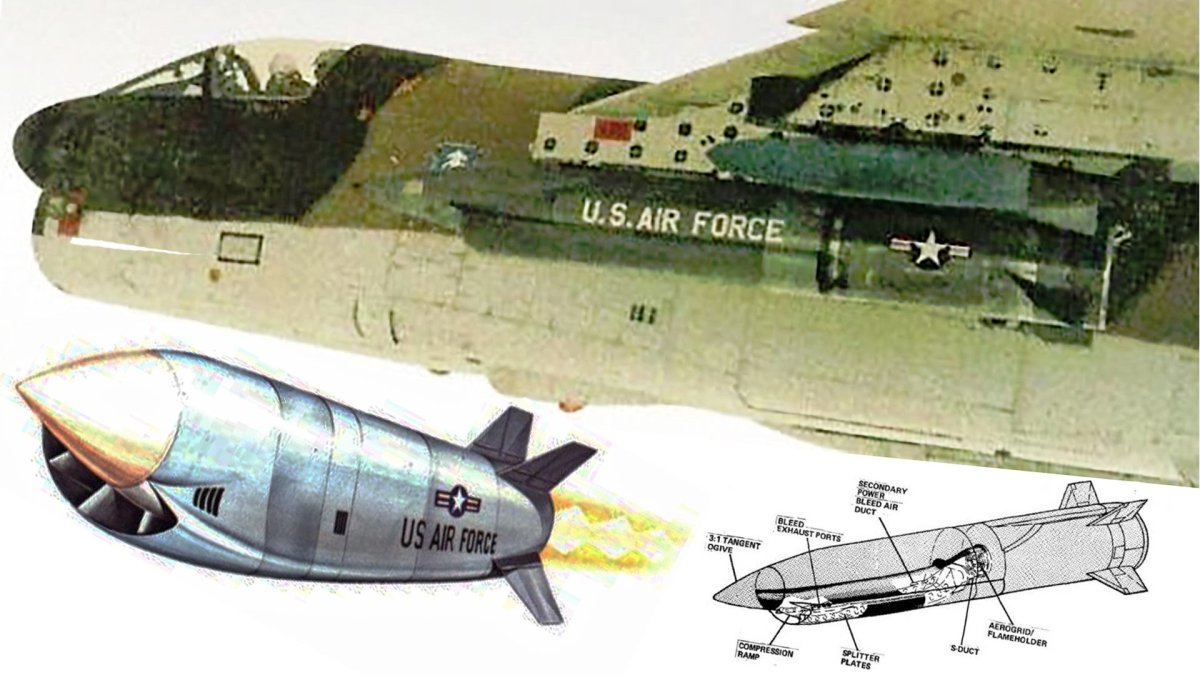
During one of the tests, the PTV test vehicle actually exceeded expectations, reaching a hypersonic speed of Mach 5.5 at an altitude of 40,000 feet. In at least one of the launches, an A-7 Corsair II combat jet was used as the launch platform, indicating the Air Force may have considered expanding the number of aircraft certified to carry the weapon. Mockups of the ASALM missiles were also shown mounted on the rotary launcher for the B-52.
A low-quality image showing an A-7 Corsair II combat jet carrying one of the PTV test articles., USAF
A mockup of ASALMs mounted on the rotary launcher inside the bomb bay of a B-52 bomber., USAF
Early concept art had also depicted the B-1A bomber, which President Jimmy Carter canceled development of in 1977, launching the weapon. The B-1 program would come back to life in 1981 under President Ronald Reagan, leading to the refined B-1B variant .
An artist’s conception of a B-1A bomber launching the McDonnell Douglas ASALM., McDonnell Douglas
An artist’s conception of a B-1A bomber firing the Martin Marietta ASALM., Martin Marietta
However, by 1980, the Air Force had already scaled back the ASALM effort, treating it more as a proof of concept or technology demonstration project. There has been some suggestion that budget constraints played a role in declining interest in the weapon. As of April 1980, the Air Force estimated the program would cost at least $140 million, more than $435.5 million in 2020 dollars, and it was looking to get $25.7 million, or nearly $80 million today, in the upcoming 1981 Fiscal Year budget. However, the defense budget for that fiscal year was substantially larger than it had been in the preceding three years, a sign of the further defense buildup to come under President Ronald Reagan.
The more likely explanation seems to be that the ASALM fell victim to a mix of technical difficulties and competing priorities. Jane’s Weapon Systems says that General Alton Slay, then head of Air Force Systems Command, had told members of Congress back in 1978 that this missile was, in part, a hedge against the failure of the AGM-86, which you can read about more in this past War Zone piece . It’s possible that Slay might’ve been referring to a larger derivative of the ASALM, as well. Regardless, production of the AGM-86 started in 1980 and it began to enter service in 1982.
By the early 1980s, the service was also well in the process of developing a dedicated SRAM successor, the AGM-131A SRAM II , which was itself canceled in 1991. There were also a number of stealthy cruise missile projects at around the same time, which culminated with the AGM-129A Advanced Cruise Missile (ACM), which you can read about more in this previous War Zone story .
An inert SRAM II now on display the National Museum of the US Air Force., USAF
In addition, while the PTV flight tests were successful, there were concerns about the rocket ramjet’s ability to perform consistently at low altitudes, where the air is thicker and there is more drag on any flying object. The missile could have had difficulty reaching an optimal speed and altitude for its air-breathing engine to function properly when launched from a bomber or other aircraft flying at a very low level to otherwise reduce the threat from enemy air defenses. However, Martin Marietta said that it felt it had solved those low altitude launch problems by 1980.
Questions about potential targeting difficulties when using the missile against aerial threats also appear to have been a contributing factor. “If the threat is sophisticated, we’re looking for extremely long-range launches at maximum range, and we’ll have to shrink down the package and subsystems,” a U.S. government official told Aviation Week in 1980 . “It would be at the very extreme of the radar horizon.”
The complete concept of operation that the Air Force envisioned for the ASALM isn’t clear. Soviet AWACSs would not have been static targets, unlike air defense sites on the ground, and Air Force bombers and other strike aircraft would not have had had the kind of sensors, such as long-range radars , necessary to spot and track them themselves at extended ranges. This issue also cropped up during tests regarding the potential use of the F-117 Nighthawk stealth combat jet in the air-to-air role, which you can read about more in this recent War Zone piece .
Having some other platform locate the AWACS first would have been one method, but stand-off targeting of threats deep inside heavily defended Soviet areas, in the air and on the ground, was definitely a general issue at the time due to limited networking capabilities and other factors. The difficulty of finding targets in denied areas remains an issue today, as you can read about more here .
Another option would have been to fire the missile into an area where an AWACS would likely be operating and let the missile either find its target by using the passive homing capabilities it would employ to find radars on the ground or its active radar seeker. With only a limited number of ALASMs on board, it’s not clear how willing the crew of a bomber or other strike aircraft might have actually been to fire them without knowing for sure they’d find a target, rather than saving them for engaging positively identified threats.
There also seemed to be questions about whether the new Soviet AWACS would actually enter service and, even if it did, whether it might not be possible to employ a mixture of other capabilities and tactics, including the improved SRAM II and electronic warfare systems, to otherwise ensure bombers and other strike aircraft made it to their targets. Advanced stand-off weapons, such as the stealthy AGM-129, would have also offered alternative options.
“The SUAWAC is projected but is not actually in being. … Even if the threat develops as projected, [the Office of the Secretary of Defense] is not convinced ASALM is the only solution,” one contemporary position paper reportedly stated . The first Beriev A-50 ultimately entered service in 1984.
It’s not clear exactly when it occurred, but the ASLAM project was finally scrapped for good sometime in the 1980s. Martin Marietta did pitch derivatives for other roles and McDonnell Douglas did the same with its losing design.
This included a version that Martin Marietta presented to the U.S. Navy as a supersonic aerial target in 1983. The Navy did hire the company the following year to develop what subsequently became known as the YAQM-127A Supersonic Low-Altitude Target (SLAT). That design fared poorly in testing, with only one of eight launches between 1987 and 1991 being deemed successes. The Navy canceled this program, too, eventually buying a derivative of an actual Soviet-designed surface-to-air missile for use as an aerial target. You can read more about the MA-31, a cooperative effort between McDonnell Douglas, and later Boeing, and Russia’s Zveda-Strela, in this recent War Zone piece .
A comparative look at the ASALM design used for the PTV effort, also seen here described as the Multi-Purpose Missile (MPM) versus the longer derivative of the ASALM that Martin Marietta developed for the Navy’s Supersonic Low-Altitude Target (SLAT) program., Public Domain
Martin Marietta did propose ship-launched derivatives to the Navy, as well. These designs were referred to variously as the Outer Air Battle Missile and Outer Perimeter Defense Missile. It’s not clear whether the naval versions would have had nuclear or conventional warheads, but they were described as being intended for use as high-speed surface-to-air missiles that could shoot down incoming Soviet aircraft before they got close enough to launch anti-ship missiles.
McDonnell Douglas also proposed a submarine-launched missile based on its proposed ASALM design that would carry a torpedo as payload and release it over the suspected location of an enemy sub. This was similar in some general respects to the submarine-launched UUM-44 Submarine Rocket (SUBROC) and the ship-launched RUR-5 Anti-Submarine Rocket (ASROC) that were in service at the time, but would have had massively longer range.
Artwork depicting a McDonnell Douglas proposal for a submarine-launched derivative of its ASALM proposal armed with a torpedo for use as an anti-submarine warfare (ASW) standoff weapon., McDonnell Douglas
The general requirements that led to the development of the ASALM, especially the desire for a long-range “AWACS killer” missile, certainly didn’t go away. The United States, as well as its potential competitors, have continued to explore air-to-air weapons to fill this role in the decades since. Russia and China, in particular, have developed various missiles for this mission and continue to do so.
In the mid-2000s, there were reports that Russia, in cooperation with India had started work on a derivative of the 1990s-era KS-172 , which eventually became known as the K-100 , a very long-range air-to-air missile intended, at least in part, for the AWACS hunting role. In 2016, images emerged of a Chinese J-16 fighter jet carrying a large air-to-air missile , now sometimes referred to as the PL-21, which could have a similar intended mission set.
A mockup of the Russian K-100 very-long-range air-to-air missile, previously also known as the R-172S-1., KnAAPO
The U.S. military itself is now in the process of developing the AIM-260 , its own very long-range air-to-air missile , as well as the separate Long Range Engagement Weapon (LREW), another air-to-air weapon that could have a counter-AWACS role. There has also been steady progress in the development of an improved supersonic anti-radiation missile, the AGM-88G Advanced Anti-Radiation Guided Missile-Extended Range (AARGM-ER). The AGM-88G will also have more general-purpose air-to-ground capabilities and it’s improved capabilities might even leave the door open for employing it against aerial targets, such as enemy AWACS.
In addition, in the early 2010s, Lockheed Martin, a company that had come into being as the result of a merger between Lockheed and Martin Marietta in 1995, began work on two different anti-ship cruise missiles for the Navy. One of these was the subsonic AGM-158C Long-Range Anti-Ship Missile (LRASM), which began life as the LRASM-A.
There was, however, a separate effort to develop a supersonic companion to that weapon, called the LRASM-B, the design of which bears more than a passing resemblance, at least visually, to that of the ASALM. It seems hard to believe the LRASM-B was not at least a spiritual successor to the earlier Cold War missile. Officially, work on the LRASM-B ended in 2013, but there is the possibility that it or a further derivative of it might have evolved into the top-secret Sea Dragon supersonic submarine-launched anti-ship cruise missile, which you can read about more in this past War Zone story .
A model of Lockheed Martin’s LRASM-B, which shares distinct visual similarities with the Martin Marietta ASALM., Americanmilitaryforum.com
Beyond all this, there has also been a more general surge of interest in ramjet-powered air-breathing cruise missiles around the world in recent years. These include, among others, multiple development efforts the U.S. military has in progress and Russia’s work on the 3M22 Zircon , designs that are all expected to boast hypersonic speeds. China is in the process of developing a ground-launched hypersonic cruise missile and is already working on supersonic ramjet-powered weapons in this same category.
All told, the ASALM seems to have been ahead of its time in many respects. With all the developments going on now that we know about, in addition to ones that are almost certainly happening in the classified realm, it seems very possible that we may now see the return of this concept in some form, if it doesn’t exist already.
Contact the author: joe@thedrive.com
Comments couldn’t be loaded. Please refresh the page.
作者:约瑟夫·特雷维西克
发布于美国东部时间2020年7月1日下午4:17
冷战期间,美国空军始终面临着这样的问题:一旦第三次世界大战爆发,其战略轰炸机能否突破苏联的防线,投下核弹头?多年来,美国空军试验并部署了多种不同的武器,并采用了不同的战术,所有这些都是为了确保这些飞机在飞往目标途中尽可能地免受敌机和防空火力的威胁。
上世纪70年代,美国空军开始研发一种新型核弹头防区外导弹,其设计在许多方面都远超时代,并能达到接近高超音速的速度。它的目的是在轰炸机飞往目标途中摧毁敌方防空系统,但它还有一个相对特殊的辅助任务——击落苏联的空中预警和控制飞机。
据官方历史记载,美国空军于1971年授予了这项新型武器概念的初步设计研究合同,该武器最终被称为先进战略空射导弹(ASALM)。当时,AGM-69A短程攻击导弹(SRAM)正处于研发的最后阶段,您可以在之前的“战区”文章中了解更多详情。SRAM导弹每枚都配备一枚W69型热核弹头,当量约为200千吨。次年,当B-52轰炸机和FB-111“土豚”战斗机投入使用后,它们便拥有了立即打击沿途苏联地对空导弹阵地的手段。
配合低空飞行,SRAM导弹有望确保B-52和FB-111轰炸机成功突破苏联防线。如果飞机抵达指定目标区域时仍有剩余的SRAM导弹,它们本身也可用于执行更广泛的打击任务。
一对惰性AGM-69A SRAM电池,美国空军
然而,即便在AGM-69A的研发工作不断推进的同时,空军也已开始着手研发其后续型号。1994年出版的《核武器数据手册》第一卷指出,ASALM导弹至少在概念上可以追溯到1968年,比SRAM原型机的首次动力飞行早一年。该书还提到,ASALM导弹是早期轰炸机防御导弹(BDM)和多用途导弹(MPM)项目的延伸。
据美国空军1985年出版的《巡航导弹的演变》一书所述,在1971年授予导弹初始设计合同后,美国空军进一步聘请承包商探索冲压式喷气发动机推进方案,以使导弹至少达到接近高超音速的速度。高超音速的定义是超过5马赫的任何速度。
ASALM概念,有时也被称为先进超音速空射导弹,承诺研制出比SRAM导弹速度更快、射程更远的导弹。这将使轰炸机和攻击机能够从更远的距离、更快的速度打击目标,从而增加敌方反应时间,延长发射飞机机组人员的决策时间,并提高他们的生存能力。
空军最终选定了某种形式的火箭冲压发动机作为理想的推进方式。ASALM采用了一种火箭冲压发动机布局,其中火箭助推器将整个系统推进到最佳速度,以便吸气式冲压发动机接管推进。空的火箭发动机壳体则用作冲压发动机的燃烧室。
这张图出自ASALM计划后期,展示了推进系统的运行顺序,从上到下。第一张图显示火箭发动机点火,第二张图显示火箭燃烧殆尽时,覆盖冲压发动机进气口的整流罩脱落。第三张图显示尾翼脱落,第四张图显示冲压发动机利用空置的火箭发动机壳体作为燃烧室进行工作。(公共领域)
最终目标是让ASALM能够以大约4.5马赫的速度巡航,最大续航里程达到300英里。而SRAM的最高速度为3马赫,续航里程为100英里。
1972年,空军发布了更多合同,用于研究ASALM导弹将使用的推进剂,并探索制导系统的各种方案。两年后,空军举行了一场竞标,选择一家国防承包商将该系统的所有组件组装成一枚真正的导弹。一项关键要求是,最终设计必须与SRAM导弹具有相同的外形尺寸,并且无需任何改动即可使用相同的发射器,包括可安装在B-52轰炸机弹舱内的旋转发射器。当时正在研发的B-1A轰炸机也被期望能够携带同样的内置发射器。
B-52轰炸机内部旋转发射器上的八枚SRAM导弹。波音公司
马丁·玛丽埃塔公司最终击败了麦克唐纳·道格拉斯公司的竞争方案。此前,两家公司都曾各自进行内部竞标,以选择火箭冲压发动机推进系统的分包商。根据1976年《航空周刊》一篇关于该项目的文章,两家公司最终都选择了在冲压发动机研发领域颇具声望的马夸特公司。1976年至1977年间,美国空军还对该项目进行了重组,以期加快进度。
从正面观察,对比马丁·玛丽埃塔公司ASALM设计方案(左下)和麦克唐纳·道格拉斯公司方案(右上)。(公共领域)
尽管麦克唐纳·道格拉斯公司并未被选为主承包商,但据1979-1980年版的《简氏武器系统》报道,该公司还是与波音公司一起加入了位于佛罗里达州奥兰多的马丁·玛丽埃塔分部,共同开发导弹的弹体和其他相关技术。雷神公司和罗克韦尔国际公司也为制导系统的开发做出了贡献。
目前尚不清楚具体发生时间,也不清楚是否从一开始就如此,但到那时,该项目也已增加了导弹执行辅助空对空任务的需求。然而,现有的主要和次要资料普遍认为,ASALM的主要目标是直接替代或后续的SRAM导弹。
据《航空周刊》1977年的一篇文章报道,当时参议院军事委员会甚至询问空军,该导弹是否有可能成为当时正在研发的亚音速AGM-86空射巡航导弹(ALCM)的可行替代方案。考虑到ALCM的最大射程远大于该导弹,很难想象这种可能性有多大。
苏联在 20 世纪 70 年代开发了一种性能更强大的空中预警和控制飞机,以取代图波列夫 Tu-126 Moss(它是 Tu-114 客机的衍生机型,于 1965 年首次投入使用),这似乎是推动增加空对空需求的重要因素。
新型别里耶夫A-50“主力”预警机以伊尔-76“坎迪德”运输机为基础,于1978年首飞。A-50配备的“织女星”雷达具有下视能力,这与图-126的“利亚纳”雷达(北约也称之为“扁平杰克”)截然不同。这意味着“主力”预警机能够发现并跟踪低空飞行的轰炸机和其他攻击机,这些攻击机混杂在地面杂波中——这是当时美国空军常用的渗透战术——并引导战斗机进行拦截,同时向苏联防空网络的其他部分发出警报。在重大冲突初期,摧毁或削弱敌方在空中、地面和太空的预警能力,无论过去还是现在,都是确保首轮打击尽可能取得成功的重要任务。
一张低质量图片,展示了苏联建造的约12架图-126“苔藓”空中预警和控制飞机中的一架。图片来自Wikimedia,由amon goeths提供。
1995年拍摄的一架别里耶夫A-50“主力”攻击机,它是图-126的替代机型。(图片来自Wikimedia,由Rob Schleiffert提供)
“这种导弹的目的之一是摧毁苏联计划中的SUAWACS(苏联空中预警与控制系统飞机),从而削弱苏联针对轰炸机和巡航导弹发射车的潜在有效前沿防御能力,”时任国防部长哈罗德·布朗在1980年1月向国会提交的报告中写道。“此外,ASALM导弹将提供空对地打击能力,可用于主要打击任务,并可能取代或后续部署的短程攻击导弹(SRAM)。”
ASALM的多用途能力源于其制导系统,该系统既能追踪目标的电子辐射,也能利用主动雷达导引头锁定目标。前者是打击地面敌方防空雷达的主要手段,类似于传统的反辐射导弹;后者则可与辐射导引头配合使用,用于远距离打击空中预警和控制飞机。如果未来将常规武装的ASALM投入空对空作战,后者将至关重要。
据我们了解,该导弹的主要有效载荷是一枚热核弹头,可能与SRAM导弹使用的W69弹头相同。这意味着在空对地或空对空作战中,精度并非至关重要。目前尚不清楚常规武装ASALM导弹的构想进展到何种程度。一枚仅配备反辐射导引头的核武装ASALM导弹或许能够接近SUAWACS预警机并将其击落,而无需主动雷达导引头。此外,内置的惯性导航系统也能帮助引导导弹大致命中目标区域。
这是艺术家绘制的B-52轰炸机发射麦克唐纳·道格拉斯公司提出的ASALM导弹的示意图,但空军最终放弃了该导弹方案,转而选择了马丁·玛丽埃塔公司的方案。
到 20 世纪 70 年代末,ASALM 导弹的研发进展顺利。从 1979 年 10 月到 1980 年 5 月,美国海军开展了推进技术验证 (PTV) 工作,包括七次发射没有弹头或制导系统的试验品,所有发射都被认为是成功的。
图示PTV测试样品的基本组成部分。(公共领域)
一张图表,展示了马丁·玛丽埃塔公司ASALM设计的总体形状和内部结构,PTV也采用了这种设计。(公共领域)
更详细地了解冲压式发动机进气口的构造,该进气口必须能够承受近超音速飞行时的压力。(公共领域)
在一次测试中,PTV试验飞行器表现超出预期,在40000英尺(约12000米)高空达到了5.5马赫的高超音速。至少有一次发射使用了A-7“海盗II”战斗机作为发射平台,这表明空军可能考虑扩大可携带该武器的飞机数量。此外,还展示了安装在B-52轰炸机旋转发射架上的ASALM导弹模型。
一张低质量图片显示一架A-7“海盗II”战斗机携带PTV测试样品之一。(美国空军)
美国空军B-52轰炸机弹舱内旋转发射器上安装的ASALM导弹模型。
早期概念图也描绘了B-1A轰炸机,但吉米·卡特总统于1977年取消了该项目的研发,并最终放弃了这一武器。B-1项目在罗纳德·里根总统任内于1981年重启,并最终发展出了改进型B-1B。
艺术家描绘的B-1A轰炸机发射麦克唐纳·道格拉斯ASALM导弹的场景。
艺术家描绘的B-1A轰炸机发射马丁·玛丽埃塔ASALM导弹的场景。
然而,到了1980年,空军已经缩减了ASALM项目,将其更多地视为概念验证或技术演示项目。有观点认为,预算限制是导致空军对该武器兴趣下降的原因之一。截至1980年4月,空军估计该项目至少需要1.4亿美元,相当于2020年的4.355亿美元以上,并希望在即将到来的1981财年预算中获得2570万美元(相当于今天的近8000万美元)。然而,该财年的国防预算比前三年都大幅增加,这预示着在罗纳德·里根总统的领导下,国防建设将进一步加强。
更合理的解释似乎是,ASALM导弹的失败是由于技术难题和优先事项冲突等因素共同造成的。《简氏武器系统》杂志指出,时任空军系统司令部司令的奥尔顿·斯莱将军早在1978年就曾告诉国会议员,这种导弹的部分原因是为了应对AGM-86导弹的失败,您可以在之前的《战区》文章中了解更多相关信息。斯莱将军当时可能指的是ASALM导弹的更大型号。无论如何,AGM-86导弹于1980年开始生产,并于1982年开始服役。
到 20 世纪 80 年代初,美国陆军也已着手研发 SRAM 的专用后继导弹 AGM-131A SRAM II,但该项目本身于 1991 年被取消。大约在同一时期,还有许多隐形巡航导弹项目,最终发展成为 AGM-129A 先进巡航导弹 (ACM),您可以在之前的“战区”报道中了解更多相关信息。
一台惰性SRAM II型发动机现陈列于美国空军国家博物馆。
此外,尽管PTV的飞行测试取得了成功,但人们仍然担心火箭冲压发动机在低空飞行时的稳定性能。低空空气密度较大,任何飞行物都会受到更大的阻力。如果导弹从轰炸机或其他低空飞行的飞机上发射,以降低敌方防空系统的威胁,那么导弹可能难以达到吸气式发动机正常工作所需的最佳速度和高度。然而,马丁·玛丽埃塔公司表示,到1980年,他们已经解决了这些低空发射问题。
使用该导弹打击空中威胁时可能存在的瞄准困难问题似乎也是一个促成因素。“如果威胁很复杂,我们就需要进行超远程发射,达到最大射程,这就必须缩小导弹及其子系统的尺寸,”一位美国政府官员在1980年接受《航空周刊》采访时表示,“这将处于雷达探测范围的极限。”
空军为ASALM设想的完整作战概念尚不明确。与地面防空阵地不同,苏联的预警机并非固定目标,而空军的轰炸机和其他攻击机也不具备在远距离发现和跟踪它们所需的传感器,例如远程雷达。在测试F-117“夜鹰”隐形战斗机执行空对空作战任务时,也出现了类似的问题,您可以在最近一篇《战区》文章中了解更多相关信息。
让其他平台先定位预警机或许是一种方法,但由于当时网络能力有限以及其他因素,在苏联重兵把守的区域深处,无论是空中还是地面,对威胁进行远程打击无疑是一个普遍存在的问题。时至今日,在敌方控制区域内寻找目标的难度依然存在,您可以在这里阅读更多相关内容。
另一种方案是将导弹发射到预警机可能活动的区域,让导弹利用其被动寻的能力(用于搜索地面雷达)或主动雷达导引头来寻找目标。由于机载ALASM导弹数量有限,轰炸机或其他攻击机的机组人员是否愿意在无法确定能否找到目标的情况下发射导弹,而不是将它们留作应对已明确识别的威胁,这一点尚不明确。
人们似乎也对新型苏联预警机是否真的会投入使用存在疑问,即便投入使用,是否还能结合其他能力和战术,例如改进型SRAM II预警机和电子战系统,来确保轰炸机和其他攻击机能够抵达目标。先进的防区外武器,例如隐形AGM-129导弹,也能提供其他选择。
据报道,一份当时的立场文件指出:“SUAWAC(超音速预警机)项目虽已提出,但尚未实际部署……即使威胁如预测般发展,[国防部长办公室]也不认为ASALM(主动雷达拦截导弹)是唯一的解决方案。” 首架别里耶夫A-50最终于1984年投入使用。
尚不清楚具体时间,但ASLAM项目最终在20世纪80年代的某个时候彻底取消了。马丁·玛丽埃塔公司曾提出过其他用途的衍生方案,麦克唐纳·道格拉斯公司也曾用其落选的设计方案做过类似的事情。
这其中包括马丁·玛丽埃塔公司于1983年向美国海军提交的超音速空中靶弹方案。海军于次年聘请该公司开发后来被称为YAQM-127A超音速低空靶弹(SLAT)的方案。该方案在测试中表现不佳,1987年至1991年间进行的八次发射中仅有一次被认为是成功的。海军最终也取消了该项目,转而购买了一种苏联设计的地对空导弹的衍生型号作为空中靶弹。您可以在最近一篇《战区》文章中阅读更多关于MA-31的信息,MA-31是麦克唐纳·道格拉斯公司(后被波音公司收购)与俄罗斯“星辰-箭”导弹公司合作开发的。
本文对比了用于PTV项目的ASALM设计(此处也称为多用途导弹MPM)与马丁·玛丽埃塔公司为海军超音速低空目标(SLAT)项目开发的ASALM加长衍生型号。(公共领域)
马丁·玛丽埃塔公司也曾向海军提出过舰载衍生型号的方案。这些设计方案曾被称作“外层空战导弹”或“外围防御导弹”。目前尚不清楚舰载版本会配备核弹头还是常规弹头,但据称其设计用途是作为高速地对空导弹,能够在苏联飞机接近到足以发射反舰导弹的距离之前将其击落。
麦克唐纳·道格拉斯公司还提出了一种基于其ASALM导弹设计的潜射导弹方案,该导弹将携带鱼雷作为有效载荷,并将其投放至疑似敌方潜艇所在的位置。这在某些方面与当时服役的潜射UUM-44反潜火箭(SUBROC)和舰载RUR-5反潜火箭(ASROC)类似,但射程要远得多。
这幅艺术作品描绘了麦克唐纳·道格拉斯公司提出的ASALM潜射衍生型方案,该衍生型配备鱼雷,可用作反潜作战(ASW)远程武器。
促成ASALM导弹研发的总体需求,特别是对远程“预警机杀手”导弹的需求,并未消失。此后的几十年里,美国及其潜在竞争对手一直在持续研发能够胜任这一角色的空空武器。特别是俄罗斯和中国,已经研发出多种用于此任务的导弹,并且仍在继续研发。
2000年代中期,有报道称俄罗斯与印度合作,开始研发1990年代KS-172导弹的衍生型号,最终命名为K-100,这是一款超远程空空导弹,其设计用途至少部分是用于侦察预警机(AWACS)的猎杀任务。2016年,有照片显示一架中国歼-16战斗机携带了一枚大型空空导弹,该导弹现在有时被称为PL-21,其设计用途可能与K-100类似。
俄罗斯K-100超远程空空导弹(此前也称为R-172S-1)的模型。(图片来源:KnAAPO)
美国军方目前正在研发其自主研发的超远程空空导弹AIM-260,以及另一款可用于对抗预警机的空空武器——远程交战武器(LREW)。此外,改进型超音速反辐射导弹AGM-88G先进反辐射导弹增程型(AARGM-ER)的研发也取得了稳步进展。AGM-88G将具备更强的通用空对地攻击能力,其性能的提升甚至可能使其能够用于打击敌方预警机等空中目标。
此外,在 2010 年代初期,洛克希德·马丁公司(该公司由洛克希德公司和马丁·玛丽埃塔公司于 1995 年合并而成)开始为海军研发两种不同的反舰巡航导弹。其中一种是亚音速 AGM-158C 远程反舰导弹 (LRASM),其最初型号为 LRASM-A。
然而,当时还有一项独立的研发计划,旨在开发与ASALM导弹相匹配的超音速导弹,名为LRASM-B。LRASM-B的设计,至少在外观上,与ASALM导弹有着惊人的相似之处。很难相信LRASM-B并非冷战时期ASALM导弹的精神继承者。官方数据显示,LRASM-B的研发工作已于2013年结束,但它或其衍生型号有可能演变成了高度机密的“海龙”(Sea Dragon)超音速潜射反舰巡航导弹。您可以在之前的“战区”(War Zone)报道中了解更多相关信息。
洛克希德·马丁公司LRASM-B导弹的模型,与马丁·玛丽埃塔公司ASALM导弹在外观上有着明显的相似之处。(Americanmilitaryforum.com)
除此之外,近年来全球对冲压式喷气发动机动力吸气巡航导弹的兴趣也普遍高涨。这其中包括美国军方正在进行的多项研发项目,以及俄罗斯正在研发的3M22“锆石”导弹,所有这些导弹预计都将具备高超音速飞行能力。中国正在研发陆基高超音速巡航导弹,并且已经在研发同类超音速冲压式喷气发动机动力武器。
总而言之,ASALM在许多方面似乎都超前于时代。鉴于我们目前所知的各种发展,以及几乎可以肯定在机密领域正在进行的项目,我们很有可能会看到这一概念以某种形式回归,即便它现在尚未出现。
联系作者:joe@thedrive.com
评论加载失败,请刷新页面。