This Massive Desert Base Is China’s Version Of America’s Nellis Air Force Base这个巨大的沙漠基地是中国版的美国内利斯空军基地
As China's air combat capabilities rapidly evolve so do the bases used to support them. One in the Gobi Desert is uniquely critical to those efforts.
新闻视频
Published Jan 15, 2020 3:18 PM EST
As China’s military capabilities continue to rapidly expand and mature, so do the bases that support and test them. Case in point, the Dingxin Test and Training Base, a sprawling facility located Gansu Province, in the Gobi Desert, an area that has long been a military and weapons testing stronghold for the People’s Liberation Army. The base is one of the most unique in China as it supports the development of tactics and weaponry and advanced training of People’s Liberation Army Air Force (PLAAF) units in high-end, complex scenarios. Live fire drills are also a big part of what goes on there. The base hosts a fleet of aggressor fighters, as well as full-scale aerial target drones, the latter of which are converted largely from stocks of antique MiG clones. As such, Dingxin is roughly analogous to Nellis Air Force Base in the United States, with a bit of Eglin Air Force Base and Edwards Air Force Base mixed in.
With relative seclusion, wide-open airspace, expansive training range complexes, and good weather for year-round flying operations, Dingxin is home to the country’s highest-profile fighter and attack aircraft exercises , including the annual air-to-air focused Golden Helmet and air-to-ground focused Golden Dart competitions. Large force employment (LFE) exercises like Red Sword, roughly similar to the United States Air Force’s Red Flag , and Red and Golden Shield, which include advanced competitive training for Chinese surface-to-air missile , anti-aircraft artillery, and electronic warfare units, also occur at and near the base.
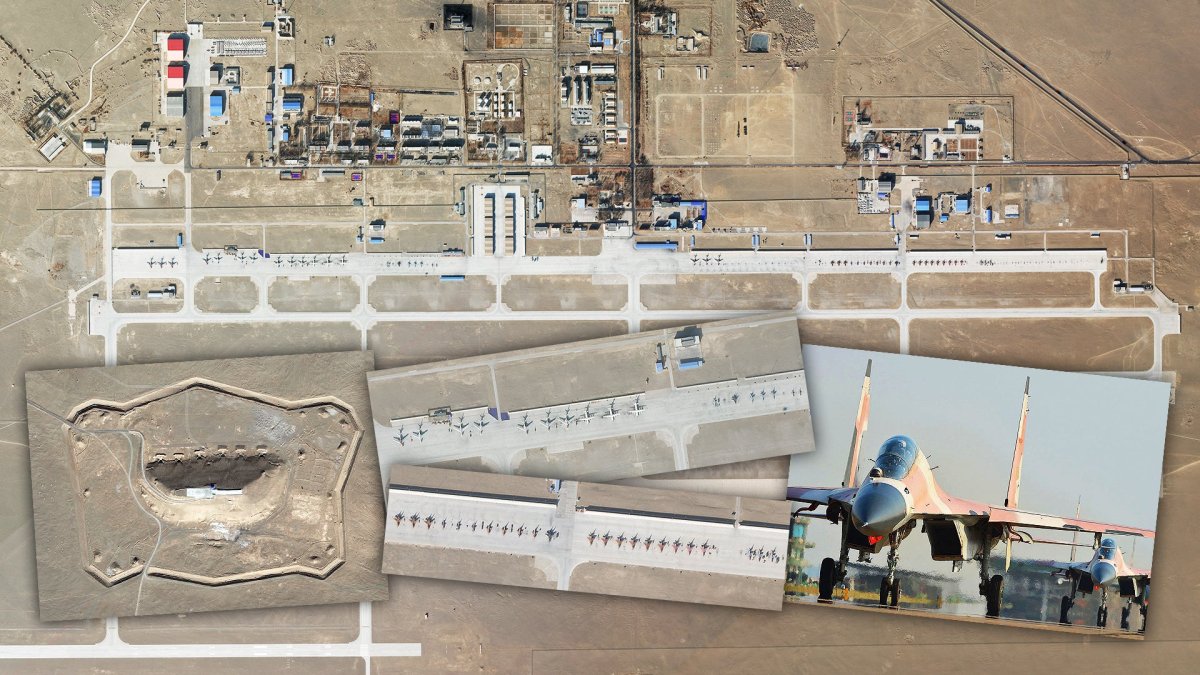
The installation is located next to Jiuquan City on the southern end of the expansive Shuangchengzi missile test range, an area full of unique facilities, some of which are quite intriguing, to say the least. In exclusive Planet Labs imagery from January 6th, 2020, we get a good look at this highly important installation and its many resident and visiting aircraft.
PHOTO © 2020 PLANET LABS INC. ALL RIGHTS RESERVED. REPRINTED BY PERMISSION
The base’s huge apron can facilitate well over 100 aircraft of all different types and does so regularly. Virtually every aircraft type in the PLA’s inventory has passed through the base and most do so regularly. The pink and beige-painted aggressors, which include Su-30s and J-10s, as well as less capable types, are a staple at Dingxin Test and Training Base and provide ‘red air’ support for the exercises and tests that occur there.
The installation’s training and tactics development activities are run by the Tactical Training Center’s 175th Air Brigade and the resident test unit that supports more cutting-edge flight test programs is the 176th Air Brigade, according to Scramble Magazine .
J-10s taxi at Dingxin Test and Training Base., PLAAF
A J-11 on the runway at Dingxin Test and Training Base., PLAAF
In the cockpit of a J-11 over the Gobi Desert near Dingxin Test and Training Base., PLAAF
In the satellite imagery from January 6th, 2020, roughly 13 H-6 bombers and other variants are shown on the ramp, along with six J-10s, 5 Su-27/30/J-11 Flanker derivatives, 12 JH-7s, six F-7s, four F-8s, and three Y-9 transports. Many more target drones and aircraft waiting to be converted for those purposes are also visible.
, PHOTO © 2020 PLANET LABS INC. ALL RIGHTS RESERVED. REPRINTED BY PERMISSION
The long runway to the south, which is fairly new, having been built around the middle of the last decade, is thought to be used primarily for drone launches and recoveries and as an alternate landing area for regular traffic. The base, which has seen a ton of expansion over the last decade, is quite secure, with some taxiways even being gated, and the installation has a large and desolate perimeter.
The large hangars with their own dedicated taxiway and apron appear to be used for test and development programs. , PHOTO © 2020 PLANET LABS INC. ALL RIGHTS RESERVED. REPRINTED BY PERMISSION
The base’s testing function is made clear by the aircraft that visit it in various configurations at various times. Everything from new fighters to airborne early warning and control aircraft can be seen even in their primer undercoats undergoing testing at the base. Usually, this activity is centered on the group of large hangars with their own apron on the southwestern side of the air base. For instance, three of China’s new J-20 stealth fighters , one still wearing its yellow factory primer coat , can be seen in this additional exclusive image from June 27th, 2019.
Air-to-ground targets are laid out on the desert floor starting just east of the base, with a somewhat ominous full-scale mockup of Taiwan’s Ching Chuan Kang Air Base/Taichung International Airport located just over four miles away.
PHOTO © 2019 PLANET LABS INC. ALL RIGHTS RESERVED. REPRINTED BY PERMISSION
14 miles to the north of Dingxin Test and Training Base is a very large radar cross-section testing facility that was constructed around 2012.
45 miles to the north of the base is where China’s sprawling Jiuquan Satellite Launch Center complex begins. It is one of the primary space launch facilities in the country and supports manned missions, as well as unmanned ones.
Two of the most prominent pads are located just up the desert valley from the air base. , Bing Maps
Additional pads and infrastructure are located as far as 25 miles north of the southernmost launch site, one of which can be seen below.
55 miles north of Dingxin Test and Training Base is one of if not the country’s premier missile ranges that does test and training work with various missile systems, namely surface-to-air systems.
A closer view of the pads (rotated 90 degrees off true north)., Google Earth
Maybe the most curious installation near Dingxin is what appears to be a moated mountain-bunker-like fortress located just two miles to the northwest edge of the sprawling air base.
At first glance, the facility appears to have apertures similar to Iran’s ballistic missile caverns and it also has some sort of parking facility on top of it. Initially, our thoughts were that it was some sort of a heavily fortified bunker, and it could very well serve in that role. At the same time, the structure to the right of the parking area almost looks like grandstands. This led us to wonder if this is a VIP review area for wargames that go on above the target areas located just to the south. Possibly. But the real origin story of this clearly fortified installation is way more interesting than our theories as to its current use.
It turns out that this is one of over a dozen highly-fortified moated fortresses that appear as almost ancient-like structures in the region, but were actually built in the 1960s and 1970s during a time of great tension between Russia and China. Grand General Lin Biao led the Chinese military’s initiative to build a number of these fortifications, the majority of which are in Gobi Desert in the region that surrounds Dingxin Air Base.
The majority of them are mainly abandoned, but some have been repurposed by the Chinese military, and for good reason. They were incredibly expensive to build. The mountains are manmade and underneath them lies a labyrinth of chambers and passageways that can house and sustain large groups of soldiers and command staff for long periods of time. The complexes are steel and concrete reinforced and go quite deep underground, making them remarkably resilient. They were built in flat areas that were easily defendable and were packed with all types of artillery and weaponry used to keep a marauding army at bay. This included anti-aircraft artillery, tank guns, and other heavy weapons.
These are truly massive fortifications. The man-made mountains are longer than an aircraft carrier. When they were built, the area was less arid and the moats would fill in naturally due to spring water and other local water sources. With all this in mind, it’s no surprise that a few of the moated fortifications have been adapted by the PLA for more modern uses.
Dingxin Test and Training Base truly sits at the heart of China’s air combat capabilities. As People’s Liberation Army forces adopt more and more western-like concepts of technology, tactics, and training, it will only become more important, and as a result, it will continue to expand. The region as a whole, although fairly desolate, has always been incredibly important to China’s military, but this will only expand as its capabilities become more complex and sensitive in nature. China’s rapid development of its space programs only makes the region all that much more critical to Beijing, as well.
With all that being said, China’s potential adversaries and friends alike are keeping a close eye on developments at the base and its surroundings for indications of how the country’s rapidly expanding combat capabilities will continue to morph in the years to come.
Contact the author: Tyler@thedrive.com
Comments couldn’t be loaded. Please refresh the page.
发布于 2020 年 1 月 15 日下午 3:18(美国东部时间)
随着中国军事能力的快速发展和日趋成熟,支撑和测试这些能力的基地也在不断壮大。例如,位于甘肃省戈壁沙漠的鼎新试验训练基地,规模庞大,长期以来一直是中国人民解放军的军事和武器测试中心。该基地是中国最独特的基地之一,它支持战术和武器装备的研发,并为中国人民解放军空军部队提供高端、复杂场景下的先进训练。实弹演习也是该基地的重要组成部分。基地驻扎着一支假想敌战斗机队,以及全尺寸空中靶机,后者大多由老旧的米格战机改装而来。因此,鼎新基地大致相当于美国的内利斯空军基地,并融合了埃格林空军基地和爱德华兹空军基地的一些特点。
鼎新基地地理位置相对偏僻,拥有开阔的空域、广阔的训练靶场以及适宜全年飞行作业的气候,是中国最高级别战斗机和攻击机演习的举办地,其中包括一年一度的以空对空作战为重点的“金头盔”和以空对地作战为重点的“金镖”竞赛。此外,基地及其周边地区还会举行大规模兵力运用演习,例如与美国空军“红旗”演习大致类似的“红剑”演习,以及包含中国地对空导弹、防空炮兵和电子战部队高级竞技训练的“红盾”和“金盾”演习。
该设施位于酒泉市附近,坐落在广袤的双城子导弹试验场南端。该区域遍布各种独特的设施,其中一些设施可谓引人入胜。在Planet Labs于2020年1月6日独家拍摄的图像中,我们可以清晰地看到这座至关重要的设施及其众多常驻和来访的飞机。
照片版权所有 © 2020 PLANET LABS INC. 保留所有权利。经许可转载。
该基地巨大的停机坪可容纳超过100架各种类型的飞机,并且经常如此。解放军现役几乎所有机型都曾在此起降,其中大多数机型还会定期在此进行训练。涂有粉色和米色的假想敌飞机,包括苏-30和歼-10,以及一些性能稍逊的机型,是定新试验训练基地的常客,为基地举行的演习和测试提供“红方”空中支援。
据《Scramble》杂志报道,该基地的训练和战术发展活动由战术训练中心第 175 航空旅负责,而支持更尖端飞行测试项目的常驻测试部队是第 176 航空旅。
歼-10战机在定新试验训练基地滑行。(中国人民解放军空军)
一架歼-11战斗机停在定新试验训练基地的跑道上。(中国人民解放军空军)
在戈壁沙漠上空,靠近定新试验训练基地的歼-11战斗机驾驶舱内。
2020年1月6日的卫星图像显示,停机坪上大约停放着13架轰-6轰炸机及其他衍生机型,此外还有6架歼-10战斗机、5架苏-27/30/歼-11侧卫系列战机、12架歼轰-7轰炸机、6架F-7战斗机、4架F-8战斗机和3架运-9运输机。图像中还可以看到更多靶机和等待改装的飞机。
照片版权所有 © 2020 PLANET LABS INC. 保留所有权利。经许可转载。
南侧的长跑道相对较新,大约建于上个十年中期,据信主要用于无人机的起降,也作为常规航班的备用着陆区。该基地在过去十年中进行了大规模扩建,安保措施相当严密,部分滑行道甚至设有闸门,基地周边区域广阔而荒凉。
这些大型机库拥有独立的滑行道和停机坪,似乎用于测试和研发项目。照片 © 2020 PLANET LABS INC. 保留所有权利。经许可转载。
从不同时期、不同配置的飞机频繁造访该基地,便可看出其测试功能。从新型战斗机到空中预警和控制飞机,甚至在涂有底漆的情况下,都能看到它们在基地进行测试。通常,这些测试活动集中在空军基地西南侧拥有独立停机坪的大型机库群。例如,在这张2019年6月27日的独家照片中,可以看到三架中国新型歼-20隐形战斗机,其中一架仍保留着出厂时的黄色底漆。
从基地东侧开始,沙漠地面上布满了空对地目标,而距离基地仅四英里多一点的地方,则有一个颇为不祥的台湾清泉岗空军基地/台中国际机场的全尺寸模型。
照片版权所有 © 2019 PLANET LABS INC. 保留所有权利。经许可转载。
鼎信试验训练基地以北 14 英里处有一个非常大的雷达截面测试设施,该设施建于 2012 年左右。
基地以北45英里处是中国庞大的酒泉卫星发射中心。它是中国主要的航天发射场之一,支持载人航天任务和无人航天任务。
其中两个最显眼的停机坪位于空军基地上方不远的沙漠山谷中。(必应地图)
额外的发射台和基础设施位于最南端发射场以北 25 英里处,其中一个发射台如下图所示。
鼎新试验训练基地以北 55 英里处,坐落着该国首屈一指的导弹靶场,该靶场对各种导弹系统(尤其是地对空导弹系统)进行测试和训练。
从谷歌地球可以看到更近距离的停机坪视图(偏离正北方向旋转了 90 度)。
丁新附近最奇特的设施或许是位于庞大空军基地西北边缘两英里处,看起来像是一座被护城河环绕的山地掩体堡垒。
乍一看,这个设施似乎有类似伊朗弹道导弹发射井的开口,顶部还有某种停车场。起初,我们认为它是一个戒备森严的掩体,而且它很可能确实发挥着这样的作用。与此同时,停车场右侧的建筑看起来很像看台。这让我们不禁想到,这会不会是位于其南侧目标区域上方的军事演习的贵宾检阅区?或许如此。但这个明显戒备森严的设施的真正起源故事,远比我们对其当前用途的推测有趣得多。
原来,这只是该地区十几座防御工事坚固、四周环绕护城河的堡垒之一。这些堡垒外观如同古代建筑,但实际上建于上世纪六七十年代,正值中俄关系高度紧张时期。林彪大将领导中国军队修建了其中许多堡垒,大部分位于戈壁沙漠,环绕着定新空军基地。
大部分地下堡垒已基本废弃,但部分已被中国军方重新利用,这并非没有道理。建造这些堡垒耗资巨大。这些人工山体下方是迷宫般的洞穴和通道,可以长期容纳和维持大量士兵和指挥人员的运转。这些建筑群采用钢筋混凝土加固,深入地下,因此极其坚固。它们建在易守难攻的平坦地带,内部配备了各种火炮和武器,用于抵御敌军的入侵,其中包括高射炮、坦克炮和其他重型武器。
这些防御工事规模宏大,人工堆砌的山峰比航空母舰还要长。建造之时,这片区域气候远比现在湿润,护城河会因泉水和其他当地水源的注入而自然填满。考虑到这些因素,解放军对其中一些护城河防御工事进行改造以用于更现代化的用途也就不足为奇了。
定新试验训练基地是中国空中作战能力的核心所在。随着解放军越来越多地采用西方式的技术、战术和训练方法,该基地的重要性只会与日俱增,规模也将随之扩大。尽管该地区地处偏远,但对中国军队而言一直至关重要,而随着中国军事能力的日益复杂和敏感化,其重要性只会进一步提升。此外,中国航天事业的快速发展也使该地区对北京的重要性更加凸显。
综上所述,中国的潜在对手和朋友都在密切关注该基地及其周边地区的发展,以了解中国快速增长的作战能力在未来几年将如何继续演变。
联系作者:Tyler@thedrive.com
评论加载失败,请刷新页面。