Mobile howitzers take center stage at Eurosatory as artillery battles intensify in Ukraine随着乌克兰炮战加剧,移动式榴弹炮在欧洲防务展上成为焦点。
On the Eurosatory defense exposition floor, artillery was king as the Russian invasion of Ukraine evolves from missile attacks and close combat to daily artillery barrages.
PARIS — The producers of 155mm mobile howitzers are seeing an uptick in interest from European countries in the wake of Russia’s invasion of Ukraine, with the most recent biennial Eurosatory defense expo taking on an artillery-centric approach .
The show, held last week in Paris, featured companies from all over the world displaying 155mm howitzers that are either in operation or in their concept phase.
In recent years, Eurosatory has emphasized robotics, artificial intelligence and other burgeoning high-tech capabilities, but this year the focus was on heavy artillery, armor, firepower and unmanned aircraft capable of targeting and providing intelligence, surveillance and reconnaissance — capabilities the Ukrainian military needs right now.
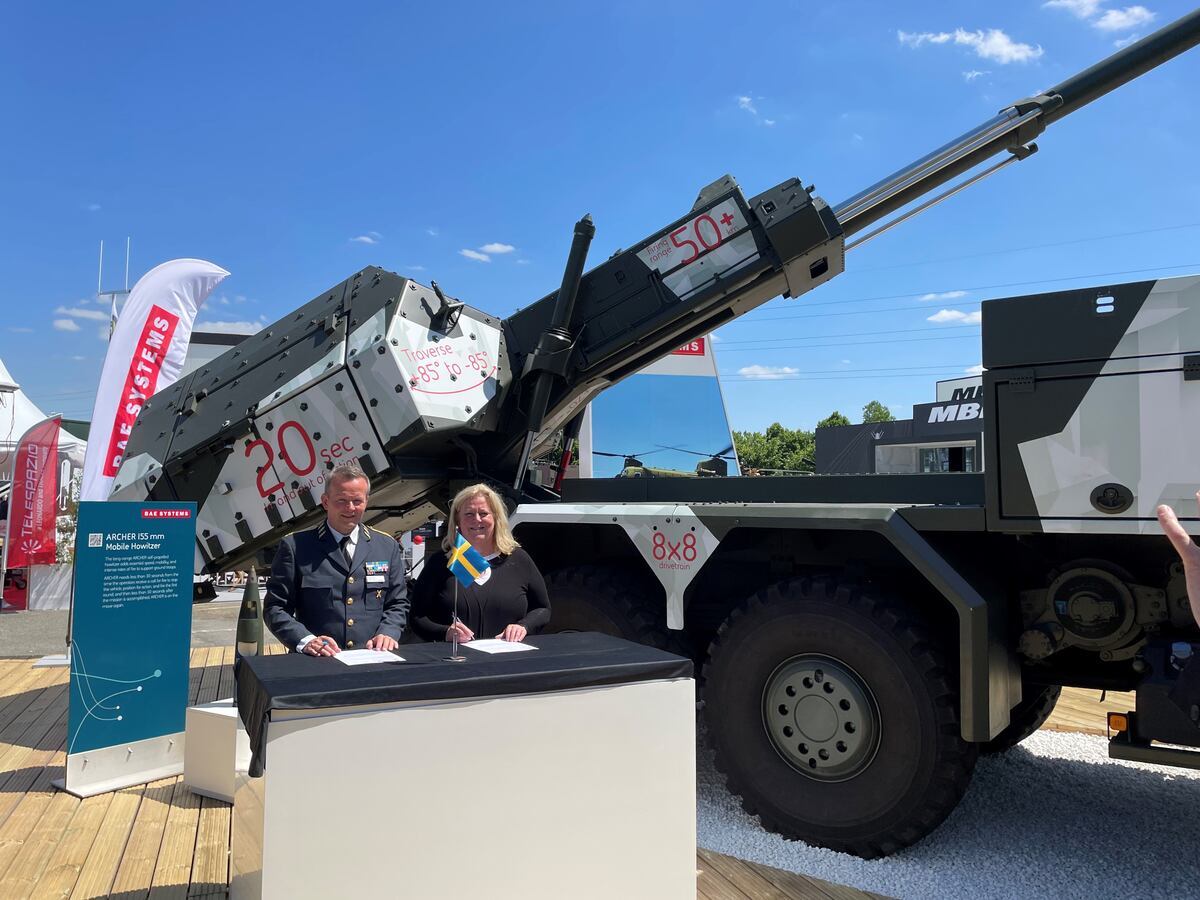
Several governments and industry members signed 155mm howitzer deals during the show. BAE Systems, for example, sold more Archer 155mm mobile howitzer systems to its first customer of the product, Sweden.
The country had committed to buying more Archers through the signing a letter of intent at Eurosatory, which took place in front of an Archer system on display at the manufacturer’s outdoor display. The letter marks the first step to establish an additional artillery battalion in line with Sweden’s current defense strategy, which runs through 2025.
The British defense company recently finished delivering the first 48 Archer vehicles to the Swedish Army. The system has been fielded for five years.
Meanwhile, the Archer was selected as one of two contenders in a competition for a new mobile howitzer in Switzerland last week. The other contender was not made public. The country is looking to replace its aging howitzer, which is based on the M109 platform.
BAE Systems’ vice president of platforms and services, Mark Signorelli, told Defense News at the show that since Russia invaded Ukraine on Feb. 24, the company has seen an increase in inquiries of the Archer system.
French company Nexter is also seeing increased interest in its fielded Caesar 155mm mobile howitzer. The system comes in eight-wheel drive and a six-wheel drive versions. France, Indonesia, Saudi Arabia and Thailand currently owner and operator the weapon. Belgium, Denmark and Morocco are also signed on to buy the system. The Czech Republic plans to buy Caesar installed on the locally made Tatra 815-7T3RC1 eight-wheel drive vehicle.
Along with the American-made M777 howitzers and British FH70 howitzers, Ukraine is also expected to receive the Caesar from France.
At Eurosatory, Nexter signed on another country — Lithuania. The country’s defense minister announced he was visiting Paris to sign a letter of intent with his French counterpart to buy the system.
Since the Russian invasion of Ukraine, “the trend that we notice is that some prospects had initially wanted a certain number of guns, and now they are asking for — in most cases, not every case — in most cases they have increased the number,” Olivier Fort, the director of Nexter’s systems and programs business unit, told Defense News at the expo.
The fight in Ukraine is magnifying the need for howitzers to be highly mobile, Fort said, as Russian forces are able to determine the location of artillery systems once Ukrainians fire them.
Reports show Ukrainians are camouflaging the older, less-mobile systems currently in stock. But a highly mobile howitzer, for instance, would be able to relocate before Russians could detect its position. Caesar and other systems like it can fire and move out of the area in just a few minutes.
Artillery is also an attractive capability, Fort noted, as they’re less expensive to replace than tanks.
Fort said that several European governments are authorizing additional funds for buying more defense equipment, including artillery systems.
Directly across from Nexter’s Caesar stood a demonstrator vehicle developed by German company Krauss-Maffei Wegmann for future indirect fire. Nexter and KMW embarked on a joint venture called KNDS in 2015.
The company claims the vehicle — a Boxer chassis with a 52-caliber gun tube that uses 155mm rounds — can fire on the move and engage moving targets. The vehicle also comes with an automated gun loading system. The gun can fire eight rounds per minute with a two-person crew.
Another German company, Rheinmetall, displayed a truck-based 155mm howitzer demonstrator using the same chassis it plans to submit for the U.S. Army’s Common Tactical Truck competition. The service plans to kick it off after a request for proposals is released by month’s end.
The HX3 10-wheel drive chassis supports a 155mm gun with a 360-degree capability. The vehicle, according to an information card by the system at the show, is highly mobile, particularly when it comes to off-road performance.
Tucked against a wall in a more remote area of the large exhibition space sat a new product: a 155mm mobile howitzer developed by Czechoslovak Group subsidiary Excalibur Army. Dubbed Morana, the weapon features a chassis from Czech company Tatra, enabling the vehicle to cross terrain typically only suitable for tracked vehicles, according to information displayed alongside the platform.
The system has a 52-caliber gun tube with a range of 41.5 kilometers (25.8 miles). The crew can carry 45 rounds, and the vehicle comes equipped with fully automated gun loading, allowing crews to fire six rounds in one minute. The vehicle can travel 90 kph (56 mph) and fits three crew.
South Korean company Hanwha displayed a small model of its K9 Thunder, a 155mm self-propelled howitzer whose European customers include Finland, Norway and Estonia.
Poland last month donated 18 Krab howitzer systems — which are K9s built in the country — to Ukraine and then signed on to increase K9 production. Earlier this month, Poland agreed to sell Ukraine an additional 54 units.
A team led by Hanwha is also competing in a British program to replace the country’s AS90 with a mobile fires platform in late 2023. That team, dubbed Team Thunder, includes Leonardo UK, Pearson Engineering, Horstman Defense Systems, Soucy Defense and Lockheed Martin UK.
Several of the systems on display at Eurosatory underwent evaluation by the U.S. Army last year at Yuma Proving Ground, Arizona, including the Caesar and Archer. Elbit Systems of America, a subsidiary of Israeli company Elbit Systems, was chosen to bring its Autonomous Truck Mounted Ordnance System Iron Sabre to the evaluation. Florida-based business Global Military Products brought in its Serbian partner Yugoimport’s NORA B-52 155mm wheeled howitzer for the shoot-off as well.
But following the evaluation, the Army did not choose a system.
The service is studying how its fires formations are going to look, but it hasn’t yet made a determination on that force structure, or where and what capabilities will lie within that. Several participants noted the shoot-off will supply data to help the Army figure out a path forward.
When pressed, high-ranking Army officials, including the chief of staff, have said there is a need for artillery systems but that the service is prioritizing the development of other capabilities, most importantly its Extended Range Cannon Artillery system .
“I think we need to make artillery great again, and we will,” Army Chief of Staff Gen. James McConville said at an Association of the U.S. Army breakfast near Fort Belvoir, Virginia, in March. When you look at large-scale combat operations, “you need to be able to mass artillery.”
Speed and range “becomes so critical,” he added. “So within the force, we’re growing artillery, we are growing air and missile defense. ”
The Army has prioritized long-range fires, including hypersonic weapons , the Precision Strike Missile , and the extended range cannon artillery system. But McConville noted that “we only have so much resources.”
Jen Judson is an award-winning journalist covering land warfare for Defense News. She has also worked for Politico and Inside Defense. She holds a Master of Science degree in journalism from Boston University and a Bachelor of Arts degree from Kenyon College.
巴黎——在俄罗斯入侵乌克兰之后,155毫米移动式榴弹炮的生产商看到了欧洲国家日益增长的兴趣,最近两年一度的欧洲防务展也以火炮为中心展开。
上周在巴黎举行的这场展会,来自世界各地的公司展示了正在服役或处于概念阶段的 155 毫米榴弹炮。
近年来,欧洲防务展一直强调机器人、人工智能和其他新兴高科技能力,但今年的重点是重型火炮、装甲、火力以及能够进行目标定位和提供情报、监视和侦察的无人机——这些都是乌克兰军队目前急需的能力。
展会期间,多个政府机构和行业成员签署了155毫米榴弹炮采购协议。例如,英国航空航天系统公司(BAE Systems)向其首个客户瑞典出售了更多“弓箭手”(Archer)155毫米移动式榴弹炮系统。
瑞典在欧洲防务展上签署了一份意向书,承诺购买更多“弓箭手”自行榴弹炮。签署仪式在制造商户外展位上展出的“弓箭手”系统前举行。这份意向书标志着瑞典根据其现行国防战略(该战略有效期至2025年)组建一支新的炮兵营迈出了第一步。
这家英国国防公司最近完成了向瑞典陆军交付首批48辆“弓箭手”装甲车的流程。该系统已服役五年。
与此同时,上周瑞士举行新型移动榴弹炮竞标,Archer榴弹炮被选为两款候选型号之一。另一款候选型号尚未公开。瑞士正寻求替换其老旧的M109平台榴弹炮。
BAE Systems 平台和服务副总裁 Mark Signorelli 在展会上告诉《防务新闻》,自 2 月 24 日俄罗斯入侵乌克兰以来,该公司收到的关于 Archer 系统的咨询量有所增加。
法国奈克斯特公司(Nexter)的凯撒155毫米移动式榴弹炮也越来越受到关注。该系统有八轮驱动和六轮驱动两种版本。目前,法国、印度尼西亚、沙特阿拉伯和泰国拥有并使用该型火炮。比利时、丹麦和摩洛哥也已签署采购协议。捷克共和国计划采购安装在国产塔特拉815-7T3RC1八轮驱动车辆上的凯撒榴弹炮。
除了美国制造的 M777 榴弹炮和英国制造的 FH70 榴弹炮外,乌克兰预计还将从法国接收凯撒榴弹炮。
在欧洲防务展上,Nexter公司又与另一个国家——立陶宛——签署了合作协议。该国国防部长宣布,他将访问巴黎,与法国国防部长签署购买该系统的意向书。
Nexter 系统和项目业务部门主管奥利维尔·福特在展会上告诉《防务新闻》:“自俄罗斯入侵乌克兰以来,我们注意到的趋势是,一些潜在客户最初想要一定数量的枪支,而现在他们要求的数量——在大多数情况下,不是所有情况——在大多数情况下,他们都增加了数量。”
福特表示,乌克兰的战斗凸显了榴弹炮高度机动性的必要性,因为一旦乌克兰人开火,俄罗斯军队就能确定火炮系统的位置。
报道显示,乌克兰方面正在对目前库存的旧式、机动性较差的火炮系统进行伪装。但例如,一门高机动性的榴弹炮就能在俄军发现其位置之前转移阵地。“凯撒”等类似系统可以在几分钟内完成发射并撤离该区域。
福特指出,火炮也是一项很有吸引力的能力,因为更换火炮的成本比更换坦克要低。
福特表示,一些欧洲国家政府正在批准追加资金,用于购买更多国防装备,包括火炮系统。
在Nexter公司的凯撒装甲车正对面,停放着一辆由德国克劳斯-玛菲·韦格曼公司(Krauss-Maffei Wegmann,KMW)开发的用于未来间接火力作战的演示车。Nexter和KMW于2015年成立了一家名为KNDS的合资企业。
该公司声称,这款车辆——基于“拳击手”底盘,配备一门52倍径火炮,使用155毫米炮弹——能够行进间射击并打击移动目标。该车辆还配备了自动装弹系统。在两人操作下,该火炮每分钟可发射8发炮弹。
另一家德国公司莱茵金属展示了一款基于卡车底盘的155毫米榴弹炮演示样车,该样车采用与该公司计划提交给美国陆军通用战术卡车竞标项目相同的底盘。美国陆军计划在本月底发布招标书后启动该项目。
HX3十轮驱动底盘搭载一门155毫米火炮,具备360度旋转能力。根据展会上该系统提供的信息卡,该车辆机动性极佳,尤其在越野性能方面表现出色。
在大型展厅较为偏僻的一角,靠墙摆放着一款新产品:捷克斯洛伐克集团旗下子公司Excalibur Army研发的155毫米移动式榴弹炮。这款名为“莫拉纳”(Morana)的火炮采用捷克Tatra公司生产的底盘,使其能够穿越通常只有履带式车辆才能通行的地形。以上信息展示在火炮平台旁。
该系统配备一门52倍径火炮,射程达41.5公里(25.8英里)。乘员可携带45发炮弹,车辆配备全自动装弹系统,使乘员能够在1分钟内发射6发炮弹。车辆最高时速可达90公里/小时(56英里/小时),可容纳3名乘员。
韩国韩华公司展示了其 K9 Thunder 小型模型,这是一款 155 毫米自行榴弹炮,其欧洲客户包括芬兰、挪威和爱沙尼亚。
波兰上个月向乌克兰捐赠了18套Krab榴弹炮系统(即波兰自主研发的K9榴弹炮),并承诺扩大K9榴弹炮的产量。本月初,波兰又同意向乌克兰出售另外54套该系统。
由韩华领导的团队也在参与英国的一项计划,该计划旨在用移动式火力平台取代该国的 AS90,预计于 2023 年底完成。该团队被称为“雷霆团队”,成员包括 Leonardo UK、Pearson Engineering、Horstman Defense Systems、Soucy Defense 和 Lockheed Martin UK。
在欧洲防务展上展出的几套系统,包括“凯撒”和“弓箭手”系统,去年曾在亚利桑那州尤马试验场接受过美国陆军的评估。以色列埃尔比特系统公司(Elbit Systems)的子公司——美国埃尔比特系统公司(Elbit Systems of America)被选中携其“铁军刀”车载自主火炮系统参与评估。总部位于佛罗里达州的全球军事产品公司(Global Military Products)也带来了其塞尔维亚合作伙伴Yugoimport公司的NORA B-52型155毫米轮式榴弹炮参加实弹射击测试。
但经过评估,陆军并未选择任何系统。
该军种正在研究其火力部署方案,但尚未确定具体的部队结构,也未明确其内部将包含哪些能力。多位与会者指出,此次实弹演练将提供数据,帮助陆军制定未来的发展方向。
在被追问时,包括参谋长在内的高级陆军官员表示,陆军需要火炮系统,但陆军优先发展其他能力,其中最重要的是其远程火炮系统。
“我认为我们需要重振炮兵,而且我们一定会做到,”陆军参谋长詹姆斯·麦康维尔将军3月份在弗吉尼亚州贝尔沃堡附近举行的美国陆军协会早餐会上说道。他指出,在大规模作战行动中,“你需要能够集中使用炮兵”。
他补充说,速度和射程“变得至关重要”。“因此,在部队内部,我们正在加强火炮、防空和导弹防御。”
陆军已将远程火力发展列为优先事项,包括高超音速武器、精确打击导弹和远程火炮系统。但麦康维尔指出,“我们的资源毕竟有限。”
珍·贾德森是一位屡获殊荣的记者,为《防务新闻》报道陆地战争。她也曾为《政治报》和《内幕防务》工作。她拥有波士顿大学新闻学硕士学位和凯尼恩学院文学学士学位。