Army awards up to $7B in sprawling counter-drone IDIQ陆军授予高达70亿美元的庞大反无人机无限期交付/无限期数量合同。
The Army awarded 10 companies for a variety of counter-drone tech including sensors, effectors and C2 systems, Brent Ingraham, the head of ASA(ALT), told reporters.
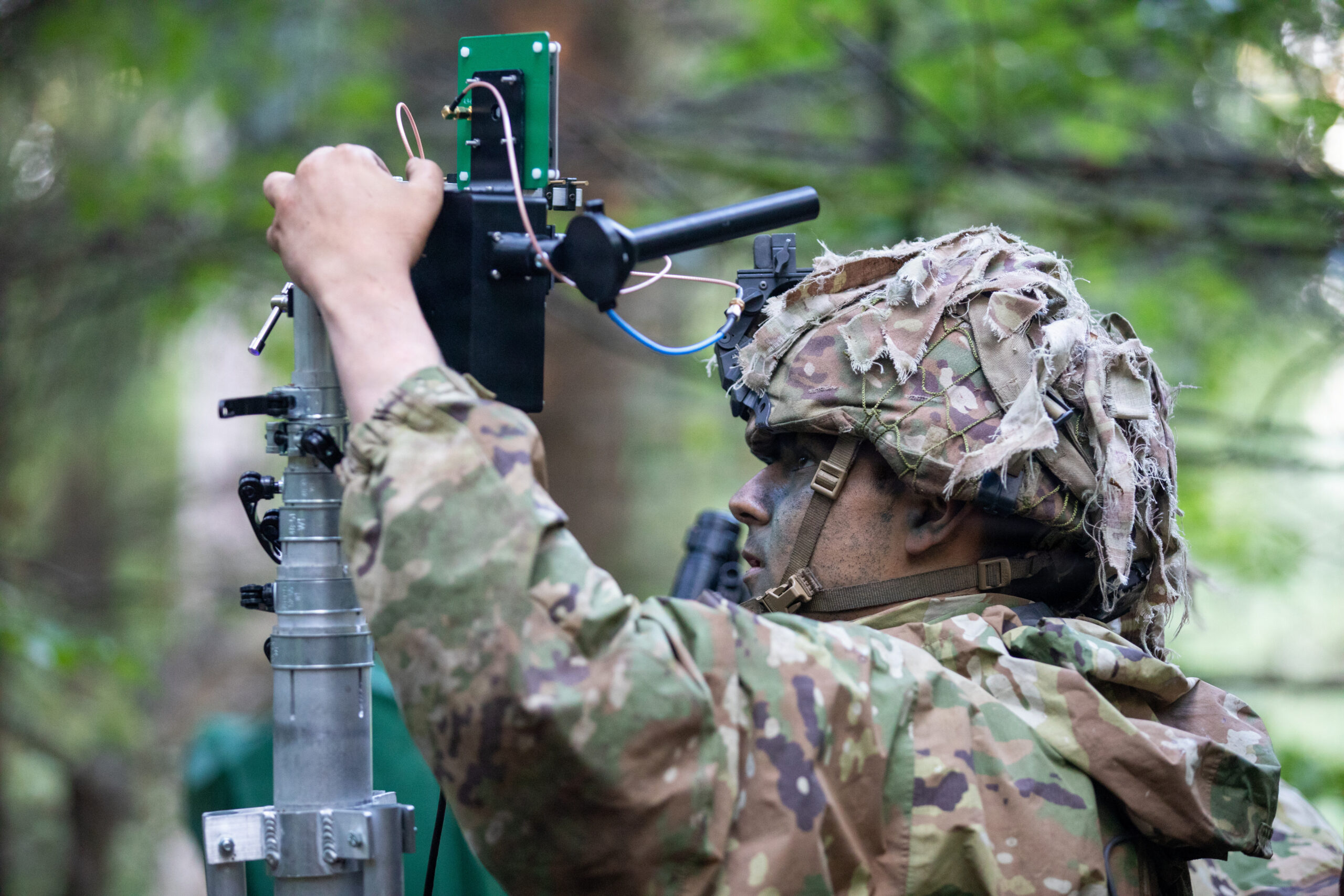
U.S. Army Pfc. Kristopher Pelroy, an air traffic control operator with 173rd Mobile Brigade Combat Team (Airborne), trains to counter unauthorized drones during exercise Saber Junction 26 at Joint Multinational Readiness Center's Hohenfels Training Area, Germany, Aug. 29, 2026. The ground control system utilized disables drones by jamming their navigation and control channels. During Saber Junction 26. (U.S. Army Photo by Sgt. Marc Morgenstern)
WASHINGTON — Army acquisition leaders and Joint Interagency Task Force 401 officials announced today that the service awarded multiple contracts worth up to $7 billion for counter-drone capabilities.
The contracts, which the Army began awarding Monday, are part of an indefinite delivery, indefinite quantity (IDIQ) vehicle, the leaders said. The contracts will support the Pentagon’s drone and counter-drone marketplace , as well as its Domestic Shield program — a project aimed at protecting US military installations and critical infrastructure from threats posed by small drones.
It will also support “ot her counter-UAS [unmanned aerial system] requirements” across the federal government, Brent Ingraham , the Army’s Assistant Secretary of the Army for Acquisition, Logistics and Technology ASA(ALT), told reporters today ahead of the announcement.
“These vehicles we awarded yesterday span a range of counter-UAS capabilities — from sensors to effectors to C2 [command and control] systems. [They] really give us options as newer requirements emerge. The Army wants competition. The JIATF-401 team wants competition. We want to bring better technology forward every day, and we don’t want to be locked into a single vendor as that threat evolves,” Ingraham said. “We’ve laid the contracting foundation before the next requirement hits.”
The Army awarded the following companies under the IDIQ:
$500 million base for Allen Control Systems
$500 million base for Digital Force Technologies
$500 million base for DroneShield
$250 million base for Echodyne Corp
$500 million base for Napatree Technology
$250 million base for PVP Advanced EO Systems
$500 million base for RADA Technologies, LLC
$150 million for SmartShooter Inc
$500 million base for SRC
$500 million base for L3Harris WESCAM
The Army did not detail what kind of capabilities each company will provide. However Brig. Gen. Matt Ross, JIATF-401’s commanding general, told reporters that the service hopes to build a “layered defense” capable of detecting, tracking, identifying, mitigating and capturing drones.
A new era of uncrewed airpower: GA-ASI’s lineup for high-tech warfare
GA-ASI is serious about retaining its position as the leading provider of UAS to the United States and its allies.
Rather than relying on a single “system of systems,” the Army is buying multiple interoperable systems to perform those functions, Ross said.
“There’s no silver bullet. I think at times in the past, people thought that we could just down-select to a really good counter-UAS capability and give one to everybody,” Ross said. “What we’ve seen is that there is no single solution.”
Ingraham and Ross said the Army will utilize multiple acquisition channels to facilitate buys — suc h as commercial solutions openings, a Common Command and Control Enterprise License Agreement, existing service contracts and the Pentagon’s drone and counter-drone marketplaces.
Through the marketplace, soldiers, other federal agencies and allied nations can purchase various counter-drone capabilities, Ingraham said. He said he foresees the counter-drone marketplace being just as successful as the Army’s dr one marketplace, which to date has made over $800 million in sales.
Further, Ross said the marketplace will help to scale the number of drones available for purchase as the demand for such systems “exceeds available supply right now.”
“What we’re trying to do through the marketplace is to connect those producers with customers so they can see that true demand across the United States, then also with our partners and allies,” Ross said. “A large IDIQ contract will allow companies to raise additional capital to build up their inventory because they have a reasonable expectation that we’re going to continue to partner with them.”
Neither Ingraham nor Ross answered questions about when the systems are expected to be delivered or to whom.
Separately, the National Nuclear Security Administration (NNSA) and JIATF-401 signed a memorandum of understanding today t o improve information sharing on drone threats. According to a NNSA announcement, the memorandum will share data from i ts counter-drone test events with the task force, and in turn JIATF-401 will do the same. “Together, we will reduce duplicative testing, accelerate the fielding of effective C-UAS capabilities, and strengthen protection of critical national security facilities,” the NNSA announcemen t said. “Increased collaboration will help participating organizations make better use of taxpayer funding while accelerating the evaluation and fielding of advanced C-UAS technologies.”
2026年8月29日,在德国霍亨费尔斯联合多国战备中心举行的“军刀交汇26”演习中,美国陆军第173机动旅战斗队(空降)的空中交通管制员克里斯托弗·佩尔罗伊一等兵正在进行对抗未经授权无人机的训练。地面控制系统通过干扰无人机的导航和控制信道使其失效。(美国陆军中士马克·摩根斯坦摄)
华盛顿——陆军采购负责人和联合跨部门特遣部队 401 的官员今天宣布,陆军授予了多份价值高达 70 亿美元的合同,用于反无人机能力。
陆军领导层表示,这些合同已于周一开始授予,属于无限期交付、无限量(IDIQ)合同模式。这些合同将支持五角大楼的无人机和反无人机市场,以及其“国内盾牌”计划——该计划旨在保护美国军事设施和关键基础设施免受小型无人机的威胁。
陆军负责采购、后勤和技术的助理部长布伦特·英格拉姆 (Brent Ingraham) 在今天宣布之前告诉记者,它还将支持联邦政府“其他反无人机系统 (UAS) 需求”。
“我们昨天授予的这些车辆涵盖了一系列反无人机系统能力——从传感器到效应器再到指挥控制系统。它们确实为我们提供了应对新需求的多种选择。陆军希望竞争,联合跨部门特遣部队401也希望竞争。我们希望每天都能推进更先进的技术,并且不希望随着威胁的演变而被单一供应商束缚,”英格拉姆说。“在下一个需求出现之前,我们已经奠定了合同基础。”
陆军根据无限期交付/无限期数量合同授予了以下公司:
艾伦控制系统公司5亿美元的基准
数字力量技术公司5亿美元的基地
DroneShield 5亿美元基础预算
Echodyne公司2.5亿美元的基本资产
Napatree Technology 5 亿美元基础
PVP先进EO系统2.5亿美元基础预算
RADA Technologies, LLC 的基本资产为 5 亿美元
SmartShooter公司获得1.5亿美元
SRC 5亿美元基础
L3Harris WESCAM 5 亿美元基础预算
陆军并未详细说明各公司将提供哪些能力。不过,第401联合跨部门特遣部队指挥官马特·罗斯准将告诉记者,陆军希望建立一套“多层防御体系”,能够探测、跟踪、识别、缓解和捕获无人机。
无人空中力量的新时代:通用航空系统公司(GA-ASI)的高科技战争产品阵容
通用航空系统公司 (GA-ASI) 非常重视保持其作为美国及其盟国领先的无人机系统供应商的地位。
罗斯表示,陆军并没有依赖单一的“系统之系统”,而是购买了多个可互操作系统来执行这些功能。
“没有万全之策。我认为过去人们有时会认为,我们可以精简选择一种非常优秀的反无人机系统,然后给所有人配备,”罗斯说。“但我们已经看到,并不存在单一的解决方案。”
英格拉姆和罗斯表示,陆军将利用多种采购渠道来促进采购,例如商业解决方案开放、通用指挥与控制企业许可协议、现有服务合同以及五角大楼的无人机和反无人机市场。
英格拉姆表示,通过这个市场,士兵、其他联邦机构和盟国可以购买各种反无人机能力。他预计反无人机市场将像陆军的无人机市场一样成功,后者迄今为止的销售额已超过8亿美元。
罗斯还表示,该市场将有助于扩大可供购买的无人机数量,因为目前对这类系统的需求“超过了供应量”。
罗斯表示:“我们希望通过这个市场平台,将生产商与消费者联系起来,让他们能够了解全美各地的真实需求,同时也能与我们的合作伙伴和盟友建立联系。一份大型的无限期交付/无限期数量(IDIQ)合同将使企业能够筹集更多资金来增加库存,因为他们有理由相信我们会继续与他们合作。”
英格拉姆和罗斯都没有回答有关系统预计何时交付或交付给谁的问题。
此外,美国国家核安全管理局(NNSA)和第401联合跨部门特遣部队(JIATF-401)今日签署了一份谅解备忘录,旨在加强无人机威胁方面的信息共享。NNSA在一份声明中表示,该备忘录将与JIATF-401共享其反无人机测试活动的数据,JIATF-401也将采取同样的做法。NNSA在声明中指出:“我们将携手减少重复测试,加快高效反无人机系统(C-UAS)能力的部署,并加强对关键国家安全设施的保护。加强合作将有助于参与机构更有效地利用纳税人的资金,同时加快先进反无人机系统的评估和部署。”