The drone war will be won on the factory floor, not just the front line无人机战争的胜利将在工厂车间决出,而不仅仅是在前线。
From FPV drones to autonomous rotorcraft, scale and repeatability are becoming as important as innovation.
新闻视频
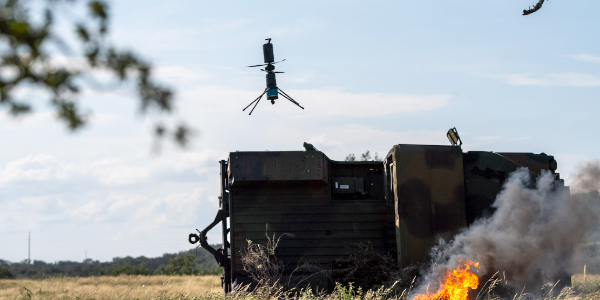
Robinson Unmanned Blue UAS Cleared SPIRIT Group 1 UAS in flight with Arete AIMS Sensor during capability demonstration at Reveille Proving Ground, Texas. (Photo courtesy of Robinson Unmanned.)
The Pentagon’s Drone Dominance program is testing more than industry’s ability to field new drone designs. It is also testing whether industry can repeatedly manufacture reliable, affordable unmanned aircraft at scale, sustain the supply chain under them, and integrate new capabilities, payloads, and mission systems as requirements evolve.
It’s that shift from innovation to industrialization that is the next phase of UAS competition.
Paul Fermo, President, Robinson Unmanned
“Producing a capable aircraft is one challenge; producing thousands of them that perform consistently is another”, according to Paul Fermo, president of Robinson Unmanned, the UAS business unit of Robinson Helicopter. “Innovation is interesting, but it’s not necessarily combat capability or capability at a fleet level,” he said. “In order to get there, you have to be able to have repeatable standards of production.”
The distinction matters because the drone sector has spent years rewarding innovation. New platforms, autonomy software, sensors and other payloads have emerged at a pace rarely seen in traditional defense aviation. Ukraine has only accelerated that cycle, demonstrating how its industrial base can quickly adapt at scale to address electronic warfare, countermeasures, and changing battlefield requirements.
From innovation to industrialization
The UAS industry has historically been optimized for rapid innovation and low-volume production, not repeatability at fleet scale. The result, Fermo said, can be “unique snowflakes” rather than standardized systems. Industrialization changes that equation by requiring manufacturers to vet incoming components, control production processes, build to consistent standards, and test repeatedly so operators can expect the same capability from one aircraft to the next.
That manufacturing argument is central to Robinson Helicopter’s creation of Robinson Unmanned. The business traces its small-UAS lineage to Ascent AeroSystems, founded in 2014 and acquired by Robinson Helicopter in 2024. Rebranded as Robinson Unmanned in 2026, it is now Robinson Helicopter’s UAS business unit that offers systems from the sub-250-gram HELIUS nano UAS to the Blue UAS-cleared SPIRIT coaxial drone and its larger SPARTAN system, as well as autonomous versions of the R44 and R66 helicopters that are built on more than half a century of rotorcraft production experience.
Rather than manufacturing one platform and stretching it across every possible mission, Robinson Unmanned starts with the premise that different operations require different autonomous aircraft. Spirit and Spartan support intelligence, surveillance, and reconnaissance, as well as force protection, search and rescue, and kinetic effects at small-unit and tactical levels. At the other end of the portfolio, the larger R44s and R66s can perform resupply, casualty evacuation, and other logistics missions where weather, operating conditions, or enemy threats make putting a crew aboard undesirable.
These vertical-lift systems can operate in confined spaces and urban environments, require less landing infrastructure, and can hover and place payloads precisely, giving them advantages for expeditionary missions, in particular.
Manufacturing credibility matters
They all benefit from Robinson Helicopter’s established US production infrastructure and an FAA-certified manufacturing culture that stands in contrast to a UAS industry historically characterized by much smaller production runs. Fermo described a vertically integrated factory in which raw material enters one end and completed vertical-lift aircraft emerge from the other. Robinson Unmanned says that infrastructure has already scaled SPIRIT production capacity to as many as 10,000 systems annually, with room to scale higher.
The company is also identifying smaller components it can manufacture internally rather than depend on potentially constrained outside sources. Bushings and blade grips, for example, may lack the visibility of an autonomy stack or advanced sensor, but a shortage of inexpensive components can stop an assembly line just as effectively as a shortage of engines.
“With the manufacturing capability that Robinson has, we can bring that stuff in-house and build it ourselves from raw materials to a usable component,” Fermo said.
The R66 TURBINETRUCK, an autonomous cargo helicopter developed by Sikorsky and Robinson Unmanned, was selected for the United States Marine Corps Medium Aerial Resupply Vehicle – Expeditionary Logistics (MARV-EL) Increment 2 program. (Photo rendering courtesy of Robinson Unmanned.)
That experience is now being tested through the Pentagon’s Drone Dominance effort. Robinson Unmanned is delivering 1,600 Spirit FPV systems under a Gauntlet 1 award and was invited to participate in Gauntlet 2 after meeting additional qualification requirements. Fermo views the initiative as more than an aircraft competition. It is also revealing where the broader US drone industrial base has inadequate capacity, overly concentrated suppliers, or dependencies on foreign sources.
In that sense, Drone Dominance is testing two things at once: what an aircraft can do and whether the industrial system behind it can continue producing that capability in quantity.
Scale only matters if the technology can keep evolving
Manufacturing scale solves only part of the problem. A drone manufactured by the thousands can still become obsolete quickly if it cannot accommodate new software, sensors, weapons, or communications technology. That’s where modular open architecture comes in.
Rather than trying to own the complete technology/autonomy stack, Fermo said the company will continue to concentrate on building reliable, high-performance aircraft and then integrating the best hardware and software technologies developed by specialists. The company has worked with: Sikorsky; Textron Systems; Dynetics, a Leidos company; Shield AI, and others.
The Robinson Unmanned portfolio illustrates this strategy at several levels. At the large end, the unmanned R44 AIRTRUCK, powered by the RPX Flight System autonomy software, is aimed at logistics and resupply, while the R44 SPRAYHAWK applies the same basic aircraft family and autonomy suite to agricultural spraying.
The R66 TURBINETRUCK expands the concept into a larger turbine-powered aircraft and is being used for the Marine Corps’ MARV-EL, or Medium Aerial Resupply Vehicle-Expeditionary Logistics, effort with Sikorsky’s MATRIX technology providing the autonomy component.
Smaller SPIRIT and SPARTAN UAS take the same approach, accepting mission-specific payloads that can shift the aircraft from sensing to communications to effects as needed. Depending on the platform and the mission, integrations can include EO/IR and multispectral imaging, biometric and CBRNE sensing, communication relay and electronic warfare payloads, and kinetic configurations.
Modularity beyond the payload
In addition, Robinson Unmanned’s definition of modularity extends beyond what can be integrated onto a drone. The cylindrical form factor of its small SPIRIT and SPARTAN UAS, for example, is particularly well suited for integration into larger systems and deployment through a variety of modalities.
“When we think about integrating best-in-class capabilities, oftentimes it’s about people thinking about the drone and then taking capability and putting it on the drone,” Fermo said. “But it also means taking that drone and integrating it into another system as a system of systems.”
Fermo said its small UAS have been successfully deployed from common launch tubes, as well as from both crewed and uncrewed airborne, maritime, and ground-based platforms.
SPIRIT’s modular architecture supports rapid integration and interchange of mission-specific payloads, enabling operators to tailor the aircraft to evolving mission requirements. (Photo courtesy of Robinson Unmanned.)
The company is also already working on deployment approaches in which its R-series rotorcraft carry and release its smaller Group 1 drones to operate alongside them. Instead of viewing the portfolio as separate product lines, the longer-term objective is for aircraft across Groups 1 through 4 to share information and operate collaboratively.
There is already a civilian example. In firefighting applications, multiple SPIRIT aircraft can communicate with one another, identify hotspots, maintain a common operating picture, and rotate aircraft as batteries run low so operators do not lose coverage.
The result is a broader definition of an autonomous aviation ecosystem – not one drone, one autonomy stack, or one mission, but multiple aircraft sizes connected by a common manufacturing infrastructure, modular interfaces, integration with outside technology partners, and the ability to operate together.
“I think one thing that we’re learning in the industry is that it’s no longer enough to produce a single capable system or an interesting innovation,” said Fermo. “The companies that will win in the future will be the ones that can take that capability and build it at scale over and over again in the thousands.”
For a Pentagon seeking not merely more drones but a sustainable US unmanned industrial base, that combination may ultimately matter more than which company produces the most eye-catching prototype.
Robinson Unmanned SPRIT-FPV Group 1 Coaxial UAS demonstrating sensor capture in flight and target acquisition as seen in official Drone Dominance Program videos released on https://www.dronedominance.mil.
罗宾逊无人驾驶公司(Robinson Unmanned)的“蓝色无人机”(Blue UAS)无人机系统已获准在德克萨斯州雷维尔试验场进行性能演示,该无人机搭载了Arete AIMS传感器。(照片由罗宾逊无人驾驶公司提供。)
五角大楼的“无人机优势”计划不仅测试业界部署新型无人机设计的能力,还测试业界能否持续大规模生产可靠且价格合理的无人机,维持其供应链,并随着需求的演变整合新的功能、有效载荷和任务系统。
从创新到产业化的转变,是无人机系统竞争的下一个阶段。
保罗·费尔莫,罗宾逊无人机公司总裁
罗宾逊直升机公司无人机系统业务部门罗宾逊无人机总裁保罗·费尔莫表示:“制造一架性能卓越的飞机是一项挑战;制造数千架性能始终如一的飞机则是另一项挑战。” 他说:“创新固然令人兴奋,但它并不一定能转化为作战能力或舰队级作战能力。要实现这一目标,就必须拥有可重复的生产标准。”
这一区别至关重要,因为无人机领域多年来一直致力于奖励创新。新型平台、自主软件、传感器和其他有效载荷的涌现速度,在传统国防航空领域实属罕见。乌克兰进一步加速了这一进程,展现了其工业基础如何能够快速大规模地适应电子战、对抗措施以及不断变化的战场需求。
从创新到工业化
无人机系统(UAS)行业历来注重快速创新和小批量生产,而非大规模的重复性。费尔莫表示,其结果往往是“独一无二的雪花”,而非标准化的系统。工业化改变了这种局面,它要求制造商对进货零部件进行严格审查,控制生产流程,按照统一的标准进行制造,并反复测试,从而确保运营商能够获得性能一致的无人机。
这一制造优势是罗宾逊直升机公司创建罗宾逊无人机业务的核心。该业务的小型无人机系统(UAS)起源于2014年成立的Ascent AeroSystems公司,该公司于2024年被罗宾逊直升机公司收购。2026年,该公司更名为罗宾逊无人机业务部,如今已成为罗宾逊直升机公司的无人机业务部门,提供从重量不足250克的HELIUS纳米无人机到获得Blue UAS认证的SPIRIT同轴无人机及其更大型的SPARTAN系统,以及基于罗宾逊直升机公司半个多世纪旋翼机生产经验打造的R44和R66直升机的自主版本。
罗宾逊无人机公司并没有采用单一平台并将其应用于所有可能的任务,而是秉持着不同的作战行动需要不同的自主飞行器的理念。“幽灵”和“斯巴达”无人机支持情报、监视和侦察,以及小型部队和战术层面的部队保护、搜救和动能打击。另一方面,更大型的R44和R66无人机则可在天气、作战条件或敌方威胁等不适宜机组人员登机的情况下,执行补给、伤员撤离和其他后勤任务。
这些垂直升降系统可以在狭小的空间和城市环境中运行,需要的着陆基础设施较少,并且可以悬停和精确放置有效载荷,这使得它们在远征任务中具有优势。
制造业信誉至关重要
他们都受益于罗宾逊直升机公司在美国成熟的生产基础设施和获得美国联邦航空管理局(FAA)认证的制造文化,这与无人机系统(UAS)行业以往小批量生产的特点截然不同。费尔莫描述了一个垂直整合的工厂,原材料从一端进入,成品垂直起降飞机从另一端驶出。罗宾逊无人机公司表示,该基础设施已将SPIRIT的年产能提升至1万套,并且还有进一步提升的空间。
该公司还在寻找可以自行生产的小型零部件,以避免依赖可能供应紧张的外部供应商。例如,衬套和叶片夹持件可能不像自动驾驶系统或先进传感器那样显眼,但廉价零部件的短缺与发动机短缺一样,都会严重影响生产线的运转。
费尔莫说:“凭借罗宾逊公司的制造能力,我们可以将这些部件带回公司内部,从原材料到可用的组件自行制造。”
由西科斯基和罗宾逊无人机公司联合开发的R66 TURBINETRUCK自主货运直升机,被选中参与美国海军陆战队中型空中补给飞行器——远征后勤(MARV-EL)第二阶段项目。(图片由罗宾逊无人机公司提供。)
五角大楼的“无人机优势”计划正在检验这一经验。罗宾逊无人机公司根据“挑战赛1”的合同交付了1600套“幽灵”FPV系统,并在满足额外的资格要求后受邀参加“挑战赛2”。费尔莫认为,这项计划不仅仅是一场飞机竞赛,它还揭示了美国更广泛的无人机产业基础在哪些方面存在产能不足、供应商过于集中或对外国资源依赖等问题。
从这个意义上讲,“无人机主导权”同时测试了两件事:一架飞机能做什么,以及支撑它的工业系统能否继续批量生产这种能力。
只有当技术能够不断发展演进时,规模才重要。
规模化生产只能解决部分问题。即使批量生产数千架无人机,如果无法兼容新的软件、传感器、武器或通信技术,仍然会很快过时。而模块化开放式架构正能解决这个问题。
费尔莫表示,公司不会试图掌控整套技术/自主系统,而是会继续专注于打造可靠的高性能飞机,然后整合由专业公司开发的最佳硬件和软件技术。公司曾与西科斯基、德事隆系统、雷多斯旗下的Dynetics公司、Shield AI等公司合作。
罗宾逊无人机产品组合在多个层面体现了这一战略。在大型机型方面,搭载RPX飞行系统自主软件的R44 AIRTRUCK无人机主要用于物流和补给;而R44 SPRAYHAWK无人机则采用相同的基本机型和自主系统,用于农业喷洒作业。
R66 TURBINETRUCK 将这一概念扩展到更大的涡轮动力飞机,并被用于海军陆战队的 MARV-EL(中型空中补给飞行器-远征后勤)项目,其中西科斯基的 MATRIX 技术提供了自主组件。
较小的 SPIRIT 和 SPARTAN 无人机系统采用相同的方法,可搭载特定任务载荷,根据需要将飞机从传感、通信切换到作战模式。根据平台和任务的不同,集成功能可以包括光电/红外和多光谱成像、生物识别和核生化探测、通信中继和电子战载荷,以及动能配置。
有效载荷之外的模块化
此外,罗宾逊无人机公司对模块化的定义远不止于无人机本身的集成。例如,其小型SPIRIT和SPARTAN无人机的圆柱形外形设计,就特别适合集成到大型系统中,并通过多种方式进行部署。
费尔莫说:“当我们考虑整合一流能力时,人们通常想到的是无人机本身,然后将各种功能安装到无人机上。但这同时也意味着将无人机整合到另一个系统中,形成一个系统之系统。”
Fermo公司表示,其小型无人机系统已成功从通用发射管以及有人和无人驾驶的空中、海上和地面平台部署。
SPIRIT的模块化架构支持快速集成和互换特定任务载荷,使运营商能够根据不断变化的任务需求定制飞机。(图片由罗宾逊无人机公司提供。)
该公司目前也在研究部署方案,利用其R系列旋翼机搭载并释放较小的1类无人机,使其协同作战。与其将产品组合视为独立的产品线,不如着眼长远,力求1至4类无人机之间实现信息共享和协同作战。
民用领域已有先例。在消防应用中,多架SPIRIT飞机可以相互通信,识别热点区域,保持统一的作战态势感知,并在电池电量不足时轮换使用飞机,从而确保行动人员不会失去支援。
由此产生了一个更广泛的自主航空生态系统定义——它不是指一架无人机、一个自主系统或一个任务,而是指通过通用制造基础设施、模块化接口、与外部技术合作伙伴的集成以及协同运行能力连接起来的多种尺寸的飞机。
费尔莫表示:“我认为我们行业正在逐渐认识到,仅仅生产出一个功能强大的系统或一项有趣的创新已经远远不够了。未来能够胜出的公司,将是那些能够将这种能力大规模地、反复地复制生产数千套系统的公司。”
对于一个不仅寻求更多无人机,而且寻求可持续的美国无人工业基础的五角大楼来说,这种组合最终可能比哪家公司生产出最引人注目的原型机更重要。
Robinson Unmanned SPRIT-FPV Group 1 同轴无人机系统演示了飞行中的传感器捕获和目标捕获,如在 https://www.dronedominance.mil 上发布的官方无人机优势计划视频中所示。