From serial collectors to reluctant recyclers: How Singapore’s beverage container return scheme is shifting habits从热衷收集者到不情愿回收者:新加坡的饮料容器回收计划如何改变人们的习惯
As the transition period for the Beverage Container Return Scheme draws to a close, how has the scheme changed consumer behaviour, and will this translate into better recycling habits in the long run?
As the transition period for the Beverage Container Return Scheme draws to a close, how has the scheme changed consumer behaviour, and will this translate into better recycling habits in the long run?
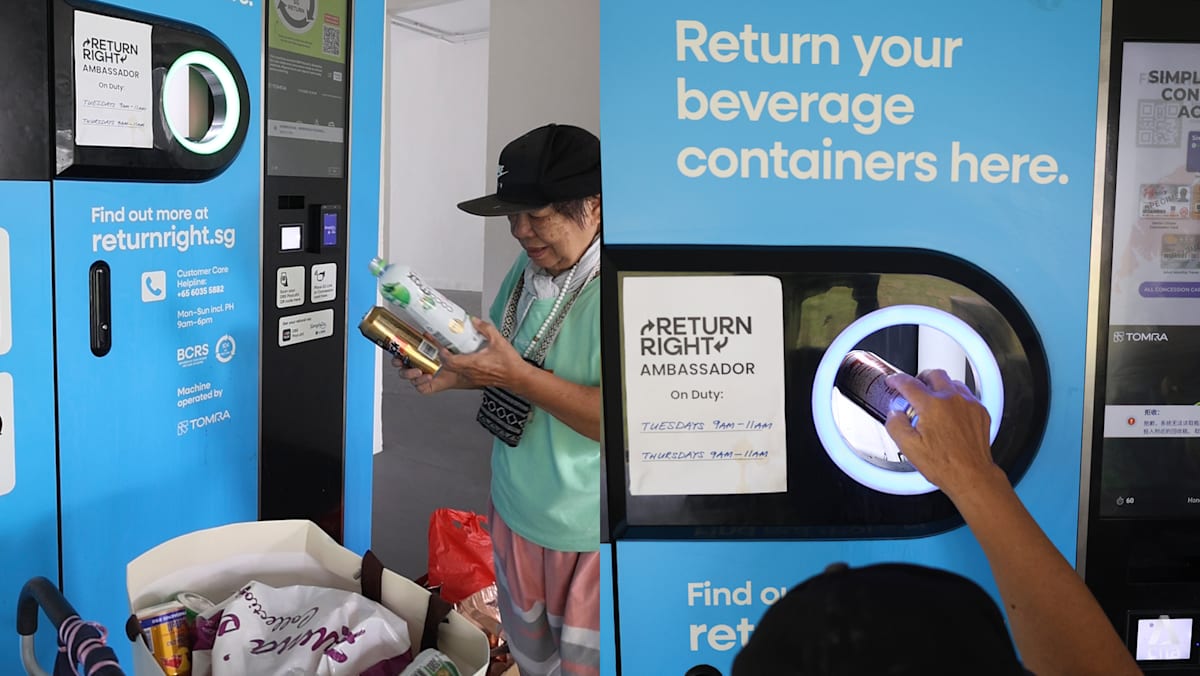
Madam Tan Mui Sng, 79, a retiree, feeding a can into a reverse vending machine at the void deck of her housing block in Serangoon on Sep 17, 2026. (Photo: CNA/Ooi Boon Keong)
This audio is generated by an AI tool.
SINGAPORE: Every few weeks, 79-year-old Tan Mui Sng heads to the reverse vending machine at the void deck of her Serangoon housing block with a trolley and bags of empty containers in tow.
The retiree returns dozens of containers each time, earning a few dollars in deposits — the result of hours spent scouring her neighbourhood for discarded drink cans and bottles.
While already a habitual collector before the nationwide Beverage Container Return Scheme (BCRS) was launched on Apr 1, the prospect of higher returns from reverse vending machines has spurred Mdm Tan to collect even more.
The scheme, which is still in a transition period until Thursday (Oct 1), may not have altered her desire to recycle discarded cans and bottles, but it has certainly made her weekly efforts more profitable.
"For this one, there's much more money," she said in Mandarin, adding that she used to earn S$0.50 (US$0.39) for every 1kg of containers she sold to the rag-and-bone man.
She has lost track of how often she has used the reverse vending machine, but estimated earning more than S$10 from returning containers.
Under the scheme, consumers have to pay a refundable 10-cent deposit on eligible beverage containers, comprising pre-packaged plastic or metal containers with volumes between 150ml and 3,000ml.
The deposit can be reclaimed by returning marked containers at one of around 1,300 Return Right reverse vending machines across Singapore.
On Sep 21, BCRS Ltd, the operator of the scheme, reported that more than 33 million bottles and cans had been collected by mid-September, up from 5.5 million as of Aug 5 .
The operator has yet to say what proportion of eligible containers sold have been returned — also known as the return rate.
Singapore consumes more than one billion beverage containers annually, according to the National Environment Agency (NEA).
Dr Adrian Kuah, Professor of Strategy and Sustainability at James Cook University said while 33 million returned containers may "sound small" compared with the more than one billion consumed annually, this was not an apples-to-apples comparison, given that the scheme is still in transition.
"More significant is the acceleration — from 5.5 million returns in early August to more than 33 million by mid-September — showing participation is increasing."
The return rate would ultimately be a more meaningful measure of how well the scheme is working, he said.
While it may still be too soon to tell how overall recycling rates have changed with the scheme still in its infancy, there are signs that the 10-cent deposit is already influencing some behaviours.
Several consumers told CNA the scheme has reinforced their recycling habits, while collectors like Mdm Tan actively hunt for containers discarded by others. Others, however, dismissed the process as too much hassle to bother.
CNA Games Guess Word Crack the word, one row at a time Buzzword Create words using the given letters Mini Sudoku Tiny puzzle, mighty brain teaser Mini Crossword Small grid, big challenge Word Search Spot as many words as you can Show More Show Less
What will happen after Oct 1
The scheme is currently in a transition period as retailers phase out beverage containers without the deposit mark.
It was initially slated to be fully implemented on Oct 1, after which containers without the deposit mark could no longer be sold.
NEA announced on Sep 18 a one-month grace period for eligible small retailers to clear unmarked stock by Oct 31.
Since then, over 2,000 smaller retailers have applied for more time to clear non-BCRS drinks stock.
A NEW VALUE FOR USED CONTAINERS
For those who are making recycling containers through BCRS part of their routines, the process of collecting containers and returning them is a rewarding experience despite the extra effort.
When CNA met Mdm Tan on Sep 17 afternoon, she methodically placed a bag and cardboard box at the foot of her usual reverse vending machine to collect rejected containers for disposal in a rubbish bin nearby.
She said that she had already been collecting empty cans to sell to the rag-and-bone man for five to six years before the scheme began, having taken it up in her spare time.
In the evenings, when it was cooler, she would head out to hunt for containers in nearby bins.
Mdm Tan demonstrated the process of inserting 32 containers into the machine. But only 14 containers were accepted, as the rest were either unmarked or dented despite carrying the deposit mark.
Grumbling about how she ended up with so many rejected drink containers, Mdm Tan said she could not check every container due to her poor eyesight.
Nevertheless, the retiree said she is now well-versed in the process of returning the containers and crediting refunds to her EZ-Link card.
"At first my MRT card only had S$6. A few days I went to use and there was S$8, there was an increase," said Mdm Tan.
Mdm Tan Mui Sng puts a bag and cardboard box at the foot of the reverse vending machine to collect beverage containers that are rejected. About half of the containers she tries to return on Sep 17, 2026, are not accepted for various reasons. (Photo: CNA/Koh Wan Ting)
Others told CNA that they have developed a regular habit of returning discarded cans and bottles. Reclaiming their deposits was their main reason for doing so.
Mr Mark Zhang, 24, and his girlfriend save their containers for a trip to a reverse vending machine near their home in Hougang every two weeks.
The couple were spotted feeding 24 plastic bottles and 10 metal cans into a reverse vending machine for S$3.40 in refunds on Sep 23.
They said the scheme was already in place when they moved to Singapore from China six months ago, so they had little difficulty adopting the practice despite not having done anything similar back home.
Asked why he had taken up the habit, Mr Zhang said in Mandarin: "It is to recycle and to get my money back."
Another recycling convert, who gave his name as Roy, said the machine has incentivised him to recycle more.
The 71-year-old said he "seldom" used to recycle cans or bottles after consuming their contents, leaving them at tray return stations or occasionally depositing them in blue recycling bins if he came across them.
He has since used the reverse vending machine four to five times to return containers of sparkling Oldenlandia water he drinks at home.
Roy said using the machine required him to make a conscious effort to leave home and return the containers. He takes them to the reverse vending machine at Kang Kar Mall, the closest one to his home.
However, on one occasion, he tried to recycle his containers, only to find that the machine had reached full capacity. He suggested that full machines could direct users to the nearest alternative.
A used beer can with the deposit mark that Mdm Tan Mui Sng placed into the reverse vending machine a few times was ultimately rejected, likely because the container was dented. (Photo: CNA/Koh Wan Ting)
NOT ALL ON BOARD WITH SCHEME
But not everyone is on board with the scheme, with some saying the effort of returning their cans and bottles may not be worth getting their 10-cent deposit back.
On a Monday evening, CNA spent 20 minutes observing three different reverse vending machines in the north-east where rubbish bins were located nearby.
About two in five people seen disposing their drink containers tossed them straight into the bins rather than using the machines.
Even with a machine a few steps away, some consumers still opt for the quickest way to dispose of their containers.
Mr Jude Theng, 30, is one such consumer who remains unconvinced despite having reverse vending machines near his home.
On weekday mornings, Mr Theng passes at least two reverse vending machines during his walk and short bus ride to the MRT station on his way to work. But he has never used one as he feels the process is very cumbersome.
Instead, he disposes of his recyclable items through the recycling chute below his block every now and then.
Now that the scheme's transition period is about to end, Mr Theng said he will need to choose between going through the hassle of returning a container or losing the deposit he paid.
“It is a refundable tax that you have to work to get back. It’s not an incentive to me. It feels like I’m being forced to recycle, and it increases this whole barrier for me.
“If I were to recycle, I want to recycle of my own accord rather than because of this tax burden. So personally, at this moment, I don’t see myself queuing up, waiting for each individual in front of me to slot in bottles one by one," said Mr Theng, who works in an admin job.
Cleaners at a coffee shop next to Buangkok MRT collected empty cans with deposit marks left behind by customers on Sep 28, 2026 and placed them in a bin to later return. (Photo: CNA/Charmaine Jacob)
There are also a few people who said they have tried out the BCRS process but were not persuaded to try again.
Having used the machines about 10 times, Mr Dean Heng has cut back their usage in recent months and may eventually stop altogether.
Long queues, rejected cans and bottles, and machines reaching full capacity have put him off the scheme.
“I wanted to return a plastic bottle that day and even queued for almost 10 minutes. When it was my turn, the machine had reached its maximum capacity and was no longer accepting bottles,” the 22-year-old student said.
Rather than making a point of seeking out a reverse vending machine, Mr Heng now disposes of his cans and plastic bottles at whichever option he comes across first — be it a reverse vending machine, recycling bin or rubbish bin.
“If we can have more BCRS machines around, like how we have parcel lockers at so many void decks, then I would be more encouraged.”
Mr Mohamed, who goes by one name, told CNA that recycling is already part of his routine – he disposes recyclables in a bin at the roadside near his block once a week.
His bigger concern is that the scheme could make recycling more cumbersome for households like his that are already doing it.
“I’m already recycling, and now I’m being penalised in the sense that I have to not only wash and collect. But instead of just dropping it into the bin below, I have to go to the machine to get it done," said the 45-year-old.
SCHEME HAS ALREADY MADE AN IMPACT: EXPERTS
Singapore University of Social Sciences lecturer Eugene Or pointed to the 553 tonnes of material recovered by the scheme, describing it as a "real environmental outcome".
"But an economist would also ask about the counterfactual: what would have happened to these containers without BCRS?" said Dr Or, who specialises in environmental economics.
"If they would have gone into general waste, the additional environmental benefit is substantial. If they would already have gone into Singapore's blue recycling bins, there can still be an important gain because BCRS produces a cleaner recycling stream."
Overseas deposit return schemes have been proven effective at shifting consumer behaviour, Dr Kuah said.
Germany reports return rates of at least 96 per cent as of June this year, according to the Deutsche Pfandsystem, the organisation behind the deposit system framework there. In Norway, 92.4 per cent of plastic bottles and 93.1 per cent of cans were returned through reverse vending machines in 2025, according to an annual report by operator Infinitum.
But these countries have had decades to build the infrastructure, habits and social norms around returning containers, while Singapore is only beginning to build such an ecosystem.
Dr Kuah's research also suggests that the relationship between environmental values and actual consumer behaviour differs across cultures.
"European consumers, particularly in some mature recycling systems, appear more likely to translate biospheric values into individual pro-environmental action.
"In Asian contexts, environmental concern may be strong, but behaviour may be more dependent on economic incentives, social norms, institutional arrangements and perceptions that individual actions make a difference," he said.
A reverse vending machine at an NTUC FairPrice outlet in Serangoon. (Photo: CNA reader)
Dr Or said people like Mdm Tan show how putting a price on an empty container can change what happens to it.
He described individuals who collect containers beyond what they consume as a "fascinating demonstration" of how an incentive changed the value of waste.
"If the person who bought the drink does not value that 10 cents enough to return it, somebody else may," he noted.
Both Dr Or and Dr Kuah said there could still be a positive material outcome if the container is ultimately recycled, but cautioned against equating material recovery with broader behavioural change.
Dr Or added that a recycling policy did not need to change everyone's preferences to improve environmental outcomes.
"We should, of course, watch for unintended effects, such as nuisance or simply diverting material that was already going to be recycled," he said.
"The interesting point is that BCRS can change who returns the container while still increasing the likelihood that the container gets recycled."
Dr Or also pointed to the gap between reported recycling participation and actual recycling outcomes.
NEA's 2025 survey on household recycling found that 78 per cent of households reported that they recycle, even though Singapore's domestic recycling rate was 11 per cent.
While the figures are not directly comparable, Dr Or said they, together with the roughly 40 per cent contamination rate in household recycling bins and chutes, illustrate how widespread participation does not automatically translate into strong recycling outcomes.
"For Singapore, BCRS can therefore contribute not only by encouraging more recycling, but also by improving the quality of what is recovered."
While the BCRS could have a broader spillover effect on recycling habits, this would not be automatic, the experts said.
Dr Or pointed out that a person could be very disciplined about returning a can while continuing to put the wrong items into a blue recycling bin.
"For Singapore, the strongest spillover would therefore be not just more recycling, but better recycling," he added.
WHAT ELSE CAN BE DONE
For those who remain unmoved, experts said the challenge may lie less in persuading them to recycle than in making it worthwhile to return their containers.
"The hardest consumers to reach may not necessarily be those who don't care about the environment. They may be people who are time-poor, convenience-driven or simply have not developed the recycling habit," Dr Kuah said.
This could include people who consume drinks on the go or those for whom the 10-cent refund is relatively small when compared with the inconvenience involved.
Dr Or said the deeper challenge was to turn willingness to recycle into correct, consistent behaviour that produces recoverable material.
"I would therefore think of lasting change as moving from incentive, to habit, to norm. The 10-cent deposit first changes the cost-benefit calculation; repeated participation can then make returning containers habitual; eventually it becomes something people do almost automatically," he said.
Some beverage products being sold in supermarkets already carry the S$0.10 deposit mark as at June 2026, as seen on the leftmost bottle. (Photo: CNA/Koh Wan Ting)
But he said cultural change should not be the only measure of success.
"The strongest outcome for Singapore is when the economics and the culture eventually point in the same direction: the incentive gets people started, habit keeps them going and returning beverage containers becomes the normal thing to do."
Dr Kuah, meanwhile, suggested studying a different incentive model — rewarding consumers for returning containers rather than charging them a deposit upfront — to see if it could encourage stronger habits.
He cited a 2026 survey experiment comparing reward and deposit schemes, which found that a sufficiently meaningful positive reward increased recycling willingness.
"Ultimately, we should test which mechanism produces not only the highest return rate, but the strongest long-term recycling habit," he said.
Get our pick of top stories and thought-provoking articles in your inbox
Stay updated with notifications for breaking news and our best stories
Join our channel for the top reads for the day on your preferred chat app
随着饮料容器回收计划过渡期的结束,该计划如何改变了消费者的行为?从长远来看,这是否会转化为更好的回收习惯?
2026年9月17日,79岁的退休人士陈梅生女士在实龙岗组屋楼下的自动售货机里投放易拉罐。(图片:CNA/Ooi Boon Keong)
这段音频是由人工智能工具生成的。
新加坡:每隔几周,79 岁的陈梅生都会推着手推车,拖着几袋空容器,前往她位于实龙岗的组屋底层的自动回收机。
这位退休妇女每次都会退回几十个容器,赚取几美元的押金——这是她花费数小时在附近搜寻丢弃的饮料罐和瓶子的结果。
在全国饮料容器回收计划(BCRS)于 4 月 1 日启动之前,陈女士就已经习惯性地收集饮料容器,而自动售货机回收率更高的前景促使她收集了更多。
该计划目前仍处于过渡期,直至周四(10 月 1 日),虽然可能没有改变她回收废弃罐子和瓶子的意愿,但无疑使她每周的努力更有收益。
“这个赚的钱多得多,”她用普通话说,并补充说,她以前每卖给收破烂的人 1 公斤集装箱,只能赚到 0.50 新元(0.39 美元)。
她已经记不清自己使用过多少次自动回收机了,但估计通过回收容器赚了超过 10 新元。
根据该计划,消费者购买符合条件的饮料容器(包括容量在 150 毫升至 3000 毫升之间的预包装塑料或金属容器)时,必须支付 10 分的可退还押金。
用户可以通过在新加坡各地约 1300 台 Return Right 反向自动售货机之一退回带有标记的容器来取回押金。
9 月 21 日,该计划的运营商 BCRS 有限公司报告称,截至 9 月中旬,已回收超过 3300 万个瓶罐,而截至 8 月 5 日,回收量为 550 万个。
运营商尚未公布已售出的符合条件的容器的退货比例(也称为退货率)。
据新加坡国家环境局(NEA)统计,新加坡每年消耗超过10亿个饮料容器。
詹姆斯库克大学战略与可持续发展教授阿德里安·库阿博士表示,虽然 3300 万个退回的集装箱与每年消耗的超过 10 亿个集装箱相比“听起来很少”,但考虑到该计划仍处于过渡阶段,这并不是一个公平的比较。
“更重要的是,参与人数的增长速度加快了——从 8 月初的 550 万份增加到 9 月中旬的 3300 多万份——这表明参与人数正在增加。”
他表示,回报率最终才是衡量该计划运作情况的更有意义的指标。
虽然该计划仍处于起步阶段,现在判断整体回收率发生了怎样的变化可能还为时过早,但有迹象表明,10 分的押金已经对某些行为产生了影响。
多位消费者告诉亚洲新闻台,这项计划强化了他们的回收习惯,而像陈女士这样的回收者则积极寻找他人丢弃的容器。然而,也有人认为这个过程太麻烦,不值得参与。
CNA游戏 猜词游戏 逐行破解单词 流行词游戏 用给定的字母组成单词 迷你数独 小小谜题,挑战你的大脑 迷你填字游戏 小方格,大挑战 单词搜索 尽可能多地找出单词 显示更多 显示更少
10月1日之后会发生什么?
目前该计划正处于过渡期,零售商正在逐步淘汰没有押金标记的饮料容器。
原计划于 10 月 1 日全面实施,届时没有押金标记的集装箱将无法出售。
新加坡国家电力局 (NEA) 于 9 月 18 日宣布,将给予符合条件的小零售商一个月的宽限期,以便在 10 月 31 日前清理未贴标签的库存。
从那时起,已有 2000 多家小型零售商申请延长清理非 BCRS 饮料库存的时间。
旧容器的新价值
对于那些将通过 BCRS 回收容器纳入日常生活的人来说,尽管需要付出额外的努力,但收集和归还容器的过程却是一种有益的体验。
9月17日下午,当CNA记者见到陈女士时,她有条不紊地在她常用的自动回收机脚下放了一个袋子和一个纸箱,用来收集被丢弃的容器,然后扔到附近的垃圾桶里。
她说,在该计划开始之前,她已经利用空闲时间收集空罐子卖给收破烂的人五六年了。
傍晚天气凉爽的时候,她会出门去附近的垃圾箱里寻找容器。
谭女士演示了将32个容器放入机器的过程。但只有14个容器被接受,因为其余的容器要么没有标记,要么尽管带有押金标记却有凹痕。
谭女士抱怨说,由于视力不好,她无法检查每一个容器,结果收到了这么多不合格的饮料容器。
不过,这位退休人士表示,她现在已经非常熟悉退还容器和将退款存入其 EZ-Link 卡的流程。
“起初我的地铁卡里只有6新元。几天后我去用的时候,发现里面有8新元了,涨价了,”谭女士说。
陈梅桑女士在自动回收机前放置了一个袋子和一个纸箱,用来收集被拒收的饮料容器。2026年9月17日,她尝试退回的容器中约有一半因各种原因不被接受。(图片:CNA/许婉婷)
另一些人告诉亚洲新闻台,他们已经养成定期退还废弃易拉罐和瓶子的习惯。他们这样做的主要原因是为了取回押金。
24 岁的 Mark Zhang 先生和他的女朋友每两周都会把他们的容器收集起来,带到他们位于后港的家附近的自动售货机去取货。
9月23日,有人看到这对夫妇将24个塑料瓶和10个金属罐放入自动回收机,获得了3.40新元的退款。
他们表示,六个月前他们从中国搬到新加坡时,这项制度就已经存在了,所以尽管他们在国内没有做过类似的事情,但他们很快就适应了这种做法。
当被问及为何养成这种习惯时,张先生用普通话说:“这是为了回收利用,把钱赚回来。”
另一位名叫罗伊的回收利用倡导者表示,这台机器激励他进行更多回收利用。
这位 71 岁的老人说,他以前“很少”回收喝完饮料后的易拉罐或瓶子,而是把它们留在托盘回收站,或者偶尔遇到蓝色回收箱时才会把它们放进去。
此后,他四五次使用自动售货机退回了他在家喝的 Oldenlandia 气泡水。
罗伊说,使用这台机器需要他特意出门去归还容器。他把容器送到离家最近的康嘉购物中心的自动回收机。
然而,有一次他想回收自己的容器,却发现机器已经满了。他建议,如果机器满了,应该引导用户使用最近的替代回收点。
陈梅生女士多次将带有押金标记的用过的啤酒罐放入自动售货机,但最终机器拒绝接收,可能是因为罐身有凹陷。(图片:CNA/许婉婷)
并非所有人都赞同该方案
但并非所有人都赞同这项计划,有些人表示,为了拿回 10 分钱的押金而费力退回易拉罐和瓶子可能并不值得。
周一晚上,CNA花了20分钟观察了东北部三个不同的自动售货机,这些售货机附近都有垃圾桶。
大约五分之二的人在丢弃饮料容器时,直接将其扔进垃圾桶,而不是使用垃圾桶。
即使机器就在几步之遥,一些消费者仍然选择最快捷的方式来处理容器。
30岁的Jude Theng先生就是这样一位消费者,尽管他家附近就有自动售货机,但他仍然不相信这种做法。
工作日的早晨,邓先生步行或乘坐短途公交车前往地铁站上班的路上,至少会经过两台自动售货机。但他从未使用过,因为他觉得流程非常繁琐。
相反,他时不时会把可回收物品扔进他家楼下的回收槽里。
由于该计划的过渡期即将结束,滕先生表示,他将需要在费力归还集装箱和损失已支付的押金之间做出选择。
“这是一笔可退税的款项,需要你付出努力才能拿回来。对我来说,这根本不是什么激励措施。感觉就像是被迫去回收利用,反而增加了我的负担。”
“如果我要回收利用,我希望是出于自愿,而不是因为这项税收负担。所以就我个人而言,目前我并不打算排队,等着前面的人一个个把瓶子放进去,”从事行政工作的滕先生说道。
2026年9月28日,万国地铁站旁一家咖啡店的清洁工收集了顾客留下的带有押金标记的空罐,并将它们放入垃圾桶,以便稍后回收。(图片:CNA/Charmaine Jacob)
也有一些人表示他们尝试过 BCRS 手术,但没有被说服再次尝试。
Dean Heng 先生使用这些机器大约 10 次后,近几个月来减少了使用次数,最终可能会完全停止使用。
排长队、被拒收的易拉罐和瓶子,以及机器满负荷运转,都让他对这项计划失去了兴趣。
“那天我想退一个塑料瓶,甚至排了将近10分钟的队。轮到我的时候,机器已经达到最大容量,不再接收瓶子了,”这位22岁的学生说。
亨先生不再特意寻找自动回收机,而是把易拉罐和塑料瓶丢到他遇到的任何地方——无论是自动回收机、回收箱还是垃圾桶。
“如果我们能像在很多组屋底层设置包裹柜那样,多安装一些BCRS自助取件机,那我会更加鼓舞人心。”
穆罕默德先生(他只有一个名字)告诉亚洲新闻台,回收利用已经是他日常生活的一部分——他每周都会把可回收物扔到他家附近路边的垃圾桶里。
他更担心的是,这项计划可能会让像他家这样已经开始回收利用的家庭的回收工作变得更加繁琐。
“我已经在进行垃圾回收了,现在却反而受到了惩罚,因为我不仅要清洗和收集垃圾,而且还不能像以前那样直接扔进下面的垃圾桶,而是要走到机器那里去清洗,”这位45岁的男子说道。
专家表示,该计划已产生影响。
新加坡社会科学大学讲师尤金·奥尔指出,该计划回收了 553 吨材料,并将其描述为“真正的环境成果”。
“但经济学家还会问反事实问题:如果没有 BCRS,这些集装箱会发生什么?”专门研究环境经济学的奥尔博士说。
“如果这些垃圾原本会被当作普通垃圾处理,那么额外的环境效益将是巨大的。即使它们原本会被放入新加坡的蓝色回收箱,由于BCRS系统能够产生更清洁的回收流程,仍然能够带来显著的益处。”
郭博士表示,海外存款返还计划已被证明能有效改变消费者的行为。
据德国押金制度管理机构德国押金系统(Deutsche Pfandsystem)的数据显示,截至今年6月,德国的回收率至少达到96%。挪威运营商Infinitum发布的年度报告显示,到2025年,挪威将有92.4%的塑料瓶和93.1%的易拉罐通过自动回收机回收。
但这些国家有几十年的时间来建立集装箱回收的基础设施、习惯和社会规范,而新加坡才刚刚开始建立这样的生态系统。
Kuah博士的研究还表明,环境价值观与实际消费行为之间的关系因文化而异。
“欧洲消费者,尤其是一些成熟的回收系统国家的消费者,似乎更有可能将生物圈价值观转化为个人的环保行动。
他说:“在亚洲,人们对环境的关注可能很强烈,但人们的行为可能更多地取决于经济激励、社会规范、制度安排以及个人行为会产生影响的观念。”
实龙岗一家职总平价超市内的反向自动售货机。(照片:CNA读者提供)
Or 博士说,像 Tan 女士这样的人表明,给空容器定价可以改变它的命运。
他将那些收集超出自身消费范围的容器的人描述为“一个引人入胜的例证”,说明了激励机制如何改变了废弃物的价值。
“如果买饮料的人不重视这 10 美分以至于不愿退货,那么其他人可能就会重视了,”他指出。
Or 博士和 Kuah 博士都表示,如果容器最终被回收利用,仍然可能会产生积极的物质结果,但他们也告诫不要将物质回收与更广泛的行为改变等同起来。
Or博士补充说,回收政策并不需要改变每个人的偏好才能改善环境结果。
“我们当然应该注意一些意想不到的后果,例如造成滋扰,或者仅仅是转移原本要回收利用的材料,”他说。
“有趣的是,BCRS 可以在改变容器归还者身份的同时,提高容器被回收的可能性。”
Or 博士还指出,报告的回收参与率与实际回收结果之间存在差距。
新加坡国家环境局 (NEA) 2025 年家庭回收调查发现,78% 的家庭表示他们会进行回收,尽管新加坡的家庭回收率只有 11%。
虽然这些数据不能直接比较,但奥尔博士表示,这些数据,连同家庭回收箱和回收槽中约 40% 的污染率,都表明广泛的参与并不会自动转化为良好的回收结果。
“因此,对于新加坡而言,BCRS 不仅可以鼓励更多回收利用,还可以提高回收物的质量。”
专家表示,虽然BCRS可能会对回收习惯产生更广泛的溢出效应,但这并非自动发生。
Or 博士指出,一个人可能非常自律地归还易拉罐,但却继续将错误的物品放入蓝色回收箱中。
他补充说:“因此,对新加坡而言,最强烈的溢出效应不仅是更多的回收利用,而且是更好的回收利用。”
还有什么其他办法吗?
专家表示,对于那些仍然无动于衷的人,挑战可能不在于说服他们进行回收利用,而在于让他们觉得归还容器是值得的。
“最难触及的消费者未必是那些不关心环境的人。他们可能是时间紧迫、追求便利的人,或者根本没有养成回收利用习惯的人,”柯博士说。
这可能包括那些边走边喝饮料的人,或者那些觉得10美分的退款与由此带来的不便相比微不足道的人。
Or 博士表示,更深层次的挑战在于如何将回收利用的意愿转化为正确的、持续的行为,从而生产出可回收的材料。
“因此,我认为持久的改变是一个从激励机制到习惯再到规范的过程。10美分的押金首先改变了成本效益的计算;反复参与可以使归还容器成为一种习惯;最终,这会成为人们几乎自动做的事情,”他说。
截至2026年6月,部分在超市销售的饮料产品已贴有0.10新元的押金标签,如图左侧瓶子所示。(图片:CNA/Koh Wan Ting)
但他表示,文化变革不应是衡量成功的唯一标准。
“对新加坡来说,最好的结果是经济和文化最终朝着同一个方向发展:激励机制促使人们开始行动,习惯让他们坚持下去,回收饮料容器成为一种常态。”
与此同时,Kuah 博士建议研究一种不同的激励模式——奖励消费者归还容器,而不是预先收取押金——看看这种模式是否能培养出更牢固的习惯。
他引用了 2026 年的一项调查实验,该实验比较了奖励和押金方案,结果发现,足够有意义的积极奖励可以提高回收意愿。
“最终,我们应该测试哪种机制不仅能产生最高的回收率,还能培养最牢固的长期回收习惯,”他说。
订阅我们的邮件,即可获取精选热点新闻和引人深思的文章。
订阅通知,第一时间获取突发新闻和精彩报道。
加入我们的频道,即可在您常用的聊天应用上获取当日热门文章。