Uniform, but unique: The stories and styles of Singapore school attire统一却又各具特色:新加坡校服的故事与风格
ST looked at designs from more than 100 secondary schools to see how simple threads become symbols of lasting identity.
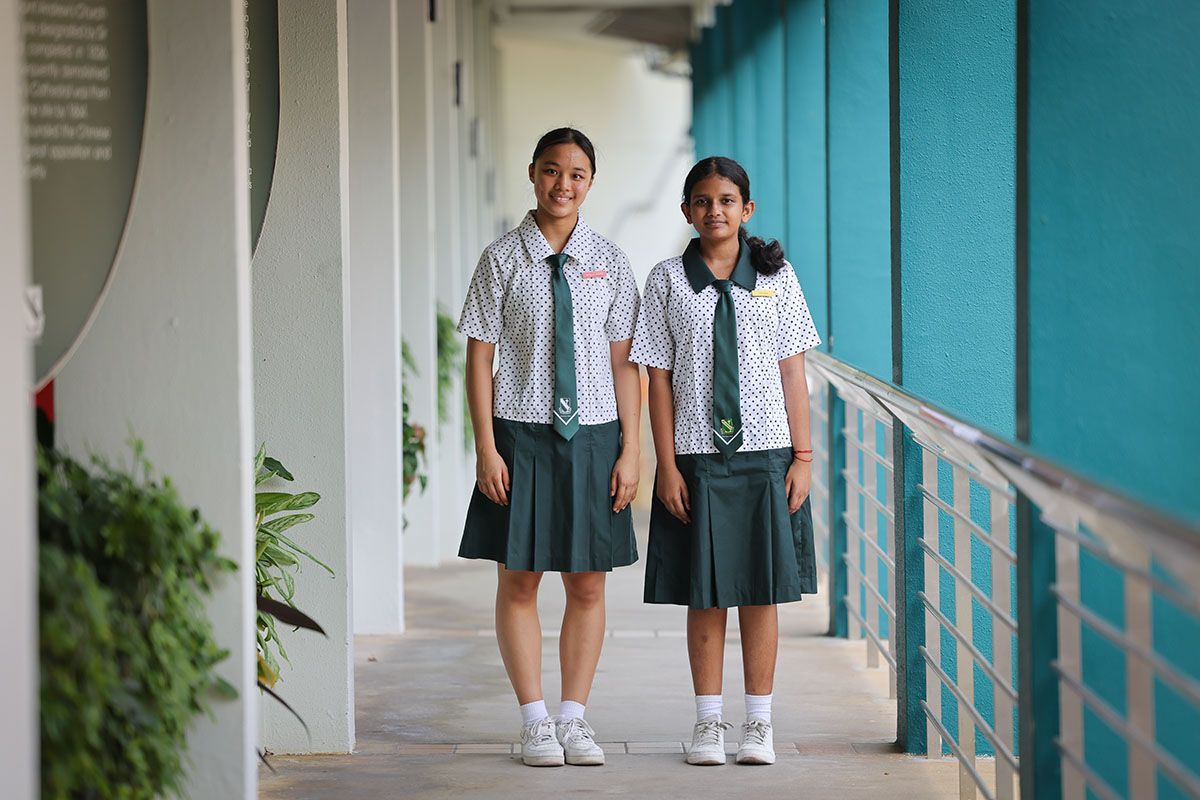
In Singapore, school uniforms are a defining part of growing up. At first glance, many look alike: a plain shirt paired with a skirt or trousers.
While many share this homogeneous look, some stand out from the crowd.
Their distinct colours, patterns and styles make them instantly recognisable, like the green polka-dot uniform worn by students from St Margaret’s School (Secondary)…
…the yellow top of Fairfield Methodist School (Secondary) or the purple-accented polo tee of Spectra Secondary School.
The Straits Times looked at the uniform designs of more than 100 secondary schools to see how simple threads weave symbols of lasting identity.
For a decade or more, like most Singaporeans, you slipped into your school uniform each morning without giving it much thought. But looking back, was it merely something you had to wear, or did it become a marker of identity and belonging?
“There is a fascinating paradox at the heart of school uniform design. Uniforms are intended to create sameness, yet constraint does not erase identity,” says Yix Guo Yi Xian, senior lecturer at Nanyang Academy of Fine Arts, University of the Arts Singapore. She explored this theme in her 2016 book, My School Uniform: An A To Z Collection Of Secondary School Uniforms In Singapore.
What’s in a uniform?
The outfit itself is simple enough: a plain shirt with shorts or trousers for boys and a blouse with a skirt, pinafore or skorts for girls. Uniforms ensure that students step onto school grounds looking sharp and on a more equal footing, regardless of socio-economic background or changing fashion trends.
At the same time, each institution expresses its uniqueness through the finer details: embroidered crests, metal pins, name tags, ties, belts and even socks or shoes. Together, these elements give students a shared identity and an instant connection to their school.
The St Margaret’s School (Secondary) uniform is a dress with a white bodice patterned with dark green polka dots. The distinctive design dates back to 1974, when it was created by an art teacher at the school.
The lower half of the dress is solid dark green, matching the dark green tie that bears the school crest.
Though it is a single dress, the uniform is designed to resemble a blouse and skirt. The lower half features side pockets and multiple pleats, giving it the appearance of a separate skirt.
There was a time when schools had no dress codes, and students simply wore their own clothes to attend classes. Singapore’s oldest girls’ school, St Margaret’s, was one such example.
Founded in 1842 as the Chinese Girls’ School, it introduced a uniform only in 1946: a white blouse with a green pinafore.
In 1974, then principal Liza M. George sought a more distinctive look, according to St Margaret’s Ex-Students’ Association. Art teacher Lim Kah Pheck won a design competition with the green polka-dot dress.
Students Jazzlynn Ng (left) and Triya Namo in the St Margaret’s School (Secondary) uniform with a matching tie. As a student councillor, Triya is distinguished by the green collar of her outfit. ST PHOTO: ONG WEE JIN
But not every school opts for a traditional uniform. Spectra Secondary School is among those breaking the mould.
Unlike most schools, it took a different approach to its uniform when it welcomed its first intake in 2014.
Instead, Spectra Secondary School adopted polo shirts to keep students comfortable throughout the school day.
The purple detailing symbolises the school’s commitment to helping its students grow and shine, while reflecting its emphasis on inclusivity.
Upper secondary girls wear trousers, allowing greater freedom of movement.
Lower secondary girls wear dark grey skorts. Both are practical choices suited to the school’s active, vocational curriculum, allowing students to move comfortably throughout the day.
Breaking from traditional schoolwear, Spectra Secondary School opts for polo shirts, as worn here by Wong Jun Yuan and Nor’ashykin Muhammad Rasul. ST PHOTO: GIN TAY
Spectra Secondary School’s uniform allows students to move freely during vocational training, such as in the school’s mock retail environment. ST PHOTO: GIN TAY
While all-white uniforms may seem ordinary, their origins stretch back decades.
Mostly found in schools established more than 50 years ago, these all-white uniforms have their roots in Singapore’s colonial and early post-independence years.
White was a practical choice in the tropical climate. The colour also carried symbolic associations with virtues such as purity and simplicity.
Nan Hua High School has retained its classic white uniform since its founding in 1917 as Nam Wah Girls’ School, even after it began admitting boys in 1984.
Today, the shirts worn by both boys and girls still feature shoulder epaulettes fastened with metal buttons, a design detail common among Chinese-heritage schools of the era.
Beyond the uniform itself, Nan Hua High is among the few remaining schools in Singapore where girls with long hair are required to wear it in twin plaits.
While no official records pinpoint when the rule began, principal Chiew Jing Wen says it dates back to a time when only members of the school’s Chinese dance society were allowed to keep their hair long, provided they wore it neatly in twin plaits. After other students asked to do the same, the school extended the practice to all girls with long hair – a tradition that has endured since then.
Nan Hua High School students Wang Jiacheng and Ashlie Khor in their all-white uniforms, a longstanding hallmark of the school’s identity. ST PHOTO: GIN TAY
Maris Stella High School has likewise retained its all-white look since its founding in 1958. For decades, boys across all levels wore a white top and shorts. That changed in 1991, when upper secondary students began wearing white trousers with a matching belt, says vice-principal Daniel Tan.
The shirt was also updated with a blue inner collar lining and the word “Marist” embroidered on it. The detail pays tribute to the Marist Brothers – the international Catholic religious institute behind Singapore’s only Marist institution – while the blue honours Mother Mary, the school’s patroness.
Maris Stella High School Secondary 2 student Charles Lai in shorts alongside Secondary 3 student Christian Mah in trousers. The switch from shorts to trousers marks a familiar rite of passage typical for boys in most local secondary schools. ST PHOTO: ONG WEE JIN
At Maris Stella High School, name tags currently display students’ names in English only. From the 2027 Secondary 1 intake, Chinese characters will be added, bringing the practice in line with its primary school and reflecting the school’s Special Assistance Plan status and bicultural heritage. ST PHOTO: ONG WEE JIN
Established in 1917, Nanyang Girls’ High School has similarly retained its all-white look, though the uniform design has evolved over the decades to better suit Singapore’s tropical climate.
Records in the 2017 book Nanyang Centenary: A Vision Celebrated show that students originally wore long-sleeved tops with a mandarin collar and floor-length skirts. Over the decades, sleeves shortened and hemlines rose, eventually giving way to today’s round-neck, sleeveless blouse and knee-length pleated skirt.
Students Lin Nike (left) and Jasmine Zhang in the Nanyang Girls’ High School uniform, which features a sleeveless blouse designed for comfort in Singapore’s tropical climate. ST PHOTO: ONG WEE JIN
The original Nanyang Girls’ High School uniform featured a long-sleeved top with a mandarin collar and a long skirt before evolving into today’s round-neck, sleeveless blouse and knee-length skirt. ST PHOTO: ONG WEE JIN
Adorning the uniform is the signature red logo, fondly known as the hongz i. Keen observers may notice that the Chinese character nan is missing a single stroke – a deliberate omission that reflects a stylistic convention favoured by calligraphers and serves as a subtle reminder of the school’s rich literary and cultural heritage.
The prevalence of white among Singapore’s heritage schools reflects the combined influence of “colonial inheritance, tropical pragmatism, institutional discipline and social aspiration”, Guo says.
What began as a practical choice or inherited convention has, over generations, evolved into a heritage code in its own right, she adds.
While white dominates the school uniform landscape, some have broken away from convention.
Female (104 schools)
ST analysed uniforms from more than 100 secondary schools to find out which colours appear most often.
For both boys and girls, white tops are the most common, followed by pastel shades such as green, blue and yellow. A handful of schools opt for bolder hues, such as Zhenghua Secondary School’s bright red top.
Blue dominates the colour palette for bottoms across both genders, while white is more prevalent among boys than girls. A small number of schools stand out with more vibrant colours, such as green and red.
The vast majority of secondary school uniforms feature white or a combination of white and navy blue. Yet, a handful of institutions depart from this classic palette.
Fairfield Methodist School (Secondary), founded as Telok Ayer Girls’ School in 1888, is among the few to embrace yellow – a colour commonly associated with optimism, warmth and energy.
Breaking away from the classic white palette, Fairfield Methodist School (Secondary)’s butter-yellow top is seen here on students Anishram Karthikeyan and Erica Ng. ST PHOTO: ONG WEE JIN
Originally founded as a girls’ school, it adapted its uniform when it became co-educational, introducing a boys’ shirt in the same distinctive yellow. ST PHOTO: ONG WEE JIN
According to principal Wee Tat Chuen, himself a school alumnus, the uniform’s signature look has remained unchanged for as long as former students can remember. But little is known today about who originally designed it.
“When the school went co-ed in 1983, it was natural to just have the colour of the top for the boys to match that of the girls,” Wee says.
Spectra Secondary School students (from left) Kumanan Abinayan, Angie Eng, Tan Wan Qi and Alberic Koh in different cohort tees, with each colour distinguishing a different level and adding vibrancy to the school environment. ST PHOTO: GIN TAY
Bright hues also appear in PE attire and house T-shirts across many schools.
At Spectra Secondary School, each cohort is assigned one of four vibrant colours – red, yellow, green or blue – which students wear throughout their four years. When the entire student body gathers in the hall or heads out on school trips, the resulting sea of colour creates an energetic, cheerful sight, says Guo Xinhui, vice-principal of student development.
In our dataset, 87 schools have girls’ uniforms comprising a top and skirt, with most of the skirts featuring multiple pleats.
But some schools opt for different styles, including pinafores, skorts and dresses.
The most enduring designs are rarely the most elaborate. Instead, they tend to have an unmistakable signature – one that generations of students come to recognise and claim as their own.
A design achieves lasting status through a combination of distinctiveness, consistency and accumulated meaning, says lecturer Guo.
“Visually, there must usually be one element you can recognise at a distance,” she says, pointing to details such as a distinct colour combination, silhouette, pinafore, tie, stripe or crest.
Here are some common uniform styles observed in our dataset.
But recognisability alone is not enough. A design must endure over time for generations of students to build memories around it. That continuity is what transforms a uniform from a dress code into something deeply personal.
At some schools, students do more than wear the uniform – they design it too.
While most schools hold fast to their original designs or make only minor tweaks, Bukit View Secondary School has taken a different approach, adopting four distinct uniform designs since its establishment in 1986. Its two most recent iterations were designed by students.
The approach stems from the school’s emphasis on authentic learning, which gives students opportunities to tackle hands-on, real-world design challenges. After Bukit View received the Design Council School Award for Excellence in Design Education in 1991, it held its first student uniform design competition the following year and a second in 2007.
Designed by a former student, the Bukit View Secondary School uniform features skorts instead of the conventional skirt for girls, as worn here by Enya Soo alongside schoolmate Aqil Aryan Mohamad Aidil. ST PHOTO: GIN TAY
For Bukit View, the uniform is a symbol of identity and culture, but not in the traditional sense. As Sharmila Gopal, head of department for character and citizenship education, puts it: “It symbolises our longstanding belief that students should not simply wear the school’s identity but actively shape it through creativity, innovation and leadership.”
Introduced in 2008, the current brown-and-white uniform balances aesthetics with practicality. Behind the 2007 design was then 14-year-old student Cheak Yen Hu.
“I primarily wanted to design a ‘fuss-free’ uniform that didn’t require tucking in – having students tuck in their shirts was an issue then – and one where the girls could move around freely without having to wear shorts under their skirts,” she recalls.
Nearly two decades later, generations of Bukit View students continue to wear her design.
There is a certain pride in identifying with a school in Singapore
Cheak Yen Hui, 33, on the significance of school attire.
If a school is considering a uniform makeover today, Guo suggests a simple starting point: involve the students and staff.
“Instead of commissioning a designer, schools can invite students, alumni and staff to identify what they consider essential about the existing uniform before redesigning it. That turns modernisation into a conversation about heritage rather than a cosmetic makeover,” Guo says.
“Ultimately, the best redesign should make someone think: ‘That is unmistakably my school,’ even though the uniform has clearly moved with the times.”
Now it is your turn. Having explored the designs and stories behind Singapore’s school uniforms, what would your ideal school uniform look like?
Try our interactive creator below to mix and match heritage-inspired cuts, traditional accents and modern colourways – and create a uniform of your own.
Start by selecting an avatar below
在新加坡,校服是成长过程中不可或缺的一部分。乍一看,很多校服都差不多:一件素色衬衫搭配裙子或裤子。
虽然许多人的外貌都比较相似,但有些人却能脱颖而出。
它们独特的颜色、图案和款式使它们极具辨识度,例如圣玛格丽特中学(中学部)学生所穿的绿色波点校服……
…费尔菲尔德卫理公会中学(中学部)的黄色上衣,或是斯佩克特拉中学的紫色点缀的polo衫。
《海峡时报》调查了 100 多所中学的校服设计,看看简单的线是如何编织出持久身份的象征的。
十多年来,像大多数新加坡人一样,你每天早上都会不假思索地穿上校服。但回首往事,校服仅仅是你必须穿的衣服,还是成为了身份和归属感的象征?
“校服设计的核心存在一个引人入胜的悖论。校服旨在创造统一性,但约束并不能抹杀个性,”新加坡艺术大学南洋艺术学院高级讲师郭怡娴说道。她在2016年出版的《我的校服:新加坡中学校服全集》一书中探讨了这一主题。
制服里有什么?
校服本身很简单:男生穿素色衬衫搭配短裤或长裤,女生穿衬衫搭配裙子、背带裙或裙裤。校服确保学生无论社会经济背景或时尚潮流如何变化,都能精神抖擞地踏入校园,并拥有更加平等的地位。
与此同时,每所学校都通过一些细节来展现自身的独特性:刺绣校徽、金属徽章、姓名牌、领带、腰带,甚至袜子或鞋子。这些元素共同赋予学生共同的身份认同感,并让他们与学校建立起紧密的联系。
圣玛格丽特中学(中学部)的校服是一件连衣裙,白色上衣饰有深绿色波点图案。这种独特的设计可以追溯到1974年,由该校一位美术老师创作。
裙子的下半部分是纯深绿色,与带有校徽的深绿色领带相配。
虽然是一件连衣裙,但制服的设计却兼具衬衫和裙子的特点。下半部分设有侧袋和多褶,使其看起来像是一条独立的裙子。
曾几何时,学校没有着装规定,学生们只需穿着自己的衣服上课即可。新加坡历史最悠久的女子学校圣玛格丽特女子学校就是其中一个例子。
该校成立于 1842 年,原名中国女子学校,直到 1946 年才引入校服:白色衬衫配绿色围裙。
据圣玛格丽特校友会称,1974年,时任校长莉莎·M·乔治希望学校拥有更具特色的形象。美术老师林嘉佩凭借绿色波点连衣裙赢得了设计比赛。
图为圣玛格丽特中学(中学部)学生吴嘉琳(左)和特丽娅·纳莫身着校服,系着同色领带。作为学生会成员,特丽娅的绿色领子格外引人注目。(海峡时报摄影:王伟进)
但并非所有学校都选择传统的校服。斯佩克特拉中学就是打破常规的学校之一。
与大多数学校不同,这所学校在 2014 年迎来第一批学生时,对校服采取了不同的做法。
为了让学生在整个上课日保持舒适,斯佩克特拉中学采用了polo衫。
紫色细节象征着学校致力于帮助学生成长和发光发热,同时也体现了学校对包容性的重视。
高年级女生穿裤子,这样可以更自由地活动。
初中女生穿深灰色短裙裤。这两种服装都很实用,适合学校积极开展的职业课程,让学生在一天中活动自如。
与传统校服不同,斯佩克特拉中学选择学生穿着polo衫,图中黄俊元和诺阿什金·穆罕默德·拉苏尔就穿着polo衫。(海峡时报摄影:金泰)
斯佩克特拉中学的校服让学生在职业培训期间,例如在学校的模拟零售环境中,能够自由活动。(海峡时报照片:金泰)
虽然全白制服看起来很普通,但它的起源可以追溯到几十年前。
这些全白校服大多出现在 50 多年前建立的学校中,其起源可以追溯到新加坡的殖民时期和独立初期。
白色在热带气候下是一种实用的选择。这种颜色也象征着纯洁和朴素等美德。
南华中学自 1917 年创立以来(当时名为南华女子中学),一直保留着经典的白色校服,即使在 1984 年开始招收男生之后也是如此。
如今,男孩和女孩所穿的衬衫仍然采用肩章设计,肩章用金属纽扣固定,这是当时中国传统学校常见的一种设计细节。
除了校服本身,南华中学是新加坡为数不多的几所仍然要求长发女生将头发扎成双辫的学校之一。
虽然没有官方记录明确指出这项规定始于何时,但校长秋静雯表示,它起源于学校中国舞蹈社团成员可以留长发,但前提是必须将头发整齐地编成双辫的时期。后来其他学生也提出同样的要求,学校便将这项规定推广到所有留长发的女生——这一传统一直延续至今。
南华中学学生王嘉诚和许艾希莉身着全白校服,这是该校由来已久的标志性校服。海峡时报摄影:金泰
玛丽斯特拉中学自1958年建校以来,一直保持着全白的校服风格。几十年来,各个年级的男生都穿着白色上衣和短裤。副校长丹尼尔·谭表示,这种情况在1991年发生了改变,当时高中部的学生开始穿白色长裤,并搭配同色腰带。
衬衫的领口内衬也进行了更新,采用了蓝色,并绣有“Marist”字样。这一细节是为了致敬马利斯特兄弟会——新加坡唯一一所马利斯特学校背后的国际天主教宗教机构——而蓝色则代表圣母玛利亚,她是这所学校的主保圣人。
玛丽斯·斯特拉中学二年级学生赖先生身穿短裤,与三年级学生马先生身穿长裤合影。从短裤换成长裤,是本地大多数中学男生常见的成长仪式。海峡时报摄影:王伟进
目前,玛丽斯·斯特拉中学(Maris Stella High School)的学生姓名牌上只显示英文姓名。从2027年中一新生入学开始,姓名牌上将添加中文,使其与小学保持一致,并体现该校的特殊援助计划(Special Assistance Plan)性质和双文化传承。(海峡时报摄影:王伟进)
南洋女子中学成立于 1917 年,同样保留了全白的校服外观,尽管几十年来校服设计不断演变,以更好地适应新加坡的热带气候。
2017年出版的《南洋百年校庆:愿景庆典》一书中记载,学生最初穿着长袖立领上衣和及地长裙。几十年来,袖子逐渐变短,裙摆也越来越长,最终演变成如今的圆领无袖衬衫和及膝百褶裙。
图为南洋女子中学学生林妮可(左)和张佳敏身着校服,校服的无袖上衣设计舒适,适合新加坡的热带气候。(海峡时报摄影:王伟进)
南洋女子中学的校服最初是长袖立领上衣搭配长裙,后来演变为如今的圆领无袖衬衫和及膝裙。(海峡时报摄影:王伟进)
校服上饰有标志性的红色校徽,人们亲切地称之为“红字”。细心的观察者可能会注意到,汉字“南”少了一笔——这是故意省略的,反映了书法家偏爱的一种风格惯例,也巧妙地提醒人们学校丰富的文学和文化遗产。
郭先生表示,新加坡传统学校中白人学生占多数,反映了“殖民遗产、热带实用主义、制度纪律和社会愿望”的综合影响。
她补充说,最初出于实际考虑或沿袭下来的习俗,经过几代人的演变,已经发展成为一种独立的文化遗产准则。
虽然白色在校服中占据主导地位,但也有一些学校打破了这种传统。
女生(104 所学校)
《海峡时报》分析了100多所中学的校服,以找出出现频率最高的颜色。
无论男女,白色上衣都是最常见的选择,其次是绿色、蓝色和黄色等柔和的粉彩色系。少数学校则选择更鲜艳的颜色,例如正华中学亮红色的上衣。
蓝色是男女学生下装颜色中最常见的,而白色在男生中比女生中更常见。少数学校则以绿色和红色等更鲜艳的颜色脱颖而出。
绝大多数中学的校服以白色或白底藏青色为主。然而,也有少数学校不采用这种经典的配色方案。
费尔菲尔德卫理公会中学(中学部),前身为 1888 年成立的直落亚逸女子学校,是少数几所采用黄色的学校之一——黄色通常与乐观、温暖和活力联系在一起。
费尔菲尔德卫理公会中学(中学部)打破了传统的白色系校服配色,图中学生阿尼什拉姆·卡尔蒂凯扬和埃里卡·吴身穿奶油黄色上衣。(海峡时报摄影:王伟进)
该校最初是一所女子学校,后来改为男女合校后,校服也随之调整,引入了同样醒目的黄色男生衬衫。(海峡时报摄影:王伟进)
据校长魏达泉(他本人也是该校校友)介绍,校服的标志性样式在历届学生的记忆中一直未变。但如今人们对校服的最初设计者知之甚少。
“1983年学校开始招收男女学生时,男生的上衣颜色自然而然地就和女生的上衣颜色保持一致了,”魏说。
斯佩克特拉中学(Spectra Secondary School)的学生(从左至右)库马南·阿比纳扬(Kumanan Abinayan)、安吉·英(Angie Eng)、陈婉琪(Tan Wan Qi)和阿尔贝里克·科(Alberic Koh)身穿不同年级的T恤,每种颜色代表不同的年级,为校园增添了活力。(海峡时报摄影:金泰)
鲜艳的色彩也出现在许多学校的体育课服装和校服T恤上。
在斯佩克特拉中学,每个年级的学生都会被分配到四种鲜艳颜色中的一种——红色、黄色、绿色或蓝色——学生们在四年的学习生活中都会穿着这种颜色的校服。学生发展副校长郭新辉表示,当全体学生聚集在礼堂或外出参加学校旅行时,这片色彩缤纷的海洋会营造出一种充满活力、令人愉悦的景象。
在我们的数据集中,87 所学校的女生校服包括上衣和裙子,其中大多数裙子都有多个褶皱。
但有些学校选择不同的款式,包括背带裙、短裙和连衣裙。
最经久不衰的设计往往并非最繁复的。相反,它们通常具有鲜明的特色——一代又一代的学生都能认出这种特色,并将其视为自己的特色。
郭讲师说,一个设计要获得持久的地位,需要具备独特性、一致性和不断积累的意义。
“从视觉上看,通常应该有一个元素可以让你在远处辨认出来,”她指着一些细节说道,比如独特的颜色组合、轮廓、围裙、领带、条纹或徽章。
以下是我们数据集中观察到的一些常见的制服样式。
但仅仅具备辨识度是不够的。一个好的设计必须经得起时间的考验,才能让一代又一代的学生围绕它建立起美好的回忆。正是这种传承性,才能将校服从一种着装规范,转变为一种具有深刻个人意义的象征。
在一些学校,学生不仅穿校服,还参与校服的设计。
虽然大多数学校都坚持使用最初的设计或只做一些小的调整,但武吉景中学却采取了不同的做法,自 1986 年建校以来,已经采用了四种不同的校服设计。其中最近的两款校服都是由学生设计的。
这种教学方法源于学校对真实学习的重视,它为学生提供了实践机会,让他们能够应对现实世界中的设计挑战。武吉景中学于1991年荣获设计委员会卓越设计教育学校奖后,于次年举办了首届学生校服设计大赛,并于2007年举办了第二届。
这套由前学生设计的武吉景中学(Bukit View Secondary School)校服,女生穿着短裙裤而非传统的裙子,图中恩雅·苏(Enya Soo)和她的同学阿基尔·阿扬·穆罕默德·艾迪尔(Aqil Aryan Mohamad Aidil)就穿着这套校服。(海峡时报摄影:金泰)
对于武吉景中学来说,校服是身份和文化的象征,但并非传统意义上的象征。正如品格与公民教育部门主管沙米拉·戈帕尔所说:“它象征着我们长期以来的信念,即学生不应只是穿着学校的制服,而应通过创造力、创新和领导力积极塑造学校的身份认同。”
现行的棕白相间校服于2008年推出,兼顾了美观与实用性。2007年的校服设计出自当时年仅14岁的学生胡哲彦之手。
“我当时主要想设计一款‘简单方便’的校服,不需要把衬衫塞进裤子里——当时让学生把衬衫塞进裤子里是个问题——而且女生可以自由活动,不用在裙子下穿短裤,”她回忆道。
近二十年后,武吉景中学的几代学生仍然穿着她设计的服装。
在新加坡,认同自己的学校会带来某种自豪感。
33岁的谢燕慧谈校服的重要性。
如果一所学校今天正在考虑进行校服改革,郭建议可以从一个简单的入手点开始:让学生和教职工参与进来。
郭说:“学校与其聘请设计师,不如邀请学生、校友和教职工在重新设计校服之前,先确定他们认为现有校服的哪些方面是必要的。这样一来,现代化就变成了一场关于传承的对话,而不是一场表面功夫。”
“归根结底,最好的重新设计应该让人一眼就能认出:‘这无疑是我的学校’,即使校服显然已经与时俱进。”
现在轮到你了。在了解了新加坡校服的设计和背后的故事之后,你理想中的校服是什么样的呢?
试试我们下面的互动式设计工具,将复古剪裁、传统元素和现代配色方案进行混搭,打造属于你自己的制服。
首先请在下方选择一个头像。