Battling sand and wind, Pentagon evaluates counter-drone tech at southern border exercise在与沙尘和强风的对抗中,五角大楼在南部边境演习中评估反无人机技术
A dozen vendors came to Yuma Proving Ground during Falcon Peak 26.2 to test their counter drone tech. Their goal: win a Pentagon contract.
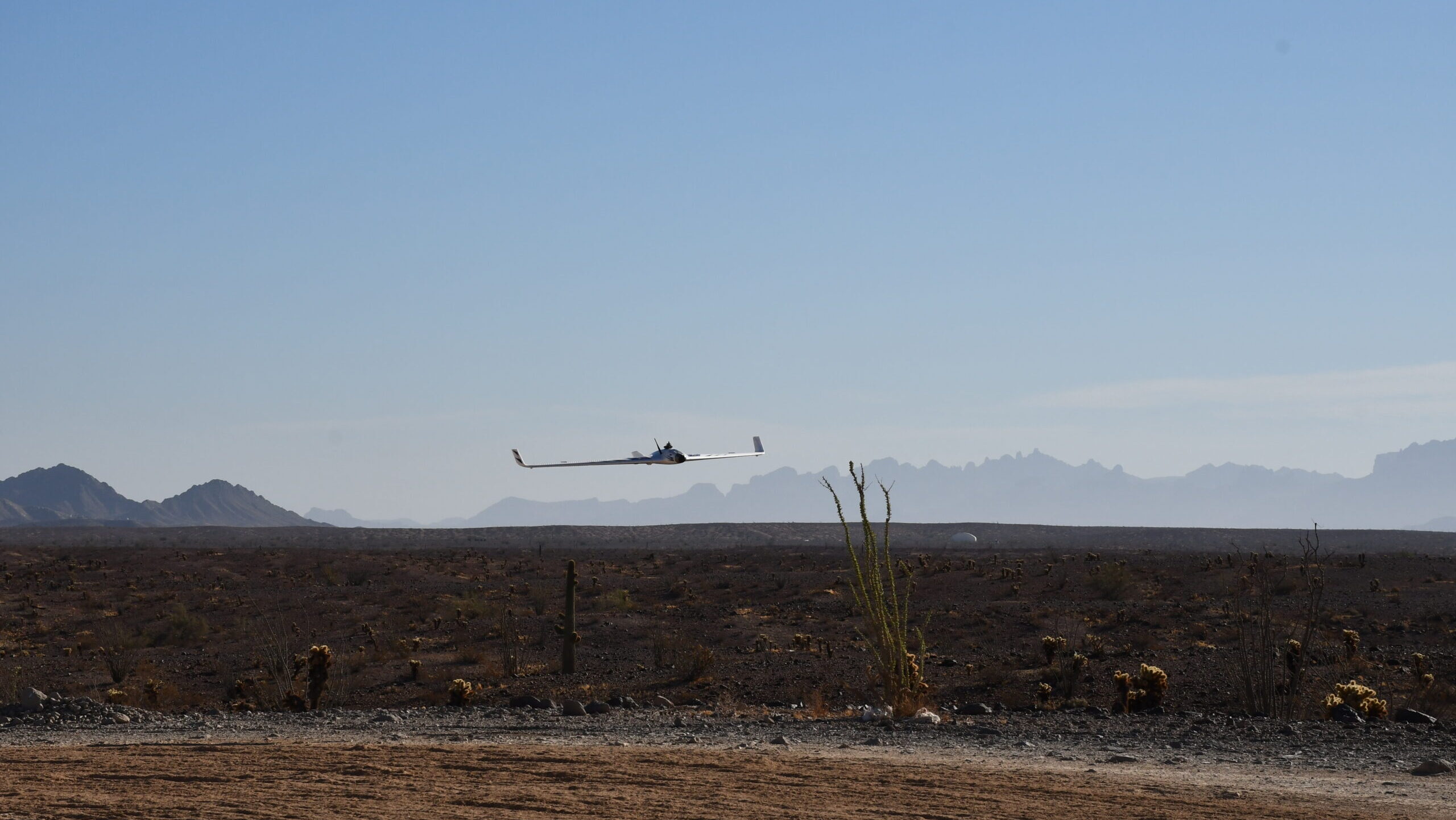
An Opterra fixed wing drone flies before it is shot down by a 12 gauge shotgun manufactured by Genesis Arms. (Photo by Carley Welch/ Breaking Defense)
YUMA PROVING GROUND, Ariz. — About seven miles away from the Mexico-United States border, an infrequent breeze provides a reprieve from the 100-degree-plus scorching heat. The reprieve is short-lived, as each zephyr comes with a cloud of dust. Weapons vendors, soldiers, drone operators and reporters cover their faces and squint their eyes, but inevitably it gets everywhere, including in equipment.
This is the scene of Falcon Peak 26.2, US Northern Command’s fourth and most recent counter-drone exercise designed to test up-and-coming tech that can defeat drones encroaching on the homeland. The exercise, which spanned from Aug. 31 to Sept. 25, saw NORTHCOM, its subordinate Joint Task Force-Southern Border (JTF-SB), the Department of Homeland Security, the Defense Innovation Unit and the Army’s Joint Interagency Task Force (JIATF 401) come together to witness vendors demo their tech — with a goal of awarding contracts soon after.
Smaller iterations of the exercise took place late last year, but the most recent Falcon Peak was the biggest yet, coming amid the Trump administration’s push to seal the border as tightly as possible. The timing is just right, too, as the Defense Department says it has experienced a “very noticeable” uptick in the number of cartel drone detections over the past several months.
“Its an increasing trend,” Air Force Brig. Gen. Brian Filler, deputy commanding general for operations for JTF-SB, told reporters on Sept. 24. “I don’t have those numbers committed to memory, but I mean it is increasing at a rate that’s very noticeable.”
Maj. Gen. Curtis Taylor, commanding general of JTF-SB, told an audience earlier that day that over the past 30 days there have been 378 detections, 75 turnbacks (instances when a counter-drone device disconnects a drone from its operator, automatically sending it limping home), 15 “engagements” (otherwise known as drone take downs), and one capture of an adversarial drone coming over the border.
Taylor acknowledged that while he would like those numbers to be higher, he’s pleased that the team has seen an uptick in both detections and turnbacks. The detections come from a variety of radar systems, Taylor said, and turn backs are possible through devices like DZYNE’s Dronebuster, a handheld device that uses radio frequency and GPS jamming to force drones to land or return to their operator.
The next step is moving from turn backs to “actual engagement” and eventually captures.
Processor upgrades enable computing at the edge
Avoiding vendor lock and providing more room for sensors and upgrades are critical considerations.
Most recently, an engagement on Sept. 24 involved using a high-energy laser system to down two cartel drones, Taylor said. He added that the one capture was initiated by a “cyber takedown system,” though both he and Filler declined to provide additional information on the system.
Detections have increased in part due to JIATF 401 bringing additional capabilities to the region, according to Brig. Gen. Jason Rueschhoff, operations director of NORTHCOM. He said more detections mean “better protection” and better data collection.
A soldier embedded with the Joint Task Force-Southern Border prepares to fly a quad copter drone over the southern border to collect reconnaissance on Sept. 23, 2026. (Photo by Carley Welch/ Breaking Defense)
Taylor said the “predominant drone threat” coming across the border are reconnaissance aircraft designed to “support human trafficking operations.” The drones are primarily Group 1, commercial off-the-shelf quadcopters, both Taylor and Filler said. To date, the task force and its partners have not seen any drones attached with “lethal” payloads cross the border, but that doesn’t mean that the possibility “does not exist,” Taylor said. “We know from open source information that’s securely available that there is a growing use of lethal drones in cartel violence in Mexico, and we all are concerned about the diffusion of lessons learned from Russia and Ukraine into the cartel fight in the hemisphere,” Taylor said.
Meanwhile, just 100 yards from the border wall, Lt. Commander Lauren Cole, the JTF-SB deputy director of public affairs, told reporters that the “narco-terrorist cartels are evolving in how they use drones, and they’re enhancing how they use drones.”
She added that they are using “different tactics in different places” causing the US military and agencies like DHS to try to stay ahead.
“We are constantly ensuring that we can meet and exceed the threats of how they use them.”
A Slew Of Industry Offerings
“Staying ahead” is the purpose of exercises like Falcon Peak, Cole said.
During the demonstration, officials covered three “lanes” of capabilities: sensing, kinetic interceptors (also known as drone-on-drone take downs) and ballistic take downs, which primarily consisted of small ammunition taking down the aircraft.
Teledyne FLIR’s Cerberus radar detects drones at Falcon Peak 26.2 on Sept. 22, 2026. (Photo by Carley Welch/ Breaking Defense)
A dozen vendors showed off their various solutions. Three were used for sensing operations, five for kinetic interceptors and four for ballistic capabilities. The vendors ranged from well-known firms such as Teledyne FLIR, offering its counter-drone radar dubbed Cerberus, and Allen Control Systems, with its kinetic Bullfrog interceptor, to lesser-known vendors such as Harmattan AI, with its hit-to-kill interceptor dubbed GOBI, and Genesis Arms, with its GEN-12 12-gauge, magazine-fed shotgun.
Of the tech tested, Breaking Defense was only shown Teledyne FLIR’s radar and Genesis Arms’ GEN 12 device. After three days in the desert, a small group of reporters saw a total of three test drones taken down by the GEN 12.
Additionally, during the last day, on Sept. 25, NORTHCOM also showed off its flyaway kit made by Anduril. The kit consists of a combination of sensors and effectors like the Heimdal 360-degree sensor, Anvil drone interceptors, the electromagnetic warfare effector called Pulsar, an AI-enabled infrared system dubbed the Wisp and the company’s Ghost-X reconnaissance drones.
Reporters and other observers witnessed the reconnaissance drones fly off to detect the whereabouts of “enemy drones” and then return to their launch site. The flyaway kit was purchased by NORTHCOM last fall.
Learning From Tough Conditions
Here the ubiquitous sand and winds aren’t only inconveniences, but operational challenges the military expects the counter-drone tech to withstand. Executives from Harmattan AI told reporters that the company has learned its tech will have to “overcome” the harsh desert environments over the course of Falcon Peak. Reporters didn’t get to observe GOBI’s kinetic attack in action, but executives gave accounts on how the capability works.
“We’ve been out here for a sustained period of time, which now also teaches us the endurance of our technology’s battery life. How does dust really affect it over time? Does that make a difference?” Callie Roth, one of Harmattan AI’s executives, told reporters during the exercise. “How do we kind of overcome some of those hurdles?” Roth didn’t reveal specifics , but said the company is learning how to make the GOBI more resilient with every test in the desert.
Robert Fletcher, Yuma Proving Ground’s sensor branch team lead, told reporters other vendors have learned the harsh realities of the desert environments. “A lot of people make assumptions when they come out here, and then when they’ve got the sun glaring off their system all day long, certain things melt. Certain electronics don’t work as well. So that’s always a hardship for the systems or the owners,” Fletcher said. (Breaking Defense previously reported how the harsh desert environment takes a toll on communications equipment as well.)
Apart from the heat and dust, the strong desert winds pose their own challenges, Joe Cornelius, CEO and Co-founder of Perseus, a company making a small interceptor that costs under $5,000 a hit, told Breaking Defense.
“Some of the big takeaways we took from [the exercise] were like we need to do more robust testing on different wind environments and things like that.” Cornelius said. “The winds out here at Yuma are about twice what we’ve ever tested with down in Texas. So that was a pretty big thing that we learned. We need to be a little bit more rigorous about testing in adverse conditions, such as wind, or such as … humidity, or such as fog, or rain, or whatever it may be.”
Ross told reporters that one of JIATF 401’s commitments going into Falcon Peak was to award contracts after the exercise. While he said on Sept. 24 that he didn’t yet know when those contracts will be awarded or how much they will be worth, he said the task force is using an agentic AI-powered “central repository” — a single database containing data collected during the exercise — to determine which vendors performed most successfully. He said that feedback will be available “in days, not weeks.”
“One of the things it does really well is it helps us sort through consolidated unstructured data. So our test reports will be in emails, Word documents, PowerPoint slides, Excel spreadsheets and sometimes a randomly formatted PDF document, but AI can help us kind of make sense of that,” Ross said. “I want to move really quickly because we’ve got some committed industry partners that are downstairs right now that took their time and money to come out here and perform.”
Acting Army Secretary Adam Telle and JIATF-401 commander Brig. Gen. Matt Ross have a discussion during Falcon Peak 26.2 in Yuma, Ariz. (Photo by Carley Welch/ Breaking Defense)
Ross declined to say if there was any one capability that stood out during the exercise, saying that what’s important is a “layered defense,” which combines the processes of detecting, tracking, identifying, mitigating and capturing. So, instead of buying one system that performs all of the functions, it would be ideal to purchase a variety of technology that is interoperable. Further, when buying such technology, he said it’s better to have capabilities that are expansive in scope versus acquiring tech that can only take down a certain type of drone.
“We really want to focus on those first principles that are common to all unmanned systems, and so there are solutions that will provide detection over radio frequencies and control frequencies, to jam that control, that modality of control. I’d much rather focus on sensing based [on] physical mass in the airspace, and defeating the drone based off the things that are common among all drones,” Ross said. “If we can focus on that for our defeat mechanisms, then our countermeasures will be resilient, regardless of the type of systems we start to see being used from the adversary,” he said.
一架Opterra固定翼无人机在飞行途中被Genesis Arms公司生产的12号口径霰弹枪击落。(图片由Carley Welch/Breaking Defense提供)
亚利桑那州尤马试验场——距离美墨边境约七英里处,一阵稀疏的微风带来一丝喘息,驱散了超过100华氏度(约38摄氏度)的酷暑。然而,这短暂的清凉转瞬即逝,因为每一阵微风都伴随着漫天尘土。武器供应商、士兵、无人机操作员和记者们纷纷捂住脸,眯起眼睛,但尘土还是无孔不入,无孔不入,甚至钻进了装备里。
这里是“猎鹰峰26.2”演习的现场,这是美国北方司令部第四次也是最近一次的反无人机演习,旨在测试能够击败入侵本土的无人机的新兴技术。此次演习从8月31日持续到9月25日,北方司令部、其下属的南部边境联合特遣部队(JTF-SB)、国土安全部、国防创新部门和陆军联合跨部门特遣部队(JIATF 401)齐聚一堂,共同见证供应商展示其技术——目标是在演习结束后尽快授予合同。
去年底曾进行过规模较小的类似演习,但最近一次的“猎鹰峰”演习规模最大,正值特朗普政府大力加强边境管控之际。此次演习的时机也恰到好处,因为国防部表示,过去几个月来,他们探测到的贩毒集团无人机数量出现了“非常明显的”增长。
“这是一个不断增长的趋势,”空军准将、JTF-SB作战副司令布莱恩·菲勒9月24日告诉记者。“我记不清具体数字了,但我的意思是,它的增长速度非常明显。”
联合特遣部队-SB 指挥官柯蒂斯·泰勒少将当天早些时候告诉听众,在过去的 30 天里,共发现了 378 架无人机,75 架无人机被拦截(反无人机装置将无人机与其操作员断开连接,使其自动返回基地),15 架无人机被击落(也称为无人机击落),并捕获了一架越过边境的敌方无人机。
泰勒承认,虽然他希望这些数字更高,但他很高兴看到团队在无人机探测和返航方面都取得了进步。泰勒说,探测数据来自各种雷达系统,而返航则可以通过像DZYNE公司的Dronebuster这样的设备实现。Dronebuster是一种手持设备,它利用射频和GPS干扰迫使无人机降落或返回操作员处。
下一步是从放弃转向“实际参与”,最终实现达成目标。
处理器升级使边缘计算成为可能
避免厂商锁定,并为传感器和升级留出更多空间是至关重要的考虑因素。
泰勒表示,最近一次行动发生在9月24日,当时他们使用高能激光系统击落了两架贩毒集团的无人机。他还补充说,其中一次无人机的捕获行动是由一套“网络拦截系统”发起的,但他和菲勒都拒绝提供有关该系统的更多信息。
据北方司令部作战主任杰森·鲁什霍夫准将称,探测数量的增加部分归功于第401联合特遣部队为该地区带来了更多能力。他表示,更多的探测意味着“更好的保护”和更好的数据收集。
2026年9月23日,一名隶属于南部边境联合特遣部队的士兵准备操控四旋翼无人机飞越南部边境进行侦察。(图片由Carley Welch/Breaking Defense提供)
泰勒表示,越境而来的“主要无人机威胁”是旨在“支持人口贩运活动”的侦察机。泰勒和菲勒都指出,这些无人机主要是第一类商用现成四旋翼无人机。迄今为止,特遣部队及其合作伙伴尚未发现任何携带“致命”载荷的无人机越境,但这并不意味着这种可能性“不存在”,泰勒说道。“我们从安全可获取的公开信息中得知,墨西哥贩毒集团越来越多地使用致命无人机进行暴力活动,我们都担心从俄罗斯和乌克兰吸取的经验教训会扩散到西半球的贩毒集团斗争中,”泰勒说道。
与此同时,在距离边境墙仅 100 码的地方,联合特遣部队-SB 公共事务副主任劳伦·科尔中校告诉记者,“毒品恐怖集团正在改变他们使用无人机的方式,并且他们正在增强他们使用无人机的方式。”
她补充说,他们在不同的地方使用“不同的策略”,导致美国军方和国土安全部等机构努力保持领先地位。
“我们一直在努力确保能够应对并超越他们利用这些手段所构成的威胁。”
一系列行业产品
科尔说,像“猎鹰峰”这样的演习的目的就是“保持领先”。
在演示过程中,官员们介绍了三种能力:传感、动能拦截(也称为无人机对无人机的击落)和弹道击落,其中主要包括使用小型弹药击落飞机。
2026年9月22日,泰莱达因FLIR公司的Cerberus雷达在猎鹰峰26.2号探测到无人机。(图片由Carley Welch/Breaking Defense提供)
十几家供应商展示了各自的解决方案。其中三款用于传感操作,五款用于动能拦截器,四款用于弹道作战能力。这些供应商既包括像泰莱科技(Teledyne FLIR)这样知名的公司,例如其反无人机雷达“地狱犬”(Cerberus),以及艾伦控制系统(Allen Control Systems)这样知名的公司,例如其动能拦截器“牛蛙”(Bullfrog);也包括像哈马坦人工智能(Harmattan AI)这样不太知名的公司,例如其直接命中拦截器“戈壁”(GOBI),以及创世纪武器公司(Genesis Arms)这样不太知名的公司,例如其GEN-12 12号口径弹匣供弹式霰弹枪。
在接受测试的技术中,《防务新闻》只看到了泰莱公司(Teledyne FLIR)的雷达和创世纪武器公司(Genesis Arms)的GEN 12设备。经过三天在沙漠中的测试,一小群记者亲眼目睹了GEN 12设备击落了三架测试无人机。
此外,在9月25日(最后一天),北方司令部还展示了由安杜里尔公司制造的便携式作战套件。该套件包含多种传感器和效应器,例如海姆达尔360度传感器、安维尔无人机拦截器、名为“脉冲星”的电磁战效应器、名为“Wisp”的人工智能红外系统以及该公司的“幽灵-X”侦察无人机。
记者和其他观察员目睹了侦察无人机飞离现场,探测“敌方无人机”的位置,然后返回起飞点。这套可飞行式无人机套件是北方司令部去年秋季采购的。
从逆境中学习
在这里,无处不在的沙尘和强风不仅是不便之处,更是军方期望反无人机技术能够经受住考验的作战挑战。哈马坦人工智能公司的高管告诉记者,该公司已经了解到,其技术必须在“猎鹰峰”演习期间“克服”恶劣的沙漠环境。记者们未能亲眼目睹“戈壁”反无人机系统的动能攻击,但高管们介绍了该技术的运作原理。
“我们已经在这里进行了相当长时间的测试,这也让我们了解了我们技术的电池续航能力。随着时间的推移,灰尘究竟会对电池产生怎样的影响?这真的会造成影响吗?”哈马坦人工智能公司(Harmattan AI)的一位高管卡莉·罗斯(Callie Roth)在测试期间告诉记者。“我们该如何克服这些障碍?”罗斯没有透露具体细节,但她表示,公司正在通过每一次沙漠测试来提升GOBI系统的耐用性。
尤马试验场传感器部门负责人罗伯特·弗莱彻告诉记者,其他供应商也已经体会到了沙漠环境的严酷现实。“很多人来到这里时都会想当然,但当他们的系统整天被烈日暴晒时,某些部件就会熔化,某些电子元件的性能也会下降。这对系统或用户来说始终是个难题。”弗莱彻说道。(《防务新闻》此前曾报道,严酷的沙漠环境也会对通信设备造成损害。)
除了高温和尘土,强劲的沙漠风也带来了自身的挑战。珀尔修斯公司首席执行官兼联合创始人乔·科尼利厄斯告诉《防务新闻》,该公司生产的小型拦截器每次命中成本不到 5000 美元。
科尼利厄斯说:“我们从这次演练中得到的主要启示之一是,我们需要在不同的风况下进行更全面的测试。尤马这边的风力大约是我们之前在德克萨斯州测试过的两倍。这是我们学到的一个重要经验。我们需要在恶劣条件下,例如大风、高湿度、雾、雨等等,进行更加严格的测试。”
罗斯告诉记者,联合跨部门特遣部队401在参加“猎鹰峰”演习前的承诺之一是在演习结束后授予合同。虽然他在9月24日表示,他尚不清楚这些合同何时授予以及价值多少,但他表示,特遣部队正在使用一个由人工智能驱动的“中央存储库”(一个包含演习期间收集的数据的单一数据库)来确定哪些供应商表现最为出色。他表示,反馈将在“几天内,而不是几周内”提供。
罗斯说:“它的一大优势在于能够帮助我们梳理整合的非结构化数据。我们的测试报告可能以电子邮件、Word文档、PowerPoint幻灯片、Excel表格,有时甚至是格式不规则的PDF文档的形式存在,但人工智能可以帮助我们理解这些数据。” 他还表示:“我希望尽快推进项目,因为我们有一些非常投入的行业合作伙伴,他们现在就在楼下,花费了时间和金钱来到这里进行测试。”
代理陆军部长亚当·特勒和第401联合跨部门特遣部队指挥官马特·罗斯准将在亚利桑那州尤马举行的“猎鹰峰26.2”演习期间进行了会谈。(照片由卡莉·韦尔奇/《防务新闻》提供)
罗斯拒绝透露演习中是否有哪一项能力表现突出,他表示,重要的是“多层防御”,即结合探测、跟踪、识别、缓解和拦截等流程。因此,与其购买一套能够执行所有功能的系统,不如采购多种可互操作的技术。此外,他还指出,在采购此类技术时,最好选择功能全面的系统,而不是只能击落特定类型无人机的技术。
罗斯说:“我们真正想关注的是所有无人系统共有的基本原理,因此,我们可以找到一些解决方案,通过无线电频率和控制频率进行探测,干扰这种控制方式。我更倾向于基于空域中物理质量的感知,并利用所有无人机的共同特征来对抗无人机。” 他还说:“如果我们能将这些作为对抗机制的重点,那么无论对手使用何种系统,我们的反制措施都将具有强大的韧性。”