Oleshky: How Russia Governs Through Humanitarian Decline奥列什基:俄罗斯如何在人道主义衰退中维持统治
The ongoing humanitarian crisis in the occupied Oleshky area reflects the coercive logic of Russian occupation governance in a frontline city.
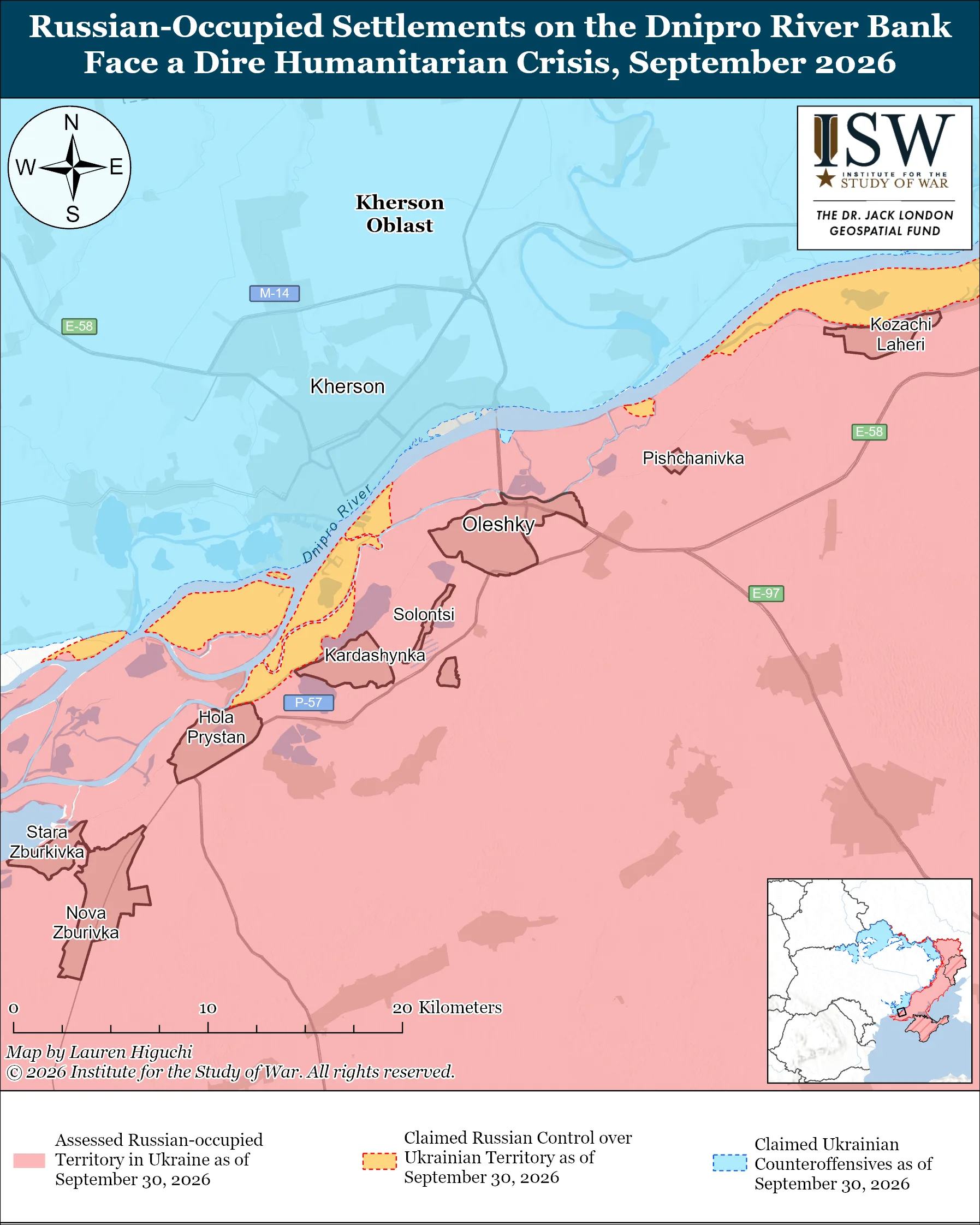
The ongoing humanitarian crisis in the occupied Oleshky area reflects the coercive logic of Russian occupation governance in a heavily damaged frontline city. Oleshky has become a test case for Russian rule in an area marked by depopulation, damaged infrastructure, chronic insecurity, and growing isolation from the rest of Ukraine. Rather than reversing these conditions, Russian occupation authorities appear to govern through them, leveraging residents’ increasing dependence on occupation-controlled services, institutions, and administrative systems to sustain control. As humanitarian vulnerabilities deepen and alternatives to occupation governance diminish, humanitarian decline and Russian occupation rule become mutually reinforcing.
Oleshky is a small town directly on the left (east) bank of the Dnipro River in Ukraine’s southern Kherson Oblast. Oleshky had a pre-war population of around 24,000 people, while around 40,000 people lived in the wider surrounding area of settlements on the left bank of the Dnipro (settlements including Hola Prystan, Stara Zburivka, Nova Zburivka, Kardashynka, Solontsi, Pishchanivka, Kozachi Laheri, and others).[1] Oleshky has become the epicenter of a mounting humanitarian crisis since late 2025, but similarly dire conditions exist in nearby left bank towns and villages.
Russian forces occupied these left bank settlements on February 24, 2022 — the first day of the full-scale invasion of Ukraine — during the initial military push to occupy all of Kherson Oblast from positions in occupied Crimea. Russian troops largely maintained a distance from Oleshky itself in the first few weeks of the invasion, and remaining elements of the Ukrainian city administration attempted to organize self-governance efforts and self-sufficient security patrols while refusing to directly cooperate with Russian soldiers.[2] Geolocated images show Russian forces had officially entered Oleshky as of late March 2022, breaking the tacit governance agreement that had been in place with the remaining Ukrainian officials.[3] Russian forces and occupation officials took full control of Oleshky in late April 2022, however, and about 40 percent of the pre-war population fled to Ukrainian-held territory while security checkpoints were still open.[4]
The occupation of the Oleshky area followed a similar pattern to the violent imposition of Russian rule across Ukraine. Russian forces brutally cracked down against any perceived dissent against the occupation, kidnapping and orchestrating enforced disappearances against prominent local officials or veterans of the Ukrainian military and their families.[5] The Ukrainian General Staff reported that Russian forces blocked evacuation routes and humanitarian corridors in the early stages of the invasion, effectively trapping people in the Oleshky area.[6] Oleshky also faced many of the same demographic engineering tactics that Russia has applied elsewhere in occupied Ukraine, including the resettlement of Russians into the area and the parallel forced removal or deportation of Ukrainians.[7] In one particularly notable instance, Russia forcibly removed 84 disabled adult and minor residents from the Oleshky Specialized Boarding School, relocating the residents to care facilities throughout occupied Ukraine and Russia — a clear example of forced transfer and illegal deportation under international law.[8]
After Ukraine liberated western Kherson Oblast up to the Dnipro River in November 2022, Oleshky and its neighbors became the new Kherson Oblast frontline, firmly under Russia’s grasp and increasingly trapped by their geography. Russian forces dug into positions in and around Oleshky, often co-mingling with civilian residents and basing military equipment in the area.[9] Ukrainian open-source investigative outlet Slidstvo Info reported that units of the 126th Coastal Defense Brigade (Russian Black Sea Fleet) and the 331st Guards Airborne Regiment (98th Airborne [VDV] Division) are likely based in or near Oleshky and may be complicit in various abuses against the civilian population in the area.[10]
Oleshky and other settlements on the Dnipro’s left bank suffered disproportionately because of Russia’s June 6, 2023 destruction of the Kakhovka Hydroelectric Power Plant (KHPP) dam.[11] The subsequent flooding nearly submerged the Oleshky area entirely, and Russian forces refused to facilitate evacuation or humanitarian support efforts. Up to 500 residents of Oleshky may have died during the flooding because Russian forces reportedly refused to evacuate anyone without a Russian passport.[12] The flooding of cemeteries throughout the area led to water contamination that created an acute sanitation crisis.[13] Russian occupation officials exploited the flood to consolidate further control over Oleshky’s residents, reportedly demanding 10,000-ruble ($120) payments for the replacement of documents washed away by the floodwater.[14] Residents of occupied Oleshky found themselves dependent on, and indebted to, the Russian occupation administration to escape from the humanitarian devastation that Russian forces themselves caused by blowing up the KHPP dam.
Russian occupation policies have contributed to a sharp decline in an already-challenging humanitarian situation in the Oleshky area since December 2025. Oleshky’s location directly on the Dnipro River frontline has exposed its residents to constant drone and artillery strikes, and the co-placement of Russian military personnel and equipment with civilian infrastructure has undoubtedly complicated Ukrainian strike operations against military targets on the left bank. The Russian occupation administration has continuously refused to take steps to ensure the safety or wellbeing of residents in the face of these military threats, however, and stopped the delivery of food and other critical supplies into Oleshky in late December 2025 by citing the threat of Ukrainian drone strikes.[15] Residents reported hunting for food and noted that there were cases of deaths due to starvation, freezing, or lack of medical care as of March 2026.[16] Ukrainian sources reported that Oleshky’s occupation leadership fled the town for Skadovsk (south of Oleshky, deeper in the rear of occupied Kherson Oblast) in March, abandoning and isolating local residents.[17] The roads out of Oleshky have become so dangerous due to drone and artillery strikes and unexploded mines, including ordnance that Russian forces reportedly retroactively laid to enforce the effective blockade of the area, that egress from the town is effectively impossible.[18] Up to three to four thousand civilians, including children, remain within Oleshky itself as of September 2026.[19] UN and Ukrainian estimates place the population of the wider area around Oleshky and Hola Prystan at 6,000.[20]
Russia has failed to deliver food, medicine, or other critical goods to the Oleshky area since May 2026. The UN Human Rights Monitoring Mission in Ukraine ( HRMMU) published a report on June 25 that found that there had been no food deliveries into Oleshky since May 26.[21] Residents have resorted to eating ground up grains and pasta mixed with baking soda and liquid from expired canned foods, grass, or soup made from garden weeds to survive.[22] An Oleshky resident posted on social media on September 1 that with the end of fruit and vegetable season approaching, people are increasingly “panicky” out of fears that there will be nothing left to eat.[23]
Deaths from starvation or illness are driving a critical sanitary situation in the Oleshky area as residents are unable to bury the bodies of the dead or use the city morgue, which has been completely destroyed.[24] Stray dogs have reportedly become used to the taste of human flesh.[25] Russian officials still had not facilitated food shipment to the Oleshky area as of September 29. Ukrainian Kherson Oblast Head Oleksandr Prokhudin reported on September 27 that units of the Ukrainian National Guard and Marines managed to conduct a covert drone operation to drop four tons of food into Oleshky to ease famine conditions.[26] Prokhudin warned, however, that Russian forces tried to shoot down the drones and are beating residents who were able to collect the delivered aid.
The Kremlin itself has acknowledged it is aware of the situation in the Oleshky area, but has refused to engage in any good-faith efforts to address the situation despite repeated Ukrainian government outreach. Kremlin Spokesperson Dmitry Peskov acknowledged during a press briefing on September 21 that there are challenges with food and medicine supply to occupied Oleshky, but blamed Ukraine entirely for the situation.[27] Alexander “Sasha” Kots, a prominent milblogger who serves on the Kremlin’s Human Rights Council, responded to the situation by similarly blaming Ukraine and called for the opening of a humanitarian corridor to occupied Melitopol (about 200 kilometers east of Oleshky in the rear of Russian-occupied Zaporizhia Oblast).[28] There have been no formal Kremlin offers for a ceasefire to secure a humanitarian corridor out of Oleshky as of the time of writing, however. Ukrainian officials, on the other hand, have made several attempts to negotiate with the Kremlin over the issue of Oleshky:
First attempt: Ukrainian Ombudsman Dmytro Lubinets first raised the issue of a negotiated local humanitarian ceasefire in order to evacuate residents from Oleshky and nearby settlements in May 2026.[29] Lubinets appealed to the International Committee of the Red Cross (ICRC), which stated it was ready to help organize evacuations from the Oleshky area. Lubinets and unspecified Russian counterparts reportedly discussed the situation in Oleshky on May 15, but no agreements arose from these discussions.[30]
Second attempt goes unanswered: Ukraine’s ceasefire proposals remained unanswered as of July 2026. Lubinets sent another appeal to the ICRC to engage with Russia over the establishment of a localized ceasefire.[31] Limited occupied Kherson Oblast-based Russian sources claimed that Russia enacted a unilateral localized ceasefire in late July, but Ukraine and the ICRC did not appear to receive any notification, therefore making the ceasefire unenforceable.[32]
Localized ceasefire efforts fall apart: Lubinets announced that Russia effectively reneged on all prior unofficial agreements working towards a localized Oleshky ceasefire as of September 2026. [33] The Ukrainian Ministry of Foreign Affairs reported on September 23 that Ukraine and the ICRC were ready to deliver food and medical aid to Oleshky, but that Russia continued to block the supplies and stall negotiation efforts.[34]
The situation in Oleshky and the Kremlin’s deliberate non-response reveal a certain logic to Russian occupation policies in Ukraine that rely heavily on the mutually reinforcing conditions of humanitarian deprivation and imposed occupation governance. Russia’s occupation of Oleshky and surrounding Kherson Oblast settlements created conditions of manufactured dependence on the occupation administration for basic administrative and bureaucratic functions that, in turn, were necessary for the conduct of everyday life. This dependence intensified the more isolated Oleshky became from both Ukrainian-controlled territory across the Dnipro River and other occupied settlements in Kherson Oblast. Russia has further weaponized the dependence resulting from its occupation by exacerbating conditions of humanitarian deprivation in the Oleshky area. Russia has systematically failed to respond decisively to the level of need displayed by the populations it occupies, instead using deprivation conditions as a means of further consolidating its control over occupied areas.
Russia notably applied a similar template during its siege of Mariupol between March and May 2022. Russian military operations effectively blockaded the city, Russian forces inhibited humanitarian evacuation efforts, and Russian occupation officials used deprivation of food, water, heating, and medical care as a method of warfare to consolidate further control of the area and its residents.[35] Ukrainian lawyers submitted a dossier to the International Criminal Court in 2024 alleging that Russia engaged in a deliberate pattern of starvation tactics in Mariupol — conditions eerily similar to the current situation in the Oleshky area.[36]
Oleshky represents a complete and total abrogation of Russia’s international legal responsibilities as a belligerent occupying power. The Kremlin has clearly demonstrated it is aware of the severity of the situation in Oleshky but has repeatedly been the party to reject or ignore Ukrainian and international proposals for a localized ceasefire. International humanitarian law requires Russia, as the occupying power, to provide food, medical supplies, and humanitarian relief efforts to the population it occupies.[37] Even these failures to deliver on the basic needs of an occupied population appear deliberate, however, particularly when viewed through a broader pattern of Russian abuses across occupied Ukraine.[38] Oleshky demonstrates that the humanitarian crisis unfolding in many Russian-occupied communities is not merely a byproduct of war, but increasingly appears to be a consequence of an occupation system that tolerates, exploits, and perpetuates civilian vulnerability as a means of sustaining control.
Russia likely views any tangible response to the situation in Oleshky as a display of weakness. Russia’s delivery of critical supplies into the area would be contingent on its acceptance of a localized ceasefire agreement- something the Kremlin has repeatedly demonstrated it has no interest in. Allowing Ukraine to airdrop supplies into the area via drone would also be contingent on the acceptance of a localized ceasefire agreement. In either event, the Kremlin would likely view an easing of the situation in Oleshky as a sort of capitulation and a sign of weakness. Russia appears to have weighed the potential reputational damage of governing through a severe humanitarian crisis with accepting Ukrainian ceasefire terms, and found the former more favorable. Human lives are once again in the crossfire of Russian hubris.
[1] https://english.nv dot ua/russian-war/thousands-trapped-in-occupied-oleshky-amid-humanitarian-catastrophe-50644886.html [2] https://decentralization.gov.ua/admin/articles/14851.html [3] https://x.com/GeoConfirmed/status/1506746615297626117 [4] https://t.me/stranaua/37959; https://www.pravda dot com.ua/news/2022/04/14/7339670/ [5] https://www.radiosvoboda dot org/a/novyny-pryazovya-vtorhnennya-rosiyi-peresliduvannya/31774842.html; https://decentralization.gov dot ua/admin/articles/14851.html; https://t.me/hueviyherson/32573; https://understandingwar.org/research/russia-ukraine/russian-offensive-campaign-assessment_9-21/ [6] https://www.facebook.com/GeneralStaff.ua/posts/321589963487422 [7] https://sprotyv.mod dot gov.ua/2023/01/25/rosiyany-prymusovo-deportuvaly-selo-v-hersonskij-oblasti/ [8] https://newlinesmag.com/reportage/in-a-propaganda-move-russia-targeted-and-deported-disabled-children-from-ukraine/ [9] https://www.facebook.com/watch/?v=869607857752561 [10] https://www.slidstvo.info/news/slidstvo-info-vstanovylo-rosiyskykh-viyskovykh-iaki-mozhut-buty-prychetnymy-do-humanitarnoi-katastrofy-v-oleshkakh/ [11] https://understandingwar.org/research/russia-ukraine/russian-offensive-campaign-assessment_7-18/; https://t.me/svobodnieslova/2082; https://t.me/rybar/48127; https://meduza dot io/feature/2023/06/06/esche-para-chasov-i-gorod-uydet-pod-vodu; https://www.nytimes.com/interactive/2023/06/16/world/europe/ukraine-kakhovka-dam-collapse.html [12] https://sprotyv.mod.gov.ua/sotni-meshkantsiv-oleshok-zapgynuly-pislya-pidryvu-ges-bo-rosiyany-vidmovyly-v-evakuatsiyi/ [13] https://t.me/rybar/48152; https://x.com/DefenceHQ/status/1667768172907229188/photo/1 [14] https://suspilne dot media/kherson/509653-v-oleskivskij-gromadi-nevidoma-kilkist-zagiblih-vid-pidtoplenna-stavlat-diagnoz-vadi-serca-miskij-golova/ [15] https://mipl.org dot ua/lyudy-pomyrayut-u-vlasnyh-domivkah-vid-holodu-ta-golodu-anonimni-svidchennya-z-okupovanyh-oleshok/ [16] https://mipl.org dot ua/lyudy-pomyrayut-u-vlasnyh-domivkah-vid-holodu-ta-golodu-anonimni-svidchennya-z-okupovanyh-oleshok/ [17] https://sprotyv dot org.ua/humanitarna-katastrofa-na-okupovanii-khersonshchyni/ ; https://t.me/sprotyv_official/8405 [18] https://lifeinwar dot com/publications/prirecheni-na-smert-yak-vizhivayut-i-vmirayut-u-peretvorenih-na-zonu-smerti-v-oleshkah-i-goliy-pristani; https://t.me/sprotyv_official/8893; https://most.ks dot ua/en/news/url/rosijani-pereminuvali-mozhlivij-pishohidnij-marshrut-z-oleshok-pislja-togo-jak-diznalisja-pro-nogo/; https://www.bbc.com/news/articles/c893xj41zwdo [19] https://suspilne dot media/kherson/1401472-ludi-vidcuvaut-sebe-prirecenimi-nacalnica-mva-pro-situaciu-v-oleskah-na-tot-hersonsini/ [20] https://ukraine.ohchr.org/en/Desperate-situation-for-civilians-trapped-in-frontline-areas-says-UN-Human-Rights-Ukraine [21] https://ukraine.ohchr.org/en/Desperate-situation-for-civilians-trapped-in-frontline-areas-says-UN-Human-Rights-Ukraine [22] https://www.bbc.com/news/articles/c60qxywdx4vvo; https://www.youtube.com/watch?v=UiqEax-Ojh8; https://x.com/andrii_sybiha/status/2103746660027228455?s=46&t=qRVLxlLsSGWt6ShPBfI5RA [23] Source available upon request. [24] https://www.youtube.com/watch?v=UiqEax-Ojh8; https://intent.press/en/news/society/2026/oleshky-has-been-without-food-and-medicine-for-over-a-month-the-humanitarian-situation-is-critical/ [25] https://www.theguardian.com/world/2026/sep/27/hell-on-earth-last-residents-eat-weeds-to-survive-in-russian-occupied-oleshky; https://www.youtube.com/watch?v=UiqEax-Ojh8; https://intent.press/en/news/society/2026/oleshky-has-been-without-food-and-medicine-for-over-a-month-the-humanitarian-situation-is-critical/ [26] https://t.me/olexandrprokudin/15572 [27] https://tass dot ru/politika/28135265; https://understandingwar.org/research/russia-ukraine/russian-occupation-update-september-24-2026/ [28] https://t.me/sashakots/64678 [29] https://suspilne dot media/kherson/1311662-obgovoruvali-rezim-tisi-ombudsman-pro-peremovini-sodo-evakuacii-z-olesok-na-tot-hersonsini/; https://suspilne dot media/kherson/1308061-trivae-robota-sodo-napracuvanna-slahiv-evakuacii-ombudsmen-otrimav-vidpovid-vid-mtch-sodo-situacii-v-oleskah-na-tot/ [30] https://suspilne dot media/kherson/1314280-cekaemo-datu-vid-rosijskoi-storoni-lubinec-pro-pocatok-evakuacii-z-olesok-na-tot-hersonsini/ [31] https://www.ukrinform dot ua/rubric-society/4139546-evakuacia-z-olesok-lubinec-zaklikav-mkch-domogtisa-vid-rosii-rezimu-tisi-3-lipna.html [32] https://t.me/VGA_Kherson/39779 [33] https://t.me/dmytro_lubinetzs/12544 [34] https://x.com/MFA_Ukraine/status/2102759038169608697 [35] https://www.reuters.com/world/europe/russians-used-starvation-method-warfare-mariupol-experts-say-2024-06-13/; https://www.reuters.com/world/russia-is-deliberately-blocking-mariupol-evacuation-ukrainian-official-says-2022-03-10/ [36] https://www.theguardian.com/world/article/2024/jun/13/russia-accused-of-deliberate-starvation-tactics-in-mariupol-in-submission-to-icc?CMP=telegram_guardian [37] https://ihl-databases.icrc.org/en/ihl-treaties/gciv-1949/article-55/commentary/2025; https://x.com/CommissionerHR/status/2103409068702339400 [38] https://www.theguardian.com/world/article/2024/jun/13/russia-accused-of-deliberate-starvation-tactics-in-mariupol-in-submission-to-icc?CMP=telegram_guardian
被占领的奥列什基地区持续不断的人道主义危机,反映了俄罗斯占领当局在这座饱受战火蹂躏的前线城市中奉行的强制统治逻辑。奥列什基已成为俄罗斯统治的一个试验场,该地区人口锐减、基础设施损毁、长期处于不安全状态,并且与乌克兰其他地区日益隔绝。俄罗斯占领当局非但没有扭转这些局面,反而似乎利用这些现状进行统治,利用居民对占领当局控制的服务、机构和行政系统的日益依赖来维持控制。随着人道主义脆弱性的加剧和替代占领统治方案的减少,人道主义危机与俄罗斯占领统治相互强化。
奥列什基是位于乌克兰南部赫尔松州第聂伯河左岸(东岸)的一个小镇。战前,奥列什基的人口约为24,000人,而第聂伯河左岸周边地区(包括霍拉普里斯坦、斯塔拉兹布里夫卡、新兹布里夫卡、卡尔达申卡、索隆齐、皮什恰尼夫卡、科扎奇拉赫里等)的居民总数约为40,000人。[1] 自2025年末以来,奥列什基已成为日益严重的人道主义危机的中心,但附近左岸城镇和村庄的情况也同样严峻。
2022年2月24日,俄军全面入侵乌克兰的第一天,即赫尔松州左岸的这些定居点被占领。这是俄军从被占领的克里米亚阵地向整个赫尔松州推进的第一步。在入侵的最初几周,俄军基本上与奥列什基保持距离,乌克兰市政当局的残余力量试图组织自治和独立巡逻,同时拒绝与俄军直接合作。[2] 地理定位图像显示,俄军于2022年3月下旬正式进入奥列什基,打破了此前与乌克兰残余官员达成的默契治理协议。[3] 然而,俄军和占领官员于2022年4月下旬完全控制了奥列什基,约40%的战前居民在安全检查站仍然开放的情况下逃往乌克兰控制区。[4]
奥列什基地区的占领与俄罗斯在乌克兰各地强行推行统治的模式如出一辙。俄军残酷镇压任何被视为反对占领的异议,绑架并强迫失踪当地知名官员、乌克兰退伍军人及其家属。[5] 乌克兰总参谋部报告称,俄军在入侵初期封锁了撤离路线和人道主义走廊,实际上将民众困在了奥列什基地区。[6] 奥列什基还面临着俄罗斯在被占领乌克兰其他地区实施的许多相同的“人口改造”策略,包括将俄罗斯人迁入该地区,以及同时强迫或驱逐乌克兰人。[7] 在一个特别引人注目的案例中,俄罗斯强行将奥列什基特殊寄宿学校的84名残疾成人和未成年居民迁出,并将他们安置到被占领的乌克兰和俄罗斯境内的护理机构——这显然违反了国际法,构成强迫转移和非法驱逐。[8]
2022年11月,乌克兰解放了赫尔松州西部直至第聂伯河一带后,奥列什基及其周边地区成为新的赫尔松州前线,牢牢处于俄罗斯的控制之下,并日益受到其地理位置的限制。俄军在奥列什基及其周边地区构筑工事,经常与平民居民混杂在一起,并在该地区部署军事装备。[9] 乌克兰开源调查媒体Slidstvo Info报道称,俄罗斯黑海舰队第126海岸防御旅和第98空降师第331近卫空降团的部队可能驻扎在奥列什基或附近,并可能参与了该地区针对平民的各种暴行。[10]
2023年6月6日,俄罗斯炸毁了卡霍夫卡水电站大坝,奥列什基和第聂伯河左岸的其他居民点遭受了不成比例的损失。[11] 随后的洪水几乎完全淹没了奥列什基地区,而俄罗斯军队拒绝协助疏散或提供人道主义援助。据报道,由于俄罗斯军队拒绝疏散任何没有俄罗斯护照的人,多达500名奥列什基居民可能在洪水中丧生。[12] 该地区各处墓地被淹,导致水污染,引发了严重的卫生危机。[13] 据报道,俄罗斯占领官员利用这场洪水进一步巩固了对奥列什基居民的控制,并要求他们支付1万卢布(约合120美元)以更换被洪水冲走的证件。[14]被占领的奥列什基的居民发现自己不得不依赖俄罗斯占领当局,并欠俄罗斯占领当局人情,才能逃离俄罗斯军队炸毁KHPP大坝造成的人道主义灾难。
自2025年12月以来,俄罗斯的占领政策导致奥列什基地区本已严峻的人道主义局势急剧恶化。奥列什基地处第聂伯河前线,居民长期遭受无人机和炮火袭击,而俄罗斯军事人员和装备与民用基础设施的混杂部署无疑加剧了乌克兰对左岸军事目标的打击难度。然而,面对这些军事威胁,俄罗斯占领当局始终拒绝采取措施保障居民的安全和福祉,并于2025年12月底以乌克兰无人机袭击威胁为由,停止向奥列什基运送食品和其他重要物资。[15] 居民报告称,截至2026年3月,他们不得不外出狩猎觅食,并指出已出现因饥饿、冻伤或缺乏医疗救助而死亡的案例。[16]乌克兰方面报道称,奥列什基的占领军领导层于3月逃离该镇,前往斯卡多夫斯克(位于奥列什基以南,更深入被占领的赫尔松州腹地),抛弃并孤立了当地居民。[17] 由于无人机和炮击以及未爆炸地雷(包括据报道俄罗斯军队为加强对该地区的有效封锁而事后埋设的弹药),通往奥列什基的道路变得极其危险,以至于实际上无法离开该镇。[18] 截至2026年9月,奥列什基镇内仍有三四千名平民,其中包括儿童。[19] 联合国和乌克兰方面估计,奥列什基和霍拉普里斯坦周边地区的人口为6000人。[20]
自2026年5月以来,俄罗斯一直未能向奥列什基地区运送食品、药品或其他重要物资。联合国乌克兰人权监测团(HRMMU)于6月25日发布的一份报告指出,自5月26日以来,奥列什基地区没有收到任何食品。[21] 为了生存,当地居民只能食用磨碎的谷物和意大利面,并加入小苏打和过期罐头食品中的液体,或者吃草,甚至用花园里的杂草熬汤。[22] 9月1日,一位奥列什基居民在社交媒体上发帖称,随着水果和蔬菜季节即将结束,人们越来越“恐慌”,担心以后会无东西可吃。[23]
由于饥饿或疾病导致的死亡,奥列什基地区的卫生状况十分危急,居民无法埋葬尸体,也无法使用已被彻底摧毁的城市停尸房。[24] 据报道,流浪狗已经习惯了人肉的味道。[25] 截至9月29日,俄罗斯官员仍未向奥列什基地区运送食品。乌克兰赫尔松州州长奥列克桑德·普罗胡金于9月27日报告称,乌克兰国民警卫队和海军陆战队部队成功实施了一次秘密无人机行动,向奥列什基空投了四吨食品,以缓解饥荒状况。[26] 然而,普罗胡金警告说,俄罗斯军队试图击落无人机,并殴打领取援助物资的居民。
克里姆林宫承认其了解奥列什基地区的局势,但尽管乌克兰政府多次施压,克里姆林宫仍拒绝做出任何真诚的努力来解决问题。克里姆林宫发言人德米特里·佩斯科夫在9月21日的新闻发布会上承认,被占领的奥列什基地区面临食品和药品供应困难的问题,但他将局势完全归咎于乌克兰。[27] 著名军事博主、克里姆林宫人权委员会成员亚历山大·“萨沙”·科茨也对局势做出了类似的回应,同样指责乌克兰,并呼吁开辟一条通往被占领的梅利托波尔(位于俄罗斯占领的扎波罗热州后方,奥列什基以东约200公里)的人道主义走廊。[28] 截至本文撰写之时,克里姆林宫尚未正式提出任何停火方案以确保从奥列什基开通人道主义走廊。另一方面,乌克兰官员曾多次尝试就奥列什基问题与克里姆林宫进行谈判:
首次尝试:乌克兰人权事务专员德米特罗·卢比涅茨于2026年5月首次提出通过谈判达成当地人道主义停火协议,以便疏散奥列什基及其附近居民。[29] 卢比涅茨向红十字国际委员会(ICRC)提出请求,该委员会表示愿意协助组织奥列什基地区的疏散工作。据报道,卢比涅茨和未透露姓名的俄罗斯同行于5月15日讨论了奥列什基局势,但这些讨论并未达成任何协议。[30]
第二次尝试未获回应:截至 2026 年 7 月,乌克兰提出的停火建议仍未得到回应。卢比涅茨再次向红十字国际委员会发出呼吁,希望其与俄罗斯就建立局部停火进行磋商。[31] 驻扎在赫尔松州的俄罗斯消息人士称,俄罗斯在 7 月下旬单方面实施了局部停火,但乌克兰和红十字国际委员会似乎没有收到任何通知,因此该停火无法执行。[32]
局部停火努力破裂:卢比涅茨宣布,俄罗斯实际上背弃了所有旨在实现奥列什基局部停火的先前非正式协议,该协议于 2026 年 9 月生效。[33] 乌克兰外交部于 9 月 23 日报告称,乌克兰和红十字国际委员会已准备好向奥列什基提供食品和医疗援助,但俄罗斯继续阻止物资供应并拖延谈判努力。[34]
奥列什基的局势以及克里姆林宫的蓄意不作为,揭示了俄罗斯在乌克兰占领政策的某种逻辑:该政策严重依赖于人道主义匮乏和强加的占领统治这两种相互强化的条件。俄罗斯对奥列什基及其周边赫尔松州居民点的占领,人为地制造了对占领当局基本行政和官僚职能的依赖,而这些职能又是日常生活所必需的。随着奥列什基与第聂伯河对岸乌克兰控制区以及赫尔松州其他被占领居民点的隔绝程度加深,这种依赖性也日益加剧。俄罗斯进一步利用占领造成的依赖性,加剧了奥列什基地区的人道主义匮乏状况。俄罗斯系统性地未能对被占领民众的需求做出果断回应,反而利用匮乏的状况来进一步巩固其对被占领地区的控制。
值得注意的是,俄罗斯在 2022 年 3 月至 5 月围困马里乌波尔期间采用了类似的模式。俄罗斯的军事行动有效地封锁了这座城市,俄罗斯军队阻碍了人道主义撤离工作,俄罗斯占领官员利用剥夺食物、水、暖气和医疗服务作为战争手段,以进一步巩固对该地区及其居民的控制。[35] 乌克兰律师于 2024 年向国际刑事法院提交了一份档案,指控俄罗斯在马里乌波尔蓄意实施饥饿战术——这种情况与奥列什基地区目前的状况惊人地相似。[36]
奥列什基事件标志着俄罗斯作为交战占领国,彻底放弃了其应承担的国际法律责任。克里姆林宫已明确表示其了解奥列什基局势的严峻性,但却一再拒绝或无视乌克兰和国际社会提出的局部停火提议。国际人道主义法要求俄罗斯作为占领国,向其占领区民众提供食物、医疗用品和人道主义救援。[37] 然而,即便如此,俄罗斯未能满足被占领民众的基本需求,似乎也是蓄意为之,尤其是在考虑到俄罗斯在被占领的乌克兰各地犯下的种种暴行时。[38] 奥列什基事件表明,在许多俄罗斯占领区正在发生的人道主义危机并非仅仅是战争的副产品,而是越来越像是占领体制的后果——该体制容忍、利用并延续平民的脆弱性,以此作为维持统治的手段。
俄罗斯很可能将对奥列什基局势的任何实际回应都视为软弱的表现。俄罗斯向该地区运送关键物资的前提是接受局部停火协议——而克里姆林宫已多次表明其对此毫无兴趣。允许乌克兰使用无人机向该地区空投物资也取决于乌克兰是否接受局部停火协议。无论如何,克里姆林宫很可能将奥列什基局势的缓和视为某种投降和软弱的迹象。俄罗斯似乎已经权衡了在严重人道主义危机中执政可能造成的声誉损害与接受乌克兰停火条款之间的利弊,并认为前者更为有利。人命再次成为俄罗斯傲慢自大的牺牲品。
[1] https://english.nv dot ua/Russian-war/thousands-trapped-in-occupied-oleshky-amid-人道主义-catastrophe-50644886.html [2] https://decentralization.gov.ua/admin/articles/14851.html [3] https://x.com/GeoConfirmed/status/1506746615297626117 [4] https://t.me/stranaua/37959; https://www.pravda dot com.ua/news/2022/04/14/7339670/ [5] https://www.radiosvoboda dot org/a/novyny-pryazovya-vtorhnennya-rosiyi-peresliduvannya/31774842.html; https://decentralization.gov.ua/admin/articles/14851.html; https://t.me/hueviyherson/32573; https://understandingwar.org/research/ Russia-ukraine/ Russian-offective-campaign-assessment_9-21/ [6] https://www.facebook.com/GeneralStaff.ua/posts/321589963487422 [7] https://sprotyv.mod 点gov.ua/2023/01/25/rosiyany-prymusovo-deportuvaly-selo-v-hersonskij-oblasti/ [8] https://newlinesmag.com/reportage/in-a-propaganda-move- Russia-targeted-and-deported-disabled-children-from-ukraine/ [9] https://www.facebook.com/watch/?v=869607857752561 [10] https://www.slidstvo.info/news/slidstvo-info-vstanovylo-rosiyskykh-viyskovykh-iaki-mozhut-buty-prychetnymy-do- humanitarnoi-katastrofy-v-oleshkakh/ [11] https://understandingwar.org/research/ Russia-ukraine/ Russian-offective-campaign-assessment_7-18/; https://t.me/svobodnieslova/2082; https://t.me/rybar/48127; https://meduza dot io/feature/2023/06/06/esche-para-chasov-i-gorod-uydet-pod-vodu; https://www.nytimes.com/interactive/2023/06/16/world/europe/ukraine-kakhovka-dam-collapse.html [12] https://sprotyv.mod.gov.ua/sotni-meshkantsiv-oleshok-zapgynuly-pislya-pidryvu-ges-bo-rosiyany-vidmovyly-v-evakuatsiyi/ [13] https://t.me/rybar/48152; https://x.com/DefenceHQ/status/1667768172907229188/photo/1 [14] https://suspilne 点media/kherson/509653-v-oleskivskij-gromadi-nevidoma-kilkist-zagiblih-vid-pidtoplenna-stavlat-diagnoz-vadi-serca-miskij-golova/ [15] https://mipl.org 点ua/lyudy-pomyrayut-u-vlasnyh-domivkah-vid-holodu-ta-golodu-anonimni-svidchennya-z-okupovanyh-oleshok/ [16] https://mipl.org 点ua/lyudy-pomyrayut-u-vlasnyh-domivkah-vid-holodu-ta-golodu-anonimni-svidchennya-z-okupovanyh-oleshok/ [17] https://sprotyv dot org.ua/ humanitarna-katastrofa-na-okupovanii-khersonshchyni/ ; https://t.me/sprotyv_official/8405 [18] https://lifeinwar dot com/publications/prirecheni-na-smert-yak-vizhivayut-i-vmirayut-u-peretvorenih-na-zonu-smerti-v-oleshkah-i-goliy-pristani; https://t.me/sprotyv_official/8893; https://most.ks dot ua/en/news/url/rosijani-pereminuvali-mozhlivij-pishohidnij-marshrut-z-oleshok-pislja-togo-jak-diznalisja-pro-nogo/; https://www.bbc.com/news/articles/c893xj41zwdo [19] https://suspilne dot media/kherson/1401472-ludi-vidcuvaut-sebe-prirecenimi-nacalnica-mva-pro-situaciu-v-oleskah-na-tot-hersonsini/ [20] https://ukraine.ohchr.org/en/Desperate-situation-for-civilians-trapped-in-frontline-areas-says-UN-Human-Rights-Ukraine [21] https://ukraine.ohchr.org/en/Desperate-situation-for-civilians-trapped-in-frontline-areas-says-UN-Human-Rights-Ukraine [22] https://www.bbc.com/news/articles/c60qxywdx4vvo; https://www.youtube.com/watch?v=UiqEax-Ojh8; https://x.com/andrii_sybiha/status/2103746660027228455?s=46&t=qRVLxlLsSGWt6ShPBfI5RA [23] 来源可应要求提供。[24] https://www.youtube.com/watch?v=UiqEax-Ojh8; https://intent.press/en/news/society/2026/oleshky-has-been-without-food-and-medicine-for-over-a-month-the-humanitarian-situation-is-critical/ [25] https://www.theguardian.com/world/2026/sep/27/hell-on-earth-last-residents-eat-weeds-to-survive-in-russian-occupied-oleshky; https://www.youtube.com/watch?v=UiqEax-Ojh8; https://intent.press/en/news/society/2026/oleshky-has-been-without-food-and-medicine-for-over-a-month-the-Humanarian-situation-is-ritic/ [26] https://t.me/olexandrprokudin/15572 [27] https://tass dot ru/politika/28135265; https://understandingwar.org/research/ Russia-ukraine/Russian-Occupation-update-september-24-2026/ [28] https://t.me/sashakots/64678 [29] https://suspilne dot媒体/kherson/1311662-obgovoruvali-rezim-tisi-ombudsman-pro-peremovini-sodo-evakuacii-z-olesok-na-tot-hersonsini/; https://suspilne dot media/kherson/1308061-trivae-robota-sodo-napracuvanna-slahiv-evakuacii-ombudsmen-otrimav-vidpovid-vid-mtch-sodo-situacii-v-oleskah-na-tot/ [30] https://suspilne dot media/kherson/1314280-cekaemo-datu-vid-rosijskoi-storoni-lubinec-pro-pocatok-evakuacii-z-olesok-na-tot-hersonsini/ [31] https://www.ukrinform 点ua/rubric-society/4139546-evakuacia-z-olesok-lubinec-zaklikav-mkch-domogtisa-vid-rosii-rezimu-tisi-3-lipna.html [32] https://t.me/VGA_Kherson/39779 [33] https://t.me/dmytro_lubinetzs/12544 [34] https://x.com/MFA_Ukraine/status/2102759038169608697 [35] https://www.reuters.com/world/europe/russians-used-starvation-method-warfare-mariupol-experts-say-2024-06-13/; https://www.reuters.com/world/russia-is-deliberately-blocking-mariupol-evacuation-ukrainian-official-says-2022-03-10/ [36] https://www.theguardian.com/world/article/2024/jun/13/russia-accused-of-deliberate-starvation-tactics-in-mariupol-in-submission-to-icc?CMP=telegram_guardian [37] https://ihl-databases.icrc.org/en/ihl-treaties/gciv-1949/article-55/commentary/2025; https://x.com/CommissionerHR/status/2103409068702339400 [38] https://www.theguardian.com/world/article/2024/jun/13/russia-accused-of-deliberate-starvation-tactics-in-mariupol-in-submission-to-icc?CMP=telegram_guardian