Taiwan’s First F-16 Block 70s Have Finally Arrived台湾首批F-16 Block 70战斗机终于抵达
The delivery of Taiwan’s first two new Vipers kicks off a long-awaited expansion of its fighter fleet in the face of ballooning threats from mainland China. The delivery of Taiwan’s first two new Vipers kicks off a long-awaited expansion of its fighter fleet in the face of ballooning threats from mainland China.
新闻视频
Published Oct 2, 2026 12:34 PM EDT
Peter Ho, Formosa Aviation & Military Image Press
After nearly seven years of waiting, Taiwan has received the first two aircraft from its long-delayed purchase of 66 new-build F-16C/D Block 70 fighters from the United States.
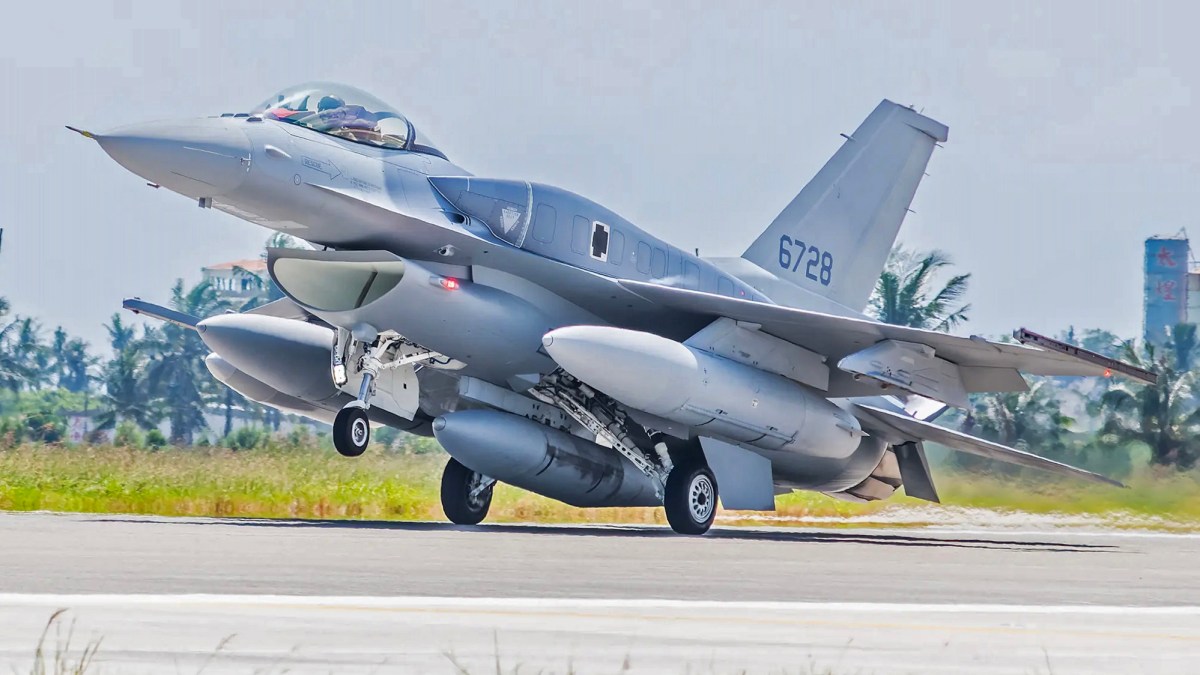
The two single-seat F-16Cs, serials 6727 and 6728, touched down at Chihhang Air Base near Taitung on October 2. They are the first factory-new fighter aircraft delivered to Taiwan in 25 years and mark the beginning of the aircraft acceptance and integration phase of the Republic of China Air Force’s (ROCAF) so-called Peace Phoenix Soaring project.
The two jets have also had an unusually eventful trip to Taiwan.
They began their journey to the island on August 17, flying from Lockheed Martin’s production facility in Greenville, South Carolina, to Hawaii. The aircraft were subsequently forced to remain there for more than a month after an unexpected issue prevented them from continuing across the Pacific as planned. The reasons for the delay have been the subject of considerable speculation, including weather and tanker availability.
ROCAF F-16C Block 70 serial 6727 arrive in Taitung. Peter Ho, Formosa Aviation & Military Image Press
The two jets finally departed Hawaii again on October 1, stopping in Guam before making the final leg to Taitung today.
Taiwanese Defense Minister Wellington Koo said today that more of the aircraft will arrive before the end of the year, although he did not provide a specific number.
Taiwan receives first 2 F-16V Block 70 fighter jets Taiwan took delivery Friday of the first two of 66 F-16V Block 70 fighter jets purchased from the United States, with the aircraft landing at Chihhang Air Base in the eastern county of Taitung at around noon. pic.twitter.com/hbqdV6io26 — Focus Taiwan (CNA English News) (@Focus_Taiwan) October 2, 2026
Taiwan receives first 2 F-16V Block 70 fighter jets Taiwan took delivery Friday of the first two of 66 F-16V Block 70 fighter jets purchased from the United States, with the aircraft landing at Chihhang Air Base in the eastern county of Taitung at around noon. pic.twitter.com/hbqdV6io26
The 66-aircraft purchase is worth approximately $8 billion. Taiwan originally expected deliveries to begin much sooner, but production-line adjustments, supply-chain problems, and software issues contributed to delays. COVID, too, had an impact on the production line.
The program’s delivery schedule has slipped repeatedly . Defense Minister Koo said in March, May, and again through his deputy in June that the first aircraft were expected to arrive by the end of September. That deadline passed without an F-16 reaching Taiwan.
ROCAF F-16C Block 70 serial 6727 touches down earlier today. Peter Ho, Formosa Aviation & Military Image Press
Taiwan’s Ministry of National Defense acknowledged in late September that development and production of the aircraft’s new electronic warfare self-protection system had also been a factor.
The Block 70s are being equipped with L3Harris’ AN/ALQ-254(V)1 Viper Shield electronic warfare suite , and the system was not yet fully through its development and production process when the first aircraft were otherwise ready for delivery . L3Harris announced on September 3 that it had completed production of the first 35 Viper Shield systems, underscoring that the electronic warfare equipment was itself still moving into production as Taiwan’s fighters were approaching delivery.
Taiwan chose to acquire the AN/ALQ-254 rather than the AN/ALQ-257 electronic warfare system used on U.S. Air Force F-16s.
Lawmakers have questioned whether the system meets requirements associated with earlier work to modernize earlier F-16A/B Block 20 fighters to the F-16V standard . Meanwhile, Defense Minister Koo argued that those requirements applied to the earlier Block 20 upgrade rather than the new Block 70 purchase. Other international F-16 Block 70 operators are also using Viper Shield.
Taiwanese officials have defended the decision, citing the specific requirements of Taiwan’s F-16 fleet and associated procurement considerations. The system is intended to provide the new fighters with a modern electronic warfare and self-protection capability against increasingly sophisticated radar and missile threats.
There are also still questions about when the Viper Shield system itself will be fully ready.
ROCAF F-16C Block 70 serial 6727. Peter Ho, Formosa Aviation & Military Image Press
Weapons deliveries have also not kept pace with the aircraft themselves.
Taiwan is receiving AIM-120C-8 AMRAAM air-to-air missiles as part of the F-16 package, with 200 ordered. The C-8 version incorporates upgrades from the U.S. Air Force’s Form, Fit, Function Refresh (F3R) effort, including new electronics and improved electronic-counter-countermeasures intended to make the missile more capable in a heavily contested electromagnetic environment. For Taiwan, the missile will provide the new F-16s with a modern beyond-visual-range air-to-air weapon that can be cued by the aircraft’s AN/APG-83 Scalable Agile Beam Radar (SABR), as well as other sources of targeting information through the F-16’s networked systems.
An AIM-120 AMRAAM is prepared to be loaded onto an F-16V at Chiayi Air Base, in Chiayi on January 28, 2026. Photo by I-Hwa Cheng / AFP
The AIM-120C-8 is particularly relevant as Taiwan fields more F-16s against China’s increasingly capable fighter fleet, which includes aircraft equipped with long-range air-to-air missiles such as the PL-15 .
Taiwan’s F-16 Block 70 package also includes the AGM-88 High-speed Anti-Radiation Missile (HARM), intended for attacks against enemy air defense systems. According to Roy Choo , a defense journalist and TWZ contributor, the first of the new AGM-88F missiles arrived in Taiwan back in 2022.
The major gap is the AGM-154C Joint Standoff Weapon (JSOW). The precision glide weapon is intended to give Taiwan a longer-range strike capability against ground targets without requiring the launching aircraft to fly directly over heavily defended areas. According to the latest reporting from Taiwan, deliveries of the AGM-154C have been held up by delays on the U.S. production line and may not begin until 2027 or 2028 at the earliest. Existing stocks of these weapons were also heavily used in Operation Epic Fury .
The two aircraft now sitting at Chihhang are significant for another reason. Unlike Taiwan’s existing F-16V fleet, they are new-production aircraft rather than older fighters that have been upgraded.
Taiwan received 141 F-16A/B Block 20s that were upgraded to the F-16V configuration under a separate modernization program completed in 2023. The new Block 70s incorporate many of the same technologies — including the APG-83 — but are built from the ground up as new aircraft.
A Taiwan Air Force F-16V taxis out during a spring military exercise at Chiayi Air Base, in Chiayi on January 28, 2026. Photo by I-Hwa Cheng / AFP
The Block 70s will also bring a significant new passive-sensing capability to Taiwan’s F-16 fleet. Under a $328.5-million U.S. Foreign Military Sales contract awarded to Lockheed Martin in February, Taiwan is receiving the company’s IRST21 Legion-ES infrared search and track system. Designed specifically for the F-16, the long-wave infrared sensor can passively detect and track airborne targets without emitting radar energy. That gives the aircraft another way to search for and track threats while reducing its own electromagnetic signature. The IRST21 also gives the F-16s a passive way to detect and track low-observable targets, potentially providing another means of finding Chinese stealth aircraft without relying solely on radar.
In 2019, Lockheed Martin displayed a model of a Block 70 F-16 with what appeared to be a podded IRST system on one of its chin stations at the biennial Taipei Aerospace & Defense Technology Exhibition in Taiwan:
The mysterious IRST pod at TADTE – https://t.co/avpx5djZMM pic.twitter.com/86lqxu6fN6 — Alert 5 (@alert5) August 16, 2019
The mysterious IRST pod at TADTE – https://t.co/avpx5djZMM pic.twitter.com/86lqxu6fN6
The new fighters will therefore complement Taiwan’s upgraded F-16A/Bs while expanding the overall number of modern F-16s available to the ROCAF.
People’s Liberation Army (PLA) aircraft operate around Taiwan on an increasingly routine basis, forcing the ROCAF to maintain a persistent air-defense posture. The additional F-16s will provide more aircraft for missions ranging from air defense and counter-air operations to maritime strike .
Ground crew prepare to load AGM-84 Harpoon anti-ship missiles in front of an F-16V during a drill at Hualien Air Force base on August 17, 2022. Photo by SAM YEH/AFP via Getty Images
The F-16V fleet is also being tested for a more specialized intelligence, surveillance, and reconnaissance role. The ROCAF has recently been conducting flight and systems integration testing of the MS-110 advanced reconnaissance pod, part of its Phoenix Scout project. The service plans to acquire six pods to replace older reconnaissance equipment . Based on the DB-110 digital sensor architecture, the system combines visible-light and infrared imaging with long-range, day-and-night reconnaissance, and real-time image transmission, allowing imagery to be passed more rapidly to ground command and intelligence elements. Integrating the pod with the F-16 and associated ground systems will give Taiwan another means of monitoring activity around the island and its surrounding waters.
A ROCAF F-16V carrying an MS-110 reconnaissance pod. Peter Ho, Formosa Aviation & Military Image Press
But Taiwan remains heavily outnumbered across the Taiwan Strait.
China is fielding an increasingly sophisticated combat aircraft fleet that includes the J-20 and J-35 stealth fighter, large numbers of advanced fourth-generation fighters, airborne early warning and other force-multiplier aircraft , and a growing variety of uncrewed systems .
A J-20 fighter during the Changchun Air Show on September 22, 2025 in Changchun, Jilin Province of China. Photo by Zhang Xiangyi/China News Service/VCG via Getty Images
And the F-16s will face the same fundamental problem as Taiwan’s other combat aircraft in a major conflict: staying operational.
China possesses extensive missile and air capabilities that could threaten Taiwan’s airbases, aircraft shelters, fuel supplies, command-and-control infrastructure, and other elements needed to keep fighters flying. You can read more about how the ROCAF would likely go to war with China in this previous in-depth feature.
Basing the new F-16s at Chihhang Air Base, operated by the 7th Tactical Fighter Wing, is significant, Choo told us.
“The basing of the aircraft at Chihhang allows the ROCAF to readily project air power south and eastwards, especially over the Bashi Channel , which is one avenue PLA can gain access to the Philippine Sea and beyond.” He explained. “Previously, ROCAF fighters from other bases maintain QRA detachments there”
A new F-16C Block 70 lands at Chihhang Air Base in Taitung on October 2, 2026. Photo by CHENG Yu-chen / AFP
The F-16 delivery today is only the beginning of a much larger effort to get all 66 aircraft into Taiwanese service.
According to the latest information from the ROCAF, 63 F-16C/D Block 70s remain in various stages of production and delivery in the United States, with some already moving through the handover process. The remaining aircraft will be delivered according to production, flight-test, and acceptance milestones before being ferried to Taiwan.
Once the full order is delivered, Taiwan will operate more than 200 F-16s when the new Block 70s are combined with its existing fleet.
That will give the ROCAF a considerably larger force of modern F-16s, with substantial commonality between the upgraded F-16V fleet and the new-production Block 70s.
The aircraft will still need to go through Taiwan’s acceptance procedures, while pilots and maintenance personnel complete the necessary conversion and training work. The new jets will then be progressively incorporated into the ROCAF’s operational units.
Remarkably, the arrival of the first Block 70 fighters today marks the first delivery of new fighters to Taiwan since 2001, when the last of the 150 F-16A/B Block 20s were delivered.
“The ROCAF’s surviving fleet of 139 F-16s, 53 Mirage 2000s , and 129 F-CK-1s was largely inducted in the 1990s, when Taiwan held the upper hand in the cross-Strait air-power balance,” Choo explined. “Even then, there remained a requirement for additional fighters, prompting the island’s first formal request to purchase 66 F-16C/Ds during the 2006 Monterey Talks.”
F-CK-1s taxi for takeoff during a scramble as part of a combat readiness exercise at Ching Chuan Kang Air Base in Taichung on January 7, 2025. Photo by I-HWA CHENG / AFP
“By the late 2000s, these fighters were approaching the limits of their combat effectiveness as the PLA air fleet expanded in both size and capability. Fortunately, substantial upgrades began to be rolled out to the F-CK-1s and F-16s from the 2010s.”
In the wake of the 2019 acquisition of the F-16C/D Block 70s, questions arose over the aircraft’s asymmetric value as the Taiwan military increasingly focused on developing a plan for asymmetric capabilities in response to the PLA’s growing combat power.
“However, developments in recent years have underscored the continued importance of a capable fighter fleet not least for policing Taiwan’s airspace amid the PLA’s sustained gray-zone air operations around the island,” Choo added.
ROCAF F-16C Block 70 serial 6728. Peter Ho, Formosa Aviation & Military Image Press
The timing of today’s arrival is also notable.
The aircraft reached Taiwan just days after U.S. President Donald Trump met Chinese President Xi Jinping in Washington. The delivery comes amid questions in Taipei about the future pace of U.S. arms transfers, after Trump said in May that a proposed $14-billion Taiwan arms package was being held in abeyance. He had approved an $11-billion package in December 2025.
Washington continues to say that its policy toward Taiwan has not changed.
Beijing, for its part, continues to oppose U.S. arms sales to Taiwan and regards the island as part of Chinese territory.
It has taken nearly seven years to get the first two F-16C/D Block 70s, to Taiwan. But their arrival marks the first step in a major modernization of the ROCAF’s F-16 fleet, adding new-production fighters with improved radar, electronic warfare, sensors, and weapons to a force that is already operating upgraded F-16Vs.
Contact the author: thomas@thewarzone.com
Comments couldn’t be loaded. Please refresh the page.
发布于美国东部时间2026年10月2日下午12:34
Peter Ho,福尔摩沙航空军事影像出版社
经过近七年的等待,台湾终于收到了从美国购买的66架全新F-16C/D Block 70战斗机中的前两架飞机,这笔交易拖延已久。
10月2日,两架单座F-16C战斗机,序列号分别为6727和6728,降落在台东附近的池行空军基地。这是25年来台湾接收的首批全新战斗机,标志着中华民国空军所谓的“和平凤凰翱翔”计划正式进入飞机验收和整合阶段。
这两架飞机前往台湾的旅程也异常精彩。
8月17日,这些飞机从洛克希德·马丁公司位于南卡罗来纳州格林维尔的生产基地起飞,飞往夏威夷,开始了前往该岛的旅程。然而,由于突发问题,飞机无法按计划飞越太平洋,被迫在夏威夷停留了一个多月。延误的原因众说纷纭,包括天气状况和加油机的可用性等。
中华民国空军F-16C Block 70战斗机(序列号6727)抵达台东。图片来源:福尔摩沙航空军事影像出版社(Peter Ho, Formosa Aviation & Military Image Press)
这两架飞机终于在10月1日再次从夏威夷起飞,经停关岛后,于今天飞往台东。
台湾国防部长顾维京今天表示,年底前还会有更多飞机抵达,但他没有给出具体数字。
台湾接收首批两架F-16V Block 70战斗机 台湾于周五接收了从美国购买的66架F-16V Block 70战斗机中的首批两架,飞机于中午左右降落在台东县志行空军基地。 pic.twitter.com/hbqdV6io26 — Focus Taiwan (CNA English News) (@Focus_Taiwan) October 2, 2026
台湾接收首批两架F-16V Block 70战斗机 台湾于周五接收了从美国购买的66架F-16V Block 70战斗机中的首批两架,飞机于中午左右降落在台东县志行空军基地。 pic.twitter.com/hbqdV6io26
这批66架飞机的采购总额约为80亿美元。台湾最初预计交付会更早开始,但生产线调整、供应链问题和软件故障都导致了延误。新冠疫情也对生产线造成了影响。
该项目的交付计划一再延期。国防部长顾耀明在3月、5月以及6月通过其副手再次表示,首批战机预计将于9月底抵达台湾。然而,截止日期已过,F-16战机仍未抵达台湾。
中华民国空军F-16C Block 70战斗机(序列号6727)今日早些时候着陆。图片来源:福尔摩沙航空军事影像出版社(Peter Ho, Formosa Aviation & Military Image Press)
台湾国防部在9月下旬承认,飞机新型电子战自卫系统的研发和生产也是一个因素。
Block 70型战机配备了L3Harris公司的AN/ALQ-254(V)1“蝰蛇盾牌”电子战系统。然而,当首批战机准备交付时,该系统的研发和生产流程尚未完全完成。L3Harris公司于9月3日宣布已完成首批35套“蝰蛇盾牌”系统的生产,这表明,在台湾战机即将交付之际,该电子战设备本身仍在生产中。
台湾选择采购 AN/ALQ-254 而不是美国空军 F-16 使用的 AN/ALQ-257 电子战系统。
议员们质疑该系统是否符合此前将早期F-16A/B Block 20战斗机升级至F-16V标准的相关要求。与此同时,国防部长具承东辩称,这些要求适用于之前的Block 20升级项目,而非此次新采购的Block 70。其他国际F-16 Block 70用户也在使用“蝰蛇之盾”(Viper Shield)系统。
台湾官员为这一决定辩护,称这是出于台湾F-16机队的具体需求和相关采购方面的考虑。该系统旨在为新型战斗机提供现代化的电子战和自卫能力,以应对日益复杂的雷达和导弹威胁。
关于 Viper Shield 系统何时才能完全准备就绪,目前仍存在疑问。
中华民国空军F-16C Block 70战斗机,序列号6727。图片来源:Peter Ho,福尔摩沙航空军事影像出版社
武器交付速度也未能跟上飞机本身的交付速度。
台湾正在接收AIM-120C-8 AMRAAM空空导弹,作为其F-16战机装备的一部分,共订购了200枚。C-8型导弹融合了美国空军“外形、适配、功能更新”(F3R)项目的升级成果,包括新型电子设备和改进的电子对抗措施,旨在提升导弹在电磁干扰严重的作战环境中的作战能力。对于台湾而言,该导弹将为新型F-16战机提供一种现代化的超视距空空武器,可通过战机上的AN/APG-83可扩展敏捷波束雷达(SABR)以及F-16网络系统提供的其他目标信息进行引导。
2026年1月28日,在嘉义空军基地,一枚AIM-120 AMRAAM导弹正准备装载到一架F-16V战斗机上。(图片来源:郑宜华/法新社)
随着台湾部署更多 F-16 战斗机对抗中国日益强大的战斗机群(其中包括配备 PL-15 等远程空空导弹的飞机),AIM-120C-8 显得尤为重要。
台湾的F-16 Block 70战机套件中还包括AGM-88高速反辐射导弹(HARM),用于攻击敌方防空系统。据国防记者兼TWZ撰稿人Roy Choo透露,首批新型AGM-88F导弹于2022年抵达台湾。
台湾目前最大的武器缺口在于AGM-154C联合防区外武器(JSOW)。这种精确滑翔武器旨在使台湾具备远程打击地面目标的能力,而无需发射飞机直接飞越重兵把守区域。据台湾方面最新报道,由于美国生产线延误,AGM-154C的交付已被推迟,最早也要到2027年或2028年才能开始。此外,现有的AGM-154C库存也已在“史诗狂怒行动”中大量使用。
目前停放在志航的这两架飞机还有另一个重要意义。与台湾现有的F-16V机队不同,它们是新生产的飞机,而不是经过升级改造的旧式战斗机。
台湾接收了 141 架 F-16A/B Block 20 型战斗机,这些战斗机在 2023 年完成的一项独立现代化计划下升级为 F-16V 型。新的 Block 70 型战斗机融合了许多相同的技术——包括 APG-83 导弹——但它们是从零开始全新制造的飞机。
2026年1月28日,一架台湾空军F-16V战斗机在嘉义空军基地参加春季军事演习时滑行离开。图片来源:郑宜华/法新社
Block 70型F-16战机还将为台湾的F-16机队带来一项重要的全新被动探测能力。根据今年2月美国授予洛克希德·马丁公司的价值3.285亿美元的对外军售合同,台湾将接收该公司研发的IRST21 Legion-ES红外搜索跟踪系统。这款专为F-16设计的长波红外传感器能够在不发射雷达能量的情况下被动探测和跟踪空中目标。这为战机提供了一种新的搜索和跟踪威胁的方式,同时还能降低自身的电磁信号特征。IRST21还使F-16能够被动地探测和跟踪低可观测性目标,从而有可能提供一种无需完全依赖雷达即可发现中国隐形战机的手段。
2019 年,洛克希德·马丁公司在台湾举行的两年一度的台北航空暨国防科技展上,展示了一架 Block 70 F-16 的模型,其机头下方的一个挂架上似乎装有吊舱式红外搜索跟踪系统 (IRST):
TADTE 神秘的 IRST 舱 – https://t.co/avpx5djZMM pic.twitter.com/86lqxu6fN6 — Alert 5 (@alert5) 2019年8月16日
TADTE 的神秘 IRST 舱 – https://t.co/avpx5djZMM pic.twitter.com/86lqxu6fN6
因此,这些新型战斗机将与台湾升级后的 F-16A/B 战斗机形成互补,同时增加中华民国空军可用的现代化 F-16 战斗机的总数。
解放军战机在台湾周边地区的活动日益频繁,迫使中华民国空军保持持续的防空态势。新增的F-16战机将为包括防空、反空袭和海上打击在内的各种任务提供更多战机。
2022年8月17日,在花莲空军基地的一次演习中,地勤人员准备在一架F-16V战斗机前装载AGM-84“鱼叉”反舰导弹。图片来源:SAM YEH/AFP via Getty Images
F-16V 机队也在接受测试,以胜任更专业的侦察、监视和监视任务。台湾空军近期一直在进行 MS-110 先进侦察吊舱的飞行和系统集成测试,该吊舱是其“凤凰侦察兵”项目的一部分。空军计划采购六个吊舱以替换老旧的侦察设备。该系统基于 DB-110 数字传感器架构,结合了可见光和红外成像、远程昼夜侦察以及实时图像传输功能,能够更快地将图像传递给地面指挥和情报部门。将该吊舱与 F-16 战机及相关地面系统集成,将为台湾提供另一种监测岛屿及其周边海域活动的手段。
一架中华民国空军F-16V战斗机,挂载MS-110侦察吊舱。图片来源:Peter Ho,福尔摩沙航空军事影像出版社
但台湾在海峡对岸的人口仍然远远少于其他国家。
中国正在部署一支日益精密的作战飞机机队,其中包括歼-20和歼-35隐形战斗机、大量先进的第四代战斗机、空中预警机和其他力量倍增器飞机,以及种类日益增多的无人系统。
2025年9月22日,在中国吉林省长春市举行的长春航展上,一架歼-20战斗机正在飞行表演。图片来源:张祥义/中国新闻社/VCG via Getty Images
在重大冲突中,F-16 将面临与台湾其他作战飞机相同的根本问题:保持作战能力。
中国拥有强大的导弹和空中力量,可能对台湾的空军基地、飞机掩体、燃料供应、指挥控制基础设施以及其他维持战斗机飞行所需的要素构成威胁。您可以在之前的深度报道中了解更多关于中华民国空军可能如何与中国开战的信息。
Choo告诉我们,将新型F-16战斗机部署在由第7战术战斗机联队运营的池行空军基地意义重大。
他解释说:“将飞机部署在池杭基地,使中华民国空军能够迅速向南、向东投射空中力量,尤其是在巴士海峡上空,而巴士海峡是解放军进入菲律宾海及更远海域的通道之一。此前,中华民国空军其他基地的战斗机也驻扎在那里,维持快速反应警戒分遣队。”
2026年10月2日,一架新型F-16C Block 70战斗机降落在台东知行空军基地。图片来源:程宇辰/法新社
今天交付的 F-16 战机只是让全部 66 架飞机进入台湾服役的更大计划的开始。
根据中华民国空军最新消息,目前仍有63架F-16C/D Block 70战斗机在美国处于不同的生产和交付阶段,部分飞机已进入交付流程。其余飞机将按照生产、试飞和验收阶段的进度交付,之后再转运至台湾。
一旦全部订单交付完毕,台湾将拥有超过 200 架 F-16 战斗机,届时新的 Block 70 型战斗机将与现有机队合并使用。
这将使中华民国空军拥有数量相当多的现代化 F-16 战机,升级后的 F-16V 机队与新生产的 Block 70 战机之间具有相当大的通用性。
这架飞机仍需经过台湾方面的验收程序,同时飞行员和维修人员也将完成必要的改装和培训工作。之后,这些新战机将逐步编入中华民国空军的作战部队。
值得注意的是,今天首批 Block 70 战斗机的到来标志着自 2001 年最后一批 150 架 F-16A/B Block 20 交付以来,台湾首次接收新战斗机。
“中华民国空军现存的139架F-16、53架幻影2000和129架F-CK-1战斗机大多是在上世纪90年代引进的,当时台湾在两岸空中力量对比中占据优势,”朱先生解释道。“即便如此,台湾仍然需要更多的战斗机,这促使台湾在2006年蒙特雷会谈期间首次正式提出购买66架F-16C/D战斗机的请求。”
2025年1月7日,在台中清泉岗空军基地举行的战备演习中,F-CK-1战斗机在紧急起飞前滑行准备起飞。图片来源:郑一华/法新社
“到了2000年代末期,随着解放军空军规模和能力的不断扩大,这些战斗机的作战效能已接近极限。幸运的是,从2010年代开始,F-CK-1和F-16战斗机开始进行大规模升级。”
在 2019 年台湾军方购入 F-16C/D Block 70 战机后,随着台湾军方日益重视发展非对称作战能力以应对解放军日益增长的战斗力,人们对该战机的非对称价值产生了疑问。
“然而,近年来的事态发展凸显了拥有一支强大的战斗机机队的重要性,尤其是在解放军持续在台湾周边进行灰色地带空中行动的情况下,维护台湾空域治安方面,”朱补充道。
中华民国空军F-16C Block 70战斗机,序列号6728。图片来源:Peter Ho,福尔摩沙航空军事影像出版社
今天抵达的时机也值得注意。
就在美国总统特朗普与中国国家主席习近平在华盛顿会晤几天后,这架飞机抵达台湾。此次交付正值台北方面对美国未来对台军售步伐提出质疑之际。此前,特朗普在5月份曾表示,一项拟议的价值140亿美元的对台军售计划已被搁置。他曾批准一项价值110亿美元的对台军售计划,原定于2025年12月实施。
华盛顿方面继续表示,其对台政策没有改变。
北京方面则继续反对美国向台湾出售武器,并将台湾视为中国领土的一部分。
历时近七年,首批两架F-16C/D Block 70战斗机才抵达台湾。它们的到来标志着中华民国空军F-16机队大规模现代化升级的第一步,为已装备升级版F-16V的部队增添了配备更先进雷达、电子战系统、传感器和武器的新型战斗机。
联系作者:thomas@thewarzone.com
评论加载失败,请刷新页面。