Pentagon partners with CIA’s In-Q-Tel for ‘technology scouting’五角大楼与中央情报局旗下的In-Q-Tel公司合作进行“技术侦察”
The CIA-funded investment firm, which has helped finance startups from Anduril to Palantir, is now formally coordinating with the Pentagon’s Critical Technologies office.
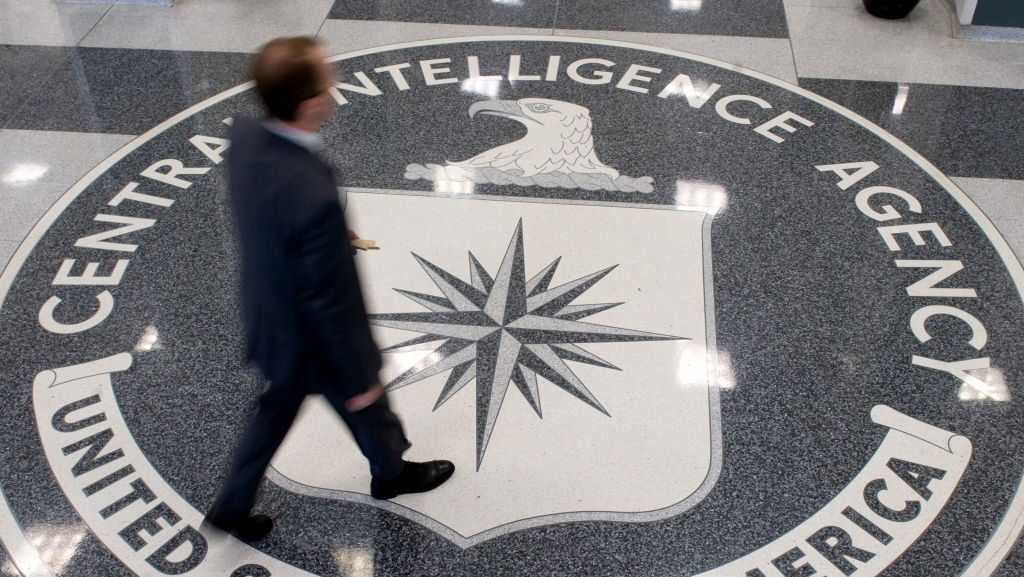
A man crosses the Central Intelligence Agency (CIA) seal in the lobby of CIA Headquarters in Langley, Virginia, on August 14, 2008. (SAUL LOEB/AFP via Getty Images)
WASHINGTON — After years of informal cooperation , today the Pentagon’s research and engineering arm announced a formal agreement with the CIA-backed investment firm, In-Q-Tel (IQT), to aid in systematic “technology scouting” for military use.
“Over the next 12 months, our benchmark for success is simple and unambiguous: moving validated commercial prototypes out of the lab and into active operational field evaluations with our combatant commands,” said Michael Dodd, Assistant Secretary for Critical Technologies, in the Pentagon release . Dodd’s organization leads the Pentagon’s side of the partnership, which will focus on the six Critical Technology Areas set by Pentagon CTO Emil Michael 11 months ago : artificial intelligence, biomanufacturing, directed energy (lasers, microwaves, et al), hypersonics, quantum and information technologies, and “contested logistics.”
Although IQT is an investment organization — technically a 501(c)3 non-profit founded by but independent of the CIA — money isn’t the main contribution it’s bringing to this partnership. Indeed, over the last five years of financial filings (2021-2025), IQT current total assets have hovered around $1 billion , less than 1 percent of what the Pentagon spends on Research, Development, Test, & Evaluation (RDTE) in a single year .
B ut IQT’s early inv estments often have an outsize impact, helping jumpstart firms as prominent as Anduril and Palantir. Those investments are not only a cash infusion but a vote of confidence that encourages other investors to follow, with IQT boasting that each dollar it invests leads to $40 from other sources.
IQT’s primary mission has been fostering companies to serve the tech needs of the Intelligence Community, with the military as a secondary emphasis. But the new partnership has IQT performing “technology scouting and technical due diligence” for the Defense Department and serving as a feeder into Pentagon development and production pipelines.
“The integration leverages In-Q-Tel’s proven venture capital methodology to vet early-stage commercial solutions that align directly with the Department’s urgent mission requirements,” the announcement says. “By combining CT’s strategic transition pathways with IQT’s deep-tech scouting infrastructure, the partnership aims to significantly de-risk the integration of commercial hardware and software for national security applications, signaling to the commercial tech sector that the Department of War is open for business.”
Said Dodd: “Technological superiority will not be determined by who invents a capability first, but by who delivers it to the warfighter fastest. The Department is fundamentally shifting its posture: we are moving from acting solely as a long-cycle technology developer to operating as an agile, credible, and rapid customer for America’s most innovative non-traditional performers.”
Building the stand-off and stand-in weapons needed for the fight
Threats have changed the range, seeking and attack capabilities necessary to ensure effectiveness.
In-Q-Tel was founded in 1999 on the urging of then-CIA director George Tenet. Its name is a reference to the fictional Q who supplies James Bond with high-tech gadgets.
2008年8月14日,一名男子走过位于弗吉尼亚州兰利市中央情报局总部大厅内的中央情报局(CIA)徽章。(SAUL LOEB/AFP via Getty Images)
华盛顿——经过多年的非正式合作,五角大楼的研究和工程部门今天宣布与中央情报局支持的投资公司 In-Q-Tel (IQT) 达成正式协议,以帮助其系统地“搜寻”军事用途的技术。
五角大楼发布的新闻稿中,负责关键技术的助理部长迈克尔·多德表示:“未来12个月,我们的成功基准简单明确:将经过验证的商业原型从实验室推向作战司令部,进行实际的作战现场评估。”多德所在的机构领导五角大楼的合作项目,该项目将重点关注五角大楼首席技术官埃米尔·迈克尔11个月前确定的六大关键技术领域:人工智能、生物制造、定向能(激光、微波等)、高超音速、量子和信息技术以及“对抗性后勤”。
尽管IQT是一家投资机构——严格来说,它是一家由中央情报局创立但独立于中央情报局的501(c)3非营利组织——但它为这项合作带来的主要贡献并非资金。事实上,在过去五年(2021-2025年)的财务报告中,IQT的当前总资产一直徘徊在10亿美元左右,不到五角大楼一年在研发、测试和评估(RDTE)方面支出的1%。
但IQT的早期投资往往产生巨大的影响,帮助Anduril和Palantir等知名公司迅速发展壮大。这些投资不仅是资金注入,更是对公司的信任投票,鼓励其他投资者效仿。IQT自豪地宣称,其每投资1美元,就能从其他渠道获得40美元的回报。
IQT 的主要任务一直是扶持企业满足情报界的技术需求,军方则是其次。但新的合作关系使 IQT 能够为国防部开展“技术搜寻和技术尽职调查”,并为五角大楼的研发和生产流程输送人才。
公告称:“此次整合利用了In-Q-Tel成熟的风险投资方法,对符合国防部紧急任务需求的早期商业解决方案进行筛选。通过将CT的战略转型路径与IQT的深度技术勘探基础设施相结合,此次合作旨在显著降低将商业硬件和软件集成到国家安全应用领域的风险,并向商业科技行业发出信号:国防部欢迎各方合作。”
多德表示:“技术优势并非取决于谁先发明出某种能力,而取决于谁能最快地将其交付给作战人员。国防部正在从根本上转变其战略:我们正在从单纯的长期技术开发商转变为美国最具创新性的非传统作战人员的敏捷、可靠和快速的客户。”
建造战斗所需的远程和远程武器
威胁改变了确保有效性所需的射程、搜索和攻击能力。
In-Q-Tel公司成立于1999年,是在时任中央情报局局长乔治·特内特的敦促下成立的。公司名称源自虚构人物Q,他为詹姆斯·邦德提供高科技装备。