Germany Is Finally Giving Its F125 Frigates Some More Teeth With IRIS-T SLM Surface-To-Air Missiles德国终于为其F125护卫舰配备IRIS-T SLM地对空导弹,以增强其作战能力。
The 7,200-ton F125 frigates were built with notoriously light armament, which is now being partly addressed. The 7,200-ton F125 frigates were built with notoriously light armament, which is now being partly addressed.
新闻视频
Published Oct 2, 2026 5:01 PM EDT
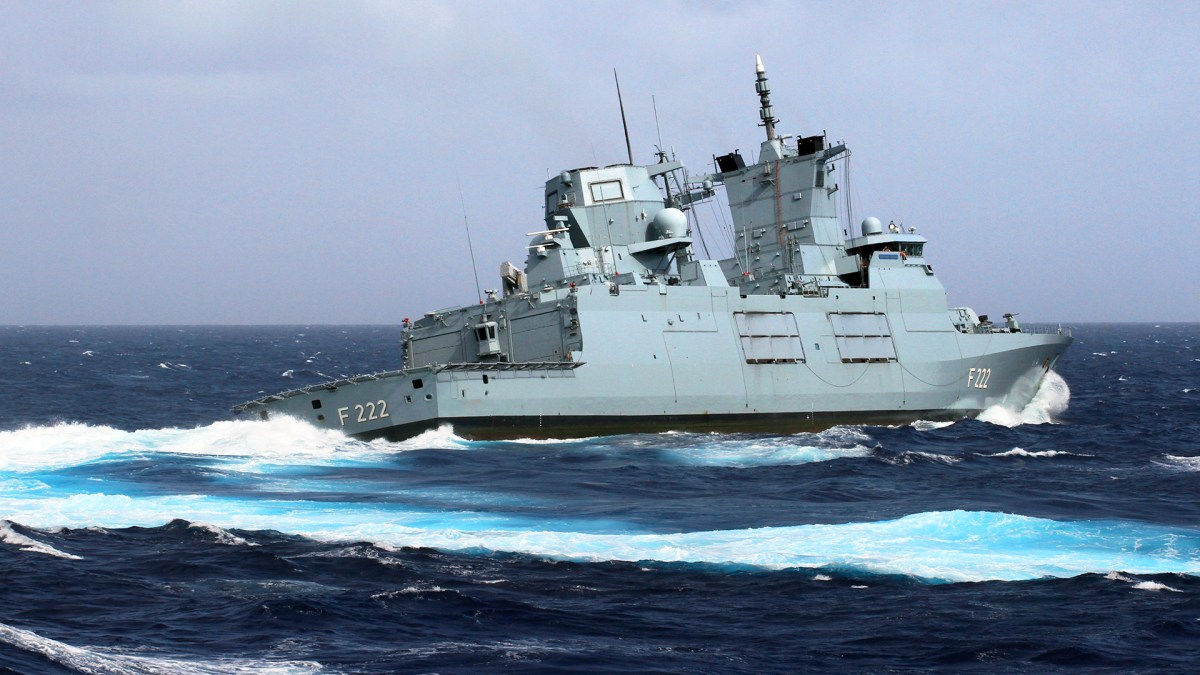
Die Fregatte Baden-Württemberg führt eine ADEX-Übung (Air Defence Exercise) durch während des Transits im Rahmen des Indo-Pacific Deployment, am 31.05.2024. Bundeswehr/Philipp Schäfer
Germany is moving ahead with plans to give its unusually large F125 frigates a medium-range air-defense capability, helping address one of the most conspicuous weaknesses of a four-ship class that has long attracted attention for having relatively little combat power for its size.
Diehl Defense and Germany’s Federal Office of Bundeswehr Equipment, Information Technology and In-Service Support (BAAINBw) have signed a contract to adapt and develop the IRIS-T SLM surface-to-air missile system for operational use aboard the German Navy’s F125 frigates. Under the agreement, Diehl will build prototypes and conduct comprehensive test firings intended to validate the system’s integration and performance within the existing F125 architecture. Each frigate will be fitted with two new launchers, each capable of holding 16 missiles, for a total of 32.
A rendering showing the location of the 32-cell IRIS-T SLM launchers on an F125 frigate. Diehl Defense
“The aim is to make the system mission-capable on the German Navy’s F125 frigates,” Diehl said in today’s announcement. The company described the prototype construction and test-firing phase as necessary to ensure “the seamless integration and maximum performance” of IRIS-T SLM within the frigate’s existing architecture.
The program has moved notably quickly, reflecting the urgency of the requirement.
Germany began examining the feasibility of integrating IRIS-T SLM with the F125 in 2024, with BAAINBw and Diehl studying the technical risks and requirements of adapting the normally land-based system for shipboard use. That effort led to the development of a navalized demonstrator in 2025. In October of that year, the F125 frigate Baden-Württemberg took part in a German Navy Maritime Firing Exercise off Andøya, Norway, carrying an experimental anti-air warfare module based on IRIS-T SLM. Diehl says the module went from concept to firing in less than 10 months and met all established test and evaluation objectives.
The IRIS-T SLM launcher on the frigate Baden-Württemberg . Bundeswehr
The Bundeswehr subsequently reported that Baden-Württemberg fired three live IRIS-T SLM missiles during the exercise. The ship’s radar supplied target data to the missile system, demonstrating the basic integration between the F125’s sensors and the navalized air defense architecture.
The exercise established that the concept could work at sea; the contract signed now is intended to turn that demonstration into a qualified fleet capability.
A night-time test of the IRIS-T SLM air defense missile system during the Maritime Firing Exercise 2025 in Andøya. Diehl Defense
The German parliament’s Budget Committee approved the adaptation effort on September 23, with the German Defense Ministry describing it as a means of expanding the F125’s self-defense capabilities in response to the current air threat. The ministry also pointed to IRIS-T SLM’s combat experience in Ukraine.
The effort needs to be seen in the context of why the F125 has been such a controversial warship in the first place.
As TWZ examined in 2017, the F125 is a roughly 7,200-ton, 490-foot warship with an unusually small core crew and a concept of operations centered on long-duration deployments, stabilization missions, crisis management, conflict prevention, and international intervention rather than high-end fleet combat. The class was designed to spend long periods away from Germany and operate with relatively modest manpower requirements.
German Navy frigate Baden-Württemberg sails in formation off the coast of Hawaii during Exercise Rim of the Pacific (RIMPAC) 2024. U.S. Navy photo by Mass Communication Specialist 1st Class John Bellino
But its armament does not remotely match the size and sophistication of the hull. A completed, the ships were equipped with eight RGM-84 Harpoon anti-ship missiles, a 127mm gun, remotely operated guns and, for close-quarters air defense, two RIM-116 Rolling Airframe Missile launchers. The F125 has no medium- or long-range surface-to-air missile capability and no organic sonar or dedicated anti-submarine warfare weapon system.
At the same time, the TRS-4D/NR radar and other sensors can see far beyond the engagement envelope of the close-in air-defense weapons, but there is little the ship itself can do with that information against an aircraft or incoming missile at medium range.
Nearly a decade later, IRIS-T SLM is emerging as an answer to at least part of that problem.
Even with IRIS-T SLM, the F125 is well short of being an air warfare destroyer. It also still lacks an organic anti-submarine warfare capability or the kind of large vertical-launch missile battery found on Germany’s F124 frigates .
However, it does fill a gap between the F125’s originl short-range defenses and the capabilities of other ships or aircraft operating around it.
IRIS-T SLM is designed as a medium-range surface-to-air system, with an engagement range of around 25 miles and an altitude envelope of approximately 65,000 feet. As shown in the 2025 demonstration, the F125’s radar can feed information directly into the missile system, exploiting the ship’s existing sensor capabilities.
Rather than rely heavily on escorts for protection against airborne threats outside the short range of RAM, an IRIS-T-equipped F125 could at least contribute to its own medium-range air defense. Recent operations in the Middle East hve underscored the importance of this in contested maritime environments.
It also gives the ships a more useful role in a task group. The threat environment has changed substantially since the F125’s original concept was drafted. Cruise missiles, drones, loitering munitions, and increasingly sophisticated aircraft mean that even ships operating away from a major naval war can face threats well beyond the range of their existing close-in defenses.
German Navy frigate Baden-Württemberg . U.S. Navy
In November 2024, Germany confirmed that the F125 frigate Baden-Württemberg , returning from an Indo-Pacific deployment, would avoid the Red Sea and sail around Africa because of the Houthi missile and drone threat. The German Defense Ministry explicitly cited the ship’s limited air defense capability and its inability to provide an effective air-defense umbrella for itself or its accompanying replenishment ship.
Ironically, the F125’s large hull, extensive electrical power, sophisticated radar, substantial aviation facilities, long endurance and relatively spacious mission areas were always supposed to provide room for a flexible approach to future missions. Yet the class’s original weight and integration constraints made adding major weapons difficult, a concern TWZ also highlighted in 2017 .
IRIS-T SLM offers Germany a way to add a meaningful capability without undertaking the much more invasive redesign associated with installing a conventional vertical-launch system. The 2025 demonstration used an AAW module mounted on the ship’s deck rather than a conventional VLS installation, and today’s program is focused on adapting the system to the F125 architecture.
Once IRIS-T SLM is installed, the F125 will still be an unusual frigate. It is enormous by the standards of its mission, optimized for endurance, and lacks some of the weapons traditionally associated with a high-end surface combatant. But it will bring more to a contested fight.
The program should give the class a credible medium-range air-defense role, and provide Germany with a way to get considerably more utility out of four ships whose original design philosophy was always somewhat controversial.
Contact the author: thomas@thewarzone.com
Comments couldn’t be loaded. Please refresh the page.
发布于美国东部时间2026年10月2日下午5:01
巴登-符腾堡州于 2024 年 5 月 31 日上午 31 日在印太部署中进行过境演习。德国联邦国防军/菲利普·谢弗
德国正在推进一项计划,为其异常庞大的 F125 护卫舰赋予中程防空能力,以帮助解决该级四艘舰艇最明显的弱点之一。长期以来,该级舰艇因其规模庞大但战斗力相对较弱而备受关注。
迪尔防务公司与德国联邦国防军装备、信息技术和在役保障办公室(BAAINBw)签署了一份合同,旨在对IRIS-T SLM地对空导弹系统进行改造和开发,使其适用于德国海军的F125型护卫舰。根据协议,迪尔公司将制造原型机并进行全面的试射,以验证该系统与现有F125舰艇架构的集成性和性能。每艘护卫舰将配备两座新型发射装置,每座装置可容纳16枚导弹,总计32枚。
一张效果图,展示了F125护卫舰上32单元IRIS-T SLM导弹发射器的位置。迪尔防务公司
“我们的目标是使该系统能够在德国海军的F125护卫舰上执行任务,”迪尔公司在今天的声明中表示。该公司称,原型机的建造和试射阶段对于确保IRIS-T SLM系统与护卫舰现有架构的“无缝集成和最佳性能”至关重要。
该项目进展迅速,体现了这项需求的紧迫性。
德国于2024年开始研究将IRIS-T SLM系统集成到F125护卫舰上的可行性,BAAINBw和迪尔(Diehl)负责研究将通常用于陆基的系统改装为舰载系统的技术风险和要求。这项工作最终促成了2025年舰载验证机的研制。同年10月,F125护卫舰“巴登-符腾堡”号(Baden-Württemberg)在挪威安德亚岛附近海域参加了德国海军海上射击演习,舰上搭载了一个基于IRIS-T SLM系统的实验性防空模块。迪尔表示,该模块从概念设计到实弹射击仅用了不到10个月的时间,并且达到了所有既定的测试和评估目标。
巴登-符腾堡号护卫舰上的 IRIS-T SLM 发射器。德国联邦国防军
德国联邦国防军随后报告称,巴登-符腾堡州在演习中发射了三枚实弹IRIS-T SLM导弹。舰载雷达向导弹系统提供目标数据,展示了F125舰载机传感器与舰载防空体系的基本集成。
这次演习证明了该概念在海上可行;现在签署的合同旨在将这一示范转化为合格的舰队能力。
在安德亚岛举行的2025年海上实弹演习期间,对IRIS-T SLM防空导弹系统进行了夜间测试。迪尔防务公司
德国联邦议院预算委员会于9月23日批准了这项改装计划。德国国防部称,此举旨在提升F-125战机的自卫能力,以应对当前的空中威胁。国防部还指出,IRIS-T SLM系统在乌克兰的实战经验值得借鉴。
我们需要结合F125战舰最初为何会成为如此备受争议的战舰这一背景来看待这项努力。
正如TWZ在2017年所分析的那样,F125是一艘排水量约7200吨、长490英尺的军舰,其核心船员人数异常精简,作战理念侧重于长期部署、稳定局势、危机管理、冲突预防和国际干预,而非高端舰队作战。该级舰艇的设计目标是在远离德国的地区长期服役,并以相对适中的人员需求执行任务。
德国海军“巴登-符腾堡”号护卫舰在2024年环太平洋军事演习(RIMPAC)期间于夏威夷海岸附近列队航行。美国海军一级大众传播专家约翰·贝利诺摄
但其武器装备与舰体的尺寸和先进程度远不匹配。完工后的舰艇配备了八枚RGM-84“鱼叉”反舰导弹、一门127毫米舰炮、遥控火炮以及两座用于近距离防空的RIM-116“滚体”导弹发射器。F125不具备中远程舰空导弹能力,也没有舰载声呐或专用反潜武器系统。
与此同时,TRS-4D/NR 雷达和其他传感器能够看到远超近程防空武器交战范围的目标,但舰艇本身却无法利用这些信息对中程飞机或来袭导弹采取有效措施。
近十年后,IRIS-T SLM 正在成为解决该问题至少部分问题的方案。
即使配备了IRIS-T SLM导弹,F125也远未达到防空驱逐舰的标准。它仍然缺乏自身的反潜作战能力,也没有像德国F124护卫舰那样的大型垂直发射导弹系统。
然而,它确实填补了 F125 原有的短程防御能力与周围其他舰船或飞机作战能力之间的空白。
IRIS-T SLM 是一款中程地对空导弹系统,作战范围约为 25 英里,飞行高度约为 65,000 英尺。正如 2025 年的演示所示,F125 的雷达可以直接向导弹系统传输信息,充分利用舰艇现有的传感器能力。
与其过度依赖护航舰艇来抵御RAM近程范围之外的空中威胁,配备IRIS-T系统的F-125战机至少可以增强自身的中程防空能力。近期在中东的作战行动凸显了这一点在复杂海域环境中的重要性。
这也赋予了这些舰艇在特遣舰队中更有用的作用。自F125最初概念提出以来,威胁环境已发生显著变化。巡航导弹、无人机、巡飞弹以及日益精密的飞机意味着,即使是远离主要海战地区的舰艇,也可能面临远超其现有近程防御能力范围的威胁。
德国海军护卫舰“巴登-符腾堡”号。美国海军
2024年11月,德国确认,从印太地区部署返回的F125型护卫舰“巴登-符腾堡”号将避开红海,绕道非洲航行,原因是胡塞武装的导弹和无人机威胁。德国国防部明确指出,该舰防空能力有限,无法为自身或其随行补给舰提供有效的防空保护。
具有讽刺意味的是,F125的大型船体、强大的电力系统、先进的雷达、完善的航空设施、较长的续航时间和相对宽敞的任务区域,原本旨在为未来任务的灵活应对提供空间。然而,该级舰艇最初的重量和集成限制使得加装大型武器变得困难,TWZ在2017年也曾强调过这一问题。
IRIS-T SLM 为德国提供了一种无需进行传统垂直发射系统那样大幅度改造即可显著提升作战能力的方法。2025 年的演示测试使用的是安装在舰艇甲板上的防空模块,而非传统的垂直发射系统。而目前的项目重点在于将该系统适配到 F125 舰艇架构上。
即使安装了IRIS-T SLM系统,F125护卫舰仍然会是一艘非同寻常的护卫舰。就其任务而言,它体型庞大,注重续航能力,并且缺少一些传统高端水面作战舰艇所配备的武器。但它将在对抗中发挥更大的作用。
该计划应该赋予该级舰艇可靠的中程防空角色,并为德国提供一种方法,使其能够从四艘最初的设计理念一直有些争议的舰艇中获得更大的效用。
联系作者:thomas@thewarzone.com
评论加载失败,请刷新页面。