The ‘blue wave’ has been stopped, even if BN wins Melaka hands down — Phar Kim Beng即使国阵在马六甲州大获全胜,“蓝色浪潮”也已经停止了——法金明
OCTOBER 3 — The so-called Blue Wave in Malaysian politics has been stopped. Even if Barisan Nasional (BN) wins Melaka hands down, that would not necessarily revive it. Indeed, a...
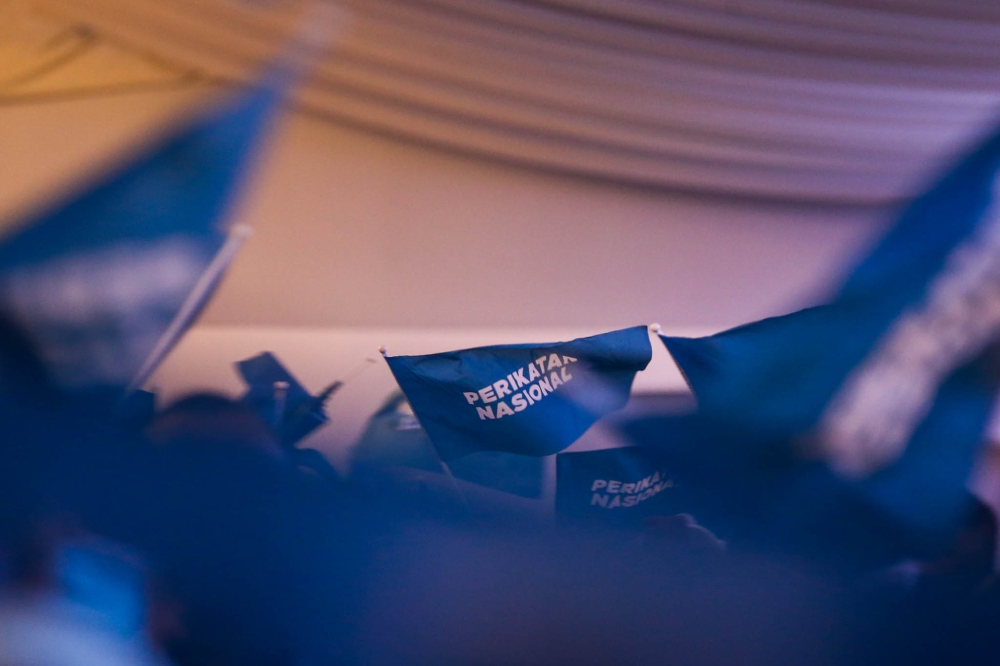
The article discusses the evolving landscape of Malaysian politics, highlighting the end of the so-called "Blue Wave" associated with Perikatan Nasional (PN) and its internal challenges, including a suspension notice from the Registrar of Societies.
It emphasizes that a potential victory for Barisan Nasional (BN) in Melaka would not signify a resurgence of the Blue Wave but rather the fragmentation of political alignments, leading to a more multipolar political environment in Malaysia.
The article underscores the importance of understanding the nuanced and competitive nature of current electoral dynamics, with different parties vying for influence among Malay voters.
OCTOBER 3 — The so-called Blue Wave in Malaysian politics has been stopped. Even if Barisan Nasional (BN) wins Melaka hands down, that would not necessarily revive it.
Indeed, a decisive BN victory could demonstrate precisely why the original concept of a single Blue Wave has ceased to describe Malaysian politics accurately.
The distinction is important.
The Blue Wave was originally associated with the extraordinary rise of Perikatan Nasional (PN), especially PAS, following GE15 and the subsequent state elections.
It conveyed the impression that Malay electoral sentiment was moving overwhelmingly and perhaps irreversibly towards PN.
But Malaysian politics has moved on.
PN itself has been thrown into institutional uncertainty.
The Registrar of Societies (RoS) suspended PN’s activities and issued the coalition a show-cause notice requiring it to explain why its registration should not be cancelled. Crucially, the RoS clarified that this was not yet an order of deregistration.
The legal distinction must be maintained. But its political implications should not be underestimated.
A coalition whose activities have been suspended while its very registration is being questioned cannot project the same organisational coherence that once allowed PN to portray itself as the principal vehicle of a national political wave.
More revealingly, the crisis emerged from tensions within PN itself. The problem was therefore not merely pressure imposed externally.
It reflected difficulties among the component parties that constituted the coalition.
PAS remains. Bersatu remains. Their respective grassroots networks and voters remain.
But the organisational umbrella connecting these forces has been seriously weakened.
This changes the meaning of Melaka.
Should BN win convincingly, the result should primarily be understood as a BN victory in Malacca — not automatically as another triumph of the Blue Wave.
BN’s blue is not PN’s blue. Their internal rivalries over lap deeply.
Umno has its own history, organisational machinery, political culture and grassroots structure.
PAS possesses another political tradition altogether. Bersatu has its own interests and calculations.
They can cooperate without becoming politically identical.
Indeed, the stronger BN becomes electorally, the more complicated their relationship becomes.
A weak BN has powerful reasons to cooperate with PN.
It needs additional votes, organisational support and ways of preventing damaging multi-cornered contests.
A resurgent BN faces a different calculation.
If Umno and BN can demonstrate through Johor, Negeri Sembilan and potentially Melaka that they remain capable of mobilising significant Malay support, their bargaining position changes substantially.
Why surrender constituencies that BN believes it can win itself ?
Indeed, why accept the assumption that PN should dominate conservative Malay politics ?
Moreover, why should an increasingly confident Umno subordinate its political future to another coalition ?
These are strategic questions that will become increasingly important approaching GE16. Malacca will all Umno and BN to look into these teasers.
In turn, the irony is therefore unmistakable. It will almost become a paradox to Malaysian politics.
The more convincingly BN wins Melaka, the more difficult it becomes to describe Malaysian politics as being driven by one amorphous Blue Wave.
There are now different shades of blue.
They overlap electorally, especially among Malay voters, but they are not interchangeable.
The Blue Wave thesis also risks obscuring another characteristic of contemporary Malaysian politics: extraordinary electoral fluidity.
Johor is not Negeri Sembilan.
Negeri Sembilan is not Melaka. Melaka will not automatically determine Selangor, Perak or GE16.
Malaysians have demonstrated repeatedly since 2018 that they are willing to change their political preferences.
State elections can turn on local leadership, candidate selection, machinery, turnout and state-specific concerns.
There are no political Nostradamuses in Malaysia.
Nor should Pakatan Harapan regard PN’s difficulties as an automatic political dividend.
The weakening of one opponent does not necessarily strengthen another.
Malay voters moving away from PN could migrate towards BN rather than PH. Equally, dissatisfied BN voters could move elsewhere.
The Unity Government must therefore continue confronting its own challenges of economic delivery, institutional reform, living costs and public confidence.
Neither should BN conclude that winning Melaka hands down guarantees victory at GE16.
Malaysia’s electoral landscape is becoming more multipolar, not less.
BN, PN’s constituent parties and PH possess different organisational strengths, geographical concentrations and demographic constituencies.
Sabah and Sarawak add another layer of complexity that makes any simplistic national-wave theory even more problematic.
What has therefore ended is not Malay political competition.
What has ended — or at least been seriously interrupted — is the assumption that this competition is moving inexorably in one direction under PN.
The suspension of PN’s activities and the possibility of deregistration have accelerated that change.
Even if PN eventually resolves its regulatory problems, the episode has exposed the fragility of coalition politics.
If BN now wins Melaka hands down, the message would be equally significant.
It would show that Umno and BN are capable of generating their own electoral momentum independent of PN.
Thus a BN landslide in Melaka would not necessarily be another manifestation of the Blue Wave.
It could be evidence of its fragmentation.
The political forces represented by PAS and Bersatu have not disappeared. Neither has Pakatan Harapan.
But the notion of one irresistible blue current sweeping across Peninsular Malaysia has become increasingly difficult to sustain.
Malaysia is entering something more complicated: competitive multipolar politics in which several political currents are struggling simultaneously for the same voters.
The Blue Wave may have been stopped.
The contest between the different shades of blue — and between them and Pakatan Harapan — is only intensifying. — Bernama
* Phar Kim Beng is professor of Asean Studies and director at the Institute of International and Asean Studies, International Islamic University Malaysia.
** This is the personal opinion of the writers or publication and does not necessarily represent the views of Malay Mail .
Malaysia’s tourism boom: Are we ready for a new generation of travellers? — Nurul Fardini Zakaria
That enquire and inquire are different is a fallacy — Hafiz Hassan
In her story, I found echoes of my own — Rabi’ah Al-Adawiyah Rahmat
Senior Citizens Bill to strengthen protection for older Malaysians, says Nancy Shukri
Anwar visits Sepang for F1 GP qualifying round, attends welcome dinner hosted by Bahrain crown prince
Malaysia aims for economic resilience over efficiency amid global uncertainties, says Tengku Zafrul
文章探讨了马来西亚政治格局的演变,重点介绍了与国民联盟(PN)相关的所谓“蓝色浪潮”的结束及其内部挑战,包括社团注册局的暂停通知。
它强调,国民阵线(国阵)在马六甲的潜在胜利并不意味着蓝色浪潮的复兴,而是政治联盟的分裂,导致马来西亚出现更加多极化的政治环境。
文章强调了理解当前选举动态的微妙性和竞争性的重要性,不同的政党都在争夺马来选民的影响力。
10月3日——马来西亚政坛所谓的“蓝色浪潮”已经停止。即使国民阵线(国阵)在马六甲州大获全胜,也未必能重现这股浪潮。
事实上,国阵的一场决定性胜利或许恰恰证明了为什么最初“蓝色浪潮”的概念已经无法准确描述马来西亚的政治现状。
这种区别很重要。
“蓝色浪潮”最初与国民联盟(PN)在第15届全国大选和随后的州选举后,特别是伊斯兰党(PAS)的异常崛起有关。
它传达出马来选民的情绪正在以压倒性且或许不可逆转的方式转向国民联盟的印象。
但马来西亚政坛已经发生了变化。
PN本身也陷入了制度上的不确定性。
社团注册局暂停了国民党(PN)的活动,并向该联盟发出责令说明通知书,要求其解释为何不应取消其注册资格。至关重要的是,社团注册局澄清,这并非注销注册的命令。
法律上的区别必须得到维护。但其政治影响不容低估。
一个活动已被暂停、注册资格也受到质疑的联盟,无法展现出曾经让国民党把自己塑造成全国政治浪潮主要载体的那种组织凝聚力。
更确切地说,这场危机源于国民党内部的紧张局势。因此,问题不仅仅在于外部压力。
这反映了组成联合政府的各成员党之间的分歧。
伊斯兰党依然存在。土著团结党依然存在。它们各自的基层网络和选民依然存在。
但连接这些力量的组织架构已被严重削弱。
这改变了马六甲的含义。
如果国阵取得压倒性胜利,这一结果首先应该被理解为国阵在马六甲的胜利,而不是自动被视为蓝色浪潮的又一次胜利。
国阵的蓝色并非国盟的蓝色。它们内部的竞争关系错综复杂。
巫统有其自身的历史、组织机制、政治文化和基层结构。
伊斯兰党有着完全不同的政治传统。土著团结党则有自己的利益和考量。
他们可以合作,而无需在政治上变得完全相同。
事实上,国阵在选举中越强大,他们之间的关系就越复杂。
弱势的国民阵线有充分的理由与国民阵线合作。
它需要更多的选票、组织支持以及防止出现有害的多方竞争的方法。
复兴的国民阵线面临着不同的考量。
如果巫统和国阵能够通过柔佛、森美兰以及可能还有马六甲来证明他们仍然有能力动员大量的马来人支持,那么他们的谈判地位将发生实质性变化。
国阵为何要放弃那些它认为自己能够赢得的选区?
的确,为什么要接受国民联盟应该主导马来保守派政治的假设呢?
此外,日益自信的巫统为什么要将自己的政治前途置于另一个联盟之下呢?
这些都是战略性问题,随着第16届全国大选的临近,这些问题将变得越来越重要。马六甲州将要求巫统和国阵认真研究这些问题。
因此,其中的讽刺意味显而易见。这几乎会成为马来西亚政治的一个悖论。
国阵在马六甲的胜利越是令人信服,就越难将马来西亚政治描述为由一股模糊的蓝色浪潮所驱动。
现在蓝色有了不同的色调。
他们在选举中有所重叠,尤其是在马来选民中,但他们并不可互换。
“蓝色浪潮”理论也可能掩盖了当代马来西亚政治的另一个特点:选举结果的极度不稳定性。
柔佛州不是森美兰州。
森美兰州不是马六甲。马六甲不会自动决定雪兰莪、霹雳或第16届大选。
自 2018 年以来,马来西亚人已经多次表明,他们愿意改变自己的政治倾向。
州选举的结果可能取决于地方领导、候选人遴选、选举机器、投票率和各州的具体问题。
马来西亚没有政治上的诺查丹玛斯。
希望联盟也不应将国盟的困境视为自动获得的政治红利。
削弱一个对手并不一定会增强另一个对手的力量。
那些不再支持国盟的马来选民可能会转而支持国阵而不是希望联盟。同样,对国阵不满的选民也可能转向其他政党。
因此,联合政府必须继续应对自身在经济发展、体制改革、生活成本和公众信心等方面的挑战。
国阵也不应就此认为轻松拿下马六甲就能保证在第16届全国大选中获胜。
马来西亚的选举格局正变得更加多极化,而不是相反。
国阵、国盟各组成党和希望联盟在组织实力、地域分布和人口构成方面各不相同。
沙巴和砂拉越又增加了一层复杂性,使得任何简单的国家浪潮理论都更加成问题。
因此,结束的并非马来政治竞争。
已经结束的——或者至少受到了严重干扰的——是这种竞争在 PN 的领导下不可阻挡地朝着一个方向发展的假设。
PN 活动的暂停以及可能被注销登记加速了这一变化。
即使国民党最终解决了其监管问题,这一事件也暴露了联合政治的脆弱性。
如果国阵现在轻松拿下马六甲,那传递的信息也将同样意义重大。
这表明巫统和国阵有能力独立于国盟之外,产生自己的选举势头。
因此,马六甲的国阵滑坡并不一定是蓝色浪潮的又一次表现。
这可能是它分裂的证据。
以伊党和土团党为代表的政治力量并没有消失。希盟也没有。
但是,认为有一股不可阻挡的蓝色潮流席卷马来西亚半岛的想法越来越难以维持。
马来西亚正在进入一个更加复杂的局面:竞争激烈的多极政治,其中几个政治派别同时争夺同一批选民。
蓝色浪潮或许已经停止了。
不同蓝色阵营之间的竞争——以及它们与希望联盟之间的竞争——正愈演愈烈。——马新社
* Phar Kim Beng 是马来西亚国际伊斯兰大学国际与东盟研究所的东盟研究教授兼所长。
**本文仅代表作者或出版方的个人观点,并不一定代表《马来邮报》的观点。
马来西亚旅游业蓬勃发展:我们准备好迎接新一代旅行者了吗?——努鲁·法迪尼·扎卡利亚
认为“询问”和“探究”不同是一种谬误——哈菲兹·哈桑
在她的故事中,我看到了自己故事的回响——拉比阿·阿达维亚·拉赫马特
南希·舒克里表示,《老年人法案》将加强对马来西亚老年人的保护。
安华前往雪邦观看F1大奖赛排位赛,并出席巴林王储举办的欢迎晚宴。
东姑扎夫鲁表示,在全球不确定性的情况下,马来西亚的目标是提高经济韧性而不是效率