The US Air Force sent F-35s to defend NATO. Here’s what it learned.美国空军派出F-35战机保卫北约。以下是他们从中了解到的情况。
NATO’s eastern flank has become an ideal proving ground for America’s most advanced fighter jet.
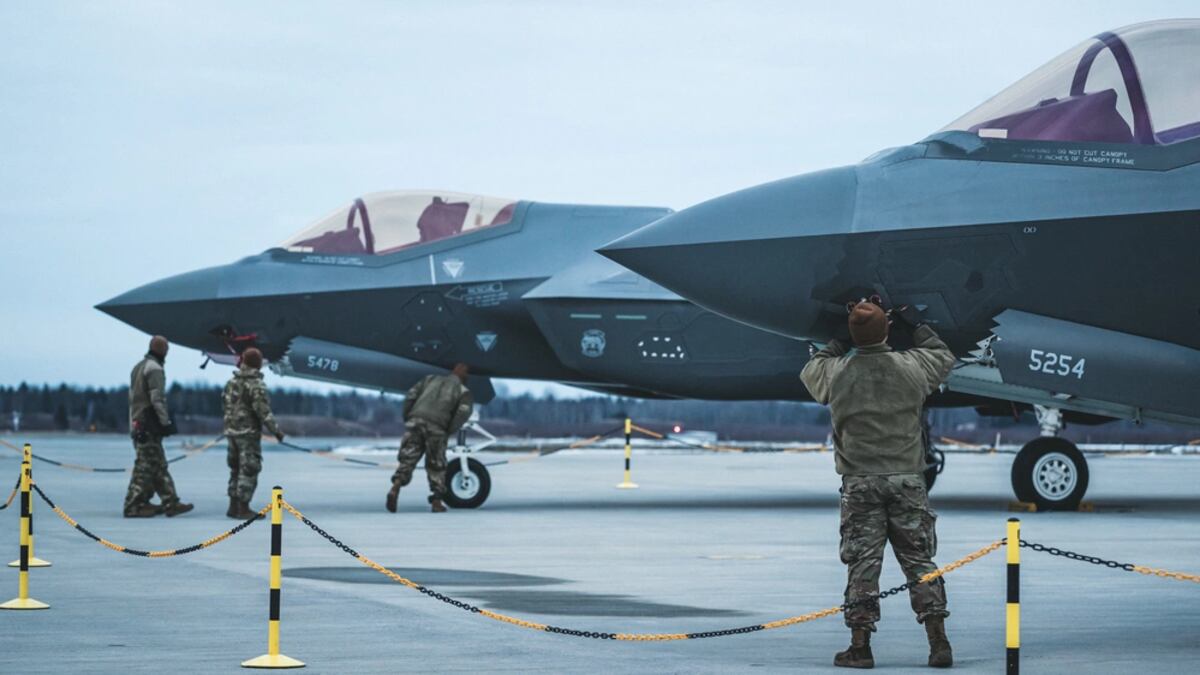
HILL AIR FORCE BASE, Utah — America’s most advanced fighter jet is in its element over Eastern Europe.
As Russia launched its offensive in Ukraine in February 2022, NATO’s eastern flank became an ideal proving ground for the F-35 Lightning II, officials with the 388th Fighter Wing here told Air Force Times during a recent visit.
Members of the active duty 388th FW and the Air Force Reserve’s 419th Fighter Wing became the first American F-35A units to arrive in support of NATO amid the opening volleys of the Russo-Ukrainian War last year. They deployed to Germany’s Spangdahlem Air Base from February to May 2022.
Their mission: Vacuum up as much electronic data as possible from the surface-to-air missiles and aircraft dotting Eastern Europe to build a map to guide NATO operations. And, if the situation spilled into NATO countries, to add some muscle.
An Air Force F-35A Lightning II from the 34th Fighter Squadron at Hill Air Force Base, Utah, taxis to an aircraft shelter on Spangdahlem Air Base, Germany, Feb. 16, 2022. (Tech. Sgt. Maeson L. Elleman/Air Force)
“We weren’t crossing the border. We’re not shooting anything or dropping anything,” said 388th Fighter Wing Commander Col. Craig Andrle in a March 20 interview here. “But the jet is always sensing, gathering information. And it was doing that very, very well.”
The mission gave the Air Force a chance to hone its new short-notice approach to deployments. It also illustrated advances in the F-35′s ability to communicate with the joint force and quickly adjust to unrecognized threats. And it offered new insight into what the jets are still missing, as the military warns of future fights with Russia or China.
The 34th Fighter Squadron began awaiting a potential deployment to Europe in October 2021 — their first time leaving home as part of an “immediate response force” that can dispatch units within a week.
Under the new force-generation model, squadrons are supposed to move through four six-month phases: resetting from their most recent travel; training locally as a unit; participating in larger exercises; and going on alert. That approach aims to give units enough time to rest, train and maintain their jets between deployments.
When that final window of peak readiness opens, Andrle said, “We could get a phone call and leave in a matter of days — to an unknown location, for an indeterminate amount of time.”
A pilot from the 388th Fighter Wing prepares an F-35A Lightning II for deployment to Spangdahlem Air Base, Germany, Feb 15, 2022. The wing's 34th Fighter Squadron, alongside reservists from the 419th Fighter Wing, deployed to Europe to bolster readiness, enhance NATO's collective defense posture and further increase air integration capabilities with allied and partner nations. (Capt. Kip Sumner/Air Force)
Waiting for the go signal
So, airmen practiced. And they waited.
The 388th Fighter Wing picked jets that could fly for at least three months without major repairs. Airmen readied their combat gear and practiced wearing gas masks. They got their medical paperwork in order, studied European rules of engagement, learned about the airfields they might use.
By mid-February, Russia had amassed more than 130,000 troops along the Ukrainian border. Hill’s intelligence team kept the fighter wings updated on the latest predictions for war.
On Friday, Feb. 11, 2022, the 34th Fighter Squadron received its initial warning call. An official go-ahead the next day, Feb. 12, set their plans in motion.
On Sunday, as Super Bowl LVI blared from a television at the squadron bar, airmen plotted the 5,100-mile trek to Germany. The next day — Valentine’s Day — F-35 pilots said goodbye to loved ones and began to deploy. By Wednesday, Feb. 16, the 34th Fighter Squadron was gone.
It was the first deployment for many pilots in the 388th and 419th Fighter Wings, which also sent maintainers and other support staff. And it was the first time their families didn’t have the stability of an assured six-month deployment on the calendar.
Local leaders and about a dozen spouses gathered on a golf course in the middle of the night to watch the jets leave for Germany, 388th Operations Group Commander Col. Brad Bashore recalled.
“Half of those are probably [seeing] the first time their significant other has ever deployed,” he said. “[There] was a finality to all the preparation. … It was emotional, but at the same time, they were all together as a family.”
An F-35A passes overhead as family members gather near the Hill Air Force Base flight line in February 2022 to watch the early morning departure of the 34th Fighter Squadron and its fighter generation squadron. (Micah Garbarino/Air Force)
Twelve jets and around 300 airmen arrived at Spangdahlem on Feb. 16, 2022. Russia’s assault on Ukraine began eight days later and has since become one of Europe’s bloodiest conflicts since World War II.
F-35s are designed to block and destroy air defenses that could down allied aircraft, paving the way for other aircraft to enter enemy territory. They also soak up electronic emissions from nearby radars to compile a picture of friendly and unfriendly forces in the area.
Airmen saw those threats in Ukraine and Kaliningrad, the Russian province wedged between Lithuania and Poland, Andrle said. The F-35s were able to locate and identify surface-to-air missile sites and pass that information to the rest of the coalition.
“We had all hoped it was going to work like it’s supposed to, but then to see it actually perform very, very well in that role was great,” Andrle said.
Airmen hopscotched from Spangdahlem to Estonia’s Amari Air Base, Lithuania’s Siauliai Air Base and Romania’s Fetesti Air Base, U.S. Air Forces in Europe said in a press release .
Two U.S. Air Force F-35 Lightning II aircraft arrive at Siauliai Air Base, Lithuania, Feb. 24, 2022. (Courtesy of the Lithuanian Air Force)
The jet didn’t always recognize objects around it, since assets like air defense systems have digital ways of evading notice.
For instance, Andrle said: “We’re looking at an Sa-20 [NATO’s name for the S-300 surface-to-air missile system]. I know it’s an Sa-20. Intel says there’s an Sa-20 there, but now my jet doesn’t ID it as such, because that Sa-20 is operating, potentially, in a war reserve mode that we haven’t seen before.”
But the F-35 flagged the object for troops who updated and re-uploaded the data into the jet. After that, NATO aircraft knew what they were looking at and how to geolocate it. That makes it harder to take NATO by surprise.
“We don’t have a ton of weapons where we can decimate the entire space,” Bashore said of the F-35. It’s the quarterback: “We’re sharing data and making sure that everybody has awareness — surface-to-air and air-to-air — of what’s out there in the environment.”
Even as Russian troops laid siege to Ukrainian cities next door, Bashore said Hill airmen didn’t see anything provocative during their air policing flights in Eastern Europe. U.S. forces passed Belarussian fighter jets friendly to Moscow, and the military buildup in Kaliningrad.
“They’re doing the same thing that we’re doing,” Bashore said. “We just looked at each other. … No direct interaction and nothing that was unprofessional on either side.”
The airmen returned to Hill in early May 2022. They’ve since tried to build on the lessons they learned overseas.
View this post on Instagram A post shared by 388th Fighter Wing (@388fw)
A post shared by 388th Fighter Wing (@388fw)
“It was the first time that we had rapidly deployed on the [immediate response force],” Bashore said. “We had as much to learn as the combatant command did about how to accept our forces and how to interweave them into their overall scheme of maneuver and operation.”
The jets proved more flexible than expected.
“For a while, there was the view that this jet needs to be connected all the time,” Andrle said. “Anywhere we go, we’re gonna have to take the servers with us. We’re gonna need to get connectivity. … We are realizing and proving that that isn’t necessarily the case.”
That’s a boon for the Air Force’s pivot to “agile combat employment,” or quick-turn combat operations across multiple regions with minimal staffing. That requires more pre-positioned tools in the field and airmen trained in multiple jobs, rather than fully equipped bases with entire units.
“We got some configurations approved to be able to fly with live missiles and a cargo pod on the inside, so we could carry some of the minimum maintenance things that they needed,” Bashore said.
That freed up space on the C-130 cargo planes or trucks that would bring maintainers in, and ensured those crews had the tools they needed at remote airfields.
But leaders realized those skeleton crews shouldn’t be quite so lean. Deploying also helped clarify the skills those airmen need to have — they may not have to drive a Humvee, but they should be able to load bombs, maintenance officials said.
Capt. Jeremy Touma, an F-35 pilot with the 388th Fighter Wing out of Hill Air Force Base, Utah,, is greeted by Senior Airman Brett Buerkle, a crew chief with the 4th Fighter Generation Squadron, after landing on a simulated forward operating base on Hunter Army Airfield, Ga., March 2 during exercise Agile Flag 23-1. (Daniel Malta/Army)
“We had built this fighting team to go forward, not fully knowing how many locations they would be at,” Bashore said. “We probably needed a little bit more personnel to be able to do distributed operations for multiple locations.”
Their pallet of spare parts was too bulky to easily move around the region, Andrle said. That spurred the wing to make its spares packages lighter and modular.
F-35 pilots told Air Force Times they’ve learned to refuel their own jets and inspect engines in a pinch as well. Agile operations have helped pilots think like crew chiefs to catch issues they may not have noticed before, said Lt. Col. Jesse Proctor, a pilot with the 4th Fighter Squadron.
Leaders here also praised the F-35′s connectivity with other NATO aircraft as a “huge win” for the alliance.
F-35 manufacturer Lockheed Martin has projected that NATO members will have stationed more than 400 of the jets across Europe by 2030. The aircraft is seen as the leader of any future fight in the region.
“No matter what your qualification is — wingman, flight lead, instructor — you will have fourth-gen instructor pilots and flight leads come up to you … to ask you questions about threats, tactics, how we’re going to integrate together,” said Capt. Josh Sturniolo, a pilot with the 4th Fighter Squadron. “They all look to us for the answer.”
Airman 1st Class Matthew J. Brown, a 52nd Security Forces Squadron patrolman at5 Spangdahlem Air Base, Germany, watches over a U.S. Air Force F-35 Lightning II aircraft at Siauliai Air Base, Lithuania, Feb. 26, 2022. (Senior Airman John R. Wright/Air Force)
The 388th’s status as the first operational F-35 wing has proven to be a double-edged sword: It was the first to deploy in the new airframe and has employed experts who have been with the program for years.
But it also helps other F-35 units stand up, and loses its most seasoned airmen to those efforts.
That means that while the wing is fully manned, its pilot corps is younger than it might like, Andrle said. Until the F-35 enterprise’s growth begins to slow — and unless the Air Force can retain more experienced aviators overall — Hill will continue giving away its pilots.
So far, that experience has been replaced by a generation of tech-savvy airmen who are eager to harness the Air Force’s so-called “flying supercomputer.”
“We’re learning new ways of operating with it,” Andrle said. “Having folks who don’t have the baggage from how we did it for the past 20 years is very beneficial to us.”
Pilots here advocated for new technology at the training ranges that better replicates the threats they might face in a fight with China or Russia. They also want more simulators, which they can use anytime and lets them practice moves they don’t want out in the open.
The European deployment drove home the importance of having access to flight and maintenance simulators anywhere in the world, Bashore said. That can help aircrews stay current on their skills, particularly in the advanced maneuvers they aren’t doing on air patrol missions.
The active duty 388th and Reserve 419th Fighter wings conduct an F-35A combat power exercise at Hill Air Force Base, Utah, Jan. 6, 2020. (R. Nial Bradshaw/Air Force)
The wing also plans to update its aircraft with fixes designed to stop a potential engine vibration problem that caused an F-35B mishap in Fort Worth, Texas, in December. Andrle said the issue doesn’t affect any of the 388th’s jets.
Highest on the wing’s wish list are two hardware and software updates in the works at Lockheed Martin, known as Technology Refresh 3 and Block 4. TR-3 is slated to start delivering new capabilities this year, but Andrle doesn’t expect to see Block 4 for another five years.
Without those improvements, Andrle said, the F-35 can’t carry a slew of advanced cruise missiles and anti-air defense weapons.
“Slinging [Small Diameter Bombs] and shooting [Advanced Medium-Range Air-to-Air Missiles] … is not where we want to be in the next fight,” he said.
Rachel Cohen is the editor of Air Force Times. She joined the publication as its senior reporter in March 2021. Her work has appeared in the Washington Post, the Frederick News-Post (Md.), Air and Space Forces Magazine, Inside Defense, Inside Health Policy and elsewhere.
犹他州希尔空军基地——美国最先进的战斗机在东欧上空如也地执行着任务。
2022 年 2 月,随着俄罗斯对乌克兰发动攻势,北约东翼成为了 F-35“闪电 II”战斗机的理想试验场。驻扎于此的第 388 战斗机联队的官员在最近一次访问中告诉《空军时报》。
去年俄乌战争爆发初期,现役第388战斗机联队和空军预备役第419战斗机联队的成员成为首批抵达北约支援的美国F-35A部队。他们于2022年2月至5月部署在德国施潘达勒姆空军基地。
他们的任务:尽可能多地收集部署在东欧各地的地对空导弹和飞机的电子数据,以绘制地图指导北约行动。如果局势蔓延到北约国家,他们还要增强自身实力。
2022年2月16日,一架隶属于犹他州希尔空军基地第34战斗机中队的美国空军F-35A“闪电II”战斗机滑行至德国施潘达勒姆空军基地的飞机掩体。(技术军士梅森·L·埃勒曼/美国空军)
“我们没有越境,也没有开火或投掷任何东西,”第388战斗机联队指挥官克雷格·安德尔上校3月20日在此接受采访时说。“但战机一直在进行感知和信息收集,而且它在这方面做得非常出色。”
这次任务让空军有机会完善其新的快速部署方式。它也展现了F-35战机在与联合部队通信以及快速应对未知威胁方面的能力提升。此外,鉴于军方警告未来可能与俄罗斯或中国发生冲突,这次任务也让人们更清楚地认识到F-35战机仍然存在的不足之处。
第 34 战斗机中队于 2021 年 10 月开始等待可能部署到欧洲——这是他们第一次作为“快速反应部队”的一部分离开家乡,该部队可以在一周内派遣部队。
根据新的部队生成模式,各飞行中队应经历四个为期六个月的阶段:从最近一次部署任务中恢复;进行本地部队训练;参加大型演习;以及进入警戒状态。这种做法旨在确保各部队在两次部署之间有足够的时间休息、训练和维护战机。
安德尔说,当最后的准备高峰期到来时,“我们可能会接到一个电话,然后在几天之内出发——前往一个未知的地点,停留时间也不确定。”
2022年2月15日,美国空军第388战斗机联队的一名飞行员正在为一架F-35A“闪电II”战斗机部署至德国施潘达勒姆空军基地做准备。该联队的第34战斗机中队与来自第419战斗机联队的预备役人员一同部署至欧洲,旨在加强战备,提升北约集体防御态势,并进一步增强与盟国和伙伴国的空中一体化能力。(基普·萨姆纳上尉/美国空军)
等待通行信号
于是,飞行员们开始训练,然后等待。
第388战斗机联队挑选的战机无需大修即可至少飞行三个月。空军人员准备好作战装备,并练习佩戴防毒面具。他们整理好医疗文件,学习欧洲交战规则,并了解可能使用的机场。
到二月中旬,俄罗斯已在乌克兰边境集结了超过13万兵力。希尔的情报小组不断向战斗机部队通报最新的战况预测。
2022年2月11日星期五,第34战斗机中队接到了最初的预警电话。第二天,即2月12日,正式的行动许可使他们的计划开始实施。
周日,当中队酒吧的电视里正播放着第56届超级碗比赛时,空军官兵们正在规划前往德国的5100英里航程。第二天——情人节——F-35战斗机飞行员们与亲人告别,开始部署。到2月16日星期三,第34战斗机中队全部撤离。
对于第388和第419战斗机联队的许多飞行员来说,这是他们首次部署,这两个联队还派出了维护人员和其他后勤人员。同时,这也是他们的家人第一次失去了以往六个月稳定部署期的保障。
第 388 作战大队指挥官布拉德·巴肖尔上校回忆说,当地领导人和大约十几名配偶在半夜聚集在一个高尔夫球场上,观看喷气式飞机飞往德国。
他说:“其中一半人可能是第一次亲眼目睹他们的伴侣被派往海外服役。所有的准备工作都告一段落……这令人动容,但与此同时,他们一家人又团聚在一起。”
2022年2月,一架F-35A战斗机从头顶飞过,家属们聚集在希尔空军基地飞行跑道附近,观看第34战斗机中队及其战斗机换代中队清晨起飞。(Micah Garbarino/空军)
2022年2月16日,12架喷气式飞机和约300名空军人员抵达施潘达勒姆空军基地。八天后,俄罗斯对乌克兰的进攻开始,此后这场战争成为二战以来欧洲最血腥的冲突之一。
F-35战斗机的设计目的是阻挡并摧毁可能击落盟军飞机的防空系统,从而为其他飞机进入敌方领空开辟道路。它们还能接收附近雷达的电子信号,以构建该区域内友军和敌军的态势图。
安德尔说,空军人员在乌克兰和加里宁格勒(位于立陶宛和波兰之间的俄罗斯省份)都发现了这些威胁。F-35战机能够定位并识别地对空导弹阵地,并将这些信息传递给联军其他成员。
安德尔说:“我们都希望它能像预期的那样发挥作用,但看到它实际上在这个角色中表现得非常出色,真是太棒了。”
美国驻欧洲空军在一份新闻稿中表示,空军人员从施潘达勒姆空军基地先后前往爱沙尼亚的阿马里空军基地、立陶宛的希奥利艾空军基地和罗马尼亚的费泰什蒂空军基地。
2022年2月24日,两架美国空军F-35“闪电II”战斗机抵达立陶宛希奥利艾空军基地。(图片由立陶宛空军提供)
由于防空系统等装备具有数字化手段来逃避侦测,因此喷气式飞机并非总能识别周围的物体。
例如,安德尔说:“我们正在查看一架Sa-20(北约对S-300地对空导弹系统的称呼)。我知道它是Sa-20。情报显示那里有一架Sa-20,但现在我的战机无法识别它,因为这架Sa-20可能正在以我们以前从未见过的战备模式运行。”
但F-35战机标记了该目标,供部队更新并重新上传数据至战机后使用。之后,北约战机便知道目标是什么以及如何定位它。这使得北约更难被突袭。
“我们没有很多武器可以摧毁整个区域,”巴肖尔谈到F-35时说。它就像四分卫:“我们共享数据,确保每个人都了解周围环境中的情况——无论是地对空还是空对空。”
即便俄军围攻了邻近的乌克兰城市,巴肖尔表示,希尔空军基地的飞行员在东欧执行空中巡逻任务时并未发现任何挑衅行为。美军飞越了亲莫斯科的白俄罗斯战斗机,并目睹了加里宁格勒的军事集结。
“他们做的和我们一样,”巴肖尔说。“我们只是互相看了一眼……没有直接交流,双方也没有任何不专业的行为。”
空军人员于 2022 年 5 月初返回希尔空军基地。此后,他们一直努力吸取在海外学到的经验教训。
在 Instagram 上查看此帖子 由 388th Fighter Wing (@388fw) 分享的帖子
由第388战斗机联队 (@388fw) 分享的帖子
巴肖尔说:“这是我们第一次快速部署到[快速反应部队]。我们和作战司令部一样,都需要学习如何接收我们的部队,以及如何将他们融入到整体的机动和作战计划中。”
这些喷气式飞机比预期的更灵活。
安德尔说:“有一段时间,人们认为这架飞机需要时刻保持联网状态。无论我们去哪里,都必须带着服务器。我们需要保持网络连接……但我们正在意识到并证明,事实并非如此。”
这对空军向“敏捷作战部署”转型来说是一大利好,即在多个地区以最少的人员投入开展快速周转的作战行动。这需要更多预先部署到战场的装备和接受过多种岗位训练的空军人员,而不是配备齐全、拥有完整部队的基地。
巴肖尔说:“我们获得了一些配置方案的批准,这些方案能够携带实弹导弹和内部货舱飞行,这样我们就可以携带他们需要的一些最低限度的维护物资。”
这样就腾出了C-130运输机或卡车的空间,可以把维护人员运送过来,并确保这些人员在偏远机场拥有所需的工具。
但领导层意识到,这些精简的机组人员不应该如此精简。部署行动也帮助明确了这些空军人员需要具备的技能——他们可能不需要驾驶悍马车,但他们应该能够装载炸弹,维修官员表示。
3月2日,在“敏捷旗帜23-1”演习期间,来自犹他州希尔空军基地第388战斗机联队的F-35飞行员杰里米·图马上尉驾驶的F-35战斗机降落在佐治亚州亨特陆军机场的模拟前沿作战基地后,受到第4战斗机代中队机组长布雷特·布尔克尔高级空军士兵的迎接。(丹尼尔·马耳他/陆军)
“我们组建这支作战队伍是为了向前推进,但当时并不完全清楚他们会在多少个地点作战,”巴肖尔说。“我们可能需要更多的人员,才能在多个地点开展分散式作战行动。”
安德尔说,他们原先的备件托盘体积太大,不便于在区域内搬运。这促使该部队改进备件包装,使其更轻便、更模块化。
F-35飞行员告诉《空军时报》,他们已经学会了在紧急情况下自行加油和检查发动机。第4战斗机中队的飞行员杰西·普罗克特中校说,敏捷作战帮助飞行员像机组长一样思考,从而发现他们以前可能没有注意到的问题。
这里的领导人还称赞 F-35 与其他北约飞机的连接性,认为这是北约的“巨大胜利”。
F-35战斗机制造商洛克希德·马丁公司预测,到2030年,北约成员国将在欧洲部署超过400架该型战机。该型战机被视为未来该地区任何冲突的领导者。
“无论你的资格是什么——僚机飞行员、飞行长、教官——都会有第四代战机的教官飞行员和飞行长来找你……问你关于威胁、战术以及我们如何协同作战的问题,”第4战斗机中队的飞行员乔什·斯特尼奥洛上尉说。“他们都指望我们来解答。”
2022年2月26日,驻德国斯潘达勒姆空军基地第52安全部队中队巡逻兵一等兵马修·J·布朗在立陶宛希奥利艾空军基地监视一架美国空军F-35“闪电II”战斗机。(高级空军兵约翰·R·赖特/空军)
第 388 联队作为第一个投入作战的 F-35 联队,其地位可谓一把双刃剑:它是第一个部署新型飞机的联队,并且聘用了多年来一直参与该项目的专家。
但这也有助于其他 F-35 部队的组建,并导致其经验最丰富的空军人员被调往这些部队。
安德尔表示,这意味着虽然该联队人员配备齐全,但其飞行员队伍比预期要年轻。除非F-35项目的增长速度开始放缓——而且除非空军能够留住更多经验丰富的飞行员——否则希尔空军基地将继续流失飞行员。
到目前为止,这种经验已经被一代精通技术的空军人员所取代,他们渴望利用空军所谓的“飞行超级计算机”。
安德尔说:“我们正在学习如何以新的方式操作它。拥有那些没有过去20年工作方式束缚的人对我们来说非常有利。”
这里的飞行员呼吁在训练场引进新技术,以便更好地模拟他们在与中国或俄罗斯作战时可能面临的威胁。他们还希望增加模拟器,以便随时使用,练习一些他们不想在实战中执行的动作。
巴肖尔表示,欧洲的部署行动凸显了在全球任何地方都能使用飞行和维护模拟器的重要性。这有助于机组人员保持技能熟练,尤其是在空中巡逻任务中不会用到的那些高级机动动作方面。
2020年1月6日,现役第388战斗机联队和预备役第419战斗机联队在犹他州希尔空军基地进行F-35A战斗机作战能力演习。(R. Nial Bradshaw/空军)
该联队还计划对其飞机进行升级,以修复可能导致去年12月在德克萨斯州沃斯堡发生的F-35B事故的发动机振动问题。安德尔表示,该问题不会影响第388联队的任何战机。
该联队最希望得到的是洛克希德·马丁公司正在研发的两项硬件和软件升级,即技术更新3(TR-3)和Block 4。TR-3计划于今年开始提供新功能,但安德尔预计Block 4还需要五年时间才能推出。
安德尔表示,如果没有这些改进,F-35 就无法携带大量先进的巡航导弹和防空武器。
他说:“投掷小直径炸弹和发射先进中程空空导弹……并不是我们下一场战斗想要采取的方式。”
瑞秋·科恩是《空军时报》的编辑。她于2021年3月加入该刊物,担任高级记者。她的作品曾发表在《华盛顿邮报》、《弗雷德里克新闻邮报》(马里兰州)、《空军与太空部队杂志》、《国防内幕》、《卫生政策内幕》等刊物上。