Where Are The Aircraft Carriers?: October 6, 2026航空母舰在哪里?:2026年10月6日
USS George H.W. Bush pulls into Phuket for first liberty call after 188 days at sea, leaving USS George Washington as the sole carrier supporting operations against Iran.
Published Oct 6, 2026 6:11 PM EDT
Aircraft carrier USS George H.W. Bush arrived in Phuket, Thailand, on Sunday for a scheduled port call after 188 days at sea, leaving just one carrier strike group, led by USS George Washington , in the Middle East for the first time in months. Across the Pacific, USS Abraham Lincoln , which Washington relieved in August, is holding off the west coast of California to disembark her air wing and offload ammunition ahead of a well-deserved homecoming this week. With several outlets now confirming that USS Theodore Roosevelt will deploy to the Middle East, there very well may be three flattops in the region again, but any overlap will be temporary given normal rotation schedules.
Here’s TWZ’s weekly carrier tracker monitoring America’s flattop fleet, including deployed Carrier Strike Groups (CSG) and Amphibious Ready Groups (ARG), using publicly available open-source information. Check out last week’s report here .
George H.W. Bush Drops Anchor Off Phuket For Liberty Port Call
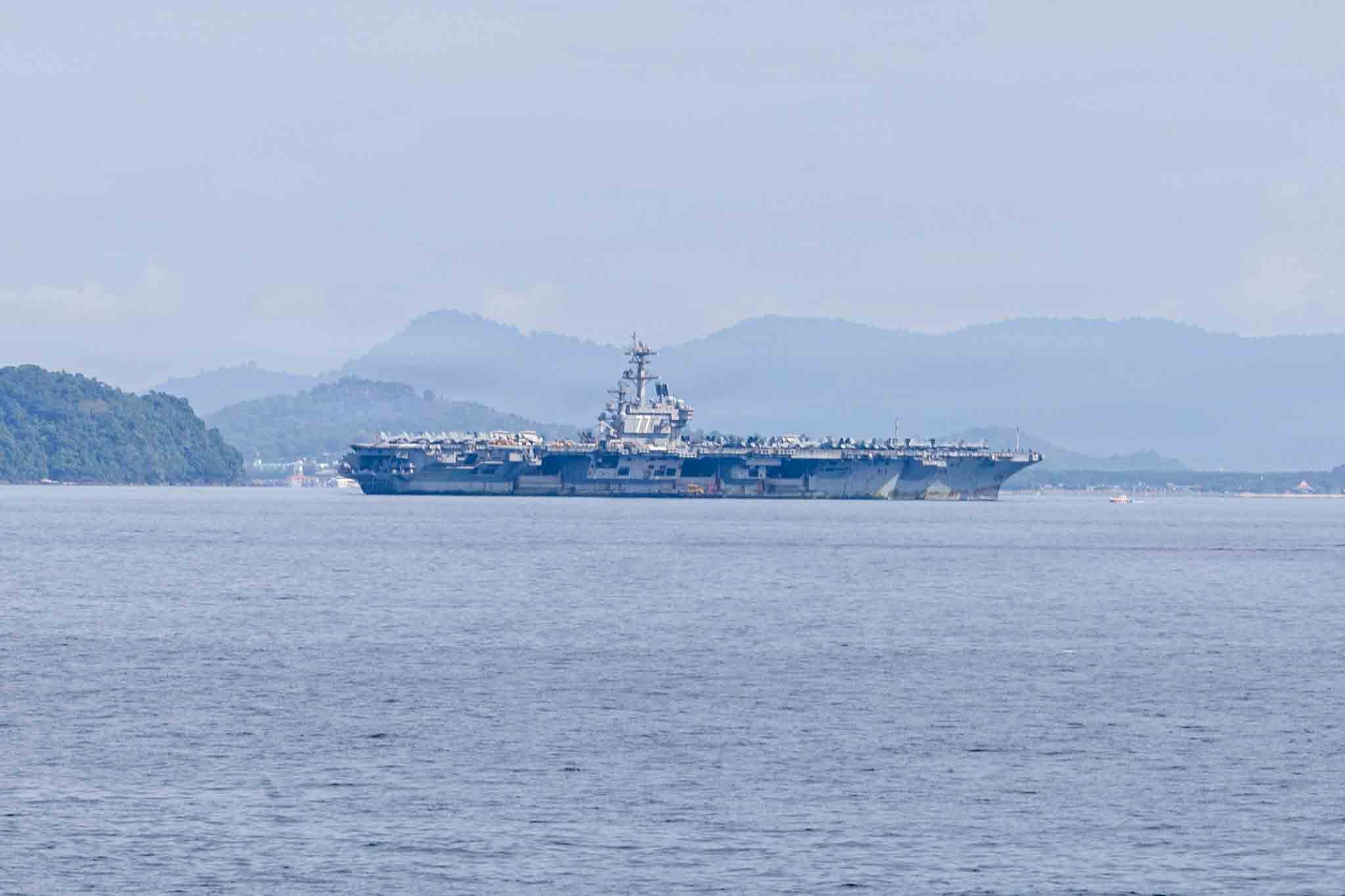
USS George H.W. Bush arrived in Thailand on October 4 for a scheduled port visit, U.S. 7th Fleet announced . Guided-missile destroyer USS Delbert D. Black escorted the flattop from her previous station in the Arabian Sea and joined the call. Bush deployed from the continental U.S. on March 31 and took the long way to the Middle East, rounding the Cape of Good Hope to limit exposure to the treacherous Red Sea and Bab Al Mandeb Strait.
USS George H.W. Bush (CVN 77) arrived in Phuket, Thailand, on October 4, 2026. U.S. Navy photo
On October 3, Bush switched her Automatic Identification System (AIS) transponder on about 15 nautical miles southwest of Thailand, broadcasting her position publicly for the first time since April, based on data available via MarineTraffic . The carrier dropped anchor approximately two nautical miles off the coast of Phuket the following day.
USS George H.W. Bush’s transit into Phuket, Thailand, on October 3. Source: MarineTraffic/KPLER (Reprinted with permission)
Bush had been operating in the U.S. Central Command (CENTCOM) area of responsibility (AOR) since April, when the U.S. briefly had three carriers on station, in support of operations against Iran. “For the last six months, the strike group supported Operation Epic Fury and the U.S. naval blockade in the U.S. Central Command area of responsibility to secure maritime security and stability in the Middle East,” according to the 7th Fleet statement. That force posture was short-lived, however, as the USS Gerald R. Ford transited the Suez Canal northbound on May 1 and began her journey home not long after Bush arrived. Bush chopped into the U.S. Pacific Command (PACOM) AOR sometime over the past week while en route to Phuket, leaving a single CSG in CENTCOM.
The current composition of CSG-10 is USS Mason , USS Ross , and USS Donald Cook , but none of the destroyers joined the flagship in Thailand. Why Black escorted the carrier instead is unclear. Black departed Mayport, Florida, on January 3, 2026, for an independent deployment and is long overdue for a liberty call after nine months. Mason transited the Malacca Strait southbound on September 29, according to public AIS data, and is currently in Singapore; the purpose of the stop is unknown. Ross and Cook have not broadcast their positions in months, but were last operating in the Arabian Sea.
The Navy confirmed this was the first port visit for Bush since deploying, marking 188 consecutive days at sea (including the end date), which falls just short of the 200-plus days that USS Abraham Lincoln recently logged.
Flight ops aboard CVN 77. U.S. Navy photo
USS Mason in CENTCOM. U.S. Navy photo
USS Delbert D. Black underway. U.S. Navy photo
USS Donald Cook sails while an MH-60S Seahawk flies alongside USS George H.W. Bush in U.S. 5th Fleet. U.S. Navy photo
Abraham Lincoln Homecoming Imminent
The USS Abraham Lincoln reappeared on AIS on October 3, roughly 200 nautical miles southwest of her homeport at Naval Air Station (NAS) North Island in San Diego, after steaming east across the vast Pacific Ocean. However, instead of returning home, Lincoln is holding off the coast of California, disembarking Carrier Air Wing (CVW) 9 and offloading ammunition alongside Lewis and Clark class dry cargo ship USNS Washington Chambers .
USS Abraham Lincoln’s transit off the coast of California. Source: MarineTraffic/KPLER (Reprinted with permission)
Lincoln is expected to arrive home on Wednesday or Thursday . The carrier departed San Diego on November 21, 2025, and an arrival this week would close out a total deployment of 320 to 321 days. That’s just shy of the 326-day record USS Gerald R. Ford set in May, representing the second longest deployment in the modern carrier era.
The marathon deployment drew scrutiny over the grueling conditions Sailors and Marines experienced aboard. In August, crew families described supply shortages and difficult living arrangements, as TWZ reported at the time. The accounts led to widespread media coverage, which Acting Secretary of the Navy Hung Cao called dishonest while also acknowledging that “a small number of mental health cases were treated with no loss of life, meal plans were adjusted when fresh resupply was unavailable, without a single meal being missed, calls home were limited when the operational threat was too high.” At least eight personnel across the strike group attempted suicide during the cruise, Cao wrote in a letter sent to Sen. Kirsten Gillibrand that was obtained by CNN .
Friends and family welcomed members of Helicopter Maritime Strike Squadron (HSM) 71 back to NAS North Island on Friday, according to a release from DVIDS, the military’s content sharing portal. A Growler squadron from CVW 9 also recently returned to NAS Whidbey Island in Washington State.
Family and friends welcome HSM 71 home. U.S. Navy photo
An MH-60R with HSM 71 on USS Abraham Lincoln. U.S. Navy photo
Ronald Reagan Moves From Washington State to San Diego
The latest carrier to rejoin the fleet after completing an extended maintenance availability, USS Ronald Reagan , pulled into San Diego on Monday after departing Bremerton, Washington, on September 30, according to public AIS data. Reagan is currently berthed at Kilo Pier on Naval Air Station North Island, a spot now available after USS Theodore Roosevelt vacated it on September 27.
USS Ronald Reagan arrives at Naval Air Station North Island in California on October 5, 2026. U.S. Navy photo
Imagery released by the Navy showed the flattop underway conducting routine operations in the U.S. 3rd Fleet area of operations on Sunday, October 4. Reagan reentered the fleet recently after completing a four-day sea trial and shakedown cruise that capped an extended 17-month Drydocking Planned Incremental Availability.
While docked at Puget Sound Naval Shipyard, she received several upgrades and enhancements, including an Unmanned Air Warfare Center to command and control the MQ-25 tanker drone . The MQ-25 will eventually take on the role of refueling carrier-based aircraft, held today by Super Hornets. That makes her the second carrier to receive such an upgrade, following USS Theodore Roosevelt . The crew aboard Reagan has conducted pierside and at-sea testing of the new command center.
USS Ronald Reagan conducts routine ops in the Pacific. U.S. Navy photo
USS Ronald Reagan departs Bremerton. U.S. Navy photo
Dwight D. Eisenhower Returns To Homeport After Growler Mishap
Following an incident off the east coast that resulted in the loss of an EA-18G Growler electronic attack jet, the USS Dwight D. Eisenhower returned to Naval Station Norfolk on October 5 after an eight-day underway.
Prior to her return, the Navy told us the following, published in full: “The Nimitz-class aircraft carrier USS Dwight D. Eisenhower (CVN 69) will return to Naval Station Norfolk to allow for a comprehensive assessment of the ship’s aircraft launch and recovery equipment following the Sept. 28 aviation mishap. The decision reflects the Navy’s deliberate approach to flight safety and readiness. While the cause of the mishap remains under investigation, Navy technical experts will conduct a thorough assessment of the affected systems and complete any necessary maintenance before flight operations resume. USS Dwight D. Eisenhower remains capable of safely navigating and conducting shipboard operations.”
Eight Sailors were ultimately evaluated by medical personnel aboard the ship. The mishap was reportedly due to a failure of the arresting gear, which catches and stops the forward momentum of aircraft on approach, and the Growler was lost overboard. Both crew members safely ejected and were rescued by MH-60 Seahawk helicopters.
Harry S. Truman Moves Dead Stick For Mid-Life Nuclear Refueling Overhaul
USS Harry S. Truman left Naval Station Norfolk on September 30 and moved “dead stick” into Dry Dock 11 at Huntington Ingalls Industries’ (HII) Newport News Shipbuilding (NNS) facility the same day. The carrier will begin the lengthy process of a mid-life Refueling and Complex Overhaul (RCOH).
USS Harry S. Truman transits the Elizabeth River after departing Naval Station Norfolk to begin the shipyard phase of its RCOH. U.S. Navy photo
Truman is the eighth Nimitz class carrier to conduct an RCOH at NNS, according to HII, which won a $5.1 billion contract to complete the work. The overhaul accounts for about one-third of the maintenance and modernization work that a carrier will undergo over a 50-year service life and involves defueling and refueling her nuclear reactors, in addition to upgrades made to the ship’s propulsion plant and combat systems.
“Our team has been diligently working to get ahead on this critical engineering and construction project that will prepare USS Harry S. Truman for the second half of her service life,” Bryan Caccavale, the NNS vice president of program management, said in a statement. “When the ship arrives at NNS, we’ll apply that same diligence to working with our suppliers and Navy partners to ensure a successful recapitalization of CVN 75,” he added.
USS John C. Stennis is also currently completing RCOH at NNS, but there has been no announcement of a return to service, as of publication. Stennis began the overhaul in 2021, and budget documents point to an October 2026 redelivery date, but it’s unclear whether that timeline will hold.
Newest Ford Class Carrier, John F. Kennedy, Transits To Norfolk After Preliminary Acceptance
The Navy took “preliminary acceptance” of the future USS John F. Kennedy from NNS on September 29, the Navy announced . The nation’s newest and second Ford class carrier completed acceptance trials in August.
“Achieving preliminary acceptance marks a new phase for the ship and her crew, allowing them to get more water under the keel as they test and train underway,” the Navy’s Program Manager for Gerald R. Ford-Class New Construction, Capt. Mark Johnson, said. “This milestone is a testament to the shared commitment of our sailors and our combined Navy-industry team, who remain laser-focused on completing the final stages of construction and test with precision and efficiency to deliver combat-ready lethality to the fleet.”
The future USS John F. Kennedy departs Newport News Shipbuilding. Photo: HII-NNS
Kennedy is 99% finished, according to the Navy, with formal delivery planned for spring 2027. “All major systems are complete. The shipbuilder is currently completing final ship systems testing, including testing of the remaining four Advanced Weapons Elevators,” the release noted. On the same day as the announcement, the carrier departed the shipyard and arrived at her new homeport of Naval Station Norfolk on October 2.
Big Deck Fleet At A Glance
Overall, four U.S. carriers are deployed (with one returning home this week), three are working up in various states of readiness, three are in maintenance, one is being used primarily for training before deactivation next year, and another will be delivered in 2027. Two amphibious ready groups are deployed, one is forward-deployed, three are working up or in port, and three are in maintenance.
Note: Positions are general approximations. Non-deployed LHA/LHD amphibious warships are not shown.
Contact the author: ian@twz.com or @ianellisjones
Comments couldn’t be loaded. Please refresh the page.
发布于美国东部时间2026年10月6日下午6:11
乔治·H·W·布什号航空母舰在海上航行188天后,于周日抵达泰国普吉岛进行例行访问。这是数月以来,中东地区首次仅剩一个航母打击群,由乔治·华盛顿号航母率领。在太平洋彼岸,亚伯拉罕·林肯号航母(华盛顿号于8月接替其任务)目前停泊在加利福尼亚州西海岸附近,准备卸载舰载机联队和弹药,为本周的返航做准备。多家媒体已证实西奥多·罗斯福号航母也将部署到中东,届时该地区很可能再次出现三艘航母同时在役的情况,但鉴于正常的轮换计划,任何重叠都将是暂时的。
以下是TWZ每周发布的航母追踪报告,监测美国航母舰队,包括已部署的航母打击群(CSG)和两栖戒备群(ARG),数据来源于公开的开源信息。点击此处查看上周报告。
老布什总统的“自由港”之旅在普吉岛附近抛锚。
美国第七舰队宣布,乔治·H·W·布什号航空母舰于10月4日抵达泰国进行例行访问。导弹驱逐舰德尔伯特·D·布莱克号从其位于阿拉伯海的先前驻地护送该舰抵达泰国,并参加了此次访问。布什号于3月31日从美国本土出发,绕道好望角前往中东,以尽量减少暴露于险恶的红海和曼德海峡的风险。
2026年10月4日,乔治·H·W·布什号航空母舰(CVN 77)抵达泰国普吉岛。美国海军照片
10月3日,布什号航母在泰国西南约15海里处开启了自动识别系统(AIS)应答器,根据MarineTraffic提供的数据,这是自4月以来首次公开广播其位置。第二天,该航母在普吉岛海岸约2海里处抛锚。
10月3日,乔治·H·W·布什号航空母舰驶入泰国普吉岛。图片来源:MarineTraffic/KPLER(经许可转载)
自四月以来,“布什”号航母一直在美国中央司令部(CENTCOM)责任区内活动。当时,美国曾短暂地在中央司令部辖区内部署了三艘航母,以支援针对伊朗的军事行动。第七舰队的声明称:“在过去的六个月里,该航母打击群支援了‘史诗狂怒’行动以及美国在中央司令部责任区内的海上封锁,以确保中东地区的海上安全与稳定。”然而,这种兵力部署并未持续太久。5月1日,“杰拉尔德·R·福特”号航母北上苏伊士运河,并在“布什”号抵达后不久便启程回国。上周,“布什”号在前往普吉岛的途中进入了美国太平洋司令部(PACOM)责任区,使得中央司令部仅剩下一支航母打击群。
目前第10航母战斗群(CSG-10)由“梅森”号、“罗斯”号和“唐纳德·库克”号驱逐舰组成,但这些驱逐舰均未与旗舰一同前往泰国。目前尚不清楚为何是“布莱克”号护航。“布莱克”号于2026年1月3日离开佛罗里达州梅波特港进行独立部署,九个月后早已过了休假期。根据公开的AIS数据,“梅森”号于9月29日向南穿越马六甲海峡,目前停靠在新加坡;此行的目的不明。“罗斯”号和“库克”号已数月未广播位置信息,但最近一次行动是在阿拉伯海。
海军方面证实,这是“布什”号航母部署以来首次靠港,标志着其在海上连续航行了 188 天(包括结束日期),略低于“亚伯拉罕·林肯”号航母最近创下的 200 多天的纪录。
CVN 77 航母上的飞行作业。美国海军照片
美国海军“梅森”号驱逐舰驻扎在中央司令部。美国海军照片
“德尔伯特·D·布莱克”号驱逐舰航行中。美国海军照片
美国海军第五舰队的“唐纳德·库克”号驱逐舰正在航行,一架MH-60S“海鹰”直升机则在“乔治·H·W·布什”号航空母舰旁飞行。(美国海军照片)
亚伯拉罕·林肯即将返乡
10月3日,美国海军“亚伯拉罕·林肯”号航空母舰在AIS系统中重新出现,位于其位于圣地亚哥北岛海军航空站母港西南约200海里处。此前,该舰已向东横渡了浩瀚的太平洋。然而,“林肯”号并未返回母港,而是停留在加利福尼亚州海岸附近,卸载了第9舰载航空联队(CVW-9)的舰载机,并与“刘易斯与克拉克”级干货船“华盛顿·钱伯斯”号并排停泊,同时卸载弹药。
“亚伯拉罕·林肯”号航空母舰驶过加利福尼亚海岸。图片来源:MarineTraffic/KPLER(经许可转载)
林肯号航母预计将于周三或周四抵达。该航母于2025年11月21日离开圣地亚哥,如果本周抵达,则其总部署时间为320至321天。这比杰拉尔德·R·福特号航母5月份创下的326天纪录略短,是现代航母时代第二长的部署时间。
这次马拉松式的部署行动引发了人们对水兵和海军陆战队员在舰上所经历的艰苦条件的关注。正如TWZ当时报道的那样,8月份,舰员家属描述了物资短缺和生活条件恶劣的情况。这些报道引发了媒体的广泛关注,代理海军部长曹洪称这些报道不实,但他同时也承认,“少数心理健康问题得到了治疗,没有造成人员伤亡;在新鲜物资无法补充的情况下调整了膳食计划,没有出现任何漏餐;在作战威胁过高时限制了与家人的通话。”曹洪在一封写给参议员克尔斯滕·吉利布兰德的信中写道,至少有8名来自打击群的人员在巡航期间试图自杀,这封信已被CNN获得。
据军方内容共享门户网站DVIDS发布的消息,周五,第71海上打击直升机中队(HSM-71)的成员返回北岛海军航空站,受到亲朋好友的热烈欢迎。此外,第9舰载航空联队(CVW 9)的一个“咆哮者”电子战中队也于近日返回华盛顿州惠德贝岛海军航空站。
家人和朋友迎接 HSM 71 回家。美国海军照片
一架装备HSM 71导弹的MH-60R直升机停在“亚伯拉罕·林肯”号航空母舰上。美国海军照片
罗纳德·里根从华盛顿州搬到圣地亚哥
根据公开的AIS数据,完成长期维护保养后最新重返舰队的“罗纳德·里根”号航空母舰于9月30日离开华盛顿州布雷默顿后,于周一抵达圣地亚哥。“里根”号目前停泊在北岛海军航空站的基洛码头,该泊位此前由“西奥多·罗斯福”号航空母舰于9月27日腾出。
2026年10月5日,罗纳德·里根号航空母舰抵达加利福尼亚州北岛海军航空站。(美国海军照片)
海军发布的图像显示,10 月 4 日星期日,这艘航母在美国第三舰队作战区域内进行例行作业。里根号航母最近完成了为期四天的海上试航和试航,结束了长达 17 个月的干船坞计划增量可用性维护,并重新加入舰队。
在普吉特海湾海军造船厂停泊期间,里根号航母接受了多项升级和改进,其中包括一个用于指挥和控制MQ-25空中加油无人机的无人机作战中心。MQ-25最终将取代目前由超级大黄蜂战斗机承担的舰载机空中加油任务。这使得里根号成为继“西奥多·罗斯福”号之后第二艘接受此类升级的航母。里根号上的舰员已经对新的指挥中心进行了码头和海上测试。
“罗纳德·里根”号航空母舰在太平洋进行例行作业。(美国海军照片)
“罗纳德·里根”号航空母舰离开布雷默顿。美国海军照片
德怀特·D·艾森豪威尔号在咆哮者导弹事故后返回母港
在东海岸附近发生的一起事件导致一架 EA-18G“咆哮者”电子攻击机损失后,“德怀特·D·艾森豪威尔”号航空母舰在航行八天后于 10 月 5 日返回诺福克海军基地。
在返回之前,海军向我们发布了以下全文:“尼米兹级航空母舰‘德怀特·D·艾森豪威尔’号(CVN 69)将返回诺福克海军基地,以便对舰载机起降设备进行全面评估,此前该舰于9月28日发生航空事故。这一决定体现了海军对飞行安全和战备的谨慎态度。虽然事故原因仍在调查中,但海军技术专家将对受影响的系统进行彻底评估,并在恢复飞行作业前完成所有必要的维护工作。‘德怀特·D·艾森豪威尔’号仍具备安全航行和执行舰上作业的能力。”
最终,八名水兵接受了舰上医务人员的评估。据报道,事故原因是阻拦装置失效,该装置用于拦截并阻止飞机进近时的向前冲力,导致“咆哮者”战斗机坠入海中。两名机组人员安全弹射,并被MH-60“海鹰”直升机救起。
哈里·S·杜鲁门推动中期核燃料更换改造计划
“哈里·S·杜鲁门”号航空母舰于9月30日离开诺福克海军基地,并于当日以静止状态驶入亨廷顿·英格尔斯工业公司(HII)位于纽波特纽斯造船厂(NNS)的11号干船坞。该航母将开始漫长的中期换料和大修(RCOH)过程。
“哈里·S·杜鲁门”号航空母舰离开诺福克海军基地后,驶过伊丽莎白河,开始其船厂大修阶段的工作。(美国海军照片)
据HII公司称,杜鲁门号是第八艘在海军造船厂进行大修的尼米兹级航母。HII公司赢得了价值51亿美元的合同,负责完成这项大修工作。此次大修约占航母50年服役期内维护和现代化改造工作的三分之一,包括核反应堆的燃料更换,以及对舰艇推进系统和作战系统的升级。
“我们的团队一直在努力推进这项关键的工程建设项目,该项目将使‘哈里·S·杜鲁门’号航空母舰为其服役生涯的后半程做好准备,”海军造船厂项目管理副总裁布莱恩·卡卡瓦莱在一份声明中表示。“当这艘军舰抵达海军造船厂后,我们将以同样的严谨态度与供应商和海军合作伙伴紧密合作,确保CVN 75(航母编号75)的顺利完成现代化改造,”他补充道。
“约翰·C·斯坦尼斯”号航空母舰目前也在海军造船厂进行大修,但截至发稿时,尚未宣布何时恢复服役。斯坦尼斯号于2021年开始大修,预算文件显示预计将于2026年10月交付,但目前尚不清楚这一时间表能否实现。
福特最新型客车“约翰·F·肯尼迪”号在初步验收后驶往诺福克
美国海军宣布,9月29日,海军从海军造船厂(NNS)接收了未来的“约翰·F·肯尼迪”号航空母舰。这艘美国最新、也是第二艘福特级航母已于8月完成验收试验。
“初步验收标志着该舰及其舰员进入了一个新阶段,使他们能够在海上测试和训练中积累更多经验,”海军杰拉尔德·R·福特级新舰建造项目经理马克·约翰逊上校表示。“这一里程碑证明了我们水兵和海军与工业界联合团队的共同承诺,他们始终专注于以精准高效的方式完成建造和测试的最后阶段,为舰队提供随时可投入战斗的强大战力。”
未来的“约翰·F·肯尼迪”号航空母舰离开纽波特纽斯造船厂。照片:HII-NNS
据海军方面称,“肯尼迪”号航母已完成99%的建造,计划于2027年春季正式交付。“所有主要系统均已完工。造船厂目前正在进行最终的舰艇系统测试,包括剩余四部先进武器升降机的测试。”新闻稿指出。就在宣布这一消息的同一天,该航母于10月2日离开造船厂,抵达其新的母港——诺福克海军基地。
大型甲板舰队概览
总体而言,美国目前部署了四艘航母(其中一艘本周返回母港),三艘正在进行不同程度的战备训练,三艘正在进行维护,一艘主要用于训练,将于明年退役,另一艘将于2027年交付。此外,美国还部署了两个两栖戒备群,其中一个位于前沿,三个正在进行战备训练或在港口,三个正在进行维护。
注:位置均为大致估计。未部署的LHA/LHD两栖攻击舰未显示。
联系作者:ian@twz.com 或 @ianellisjones
评论加载失败,请刷新页面。