Proposed COE changes could better separate luxury, mass-market models but may not lower prices拟议的拥车证变更方案或许能更好地区分豪华车型和大众市场车型,但可能不会降低价格。
Academics also weigh in on how some other ideas in the consultation, including a surcharge on multiple-car ownership, might work in practice.
Academics also weigh in on how some other ideas in the consultation, including a surcharge on multiple-car ownership, might work in practice.
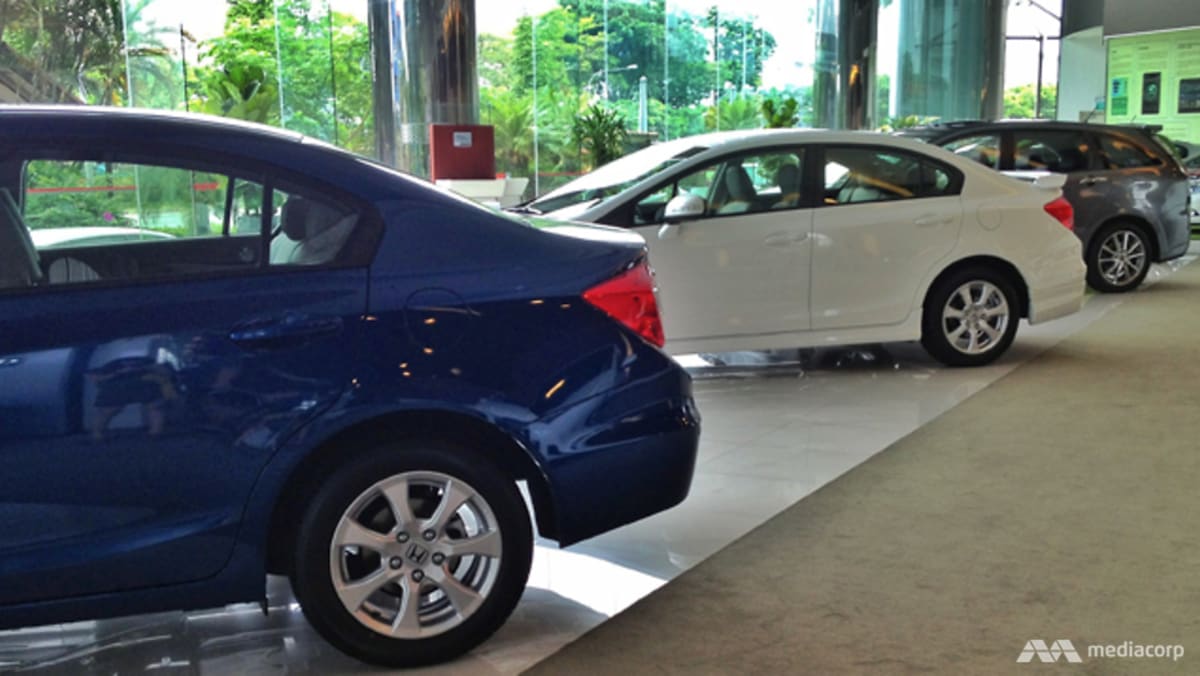
File photo of cars in a showroom in Singapore.
This audio is generated by an AI tool.
SINGAPORE: Merging the two car Certificate of Entitlement (COE) categories that are now differentiated based on engine capacity and power, and introducing a fee-and-rebate system to distinguish between luxury and mass-market cars could widen the price gap between models but may not lower premiums, transport experts said.
The Land Transport Authority (LTA) on Thursday (Oct 8) launched a public consultation on a proposal to merge categories A and B into a single pool of COEs. A rebate or surcharge would then apply to the prevailing premium based on each model's median open market value (OMV).
The authority is seeking views on two fee-and-rebate structures, with either three or five bands pegged to cars' open market value. Both would cap the rebate for lower-value cars and the surcharge for higher-end ones at S$15,000 each, creating a difference of up to S$30,000 in the COE price paid at opposite ends of the bands.
Using a car's value to determine the COE surcharge or rebate would separate luxury and mass-market models more directly than the current Category A and B criteria based on engine capacity and power, said Associate Professor in Practice Terence Ho from the National University of Singapore (NUS).
Advances in technology have allowed higher-end manufacturers to adjust the specifications of some models to fit within Category A, he said.
Assistant Professor Samuel Chng from the Singapore University of Technology and Design said using the median OMV would also treat cars of the same model more consistently and reduce the effect of fluctuations in individual import values.
CNA Games Guess Word Crack the word, one row at a time Buzzword Create words using the given letters Mini Sudoku Tiny puzzle, mighty brain teaser Mini Crossword Small grid, big challenge Word Search Spot as many words as you can Show More Show Less
NO GUARANTEE OF LOWER PRICES
The merger would not create more COEs, the experts noted. Assoc Prof Ho said supply depends on the permitted growth rate of the car population, deregistrations and special adjustments.
Associate Professor Raymond Ong from NUS described the changes as "really about an equity check between mass market and higher-end car ownership", rather than the availability of COE quota.
Associate Professor Walter Theseira from the Singapore University of Social Sciences said the system could guarantee a price gap between mass-market and luxury cars, but not a lower average premium.
If the common premium were S$100,000, a lower-value car with the maximum S$15,000 rebate would carry a COE cost of S$85,000, while a higher-value car with the maximum S$15,000 surcharge would cost S$115,000.
Both buyers would have competed in the same COE pool, but the fee-and-rebate system would create a S$30,000 difference in what they ultimately pay.
The common premium would still be set by the marginal buyer, Assoc Prof Theseira said. If that buyer is shopping for a higher-end car or can pay more, the premium could be closer to what Category B buyers are willing to pay today.
Some buyers may also put part of their savings from a rebate back into their COE bids to improve their chances, he said.
"At the end of the day, this policy can deliver you the price difference between mass-market and luxury cars, but it cannot deliver you lower COE prices," he said.
Whether rebates push premiums up would depend on how buyers respond, said Asst Prof Chng.
If existing buyers simply switch to lower-OMV models, the number of bidders would not necessarily rise. But if rebates attract additional buyers or give existing ones more room to bid, a higher common premium could offset some of the benefit, he said.
Unlike Category A today, lower-OMV cars would not have their own COE pool, so greater demand for them would feed into the same common premium, Asst Prof Chng said.
Some Category A buyers may still feel they have lost a degree of protection from higher-value buyers, although premium models in Category A have already weakened that perception, he added.
Assoc Prof Ong also flagged a possible rush to buy cars before the new bands take effect, as buyers weigh the certainty of the existing system against the unknowns of the new one.
He said COE prices should be watched ahead of implementation, although longer-term trends would still be driven by supply and demand.
SHIFTS IN WHAT'S ON OFFER
The range of cars sold in Singapore could change, the experts said.
Associate Professor Timothy Wong from NUS said Singapore is a small market where models are offered based on profitability. A new way of determining COE costs could make lower-OMV cars that qualify for rebates more appealing to bring in, he said.
Dealers could also adjust their offerings, particularly for cars just above the cut-off for a more favourable band, said Assoc Prof Theseira. This could include removing certain features or making them available only through subscriptions.
Buyers may make similar trade-offs. Assoc Prof Theseira said rebates could sway someone towards a less premium version of the same model, though he did not expect a buyer seeking an ultra-luxury car to switch to a cheaper model for the rebate alone.
Several experts favoured the five-band option, which would have S$7,500 adjustments between adjacent bands, compared with S$15,000 under the three-band option.
More bands would reduce what Assoc Prof Theseira called "cliff effects", where a car just above a cut-off attracts a significantly higher fee than one just below.
Smaller steps could also reduce the incentive to change a car's characteristics to land in a more favourable band, although such behaviour could not be eliminated as long as bands are used, he said.
Assoc Prof Ho also preferred five bands because cliff effects would be less pronounced, though this would come at the cost of greater complexity. Assoc Prof Wong said five bands would reduce the trade-offs over which cars to bring in.
OTHER IDEAS IN THE CONSULTATION
Experts were more cautious about other ideas raised in the consultation, including allocating COEs based on family needs, creating a separate category for private-hire cars and imposing a surcharge on multiple-car ownership.
On family needs, Assoc Prof Theseira questioned whether help should be tied specifically to buying a car.
"If we're going to give them a discount, then I think the question is: What is the best way of doing this?" he said. Broader financial support would let families decide whether to spend the money on a car or other needs, he added.
Assoc Prof Ong said COEs set aside for families may not end up more affordable than those in the common pool after bidding. He favoured a rebate for families meeting certain socio-economic criteria who successfully bid for a car.
Even deciding who qualifies would be difficult, said Asst Prof Chng. Family size alone would not necessarily reflect transport need, as smaller households caring for someone with a disability could face greater challenges than larger ones with better access to public transport or family support.
Needs could also change over a COE's 10-year life, complicating when households should qualify or be reassessed, he said.
Creating a separate COE category for private-hire cars would involve another balancing act, the experts said.
If the quota were set too low, commuters could face higher fares or find it harder to get a ride as operators deal with higher rental costs and tighter supply, said Asst Prof Chng.
An incorrect quota could also affect demand for private cars, said Assoc Prof Theseira. Some people who can afford a car choose not to own one because taxis and private-hire services meet their needs.
"The moment you do something to harm the viability of the industry, some of them are going to start buying private cars for their own use instead, and they will be competing with everyone else," he said.
On multiple-car ownership, experts said that enforcing a surcharge would be difficult. Assoc Prof Wong said second or third cars could be registered under different names, limiting the measure's effect on demand.
Wealthier households have more ways around such rules, including registering cars at different properties or under a company, said Assoc Prof Theseira. A large enough surcharge could even encourage businesses to help buyers restructure vehicle ownership, he added.
Closing such loopholes could require more intrusive enforcement, such as monitoring where cars are regularly kept. The more tightly rules were enforced, the more intrusive the system could become for car owners, he said.
Get our pick of top stories and thought-provoking articles in your inbox
Stay updated with notifications for breaking news and our best stories
Join our channel for the top reads for the day on your preferred chat app
学者们还就咨询中的其他一些想法(包括对拥有多辆车的人征收附加费)在实践中可能如何运作发表了看法。
新加坡一家汽车展厅的资料照片。
这段音频由人工智能工具生成。
新加坡:交通专家表示,将目前根据发动机排量和功率区分的两类汽车拥车证(COE)合并,并引入费用和回扣制度来区分豪华车和大众市场汽车,可能会扩大车型之间的价格差距,但可能不会降低保费。
陆路交通管理局(LTA)于周四(10月8日)就一项提案展开公众咨询,该提案拟将A类和B类拥车证合并为一个统一的拥车证池。合并后,将根据每款车型的市场中位数价值(OMV)对现行拥车证溢价进行折扣或附加费调整。
当局正在就两种收费和回扣方案征求意见,方案分别采用三级或五级收费标准,与车辆的公开市场价值挂钩。两种方案都将低价值车辆的回扣上限和高端车辆的附加费上限设定为15,000新元,这意味着在不同的收费标准下,车辆的拥车证价格最高可相差30,000新元。
新加坡国立大学(NUS)副教授何德伦表示,用汽车的价值来确定拥车证附加费或回扣,比目前基于发动机排量和功率的 A 类和 B 类标准更能直接地区分豪华车型和大众市场车型。
他表示,技术的进步使得高端制造商能够调整某些型号的规格,使其符合 A 类标准。
新加坡科技设计大学助理教授 Samuel Chng 表示,使用 OMV 中位数还可以更一致地对待同一型号的汽车,并减少单个进口价格波动的影响。
CNA游戏 猜词游戏 逐行破解单词 流行词游戏 用给定的字母组成单词 迷你数独 小小谜题,挑战你的大脑 迷你填字游戏 小方格,大挑战 单词搜索 尽可能多地找出单词 显示更多 显示更少
不保证价格更低
专家指出,此次合并不会增加拥车证数量。何副教授表示,拥车证供应量取决于汽车保有量的允许增长率、注销登记数量以及特殊调整措施。
新加坡国立大学副教授 Raymond Ong 将这些变化描述为“真正关乎大众市场和高端汽车所有权之间的公平性检验”,而不是拥车证配额的可用性。
新加坡社会科学大学副教授沃尔特·特塞拉表示,该系统可以保证大众市场汽车和豪华汽车之间的价格差距,但不能降低平均溢价。
如果普通保费为 100,000 新元,那么一辆价值较低的汽车,如果享受最高 15,000 新元的回扣,其拥车证成本为 85,000 新元;而一辆价值较高的汽车,如果加收最高 15,000 新元的附加费,其拥车证成本则为 115,000 新元。
两位买家原本会在同一个拥车证池中竞争,但费用和回扣制度会导致他们最终支付的金额相差 3 万新元。
塞西拉副教授表示,最终的溢价仍将由边际买家决定。如果这位买家想要购买更高端的车型,或者有能力支付更高的价格,那么溢价可能会更接近B类买家目前愿意支付的价格。
他还表示,一些买家可能会将部分退款节省下来的钱重新投入到拥车证竞标中,以提高中标几率。
“归根结底,这项政策可以让你看到大众市场汽车和豪华汽车之间的价格差异,但它无法让你降低拥车证价格,”他说。
助理教授 Chng 表示,回扣是否会推高保费,取决于买家的反应。
他表示,如果现有买家只是转向购买市场价较低的车型,竞标者数量未必会增加。但如果折扣吸引了更多买家,或者让现有买家有更大的竞标空间,那么更高的溢价可能会抵消部分收益。
助理教授 Chng 表示,与如今的 A 类汽车不同,低 OMV 汽车不会有自己的拥车证池,因此对它们的更大需求将导致同样的公共溢价。
他补充说,虽然A类高端车型已经削弱了这种看法,但一些A类买家可能仍然觉得他们失去了一定程度的保护,无法抵御更高价值的买家。
王副教授还指出,在新价格等级生效之前,可能会出现抢购汽车的现象,因为买家会权衡现有制度的确定性与新制度的未知性。
他表示,拥车证价格在实施前需要密切关注,尽管长期趋势仍将受供求关系驱动。
供应内容有所变化
专家表示,新加坡销售的汽车种类可能会发生变化。
新加坡国立大学副教授黄添明表示,新加坡市场规模较小,车型选择主要取决于盈利能力。他指出,新的拥车证成本计算方法可以使符合退税条件的低市场价值汽车更具吸引力,从而吸引更多企业引进。
副教授塞西拉表示,经销商还可以调整他们的产品,特别是对于那些价格略高于优惠区间门槛的车型。这可能包括移除某些功能,或者将其改为仅限订阅用户使用。
买家可能会做出类似的权衡。副教授塞西拉表示,折扣可能会促使消费者选择同一车型中配置较低的版本,但他并不认为原本想购买超豪华车的买家会仅仅因为折扣就转而选择更便宜的车型。
一些专家倾向于五段式方案,该方案相邻段之间的调整幅度为 7,500 新元,而三段式方案的调整幅度为 15,000 新元。
更多的收费区间可以减少 Theseira 副教授所说的“悬崖效应”,即价格略高于某个临界值的汽车比价格略低于该临界值的汽车收取更高的费用。
他还表示,较小的调整幅度也可以减少改变汽车特性以进入更有利的等级的动机,尽管只要等级制度存在,这种行为就无法消除。
何副教授也倾向于五级划分,因为这样可以减少悬崖效应,尽管这会增加系统的复杂性。黄副教授表示,五级划分可以减少在选择引进哪些车型时需要权衡的因素。
咨询中的其他想法
专家们对咨询中提出的其他想法持更为谨慎的态度,包括根据家庭需求分配拥车证、为私召车设立单独的类别以及对拥有多辆车征收附加费。
关于家庭需求,副教授塞西拉质疑援助是否应该专门与购买汽车挂钩。
“如果我们打算给他们折扣,那么我认为问题在于:怎样做才是最好的?”他说道。他还补充说,更广泛的财政支持可以让家庭自行决定将这笔钱用于买车还是其他必需品。
王副教授表示,预留给家庭的拥车证在竞标后可能并不比公共购车池中的拥车证更划算。他倾向于对符合特定社会经济条件的家庭,在成功竞标购得拥车证后给予折扣。
助理教授张教授表示,即使是确定哪些人符合资格也很困难。家庭规模本身并不一定能反映出交通需求,因为照顾残疾人士的小家庭可能比那些更容易获得公共交通或家庭支持的大家庭面临更大的挑战。
他还表示,在 COE 的 10 年使用期内,需求也可能会发生变化,这使得何时应该确定家庭是否符合资格或进行重新评估变得复杂。
专家表示,为私召车设立单独的拥车证类别需要进行另一项平衡工作。
助理教授张表示,如果配额设置得太低,通勤者可能会面临更高的票价,或者更难搭上车,因为运营商要应对更高的租金成本和更紧张的供应。
副教授塞西拉表示,配额不合理也可能影响私家车的需求。一些有能力买车的人选择不买车,因为出租车和网约车服务可以满足他们的需求。
他说:“一旦你做了损害行业生存能力的事情,他们中的一些人就会开始购买私家车供自己使用,他们将与其他人竞争。”
关于多车拥有问题,专家表示,征收附加费将难以执行。黄副教授指出,第二辆或第三辆车可能登记在不同的人名下,从而限制了该措施对需求的影响。
塞西拉副教授表示,富裕家庭有更多方法可以规避此类规定,例如将车辆登记在不同的房产名下或公司名下。他还补充说,如果附加费足够高,甚至可以促使企业帮助购车者重新安排车辆所有权。
他表示,堵住这些漏洞可能需要更严格的执法措施,例如监控车辆的常规停放地点。规则执行得越严格,对车主来说,这套系统就越会造成干扰。
订阅我们的邮件,即可获取精选热点新闻和引人深思的文章。
订阅通知,第一时间获取突发新闻和精彩报道。
加入我们的频道,即可在您常用的聊天应用上获取当日热门文章。