Hanwha sets sights on Army’s tracked howitzer program after victory in wheeled competition韩华在轮式火炮竞标中获胜后,将目光投向了陆军的履带式榴弹炮项目。
A Hanwha executive told reporters the company plans to offer its K9A1 or K9A2 tracked howitzers for the competition.
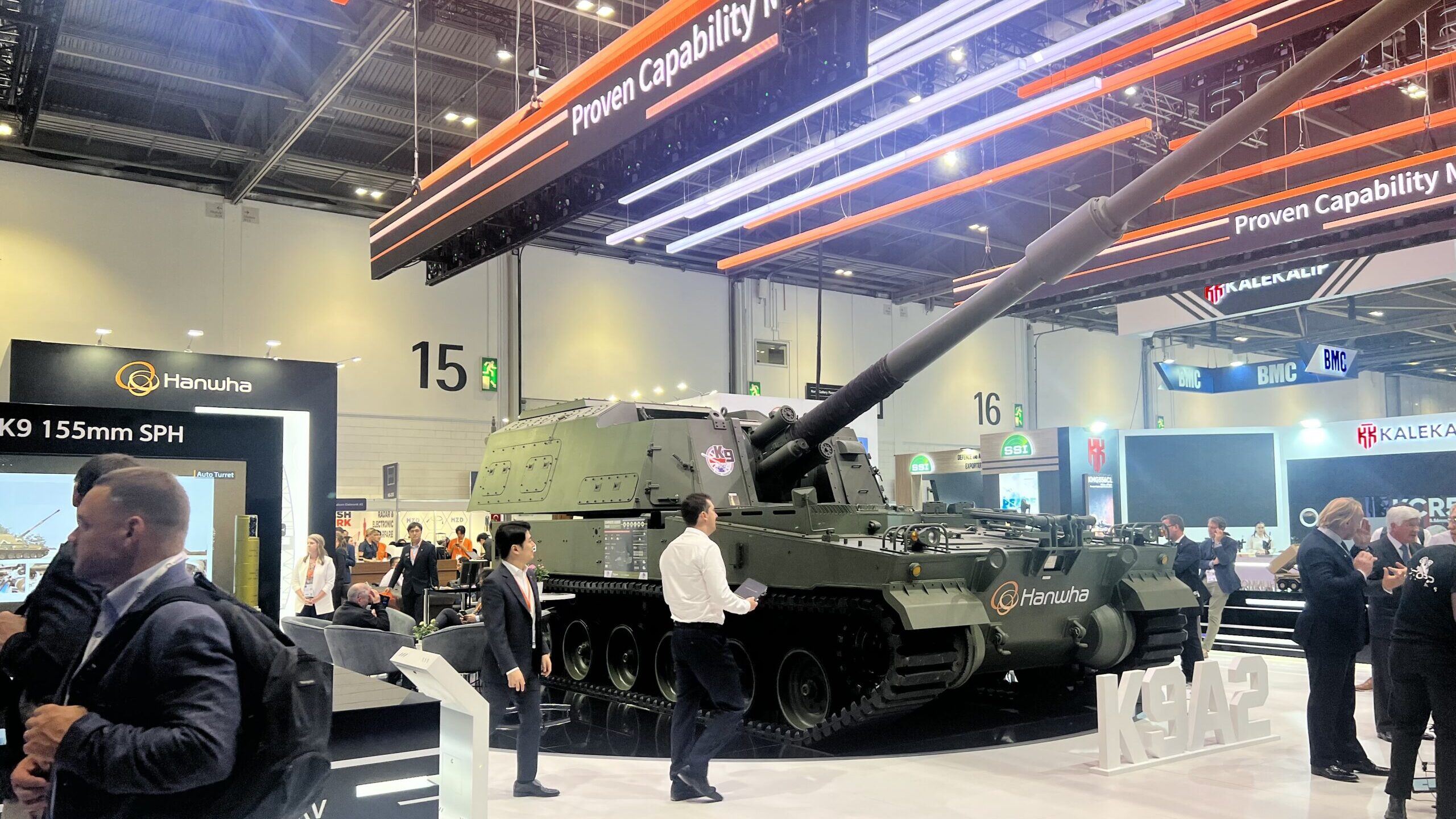
Korean defense contractor Hanwha made its presence known at the show with a few vehicles on display at DSEI 2023, including its new K9A2 self-propelled howitzer. (Lee Ferran / Breaking Defense)
WASHINGTON — Weeks after the Army tapped Hanwha Defense USA for its w heeled self-propelled howitzer modernization program, the company now plans to enter t he service’s new competition for a tracked variant.
“I think it’s a must. I mean, when we had early conversations with the Army, we actually thought the Army might be procuring tracked [variants] first,” Mike Smith, Hanwha USA’s COO and president of Land Systems, told reporters Tuesday.
Hanwha USA is looking at a “menu of options” for the competition — namely either its K9A1 or K9A2 tracked vehicles, Smith said. While he noted that the K9A1 is widely available and the “most cost-effective” option, the newer K9A2 variant features more modern capabilities.
According to Hanwha’s website , the K9A1 variant has a 155mm and 52-caliber ca nnon with a range of over 40 kilometers. At full capacity, it can fire six to eight rounds per minute for three minutes.
The K9A 2 is the company’s newer tracked variant. The howitzer has the same drive power as the K9A1, but features a fully automated turret capable of firing nine to 10 rounds per minute. The K9A2 also has two “independent” loading arms for projectiles and propellants, as well as a new autoloader system to increase the rate of fire and reduce the number of crew members needed.
The service recently awarded Hanwha $233 million for the accelerated delivery of six wheeled prototype howitzers, with an option for an additional 12. Both new wheeled and tracked variants are intended to replace the Army’s towed M777 and self-propelled M109A7s howitzers, the latter of which was originally fielded in the 1960s.
Smith’s comments come after the Army’s Program Acquisition Executive for Fires posted a request for information (RFI) on Sept. 30 seeking tracked howitzers and a coinciding resupply vehicle. The solicitation asked vendors for potential production lead times, maximum production capability , strategies to on shore US production if the vendor’s facilities are abroad and more.
Smith said the company currently has several variants of both vehicles being sold to other land forces, which could make the production lead time for the Army shorter if the service selects one of Hanwha’s tracked variants. However, he didn’t reveal what that lead time would look like.
The howitzers are “completely tailorable,” he added, meaning the company can make small tweaks to its vehicles if needed in order to meet the Army’s formal requirements.
A spokesperson from PAE Fir es told Breaking Defense earlier this month that the Army is pursuing separate tracked and wheeled howitzers because the two variants “ address different operational requirements and formations.”
The spokesperson said the wheeled variant is intended to provide more mobility, survivability and “responsiveness” for formations with towed artillery, while the tracked variant is better suited “for employment” with armored formations.
Traditionally, wheeled vehicles are also lighte r and best suited to driving on roa d s. Tracked vehicles often feature heavier chassis that can more easily maneuver in muddy or rougher environmental conditions.
Breaking Defense Video
Unpacking Boeing’s F/A-XX win, plus a report from wartime Ukraine
How Hegseth envisions a new Autonomous Warfare Command
What Europe’s military air fleets will look like in 30 years
Riyadh gets closer to F-35s, Damascus presses sovereignty and an expert take on Iran
Drone-hunting on the border, plus turmoil at an Air Force think tank
The future of European airpower might be unmanned
The big news out of AFA, plus a guided tour of the show floor
Why the ‘right to repair’ matters to the Pentagon
What the Pentagon is testing along the US-Mexico border
Chairman Caine talks cislunar ops, plus a window into next-gen airlift
韩国国防承包商韩华在2023年德国防务展(DSEI 2023)上展出了多款车辆,其中包括其新型K9A2自行榴弹炮,引起了广泛关注。(Lee Ferran / Breaking Defense)
华盛顿——就在陆军选择韩华防务美国公司参与其轮式自行榴弹炮现代化项目几周后,该公司现在计划参加该军种新的履带式榴弹炮竞标。
“我认为这是必须的。我的意思是,当我们早期与陆军进行对话时,我们实际上认为陆军可能会首先采购履带式[型号],”韩华美国公司首席运营官兼陆地系统总裁迈克·史密斯周二告诉记者。
韩华美国公司正在考虑一系列竞标方案,主要包括其K9A1或K9A2履带式车辆,史密斯表示。他指出,K9A1供应充足,是“最具性价比”的选择,而更新的K9A2则具备更先进的功能。
根据韩华官网介绍,K9A1型机炮配备一门155毫米、52倍径的火炮,射程超过40公里。满负荷运转时,每分钟可发射6至8发炮弹,持续3分钟。
K9A 2 是该公司最新推出的履带式榴弹炮。该炮的驱动力与 K9A1 相同,但配备了全自动炮塔,射速可达每分钟 9 至 10 发。K9A2 还拥有两个独立的弹丸和发射药装填臂,以及一套新型自动装弹系统,从而提高了射速并减少了所需乘员数量。
陆军最近向韩华公司授予 2.33 亿美元的合同,用于加速交付六门轮式原型榴弹炮,并可选择再增购 12 门。新型轮式和履带式榴弹炮旨在取代陆军的牵引式 M777 榴弹炮和自行式 M109A7s 榴弹炮,后者最初于 20 世纪 60 年代投入使用。
史密斯的评论是在陆军火力项目采购执行官于9月30日发布信息征询书(RFI)之后发表的。该征询书寻求采购履带式榴弹炮和配套的补给车辆。征询书要求供应商提供潜在的生产周期、最大生产能力、如果供应商的工厂位于海外,则需制定在美国本土生产的策略等等。
史密斯表示,该公司目前已向其他陆军部队出售了多种不同型号的车辆,如果陆军最终选择韩华的履带式车辆,这将缩短陆军的生产周期。但他并未透露具体的生产周期。
他补充说,这些榴弹炮“完全可定制”,这意味着如果需要,该公司可以对其车辆进行一些小的调整,以满足陆军的正式要求。
PAE Fire 的一位发言人本月早些时候告诉 Breaking Defense,陆军正在研发履带式和轮式榴弹炮,因为这两种型号“满足不同的作战需求和编队”。
发言人表示,轮式版本旨在为牵引式火炮部队提供更高的机动性、生存能力和“响应能力”,而履带式版本更适合与装甲部队一起“使用”。
传统上,轮式车辆也更轻便,最适合在道路上行驶。履带式车辆通常采用更重的底盘,可以更容易地在泥泞或更崎岖的环境条件下行驶。
突破性防御视频
深入剖析波音F/A-XX的中标,以及来自战时乌克兰的报道
赫格塞斯设想的新型自主作战指挥部
30年后欧洲军用空军机队会是什么样子
利雅得距离F-35战机更近一步,大马士革强调主权,以及专家对伊朗的看法
边境无人机猎杀行动,以及空军智库的动荡
欧洲空军的未来或许在于无人化。
AFA展会最新动态,以及展会现场导览。
为什么“维修权”对五角大楼如此重要
五角大楼正在美墨边境测试什么?
凯恩主席谈近地月空间作业,以及下一代空运技术展望