A leap in drone range and payloads come from a battery with different chemistry无人机航程和有效载荷的飞跃得益于采用不同化学成分的电池。
Licerion Strike battery technology delivers high energy density and extended flight time for unmanned aerial systems and other demanding applications.
新闻视频
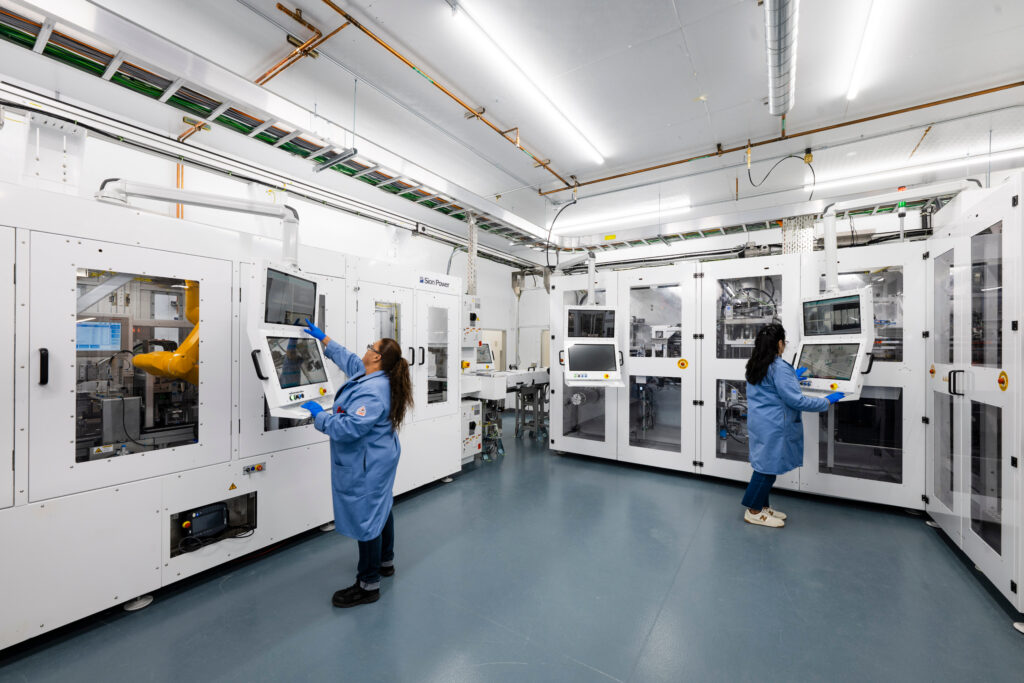
Inside Sion Power's advanced lithium-metal production facility. (Image courtesy of Sion Power.)
The US military is asking more of its unmanned systems, all of which are constrained by the energy capacity of today’s batteries. The demand for increasingly capable and power-hungry drones means the battery’s capability determines range, endurance, payload, and time on station.
Breaking Defense spoke with Sion Power CTO Job Rijssenbeek about advances in high-capacity battery chemistry, where lithium-metal technology may be applicable, and why batteries and unmanned platforms increasingly need to be co-designed as a single system.
Breaking Defense: As unmanned systems take on more demanding missions, is energy becoming a limiting factor in what they can do?
Job Rijssenbeek is chief technology officer of Sion Power.
Rijssenbeek : Absolutely. Brig. Gen. Troy Denomy, program acquisition executive for maneuver, summed up energy challenges at GVSETS (Ground Vehicle Systems Engineering & Technology Symposium) this past summer when he said, ‘Every formation we have today is underpowered.’ The insatiable demand for energy will only increase.
For airborne platforms, every pound matters. More weight requires more energy to lift, which requires more batteries, which add more weight. This quickly becomes a vicious circle. If you can put more energy into the same battery weight, you meaningfully change that math. Greater energy density batteries become enablers of greater range, endurance, and mission capability. They put more missions within reach.
What has changed in battery technology to make improvements in power, weight, and performance possible?
Lithium-ion technology has been extraordinarily successful, and will remain the right choice for many applications, but it is reaching its entitlement performance. There are several advanced battery chemistries coming onto the market, but there isn’t one chemistry that’s best for every mission. The different chemistries and ways of putting those together deliver different combinations of energy, power, cycle life, safety, and cost.
For applications where weight and endurance are especially important, lithium-metal anode batteries are compelling because replacing the graphite anode with lithium metal reduces weight and volume, and increases energy density. Those gains significantly enhance mission capability.
Sion Power has been at the forefront of lithium-metal battery innovation for more than 25 years. Over the last 15 years, we’ve developed robust IP around high-energy density batteries for electric vehicles. In the process, we developed lithium anode production technology, electrolyte formulations, cell designs, and packaging that makes this promising chemistry practical and applicable for aerospace and defense applications.
Today we’re producing large-format lithium-metal cells in Tucson, Arizona that offer double the energy density of conventional lithium-ion batteries, at the cell and pack level, which is transformational for drones and the missions they can fulfill.
What does higher energy density mean in practical terms for defense customers?
More energy at the same or lower weight translates into extended mission duration or additional payload. You can fly longer, reach farther, and do more.
Our maximum energy, one-way attack Licerion Strike cell is designed to deliver up to 500 Wh/kg at the cell level, compared with roughly 250 Wh/kg for today’s standard lithium-ion drone batteries. This means roughly twice the flight time, which translates to greater reach, significantly greater time on station, and enhanced effectiveness. Drones are being asked to carry increasingly greater electronic payloads (like communications, jamming, autonomous guidance, etc.), which consume hundreds of watts of continuous power. Higher-energy batteries allow operators to incorporate more of these capabilities without sacrificing endurance.
Defense systems must operate safely and reliably in harsh environments. How do lithium-metal cells perform under abuse conditions and temperature extremes?
Higher energy density is a benefit only if the cell can operate reliably under the conditions the mission requires. Any time more energy goes into a smaller package, safety always has to be front of mind. I’m proud to say that safety has always been our top priority at Sion Power. We design for safety rigorously, from the materials to the battery pack.
At our Tucson facility, we have approximately 2,000 test channels and a 5,300-square-foot safety and abuse lab dedicated to rigorous performance and safety testing – from exposure to extreme temperatures and vibration, to nail penetration, and forced discharge.
We understand that our batteries need to perform reliably in diverse environments and conditions, and we are constantly expanding the capabilities on that front. (defense customers will be using our batteries in non-hostile environments as well)
Licerion Strike demonstration pack on commercial drone. (Image courtesy of Sion Power.)
What happens when you take lithium-metal batteries out of the lab and put them onto an actual drone?
We asked ourselves the same question earlier this year, as we shifted our application focus to drones. To find out, we fitted one of our Licerion Strike demonstration packs onto a commercially available Freefly Astro Max drone, replacing the drone’s two conventional lithium-ion batteries. Our pack increased onboard energy by over 50 percent and reduced the pack weight by nearly 30 percent, all while using the same mechanical footprint.
More importantly, the drone flew nearly twice as long when equipped with our battery, increasing from 33 minutes to 60 minutes.
Twice the flight time means reaching targets twice as far away and putting the pilot further out of harm’s way. Twice the flight time also means more time to be productive at the target. For example, if the target area is 15 minutes away, a 33-minute aircraft has only about three minutes on station before it must return. That’s not a lot of time to be effective. However, at 60 minutes of endurance, that enables 30 minutes on station. Imagine what more you can do in 30 minutes that you cannot do in 3 minutes. That’s the kind of difference operators care about.
Can lithium-metal technology be manufactured at defense-relevant scale and cost?
Absolutely. We’re shipping cells today from Tucson and are ramping 10–20 MWh of pilot-line capacity. We have plans for expanding to 100–200 MWh and more as demand increases. While we replace graphite with a lithium metal anode, all the other battery components are commensurate with already commercialized lithium-ion batteries. We already tap those supply chains to minimize our cell costs. As our manufacturing scale increases, our cost position will improve further.
Which drones would benefit most from lithium-metal, and where else could higher energy density change the performance equation?
Our lithium-metal solutions are ideal for heavier Group 1 and Group 2 drones where the range and payload benefits are significant. Group 3 drones tend to be powered by internal combustion engines today but will benefit from greater electrification and noise reduction that high-energy batteries will enable. Beyond drones, we anticipate our cells will be able to support robotics, automotive, and space applications in the future. If weight and energy are constraints, our batteries will help.
Licerion Strike lithium-metal cell. (Image courtesy of Sion Power.)
Is lithium-metal technology primarily suited to one-way applications, or can the technology also support rechargeable systems?
Lithium-metal batteries are absolutely rechargeable. Our work for automotive was foundational to demonstrating this.
We developed large-format 400 Wh/kg Licerion pouch cells that achieve 800 charge-discharge cycles, are fast-charge capable, and were validated by leading global OEMs. While our Licerion Strike product is aimed at maximum energy density, we’ve applied those learnings to Licerion Echo, our rechargeable solution, which is designed to deliver high energy density with over 150 cycles. Rechargeability increases flexibility, supports reuse, and reduces replacement demand.
China dominates the global supply chain for battery-grade materials. How can battery technologies reduce that dependency?
China’s supply chain dominance was established over decades and that will not be undone overnight. There isn’t a single chemistry that eliminates every supply-chain vulnerability.
One advantage of lithium-metal batteries is that the anode doesn’t require graphite, which removes one key dependence from the bill of materials.
I’m proud to say that Sion Power’s batteries are 100 percent manufactured in the United States. We already have a low dependence on China-made materials, and we are systematically qualifying alternative material sources to strengthen our supply chain resilience and comply with US defense sourcing requirements.
What needs to change in how batteries and unmanned systems are designed to unlock the next leap in capability?
I don’t think drone dominance will be based on one particular chemistry; rather, it’s about using the right chemistry for the mission.
For drones where endurance and weight are critical, lithium-metal represents a significant step forward in energy density. But the bigger change will come when batteries and unmanned systems are increasingly co-designed. That will enable greater optimization of range, payload, power, cycle life, and cost at the system level. The real acceleration comes when we stop optimizing the drone and the battery separately and start optimizing the entire system as one. That kind of approach turns improvements into capabilities that will help forces achieve overmatch.
这是Sion Power公司先进的锂金属生产设施内部。(图片由Sion Power公司提供。)
美国军方对无人系统提出了更高的要求,而所有这些系统都受到现有电池能量容量的限制。对功能日益强大且耗电量更大的无人机的需求意味着电池的性能决定了无人机的航程、续航时间、有效载荷和驻留时间。
Breaking Defense 采访了 Sion Power 的首席技术官 Job Rijssenbeek,讨论了高容量电池化学的进步、锂金属技术可能适用的领域,以及为什么电池和无人平台越来越需要作为一个单一系统进行共同设计。
国防新闻:随着无人系统承担越来越艰巨的任务,能源是否正在成为限制其功能的因素?
Job Rijssenbeek 是 Sion Power 的首席技术官。
里森贝克:完全正确。机动系统项目采购主管特洛伊·德诺米准将去年夏天在地面车辆系统工程与技术研讨会(GVSETS)上总结了能源挑战,他说:“我们目前的每个编队都动力不足。” 对能源的永无止境的需求只会增加。
对于空中平台而言,每一磅都至关重要。重量越大,提升所需的能量就越多,这就需要更多的电池,而电池又会增加重量。这很快就会形成恶性循环。如果能在相同重量的电池中注入更多能量,就能显著改变这种局面。更高能量密度的电池能够提升航程、续航时间和任务能力,使更多任务成为可能。
电池技术发生了哪些变化,使得在功率、重量和性能方面取得改进成为可能?
锂离子电池技术取得了巨大的成功,并且在许多应用领域仍将是理想之选,但其性能已接近极限。目前市面上涌现出多种先进的电池化学体系,但没有一种化学体系能够完美适用于所有应用场景。不同的化学体系及其组合方式会带来不同的能量、功率、循环寿命、安全性和成本组合。
对于重量和续航能力至关重要的应用场景,锂金属负极电池极具吸引力,因为用锂金属负极取代石墨负极可以减轻重量、缩小体积并提高能量密度。这些优势显著提升了任务执行能力。
Sion Power在锂金属电池创新领域深耕超过25年,始终处于行业领先地位。过去15年间,我们围绕高能量密度电动汽车电池开发了强大的知识产权。在此过程中,我们研发了锂负极生产技术、电解液配方、电池设计和封装工艺,使这项极具前景的技术得以实际应用于航空航天和国防领域。
今天,我们在亚利桑那州图森市生产大尺寸锂金属电池,其电芯和电池组的能量密度是传统锂离子电池的两倍,这对无人机及其能够执行的任务来说具有变革性意义。
对于国防客户而言,更高的能量密度在实际意义上意味着什么?
在重量相同或更轻的情况下,更高的能量意味着更长的任务持续时间或更大的有效载荷。您可以飞行更长时间、到达更远的地方,完成更多任务。
我们推出的Licerion Strike单节电池能量密度高达500 Wh/kg,远高于目前标准锂离子无人机电池的约250 Wh/kg。这意味着飞行时间将延长近一倍,从而带来更远的作战半径、更长的驻留时间和更高的作战效能。无人机需要搭载的电子载荷(例如通信、干扰、自主导航等)越来越大,这些载荷会消耗数百瓦的持续功率。高能量电池使操作人员能够在不牺牲续航能力的前提下,集成更多此类功能。
国防系统必须在恶劣环境下安全可靠地运行。锂金属电池在严苛的使用条件和极端温度下性能如何?
只有当电池能够在任务所需的条件下可靠运行时,更高的能量密度才能带来优势。任何时候,当更多能量被封装在更小的体积内时,安全都必须始终放在首位。我很自豪地说,安全一直是Sion Power的重中之重。从材料到电池组,我们都严格把控安全设计。
我们在图森的工厂拥有大约 2,000 个测试通道和一个 5,300 平方英尺的安全和滥用实验室,专门用于严格的性能和安全测试——从暴露于极端温度和振动,到钉子穿透和强制放电。
我们深知电池需要在各种环境和条件下可靠运行,因此我们不断提升这方面的能力。(国防客户也将在非敌对环境下使用我们的电池)
Licerion Strike演示套件在商用无人机上的应用。(图片由Sion Power提供。)
如果把锂金属电池从实验室拿出来,装到真正的无人机上会发生什么?
今年早些时候,当我们把应用重点转向无人机时,我们也问过自己同样的问题。为了找到答案,我们将我们自主研发的 Licerion Strike 演示电池组安装到一架市售的 Freefly Astro Max 无人机上,替换了无人机原有的两块传统锂离子电池。我们的电池组在保持机械尺寸不变的情况下,将机载能量提升了 50% 以上,重量减轻了近 30%。
更重要的是,无人机装上我们的电池后,飞行时间几乎翻了一番,从 33 分钟增加到 60 分钟。
飞行时间翻倍意味着能够抵达两倍远的目标,从而让飞行员远离危险。飞行时间翻倍也意味着在目标区域有更多有效执行任务的时间。例如,如果目标区域距离目标15分钟航程,那么一架续航时间为33分钟的飞机在返回前只有大约3分钟的停留时间。这点时间不足以有效执行任务。然而,如果续航时间达到60分钟,则可以在目标区域停留30分钟。想象一下,30分钟内你能完成多少3分钟内无法完成的任务。这正是作战人员所关心的差异。
锂金属技术能否以国防相关的规模和成本进行制造?
当然。我们今天就从图森工厂发货,并正在逐步提升10-20兆瓦时的试点生产线产能。我们计划随着需求的增长,将产能扩大到100-200兆瓦时甚至更高。虽然我们用锂金属负极取代了石墨,但所有其他电池组件都与已商业化的锂离子电池相同。我们已经利用现有的供应链来最大限度地降低电池成本。随着生产规模的扩大,我们的成本优势将进一步提升。
哪些无人机最能受益于锂金属?更高的能量密度还能在哪些方面改变无人机的性能?
我们的锂金属解决方案是重型1类和2类无人机的理想之选,可显著提升其航程和有效载荷。目前,3类无人机通常采用内燃机驱动,但高能量电池带来的更高电气化水平和更低噪音将使其受益匪浅。除了无人机领域,我们预计未来我们的电池还将应用于机器人、汽车和航天等行业。如果重量和能量是关键因素,我们的电池将助您一臂之力。
Licerion Strike 锂金属电池。(图片由 Sion Power 提供。)
锂金属技术主要适用于单向应用,还是也可以支持可充电系统?
锂金属电池是完全可充电的。我们在汽车领域的工作为证明这一点奠定了基础。
我们开发了400 Wh/kg的大容量Licerion软包电池,其充放电循环次数可达800次,支持快充,并已通过全球领先的OEM厂商验证。我们的Licerion Strike产品旨在实现最大能量密度,而我们将这些经验应用于可充电解决方案Licerion Echo,该方案旨在提供高能量密度和超过150次的循环寿命。可充电性提高了灵活性,支持重复使用,并减少了更换需求。
中国在全球电池材料供应链中占据主导地位。电池技术如何才能降低这种依赖性?
中国供应链的主导地位是经过几十年建立起来的,不可能在一夜之间被撼动。没有任何一种单一的化学方法可以消除供应链中的所有漏洞。
锂金属电池的一个优点是阳极不需要石墨,这减少了物料清单中的一个关键依赖项。
我自豪地宣布,Sion Power的电池100%在美国制造。我们对中国制造材料的依赖程度本来就很低,而且我们正在系统地评估其他材料来源,以增强供应链的韧性,并符合美国国防采购要求。
电池和无人系统的设计需要做出哪些改变才能实现能力的下一个飞跃?
我认为无人机的主导地位不会取决于某种特定的化学成分;而是取决于为任务选择合适的化学成分。
对于续航时间和重量至关重要的无人机而言,锂金属电池在能量密度方面取得了显著进步。但更大的变革将出现在电池和无人系统日益协同设计之时。这将使系统层面的航程、有效载荷、功率、循环寿命和成本得到更优化。真正的加速发展源于我们不再分别优化无人机和电池,而是将整个系统作为一个整体进行优化。这种方法可以将改进转化为强大的能力,帮助部队取得绝对优势。