GDLS exec: New loitering munitions platform to be delivered to Army by end of month通用动力陆地系统公司高管:新型巡飞弹平台将于月底前交付陆军。
The company is on contract to provide four PERCH 2.0 prototypes to the Army's 1st Brigade, 1st Cavalry Division by the end of October.
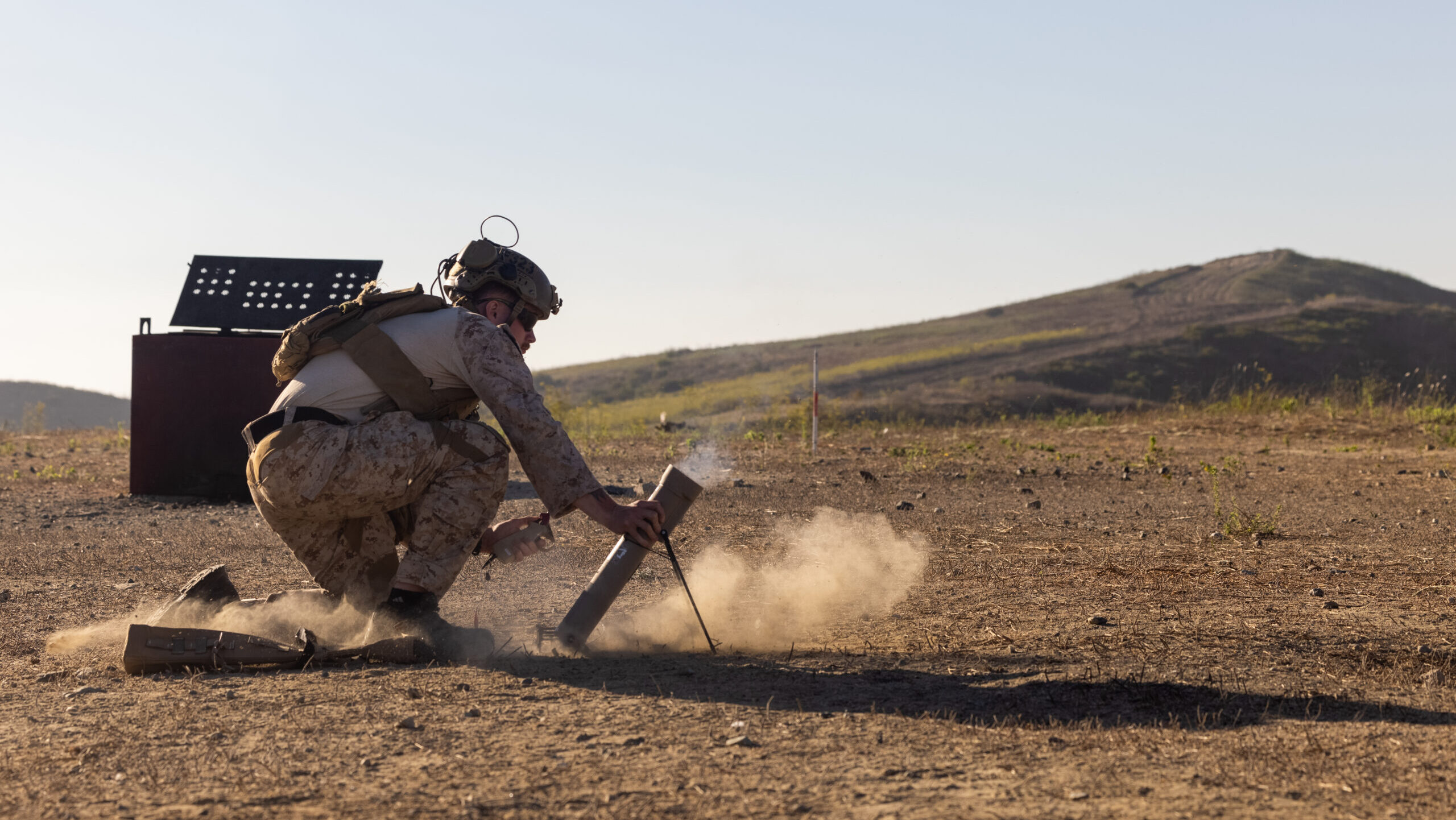
A U.S. Marine with 1st Reconnaissance Battalion, 1st Marine Division, fires a Switchblade 300 loitering munition system. The Switchblade 300 is the munition that will be incorporated into PERCH 2.0 (U.S. Marine Corps photo by Cpl. Jaye Townsend)
WASHINGTON — An updated version of General Dynamics Land Systems’ (GDLS) loitering munitions platform are set to be delivered to the Army by the end of the month, a company executive told Breaking Defense this week.
The platforms are the second iteration of the company’s Precision Effects & Reconnaissance-Canister-Housed , or PERCH system. The kit integrates on Abrams tanks and Stryker vehicles to provide beyond line-of-sight surveillance and is outfitted with AeroVironment’s (AV) Switchblade loitering munitions.
Four PERCH 2.0 prototypes will be delivered to Fort Hood’s 1st Brigade, 1st Cavalry Division by the end of October, where soldiers will integrate them into Abrams tanks for experiment ation, Scott Taylor, GDLS’ director of US growth, said.
The company developed the first PERCH iteration with internal research and development (IRAD) funding in response to reporting about the war in Ukraine, feedback from field commanders in Europe and discussions with senior leaders in III Armored Corps, Taylor said.
“So it’s sort of a rapid development, trying to meet the Army’s needs where they are,” he added.
After GDLS demonstrated its first PERCH iteration, which it debuted at last year’s AUSA, the Army provided feedback to GDLS. The company applied the Army’s comments to create the first prototype of PERCH 2.0, once again using IRAD funds.
Part of that initial feedback, Taylor explained, w as to incorporate enhanced beyond line-of-sight technology, make reloads easier, increase storage space — which the company did by switching out AV’s SB600 for the SB300 — and create a system that can fire without soldiers having to open hatches After evaluating the second version, Taylor said the Army found the design “compelling” and wanted a total of four prototypes. “We said, ‘Well, can you get some skin in the game?”’ Taylor recounted. The Army subsequently purchased three prototypes under the Abrams System Technical Support (STS) contract, which is updated periodically, with the PERCH 2.0 purchases added to the contract in August .
A spokesperson from GDLS later told Breaking Defense that “doing it that way allows us to move quickly to meet emerging needs.”
The Army has shown increased interest in mounting loitering munitions onto its armored vehicles. Apart from the Abrams tank, the service is looking to implement loitering munitions onto its replacement for the Bradley Infantry Vehicle, dubbed the XM30 .
As Breaking Defense previously reported , the two models the Army is currently choosing from — American Rheinmetall’s Lynx and GDLS’ Wolf — are both outfitted with options to attach loitering munitions. However, Taylor did not comment on what kinds of loitering munitions could be attached to the Wolf.
Breaking Defense Video
New leaders, new drone command: What we expect from AUSA 2026
Unpacking Boeing’s F/A-XX win, plus a report from wartime Ukraine
How Hegseth envisions a new Autonomous Warfare Command
What Europe’s military air fleets will look like in 30 years
Riyadh gets closer to F-35s, Damascus presses sovereignty and an expert take on Iran
Drone-hunting on the border, plus turmoil at an Air Force think tank
The future of European airpower might be unmanned
The big news out of AFA, plus a guided tour of the show floor
Why the ‘right to repair’ matters to the Pentagon
What the Pentagon is testing along the US-Mexico border
美国海军陆战队第一侦察营第一师的一名陆战队员正在发射“弹簧刀300”巡飞弹系统。“弹簧刀300”是将被纳入“鱼群2.0”系统的弹药。(美国海军陆战队下士杰伊·汤森德摄)
华盛顿——通用动力陆地系统公司(GDLS)的一位高管本周告诉《防务新闻》,该公司升级版的巡飞弹平台将于本月底交付给陆军。
这些平台是该公司“精确效应与侦察罐式弹药”(PERCH)系统的第二代产品。该套件可集成到艾布拉姆斯坦克和斯特瑞克装甲车上,提供超视距监视能力,并配备了AeroVironment公司(AV)的“弹簧刀”巡飞弹。
通用动力陆地系统公司(GDLS)美国增长总监斯科特·泰勒表示,到 10 月底,将有 4 个 PERCH 2.0 原型机交付给胡德堡第一骑兵师第一旅,士兵们将把它们集成到艾布拉姆斯坦克中进行试验。
泰勒表示,该公司利用内部研发资金开发了第一个 PERCH 版本,以响应有关乌克兰战争的报道、来自欧洲一线指挥官的反馈以及与第三装甲军高级领导人的讨论。
“所以这是一个快速发展的过程,旨在满足军队在当地的需求,”他补充道。
GDLS在去年的美国陆军协会(AUSA)年会上首次展示了其首款PERCH系统后,陆军向GDLS提供了反馈意见。该公司根据陆军的意见,再次利用内部研发(IRAD)资金,打造了PERCH 2.0的首个原型。
泰勒解释说,最初的反馈意见之一是,要加入增强型超视距射击技术,简化装弹流程,增加存储空间——为此,该公司用SB300替换了AV公司的SB600——并开发出一种无需士兵打开舱门即可射击的系统。在评估了第二版之后,泰勒表示,陆军认为该设计“引人注目”,并希望总共采购四套原型机。“我们说,‘好吧,你们能投入一些资金吗?’”泰勒回忆道。随后,陆军根据定期更新的艾布拉姆斯系统技术支持(STS)合同采购了三套原型机,PERCH 2.0的采购于8月份被添加到该合同中。
GDLS 的一位发言人后来告诉 Breaking Defense,“这样做可以让我们迅速行动,满足新出现的需求。”
美国陆军对在其装甲车辆上装备巡飞弹表现出越来越浓厚的兴趣。除了艾布拉姆斯主战坦克外,陆军还计划在其布雷德利步兵战车的替代车型——XM30上装备巡飞弹。
正如《防务新闻》此前报道,陆军目前正在考虑的两款无人机——美国莱茵金属公司的“山猫”(Lynx)和通用动力陆地系统公司的“狼”(Wolf)——都可选装巡飞弹。然而,泰勒并未透露“狼”无人机可以挂载哪些类型的巡飞弹。
突破性防御视频
新领导人,新无人机指挥部:我们对 AUSA 2026 的期待
深入剖析波音F/A-XX的中标,以及来自战时乌克兰的报道
赫格塞斯设想的新型自主作战指挥部
30年后欧洲军用空军机队会是什么样子
利雅得距离F-35战机更近一步,大马士革强调主权,以及专家对伊朗的看法
边境无人机猎杀行动,以及空军智库的动荡
欧洲空军的未来或许在于无人化。
AFA展会最新动态,以及展会现场导览。
为什么“维修权”对五角大楼如此重要
五角大楼正在美墨边境测试什么?