Swedish government launches first Patriot mission to Poland瑞典政府启动首次爱国者导弹系统波兰任务
The move, part of a NATO mission, comes as a new government is coming to power in Stockholm, with security policy at the heart of political row.
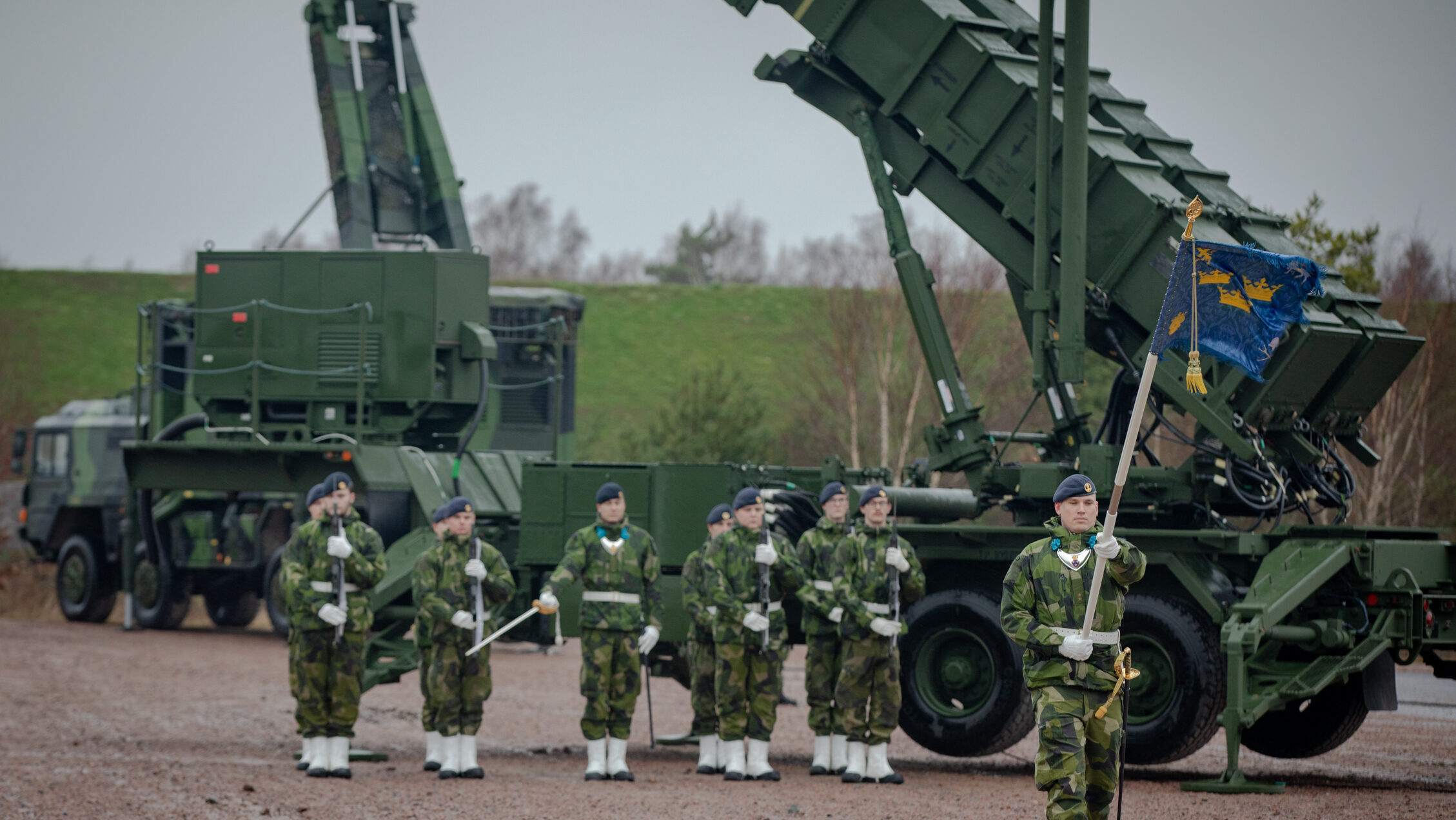
Members from the Swedish air defense regiment participated in a handover ceremony in Halmstad, Sweden on November 18, 2021. (U.S. Army Photos by Sgt. 1st Class Terrance D. Rhodes)
STOCKHOLM — Against a backdrop of political controversy over Sweden’s approach to the nations on NATO’s eastern flank, Stockholm this week announced it will be sending Patriot batteries to Poland, the first time it has deployed the high-end air defenses as part of a NATO mission.
About 100 personnel from the Swedish Air Defense Regiment (Lv 6) in Halmstad will protect NATO’s logistics hub in southeastern Poland, outgoing Prime Minister Ulf Kristersson said at a press briefing at the government headquarters on Tuesday. Saab Gripen fighters from the Blekinge Air Wing (F 17) are already flying over Poland this month to protect the same hub.
“All of this strengthens NATO, it strengthens Europe, and it strengthens Sweden,” said Kristersson.
The hub near the Ukrainian border is the main transit point for military and civilian aid to Ukraine under NATO’s Security Assistance and Training for Ukraine (NSATU). The Swedish unit will operate under NATO Air Command and contribute to NATO’s Integrated Air and Missile Defense (IAMD).
Sweden is taking over the rotational role from the Netherlands, which has Patriot batteries there. The mandate runs from December with plans to continue into the first half of 2027, Defense Minister Pål Jonson said.
“We will also gain important operational and strategic experience with a very close ally, as Poland is. These are rotational deployments to which we are now contributing in solidarity,” Jonson said.
Jonson stressed that the security situation in Sweden’s immediate neighborhood “is very serious,” citing intensified hybrid operations against Europe. “Moscow’s purpose is clear,” he said. “It is about trying to undermine support for Ukraine. It is about trying to intimidate our societies and create division and fear. Russia will not succeed in that.”
He concluded that Sweden “must prepare for a deteriorated security situation in the neighborhood for a prolonged period,” and pointed to several recent cases. Alongside the incident at Germany’s Leipzig Airport in August, the Estonian recently security service claimed that Russian intelligence services were behind the August attack on the defense company Milrem in Tallinn.
In Sweden, the current cabinet is a caretaker government after September’s parliamentary election, in which the red-green-center bloc won by a narrow margin. However, no government has been formed, and it is unclear when the parties will cohere around a new leader.
As a result, Kristersson, who has been prime minister since October 2022 with the conservative Moderate Party, is acting as a caretaker at a time when the security situation is shaky.
“Almost every day something happens that affects security in Sweden and Europe. We are monitoring it constantly. We are on our toes. Our authorities are on their toes,” he said.
The caretaker government is, as he noted, quite limited when it comes to new domestic-policy initiatives. However, Kristersson said, it “is not limited when it comes to protecting Sweden — that is, Swedish interests, Sweden’s security, and the security of Swedes in Sweden or abroad. That is also important to say.”
Foreign Minister Questions PM Candidate Andersson
Underlining Kristersson’s point that the security situation does not pause while Sweden works out its politics, an internal row broke out this week between the rival parties.
Social Democratic leader and prime-ministerial candidate Magdalena Andersson told Politico on election day that the outgoing government had focused too narrowly on the Baltic region and ignored “the global south,” seemingly an indication that should Andersson manage to form a government, Sweden’s focus on NATO’s eastern flank could change.
Andersson is in a second round of talks after the Speaker of the Riksdag again tasked her with forming a government that parliament can tolerate. She first received the mandate, returned it, and has now been given it again.
Politico’s story was later updated to say that Andersson’s office clarified she was not criticizing efforts to strengthen work in the Baltic region, but opponents, including the caretaker government, have tried to jump on her comments as a sign that a Social Democrat-led coalition will be less committed to defending NATO’s eastern flank.
On the sideline of Tuesday’s briefing, outgoing Foreign Minister Maria Malmer Stenergard painted Andersson’s comments in a negative light, saying “I actually think it gives the impression that one does not really have a grasp of the situation, and that is very concerning because she [Andersson] aspires to become prime minister in a historically difficult period for security policy.”
Malmer Stenergard added that “I want a prime minister who is comfortable with the security issues,” and ” who does not make sweeping statements about nuclear weapons without actually having grounds for them, and “who truly prioritizes security in the immediate neighborhood, because that is how we build security for Sweden.”
The day after Malmer’s Stenergard’s comments, Andersson posted on X , saying, “A government I lead will be a strong, reliable and active ally in NATO. In turbulent times, we are stronger together.”
Breaking Defense Video
Unpacking Boeing’s F/A-XX win, plus a report from wartime Ukraine
How Hegseth envisions a new Autonomous Warfare Command
What Europe’s military air fleets will look like in 30 years
Riyadh gets closer to F-35s, Damascus presses sovereignty and an expert take on Iran
Drone-hunting on the border, plus turmoil at an Air Force think tank
The future of European airpower might be unmanned
The big news out of AFA, plus a guided tour of the show floor
Why the ‘right to repair’ matters to the Pentagon
What the Pentagon is testing along the US-Mexico border
Chairman Caine talks cislunar ops, plus a window into next-gen airlift
2021年11月18日,瑞典防空团成员在瑞典哈尔姆斯塔德参加了交接仪式。(美国陆军一级军士长特伦斯·D·罗兹摄)
斯德哥尔摩——在瑞典对北约东翼国家采取的政策引发政治争议的背景下,斯德哥尔摩本周宣布将向波兰派遣爱国者导弹系统,这是瑞典首次将这种高端防空系统作为北约任务的一部分进行部署。
即将卸任的瑞典首相乌尔夫·克里斯特松周二在政府总部举行的新闻发布会上表示,驻扎在哈尔姆斯塔德的瑞典第6防空团约100名人员将负责保护位于波兰东南部的北约后勤枢纽。来自布莱金厄空军联队(F-17)的萨博“鹰狮”战斗机本月已在波兰上空执行任务,以保护同一枢纽。
克里斯特松说:“所有这些都加强了北约,加强了欧洲,也加强了瑞典。”
位于乌克兰边境附近的枢纽是北约“对乌克兰安全援助和训练”(NSATU)框架下向乌克兰运送军事和民事援助的主要中转站。瑞典部队将在北约空军司令部的指挥下行动,并为北约的综合防空和导弹防御系统(IAMD)做出贡献。
瑞典将从荷兰手中接过“爱国者”导弹系统的轮换部署任务,荷兰目前也部署有该系统。瑞典国防部长帕尔·约翰逊表示,此次轮换部署任务从12月开始,计划持续到2027年上半年。
“我们还能从波兰这样一个非常亲密的盟友那里获得重要的作战和战略经验。这些都是轮换部署,我们现在正以团结互助的态度参与其中,”约翰逊说。
约翰逊强调,瑞典周边地区的安全形势“非常严峻”,并指出针对欧洲的混合军事行动日益加剧。“莫斯科的目的很明确,”他说,“那就是试图削弱对乌克兰的支持,恐吓我们的社会,制造分裂和恐惧。俄罗斯的阴谋不会得逞。”
他总结道,瑞典“必须为周边地区安全局势长期恶化做好准备”,并列举了近期发生的几起事件。除了8月份德国莱比锡机场发生的事件外,爱沙尼亚安全部门最近声称,俄罗斯情报机构是8月份发生在塔林米尔雷姆国防公司的袭击事件的幕后黑手。
在瑞典,现任内阁是9月份议会选举后的看守政府,红绿中间联盟在选举中以微弱优势获胜。然而,政府尚未组建完成,各党派何时才能团结起来支持新领导人也尚不明朗。
因此,自 2022 年 10 月以来一直担任保守派温和党总理的克里斯特松,在安全形势不稳定的时期,扮演着看守总理的角色。
他说:“几乎每天都会发生一些影响瑞典和欧洲安全的事情。我们一直在密切关注。我们时刻保持警惕。我们的有关部门也时刻保持警惕。”
正如他所指出的,看守政府在推行新的国内政策方面权限相当有限。然而,克里斯特松表示,看守政府“在保护瑞典方面不受限制——也就是说,在保护瑞典的利益、瑞典的安全以及瑞典公民在瑞典境内外的安全方面不受限制。这一点也很重要。”
外交部长质询总理候选人安德森
克里斯特松的观点是,瑞典的政治局势不会因为政治问题而停滞不前,本周敌对政党之间爆发了内部争吵,这更加凸显了这一点。
社会民主党领袖兼总理候选人玛格达莱娜·安德森在选举日告诉 Politico,即将卸任的政府过于狭隘地关注波罗的海地区,而忽视了“全球南方”,这似乎表明,如果安德森成功组建政府,瑞典对北约东翼的关注可能会发生改变。
安德森正在进行第二轮会谈,此前瑞典议会议长再次委托她组建一个议会能够容忍的政府。她最初获得这项授权,但随后又放弃了,现在又再次获得授权。
Politico 的报道后来更新,称安德森的办公室澄清说,她并没有批评加强波罗的海地区工作的努力,但包括看守政府在内的反对派试图利用她的言论,将其视为社会民主党领导的联盟将不太致力于保卫北约东翼的迹象。
在周二的新闻发布会间隙,即将卸任的外交部长玛丽亚·马尔默·施特纳加德对安德森的言论进行了负面评价,她说:“我认为这实际上给人一种印象,即她并不真正了解情况,这非常令人担忧,因为她(安德森)渴望在安全政策历史上一个困难的时期成为总理。”
马尔默·斯泰纳加德补充说:“我想要一位能够妥善处理安全问题的首相”,“一位不会在没有实际依据的情况下就核武器问题发表笼统言论的首相”,“一位真正将周边地区的安全放在首位的首相,因为这就是我们为瑞典建立安全的方式。”
在马尔默的斯泰纳加德发表评论的第二天,安德森在X网站上发帖称:“我领导的政府将成为北约强大、可靠和积极的盟友。在动荡时期,我们团结起来会更强大。”
突破性防御视频
深入剖析波音F/A-XX的中标,以及来自战时乌克兰的报道
赫格塞斯设想的新型自主作战指挥部
30年后欧洲军用空军机队会是什么样子
利雅得距离F-35战机更近一步,大马士革强调主权,以及专家对伊朗的看法
边境无人机猎杀行动,以及空军智库的动荡
欧洲空军的未来或许在于无人化。
AFA展会最新动态,以及展会现场导览。
为什么“维修权”对五角大楼如此重要
五角大楼正在美墨边境测试什么?
凯恩主席谈近地月空间作业,以及下一代空运技术展望