Army again tweaks acquisition structure to remove unwanted layer of bureaucracy陆军再次调整采购结构,以精简不必要的官僚机构。
With this newly implemented change, the service has attempted to increase communication between its Portfolio Acquisition Executives and their subordinate program manager offices.
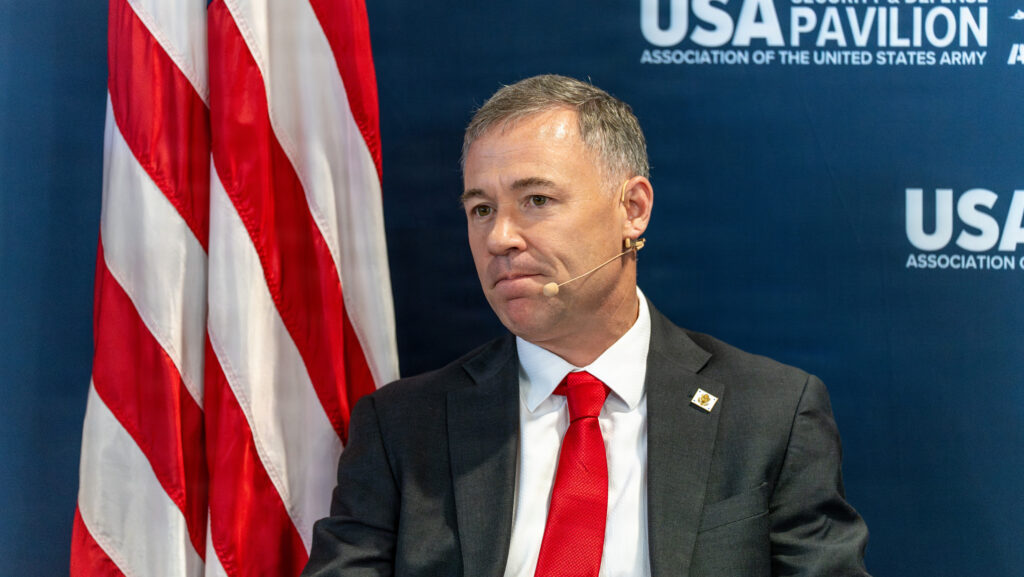
Brent Ingraham, assistant secretary of the Army for acquisition, logistics, and technology, speaks during a panel titled “Transatlantic Industrial Power: Production at Speed and Scale” during Eurosatory 2026 at the Paris Nord Villepinte Exhibition Centre in Villepinte, France, June 17, 2026. (U.S. Army photo by Maj. Alexander Watkins)
WASHINGTON — A year after the Army’s sprawling acquisition overhaul , the service has again realigned the structure of its weapons portfolios, albeit at a much smaller scale, senior service members recently told reporters.
With the new changes, the Army has attempted to remove a layer of bureaucracy between its Portfolio Acquisition Executives (PAEs) and its program managers after Congress ordered it to do so in the 2026 National Defense Authorization Act (NDAA). Brig. Gen. Troy Denomy, PAE for Maneuver Ground, said this will better ensure the acquisition and operational sides of the service are in tandem with each other.
“What’s critically important for the PAEs to deliver for the Army is the alignment, synchronization, and staying closely connected to our operational counterparts,” Denomy said Oct. 8 ahead of the annual AUSA conference “We cannot deliver those formation-based outcomes if we are not tied at the hip and synchronized closely together.”
The adjusted acquisition structure comes nearly a year after the Army underwent a major acquisition reorganization, which consolidated the original 12 Program Executive Offices under the six PAEs for a reduction on the number of general officers at the top rank. The goal: to remove constraints and hone its processes to move much faster.
Under last year’s changes, th e Assistant Secretary of the Army for Acquisition, Logistics and Technology (ASA(ALT)), along with the Army’s secretary, would direct acquisition orders down to the Army’s six PAEs and their deputies. The PAEs would then communicate orders down to their Capability Portfolio Executives (CPEs) which then pushed those down to the relevant program managers — the latter being the individuals who most often collaborate with soldiers in the field to see what they need.
However, those changes were rolled out prior to the 2026 NDAA becoming law, meaning the mandates from the legislation were not fully implemented until recently, Ingraham explained.
To meet the legislative guidelines, the Army has removed CPEs from where they formerly lay and placed them to work alongside the PAEs. The purpose of this is to ensure that a specific program is being “managed appropriately on behalf of the PAE” but there is no official reporting structure between them and the program managers, Brent Ingraham , the head of ASA(ALT), told reporters Oct. 8.
The Army also renamed the CPEs to Program Manager Executives (PMEs), Ingraham said.
The PMEs are needed, Denomy said, as they help to keep track of the day to day duties of the program managers and their “enablers” within each PAE, which would be too burdensome a task for one person. For example, he said he has nine program managers under him and each one comes with an “enabler.”
“So 18 direct reports will be very difficult to manage day-to-day. So how do we use and empower the PMEs […] to help with that day to day management?” Denomy said. “In a metaphor that doesn’t follow exactly, but it’s almost like CEO versus COO or CFO from a C-suite perspective. A much similar organization, and it seems to also, when I talk to industry about how we’re organized, seems to resonate with them because it’s very akin to how they tend to organize.”
Another change spurred by the 2026 NDAA was to have all PAEs be “ certified acquisition officials .” Prior to this change, three out of the Army’s six PAEs fell into that category and the other three had backgrounds in more of an “operational role,” or served as the heads of the Army’s various Centers of Excellence (CoE), Ingraham explained.
Now, Ingraham said, all deputies come from CoEs or prior operationally-based roles.
“We put requirements, resources, and acquisition authority all under the PAEs, where you can make those decisions in parallel instead of waiting for those sequential handoffs we always had in the past,” Ingraham said. “I can say, one year in this, we can point at real results.”
Breaking Defense Video
New leaders, new drone command: What we expect from AUSA 2026
Unpacking Boeing’s F/A-XX win, plus a report from wartime Ukraine
How Hegseth envisions a new Autonomous Warfare Command
What Europe’s military air fleets will look like in 30 years
Riyadh gets closer to F-35s, Damascus presses sovereignty and an expert take on Iran
Drone-hunting on the border, plus turmoil at an Air Force think tank
The future of European airpower might be unmanned
The big news out of AFA, plus a guided tour of the show floor
Why the ‘right to repair’ matters to the Pentagon
What the Pentagon is testing along the US-Mexico border
2026年6月17日,美国陆军负责采购、后勤和技术的助理部长布伦特·英格拉姆在法国维勒潘特巴黎北维勒潘特展览中心举行的2026年欧洲防务展(Eurosatory 2026)上,出席题为“跨大西洋工业力量:快速规模化生产”的小组讨论会并发表讲话。(美国陆军少校亚历山大·沃特金斯摄)
华盛顿——陆军大规模采购改革一年后,高级军官最近告诉记者,陆军再次调整了其武器组合的结构,尽管规模要小得多。
根据国会在2026财年国防授权法案(NDAA)中的指示,陆军通过了新的改革,试图精简其项目采购主管(PAE)和项目经理之间的层级。负责地面机动部队的PAE特洛伊·德诺米准将表示,此举将更好地确保陆军的采购和作战部门协调一致。
“对于陆军来说,PAE(项目执行机构)最重要的任务是与我们的作战伙伴保持协调、同步和紧密联系,”Denomy 在 10 月 8 日美国陆军协会年会召开前夕表示,“如果我们不能紧密联系、同步行动,我们就无法实现这些基于阵型的成果。”
此次调整后的采购结构距离陆军进行重大采购重组已近一年。重组将原有的12个项目执行办公室合并为6个采购执行机构(PAE),减少了最高级别的将级军官人数。其目标是:消除限制,优化流程,从而大幅提升效率。
根据去年的改革,陆军负责采购、后勤和技术的助理部长(ASA(ALT))将与陆军部长一起,向下级下达采购指令,分别传达给陆军的六个采购行政主管(PAE)及其副手。采购行政主管随后会将指令传达给各自的能力组合主管(CPE),能力组合主管再将指令下达给相关的项目经理——项目经理通常是与一线士兵密切合作,了解他们需求的人员。
英格拉姆解释说,这些变化是在 2026 年国防授权法案生效之前推出的,这意味着该法案的要求直到最近才得到全面实施。
为了符合立法指导方针,陆军已将CPE(首席项目执行官)从原先的位置调离,并安排他们与PAE(项目执行官)一起工作。陆军后勤保障局局长布伦特·英格拉姆(Brent Ingraham)10月8日告诉记者,此举旨在确保特定项目“得到PAE的适当管理”,但CPE与项目经理之间没有正式的汇报关系。
英格拉姆表示,陆军还将 CPE 更名为项目经理主管(PME)。
德诺米表示,项目管理执行人员(PME)是必要的,因为他们可以帮助跟踪每个项目应用单元(PAE)内项目经理及其“支持人员”的日常工作,这项工作对一个人来说负担太重。例如,他提到自己手下有九位项目经理,每位项目经理都配有一位“支持人员”。
“所以,管理18位直接下属的日常工作会非常困难。那么,我们该如何利用和赋能项目管理专家(PME)来协助日常管理呢?”德诺米说道。“打个比方,虽然不太贴切,但这就像高管层视角下的CEO与COO或CFO之间的关系。这种组织架构非常相似,而且当我与业内人士交流我们的组织架构时,他们似乎也对此很有共鸣,因为这与他们通常的组织方式非常相似。”
2026财年国防授权法案促成的另一项变革是,所有采购行政官员(PAE)都必须是“认证采购官员”。英格拉姆解释说,在此变革之前,陆军六名采购行政官员中只有三名属于这一类别,其余三名则更多地从事“作战角色”,或者担任陆军各个卓越中心(CoE)的负责人。
英格拉姆表示,现在所有副手都来自卓越中心或之前的作战岗位。
“我们将需求、资源和采购权限全部置于采购授权执行官 (PAE) 的领导之下,这样就可以并行做出这些决策,而无需像过去那样按顺序交接,”英格拉姆说。“我可以肯定地说,一年过去了,我们已经取得了切实成果。”
突破性防御视频
新领导人,新无人机指挥部:我们对 AUSA 2026 的期待
深入剖析波音F/A-XX的竞标结果,以及来自战时乌克兰的报道
赫格塞斯设想的新型自主作战指挥部
30年后欧洲军用空军机队会是什么样子
利雅得距离F-35战机更近一步,大马士革强调主权,以及专家对伊朗的看法
边境无人机猎杀行动,以及空军智库的动荡
欧洲空军的未来或许在于无人化。
AFA展会最新动态,以及展会现场导览。
为什么“维修权”对五角大楼如此重要
五角大楼正在美墨边境测试什么?